
Most corporate manuals treat safety as a way to save the company money. They focus on reducing insurance costs and protecting the employer from lawsuits. We look at it differently. If you are reading this, you want to know why workplace safety is important for you, the worker. You might be facing a dangerous situation on the job right now. You are likely scared of getting hurt, but equally terrified of getting fired if you speak up.
This 2026 employee rights guide cuts through the corporate jargon. We explain exactly why workplace safety is important by focusing entirely on your legal rights. We will teach you how to legally refuse dangerous work, how to navigate new 2026 safety standards, and how to stop retaliation dead in its tracks.
Why is workplace safety legally important for American workers?
Workplace safety is important because it is your federal right. Under the Department of Labor (DOL) and the OSH Act, the General Duty Clause guarantees a workplace free from recognized hazards, protecting your physical health and granting you the legal power to hold employers accountable.
What are the new 2026 OSHA workplace safety standards?
The legal landscape of Occupational Health changes constantly. To protect yourself, you must know what your employer is legally required to do right now. In 2026, the federal government dramatically shifted its focus to extreme weather and temperature hazards.
The 2026 Heat Illness Prevention Standard and NIOSH guidelines
As heat waves become more severe, the Occupational Safety and Health Administration (OSHA) launched an expanded National Emphasis Program (NEP) for Heat in April 2026. This program drastically increases proactive facility inspections for both indoor and outdoor work environments.
Following National Institute for Occupational Safety and Health (NIOSH) guidelines, employers in high-hazard industries must now implement a Heat Illness Prevention Standard. When the heat index hits 80°F, employers must provide drinking water, shaded areas, and cooling zones. At 90°F, they must provide scheduled Rest Breaks and actively monitor workers. Furthermore, they must use an Acclimatization protocol, allowing new workers to gradually increase their workload over 14 days to adapt to the heat safely.
Understanding federal rules vs. OSHA-Approved State Plans
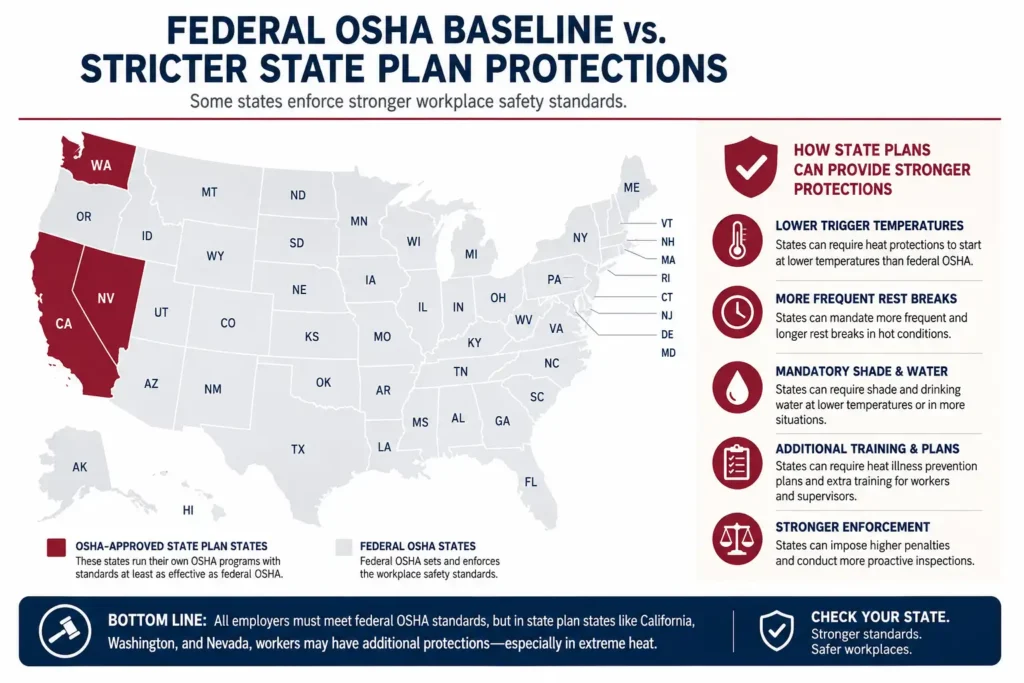
Federal rules provide the absolute baseline. However, the importance of workplace safety varies depending on where you live. Many states operate their own OSHA-Approved State Plans. States like California (Cal/OSHA), Washington (WISHA), and Nevada have safety standards that are actually stricter than federal laws. In these states, you may have even stronger protections regarding silica dust exposure, workplace violence prevention, and mandatory paid recovery periods.
Do you have the legal right to refuse unsafe work?
Yes. OSHA regulations grant you the Right to Refuse Unsafe Work without facing an Adverse Action, provided you face an Imminent Danger, hold a Good Faith Belief that the hazard threatens your life, and have no time to wait for regular enforcement channels.
How to invoke your rights without getting fired
You cannot just walk off the job because you feel uncomfortable. To legally invoke your Right to Refuse Unsafe Work, you must follow a precise process to ensure your employer cannot fire you for “insubordination.”
- Ask your employer to fix it: You must explicitly tell your supervisor about the hazard and ask them to correct it.
- State your refusal clearly: If they refuse to fix it, clearly state that you will not perform the task because you believe there is an Imminent Danger of death or serious injury.
- Stay on the job site: Do not leave the premises unless ordered to do so. Offer to do other, safer tasks while the issue is resolved.
- Maintain a Good Faith Belief: As long as a reasonable person would genuinely believe the danger was real, the law protects you. You are protected even if an inspector later says the situation was technically compliant.
Filing an anonymous confidential complaint with OSHA
If your boss ignores a dangerous situation, you do not have to confront them directly. You can file a Confidential Complaint directly with OSHA to trigger a surprise inspection.
When filling out the online complaint form, you can specifically request that OSHA keep your name out of the official report. Anonymous Reporting is your best tool for self-preservation. It forces the company to fix the hazard while keeping your identity completely shielded from your manager.
How does OSHA protect whistleblowers from retaliation?
Section 11(c) of the OSH Act explicitly outlaws Whistleblower Retaliation against any worker who reports an Occupational Health or safety violation. Employers cannot legally fire, demote, or punish you for simply asserting your federally protected right to a hazard-free work environment.
The strict 30-Day Statute of Limitations for filing a claim
This is the most critical piece of information in this guide. Most HR blogs tell you that retaliation is illegal, but they leave out the trap door.
If your boss fires you for reporting a safety violation, you have exactly 30 days from the date of the Adverse Action to file a whistleblower complaint with OSHA. This 30-Day Statute of Limitations is brutally short. If you wait 31 days because you were busy looking for a new job, you lose your legal right to sue for back pay or reinstatement entirely. Do not wait.
Recognizing “quiet” retaliation (schedule cuts and demotions)
Retaliation is not always a dramatic firing. Employers often use “quiet” Adverse Actions to punish whistleblowers. This includes suddenly cutting your overtime hours, moving you to the graveyard shift, giving you an unusually negative performance review, or isolating you from your team. If any of these things happen shortly after you report a hazard, it counts as illegal retaliation under federal law.
Practical Case Study: Surviving Imminent Danger and Winning a Retaliation Claim
Let’s look at a realistic scenario showing exactly why workplace safety is important in action.
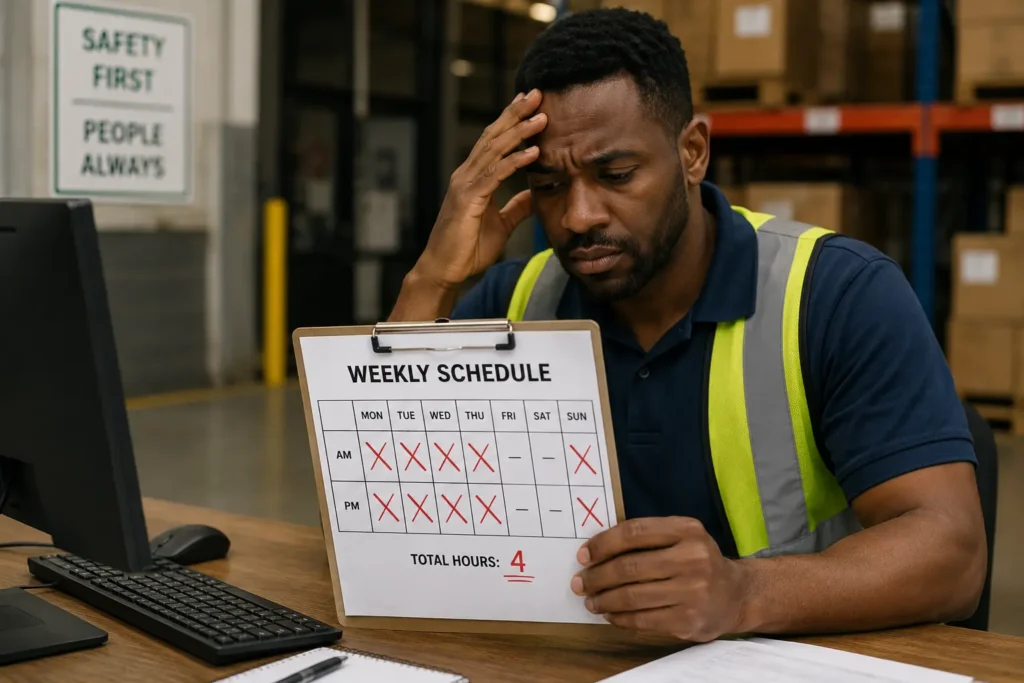
Marcus operated a forklift in a massive delivery warehouse. One morning, he noticed the forklift’s brakes were severely grinding and failing to stop the machine in time. He reported it to his supervisor, who told him, “We are behind on orders. Just drive slower.”
Marcus knew this was an Imminent Danger. He explicitly told his boss, “I have a Good Faith Belief that driving this forklift will kill someone. I refuse to drive it until the brakes are fixed, but I am happy to manually load boxes instead.”
The supervisor immediately told Marcus to pack his things and go home, effectively firing him. Marcus did exactly what the law requires. The next morning—well within the 30-Day Statute of Limitations—he filed a Section 11(c) retaliation claim online.
Because Marcus clearly invoked his Right to Refuse Unsafe Work and offered to do alternative tasks, OSHA investigators determined the firing was illegal Whistleblower Retaliation. The employer was forced to reinstate Marcus to his position and pay him for all the days he missed.
Frequently Asked Questions (FAQ) About Workplace Safety Rights
Can I be fired for refusing unsafe work?
Generally, no. While most employment in the U.S. is “at-will,” federal safety laws create a strict exception. If you genuinely believe a task presents an imminent danger of death or serious harm, and you cannot get the employer to fix it, firing you for refusing that specific task is illegal retaliation.
How do I report my employer to OSHA anonymously?
You can file a safety complaint online via the official OSHA complaint portal or by calling 800-321-6742. When you submit your complaint, simply check the box requesting that your name not be revealed to your employer. OSHA is legally required to keep your identity confidential during their investigation.
What is the difference between OSHA and Workers’ Compensation?
These are two completely separate systems. OSHA is the federal agency responsible for preventing injuries. They enforce safety standards and investigate hazardous conditions. Workers’ Compensation is a state-level insurance program that pays your medical bills and a portion of your lost wages after you have already been injured on the job.
Disclaimer: The information provided on this website does not, and is not intended to, constitute legal advice. All information, content, and materials available on this site are for general informational and educational purposes only. Laws regarding employment and labor rights frequently change, and while we strive to keep our content updated, the information on this website may not constitute the most up-to-date legal or other information.
Use of, and access to, this website or any of the links or resources contained within the site do not create an attorney-client relationship between the reader, user, or browser and the website authors, contributors, or its owners. We are an independent publishing platform, not a law firm.
Readers of this website should contact a qualified employment attorney in their specific state to obtain advice with respect to any particular legal matter. No reader or user of this site should act or refrain from acting on the basis of information on this site without first seeking legal advice from counsel in the relevant jurisdiction. Only your individual attorney can provide assurances that the information contained herein – and your interpretation of it – is applicable or appropriate to your particular situation.
Know your rights.
References & Official Worker Resources
For more detailed information regarding your federal safety rights, whistleblower protections, and how to file a complaint, please consult the official U.S. government resources below:
-
OSHA Worker Rights & General Duty Clause:
Understand your fundamental federal rights, including the right to a hazard-free workplace and the Right to Refuse Unsafe Work. -
OSHA Whistleblower Protection Program:
Learn about Section 11(c) of the OSH Act and the strict 30-day deadline to file a retaliation claim at Whistleblowers.gov. -
File a Confidential Safety Complaint:
Access the official portal to trigger a surprise inspection while keeping your identity anonymous via the OSHA Online Complaint Form. -
OSHA & NIOSH Heat Illness Prevention:
Review the latest federal guidelines and research regarding acclimatization, hydration, and extreme temperature protections at the OSHA Heat Exposure portal.