
If you are pregnant, exhausted, and dealing with a hostile boss, you might be sitting up at midnight searching for a lifeline. When human resources starts ignoring your requests for a chair or cutting your shifts, the fear of losing your paycheck and health insurance is overwhelming. You are likely wondering: is pregnancy discrimination protected under ADA or PDA?
Yes, it is. But relying on outdated advice could cost you your job. In 2026, the legal landscape for expecting mothers has drastically changed. Knowing exactly which federal law applies to your specific situation is the ultimate shield against corporate bullying. Let’s break down your rights so you can fight back.
Is pregnancy discrimination protected under the ADA or the PDA?
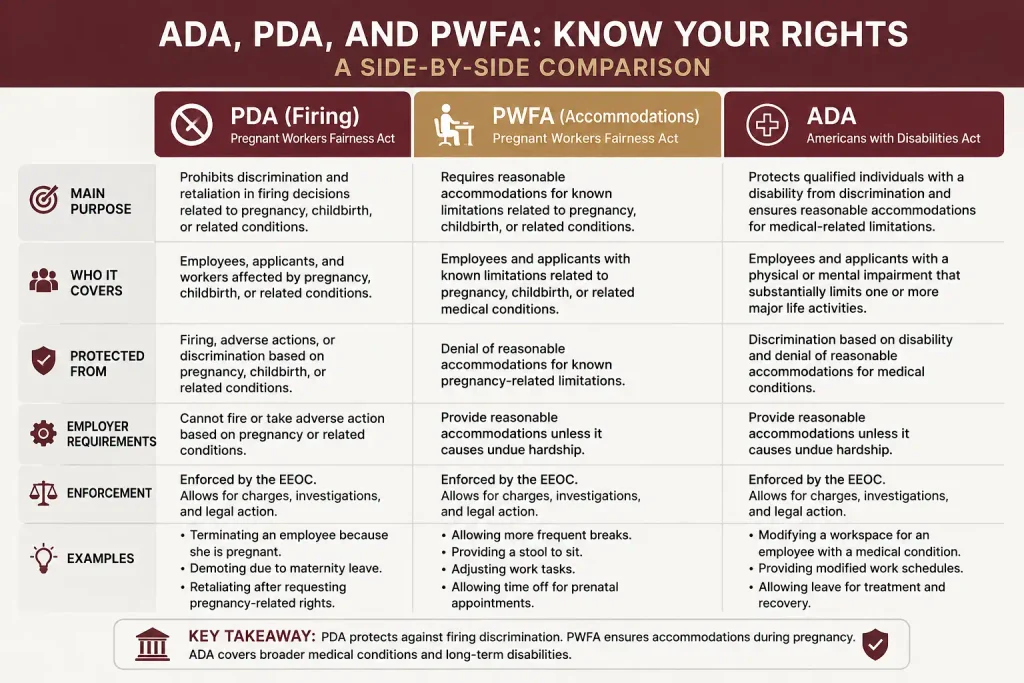
Pregnancy discrimination is protected under both the PDA and the ADA, but they serve different purposes. The PDA prevents you from being fired for being pregnant, the ADA protects severe pregnancy-related medical conditions, and the PWFA guarantees reasonable daily workplace accommodations.
How Title VII and the Pregnancy Discrimination Act (PDA) prevent you from being fired
The Pregnancy Discrimination Act (PDA) is a historic amendment to Title VII of the Civil Rights Act. It establishes a simple, powerful baseline: your employer must treat you the exact same way they treat any other employee who is similar in their ability to work.
Under the PDA, your boss cannot legally:
- Refuse to hire you because you are visibly pregnant.
- Fire you simply because you told them you are expecting.
- Force you to take unpaid leave if you are still physically able to do your job.
- Deny you promotions or cut your pay based on your pregnancy status.
If your company has 15 or more employees, the PDA acts as an absolute shield against discriminatory firing.
Why a “healthy pregnancy” isn’t an ADA disability (and when the ADA actually applies)
Many workers are shocked to learn that a standard, healthy pregnancy is not legally considered a disability under the Americans with Disabilities Act (ADA).
However, the ADA does apply if you develop severe Pregnancy-Related Medical Conditions. The law protects you when physical impairments severely limit your major life activities.
You trigger ADA protections if you are diagnosed with conditions like:
- Gestational Diabetes
- Preeclampsia
- Severe Morning Sickness (Hyperemesis Gravidarum)
- Postpartum Depression
If you suffer from these complications, your employer is legally required to treat your condition with the same seriousness as any other ADA-protected disability.

How does the Pregnant Workers Fairness Act (PWFA) change pregnancy accommodations in 2026?
The Pregnant Workers Fairness Act (PWFA) mandates that employers provide reasonable accommodations for known pregnancy limitations, even during a healthy pregnancy. You no longer need to prove a severe ADA disability to secure light duty, extra bathroom breaks, or seating.
Triggering the “Interactive Process” for light duty and workplace modifications
Before the Pregnant Workers Fairness Act (PWFA) took full effect, pregnant workers constantly fell through the cracks. They weren’t “disabled enough” for the ADA, but they still needed help carrying heavy boxes.
Now, the PWFA forces employers to provide a Reasonable Accommodation for simple, daily limitations. To get this, you must trigger the Interactive Process. This is a mandatory, good-faith conversation between you and your employer to figure out a solution.
Common PWFA accommodations include:
- Light duty (avoiding heavy lifting).
- A stool to sit on during long retail shifts.
- Extra bathroom or water breaks.
- Flexible hours for prenatal doctor appointments.
When can an employer claim “Undue Hardship”?
Employers cannot easily say “no” to your PWFA request. To legally deny a reasonable accommodation, a company must prove Undue Hardship.
This means the employer must demonstrate that granting your request would cause significant difficulty or expense to the business. For a massive retail chain, buying a $40 stool for a cashier is never an undue hardship. Do not let management trick you into thinking a simple request is “too expensive.”
The 2026 EEOC National Enforcement Plan: Are federal agencies cracking down on pregnancy discrimination?
Under its aggressive 2025–2029 National Enforcement Plan, the EEOC is actively suing employers who violate pregnancy rights. In 2026, federal regulators are strictly enforcing the PWFA and heavily penalizing corporations that deny reasonable accommodations or illegally retaliate against expecting mothers.
You are not fighting alone. The Equal Employment Opportunity Commission (EEOC)—the federal agency that enforces these laws—has made pregnancy discrimination a top litigation priority. If your employer denies a basic accommodation or fires you for asking, they are inviting a massive federal lawsuit. Document every conversation, because the government is actively looking for companies that break these rules.
Which law protects me? The PDA vs. PWFA vs. ADA Matrix
Knowing which federal law applies is vital. Use the PDA to stop discriminatory firing or demotions. Trigger the PWFA for daily physical workplace modifications. Invoke the ADA if you experience severe pregnancy-related medical impairments like preeclampsia or gestational diabetes.
Comparing Gestational Diabetes (ADA) versus morning sickness (PWFA)
To survive HR meetings, you must know which law to quote. Use this 2026 comparative matrix to understand your specific protections:
| Workplace Situation | Which Law Applies? | What It Does For You |
| Boss fires you because you are pregnant. | PDA (Pregnancy Discrimination Act) | Makes the firing illegal; allows you to sue for lost wages. |
| You need a chair or extra water breaks. | PWFA (Pregnant Workers Fairness Act) | Forces the company to modify your workspace immediately. |
| Diagnosed with Gestational Diabetes. | ADA (Americans with Disabilities Act) | Protects your severe medical impairment as a legal disability. |
| Need time off to give birth. | FMLA (Family and Medical Leave Act) | Grants up to 12 weeks of unpaid, job-protected leave. |
Practical Case Study: Fighting illegal retaliation and securing a reasonable accommodation
Consider a retail worker denied a stool under the PWFA. When she formally requested this reasonable accommodation through the interactive process, HR cut her hours. Her attorney used the PDA to prove illegal retaliation, forcing the company into a settlement.
Let’s look at a real-world example to see how these laws overlap.
Maria worked as a cashier at a large hardware store. At six months pregnant, her feet swelled painfully. Under the PWFA, she sent an email to HR asking for a stool to sit on. Instead of engaging in the interactive process, her manager claimed the stool was a “safety hazard” and cut her schedule from 40 hours to 10 hours a week.
Maria didn’t quit. She contacted an employment lawyer. The lawyer informed the company that denying the stool violated the PWFA, and cutting her hours was illegal Retaliation under the PDA. Facing a guaranteed EEOC investigation under the new 2026 enforcement rules, the company immediately restored Maria’s full-time hours, provided the stool, and offered a financial settlement to avoid a lawsuit.
Frequently Asked Questions (FAQ) About Pregnancy Labor Laws
If you are expecting a child and dealing with corporate HR, you need fast answers. Below, we address critical questions about employer retaliation, performance write-ups, and when you actually need to provide a doctor’s note to secure federal workplace protections.
Can I be fired if my pregnancy affects my work performance?
Under the PWFA, an employer cannot legally discipline or fire you for a drop in performance unless they have first offered you a reasonable accommodation. If you are struggling to hit quotas because you need more bathroom breaks, they must accommodate the breaks first. They cannot use your pregnancy-related limitations as a loophole to fire you for “poor performance.”
Do I need a doctor’s note for pregnancy accommodations?
Not always. According to 2026 EEOC guidelines, employers are forbidden from demanding a doctor’s note for obvious, simple accommodations under the PWFA—like carrying water, using the restroom, or sitting on a stool. However, if you need complex leave or suffer from an ADA-qualifying condition like preeclampsia, the company can legally request supporting medical documentation.
Disclaimer: The information provided on this website does not, and is not intended to, constitute legal advice. All information, content, and materials available on this site are for general informational and educational purposes only. Laws regarding employment and labor rights frequently change, and while we strive to keep our content updated, the information on this website may not constitute the most up-to-date legal or other information.
Use of, and access to, this website or any of the links or resources contained within the site do not create an attorney-client relationship between the reader, user, or browser and the website authors, contributors, or its owners. We are an independent publishing platform, not a law firm.
Readers of this website should contact a qualified employment attorney in their specific state to obtain advice with respect to any particular legal matter. No reader or user of this site should act or refrain from acting on the basis of information on this site without first seeking legal advice from counsel in the relevant jurisdiction. Only your individual attorney can provide assurances that the information contained herein – and your interpretation of it – is applicable or appropriate to your particular situation.
Know your rights.
Official Legal Resources & References
Do not rely solely on your employer’s HR department to explain your rights. Verify your federal protections, explore reasonable accommodation guidelines, and understand your rights by consulting these authoritative government resources:
-
U.S. Equal Employment Opportunity Commission (EEOC) – Pregnancy Discrimination:
Review the official federal guidelines on the Pregnancy Discrimination Act (PDA) and how to file a formal workplace complaint at the EEOC Pregnancy Discrimination Portal. -
EEOC – The Pregnant Workers Fairness Act (PWFA):
Understand the new 2023/2026 standards for requesting mandatory reasonable accommodations for pregnancy and childbirth at the EEOC PWFA Guidelines. -
Americans with Disabilities Act (ADA):
Explore how severe pregnancy-related medical conditions are evaluated as legal disabilities under federal law at ADA.gov. -
U.S. Department of Labor (DOL) – FMLA:
Learn about your right to job-protected, unpaid time off for childbirth and recovery under the Family and Medical Leave Act at the DOL FMLA Resource Center.
Keywords: is pregnancy discrimination protected under ada or pda, pda vs ada pregnancy, pregnant workers fairness act pwfa, pregnancy reasonable accommodation, fired for being pregnant laws, eeoc pregnancy discrimination 2026, is a healthy pregnancy a disability under ada