
If you are wondering, “will I lose my disability if I work part-time?” the short answer is no—but only if you follow strict income rules. In 2026, you can work part-time and keep your Social Security Disability Insurance (SSDI) as long as you do not earn more than the $1,690 monthly limit (Substantial Gainful Activity). For Supplemental Security Income (SSI), your part-time wages will reduce your monthly check, but you will not lose your benefits entirely until your income reaches a much higher cap.
Navigating the Social Security Administration (SSA) rules can feel like walking a tightrope without a net. You want to work. You need the extra money. But you are terrified of losing the financial lifeline and health insurance you fought so hard to get.
Take a deep breath. You are in the right place. As an employment law strategist, I am going to walk you through the exact 2026 rules, the math, and the safest way to re-enter the workforce without jeopardizing your livelihood.
What Are the 2026 Income Limits to Keep Disability Benefits?
To keep your benefits safe, you must memorize the Substantial Gainful Activity (SGA) limit. The SSA uses SGA to determine if you are earning too much to be considered disabled.
For 2026, the official SGA limits are:
- $1,690 per month for non-blind individuals.
- $2,830 per month for statutorily blind individuals.
If your gross earnings (before taxes) stay below this line, the SSA generally considers you safe. However, the exact way this limit applies depends entirely on which disability program you are enrolled in.
SSDI vs. SSI: How Does Part-Time Work Affect Each Program?
The biggest mistake people make is reading the rules for the wrong program. Social Security manages two different disability programs, and they treat part-time income completely differently.
Social Security Disability Insurance (SSDI) Basics
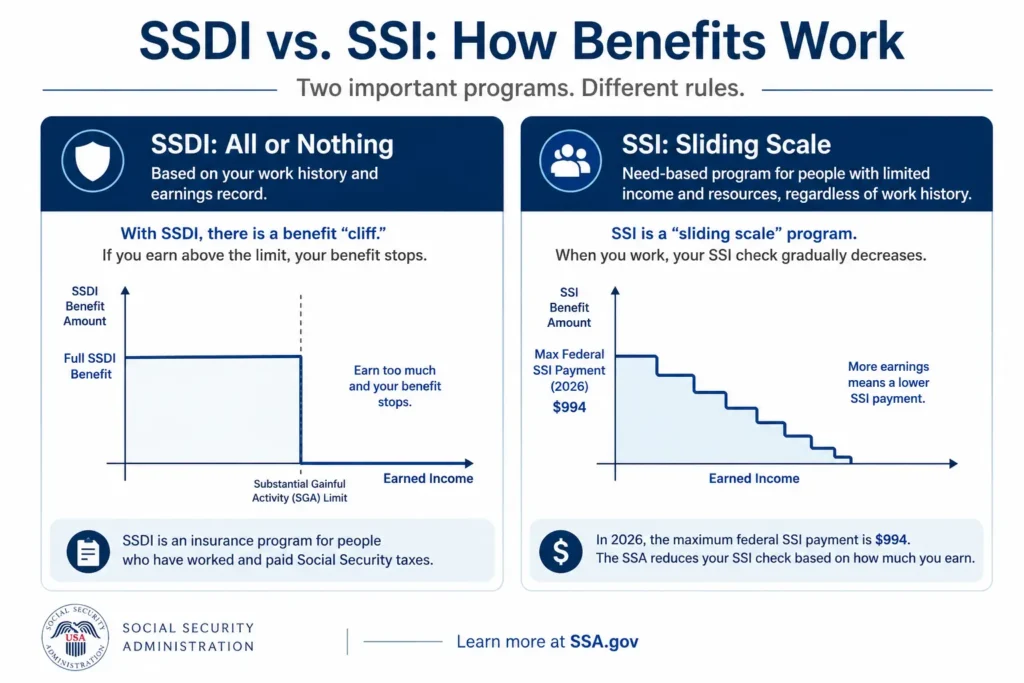
SSDI is based on your past work history and the taxes you paid into the system. It is an “all-or-nothing” program. As long as you stay under the $1,690 SGA limit, you keep your full SSDI check. If you earn over the limit after your trial period, your check drops to zero.
Supplemental Security Income (SSI) Basics
SSI is a need-based program for people with limited income and resources, regardless of their work history. In 2026, the maximum federal SSI payment is $994. SSI is a “sliding scale” program. When you work part-time, the SSA reduces your SSI check based on how much you earn.
Can I Work Part-Time on SSDI Without Losing Benefits?
Yes, you can. To encourage people to try working again, the SSA has built a safety net called “Work Incentives.” This system gives you a runway to test your ability to work part-time without instantly losing your benefits. It happens in three phases.
Phase 1: The Trial Work Period (TWP) and the $1,210 Trigger
The SSA gives you 9 months to test working part-time. During the Trial Work Period (TWP), you can earn any amount of money—even $5,000 a month—and still keep your full SSDI check.
In 2026, any month you earn $1,210 or more counts toward your 9 months. These 9 months do not have to be consecutive; they roll over a 5-year window.
Phase 2: The Extended Period of Eligibility (EPE) and the SGA Cliff
Once you use up your 9 TWP months, you enter Phase 2: The Extended Period of Eligibility (EPE). This lasts for 36 months.
During this 3-year phase, the SGA cliff takes effect:
- If you earn under $1,690, you get your full SSDI check.
- If you earn over $1,690, you get $0 for that month.
Phase 3: Expedited Reinstatement (EXR) as a Safety Net
What if your benefits stop because you worked full-time, but a year later, your condition worsens and you cannot work anymore? You have a 5-year safety net called Expedited Reinstatement (EXR). You can ask the SSA to restart your benefits immediately without having to reapply from scratch.
How Many Hours Can I Safely Work on Disability in 2026?
People do not think in monthly gross numbers; they think in hourly wages. If you are applying for a part-time job, you need to know exactly how many hours you can accept.
Part-Time Hourly Wage Scenarios for the SGA Limit
To stay under the 2026 non-blind SGA limit of $1,690 per month, here is your maximum safe weekly hours cheat sheet:
- At $10/hour: You can work roughly 38 hours/week.
- At $15/hour: You can work safely up to 25 hours/week.
- At $20/hour: You can work safely up to 19 hours/week.
- At $25/hour: You can work safely up to 15 hours/week.
Pro Tip: Always aim a few hours lower than the absolute maximum. A single busy week with overtime could accidentally push you over the $1,690 cliff.
The Self-Employment “80-Hour Rule”
If you are an independent contractor, gig worker (like driving for Uber), or freelancer, the SSA looks at more than just your profits. If you spend more than 80 hours a month running a business, the SSA considers that a Trial Work Period month—even if you did not make a single dollar of profit.

How Does Part-Time Income Reduce My SSI Benefits?
If you are on SSI, there is no Trial Work Period. Instead, the SSA uses a specific math formula to reduce your benefit. They do not count every dollar you make.
Practical Case Study: The Exact SSI Reduction Math
Let’s look at a real-world example to make the math easy.
Meet Sarah. She gets the maximum 2026 SSI benefit of $994. She gets a part-time job at a bookstore earning $885 a month before taxes. How much will her new SSI check be?
- The $20 General Exclusion: The SSA ignores the first $20. ($885 – $20 = $865).
- The $65 Earned Income Exclusion: The SSA ignores the next $65 of wages. ($865 – $65 = $800).
- The 50% Reduction Rule: The SSA cuts the remaining amount in half. ($800 ÷ 2 = $400).
This $400 is Sarah’s “Countable Income.” The SSA subtracts this from her base rate:
$994 (Base SSI) – $400 (Countable Income) = $594.
Sarah keeps $594 of her SSI, plus she has her $885 from her job. Her total monthly income is now $1,479! Working part-time gave her more total money in her pocket.
Will I Lose My Medicare or Medicaid If I Work Part-Time?
This is the number one fear for most workers. You might be willing to lose the cash benefit, but you cannot afford to lose your healthcare. Fortunately, the law protects your insurance.
Keeping Medicare While on SSDI
If your SSDI cash payments stop because you are earning over the SGA limit, you do not immediately lose Medicare. Under federal law, your premium-free Medicare Part A coverage continues for at least 93 months (7 years and 9 months) after your Trial Work Period ends.
Section 1619(b): Keeping Medicaid While on SSI
For SSI recipients, a powerful legal provision called Section 1619(b) protects your Medicaid. If your part-time income reduces your SSI cash check to $0, you will keep your Medicaid coverage as long as you still have a disability, meet asset limits, and earn below your state’s specific “threshold amount” (which is often over $40,000 a year).
How Do I Report Part-Time Wages to Social Security in 2026?
Failing to report your income is the fastest way to trigger an overpayment—a nightmare scenario where the SSA demands you pay back thousands of dollars. You must report your wages by the 6th day of every month.
The New Payroll Information Exchange (PIE) System
In 2026, the SSA has expanded its Payroll Information Exchange (PIE). If your employer uses a major payroll provider, your wages might be reported automatically. However, do not assume PIE covers you until the SSA confirms it. Until then, report your wages manually using:
- The SSA Mobile Wage Reporting App.
- Your my Social Security online account.
- Calling the SSA automated toll-free line.
[External Link Opportunity: Include a link to the official SSA page on Wage Reporting (rel=”external noopener noreferrer”).]
Deducting Impairment-Related Work Expenses (IRWE)
If you pay out-of-pocket for things you need to work because of your disability, you can deduct them from your gross income. This is called an Impairment-Related Work Expense (IRWE).
Examples include:
- Specialized transportation (if you cannot drive).
- Co-pays for medications that keep your symptoms managed at work.
- Ergonomic desk equipment.
If you earn $1,750 a month (over the $1,690 SGA limit) but have $100 in approved IRWEs, your countable income drops to $1,650. You are safely under the limit and keep your benefits!
Utilizing the Ticket to Work Program
If you want help finding part-time work that accommodates your disability, look into the free Ticket to Work Program{:target=”_blank” rel=”external noopener noreferrer”}. Participating in this program not only helps you find employment but also shields you from standard continuing disability reviews (CDRs) while you are making progress.
Frequently Asked Questions About Working Part-Time on Disability
What happens if my condition worsens after I start part-time work?
If you are on SSDI and fall within the 5-year Expedited Reinstatement (EXR) window, you can request your benefits to restart immediately without a new application. For SSI, if your income drops, your benefit amount will simply increase back up the sliding scale.
Can I volunteer without risking my disability benefits?
Usually, yes. However, if you are volunteering for a job that someone would normally be paid to do (like managing a store), the SSA might consider the “value” of your work as Substantial Gainful Activity. Stick to traditional volunteer roles.
Does passive income count toward the SGA limit?
No. The SSA only counts “earned income” (wages from a job or self-employment profits). Passive income like stock dividends, rental income, or lottery winnings do not count toward the $1,690 SGA limit (though they can affect the asset limits for SSI).
Disclaimer: This article provides educational information regarding 2026 Social Security regulations and is not intended as formal legal advice. Always consult with a qualified disability advocate or the Social Security Administration regarding your specific case.