
- You can legally be fired while on FMLA leave if your termination is completely unrelated to your medical leave, such as during a company-wide reduction in force or for documented misconduct. However, firing you because you requested or took medical leave is strictly illegal retaliation.
If you are currently dealing with a severe illness, caring for a newborn, or supporting a dying family member, the last thing you need is the crushing anxiety of losing your job. Yet, thousands of American workers search the internet at midnight asking: can you get fired while on fmla?
The Family and Medical Leave Act (FMLA) is a powerful federal law, but it is not an absolute shield against termination. It does not grant you immunity from everyday business realities. This 2026 guide is your strategic legal shield. We will break down exactly when an employer can legally let you go, the dirty tricks companies use to bypass the law, and how the Americans with Disabilities Act (ADA) protects you the exact second your FMLA leave runs out.
When can an employer legally fire you while on FMLA leave?
An employer can legally fire you while on FMLA leave if they can prove they would have terminated you regardless of your leave. This includes pre-arranged reduction in force (layoffs), clear corporate restructuring, or serious pre-existing performance issues that were already heavily documented.
The core rule of the FMLA is that it gives you “no greater right” than you would have had if you stayed at work. If your entire department is eliminated in a pre-planned Reduction in Force (RIF), your employer can legally lay you off, even if you are in a hospital bed on approved medical leave.
Similarly, if your employer had already placed you on a formal Performance Improvement Plan (PIP) before you requested leave, and they have an unassailable paper trail proving you were failing to meet metrics, they can proceed with termination. The key threshold is causation: your FMLA leave cannot be the motivating factor behind the decision.
What is FMLA interference, and is my boss allowed to text me?
FMLA interference occurs when an employer discourages, delays, or denies your right to take medical leave. Requiring a worker to answer emails, take phone calls, or complete “quick tasks” while on approved FMLA leave is a strict federal violation.
When your doctor signs your medical certification, you are legally completely off the grid. Your employer is paying you $0 in exchange for 100% of your time back to heal or care for a loved one.
Many desperate managers commit interference by sending “innocent” text messages: “Hey, sorry to bother you, but where is this client file?” or “Can you just jump on a 15-minute Zoom call to hand over your accounts?”
Under federal law, forcing an employee to perform work while on FMLA leave is illegal. An employer can contact you briefly to discuss administrative leave logistics (like health insurance premiums), but requiring any operational work completely violates your right to an uninterrupted leave.
How do employers use pretextual firing to cover up illegal retaliation?
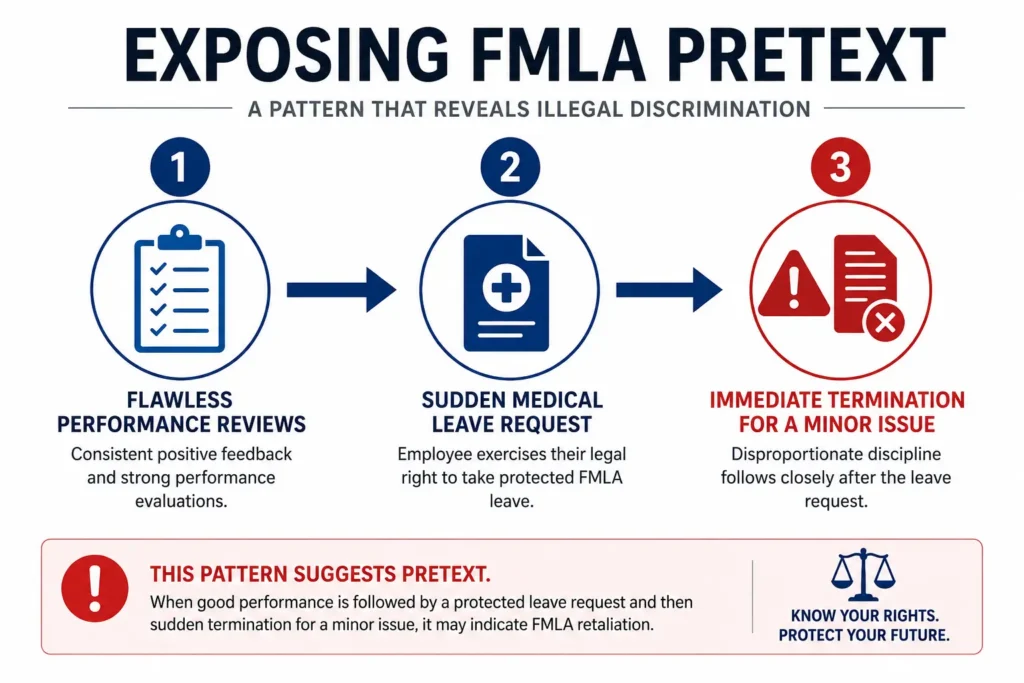
Employers use pretextual firing by inventing a fake, legal reason—such as minor policy violations or sudden performance issues—to mask the fact that they are committing illegal FMLA retaliation against an employee.
Employers are smart. They rarely tell a worker, “We are firing you because your cancer treatments are hurting our productivity.” Instead, they wait until you request leave and then suddenly find fault with everything you do. This is called a pretextual firing.
Courts and the U.S. Department of Labor (DOL) look closely at temporal proximity—the suspicious timing of events—to expose an employer’s true intent. If you have had flawless performance reviews for three years, but you get fired for being five minutes late two days after submitting your FMLA paperwork, a judge will easily see that the employer’s excuse is a fake pretext for retaliation.

Protect Yourself Before You Submit Paperwork
If you suspect your employer is looking for an excuse to push you out, take these defensive actions before you formally notify HR of your need for leave:
- Export Your Records: Forward copies of your past performance reviews, congratulatory emails from managers, and sales metrics to your personal email address.
- Document Everything: If your boss gives you verbal pushback after you mention needing surgery, immediately follow up with an email summarizing the conversation: “Per our conversation today, I am confirming that I will be submitting my FMLA paperwork by Friday…” This forces a written record.
What is the Week 13 ADA transition trap?
FMLA only protects your job for a maximum of 12 weeks. However, if you are still too sick to return on Day 1 of Week 13, the Americans with Disabilities Act (ADA) forces your employer to discuss a reasonable accommodation, which can legally include additional unpaid leave.
This is a massive content gap on generic HR sites. Most blogs tell workers that once their 12 weeks of FMLA run out, they can instantly be fired. In 2026, firing a worker immediately on Day 1 of Week 13 without an automated review is a fast track to an EEOC lawsuit.
If your medical condition qualifies as a disability under the ADA, your employer must engage in an “interactive process” to accommodate you. If your doctor provides a note saying, “The employee needs an additional 4 weeks of leave to fully recover from surgery,” federal courts often view this additional leave as a reasonable accommodation.
An employer cannot simply fire you at Week 12 without proving that holding your job for a few more weeks would cause them “undue hardship.”
What is the “Key Employee” exemption under federal leave laws?
The key employee exemption allows an employer to deny job restoration to a worker if they are among the highest-paid 10% of all employees within a 75-mile radius, and restoring them would cause substantial and grievous economic injury to the company.
If you are a high-earning corporate executive or a critical director, your job restoration rights look slightly different. Under the FMLA’s key employee exemption, an employer can legally choose not to give you your exact job back when you return.
However, the employer must follow an incredibly strict process:
- They must notify you that you are a “Key Employee” the moment you request leave.
- They must prove that keeping your position vacant or hiring a permanent replacement is an absolute financial necessity to prevent grievous economic injury to the business.
- They must still allow you to take the 12 weeks of leave; they just don’t have to save your specific desk.
Practical Case Study: Beating a Corporate “Restructuring” Scheme
Understanding the legal mechanisms in action is vital. In a recent case, an employer tried to use a department-wide reorganization to selectively terminate an engineer on medical leave, resulting in a severe FMLA lawsuit.
Let’s look at how federal investigators uncover illegal employer tactics using a real-world corporate scenario.
The Situation: “Elena” was a senior software engineer who took FMLA leave to undergo chemotherapy. Six weeks into her leave, her company announced a major corporate restructuring, merging her engineering division with another team. When Elena checked her email, she found a termination notice stating her specific role had been eliminated due to the reorganization.
The Discovery: Elena contacted an employment attorney, who filed a complaint with the DOL’s Wage and Hour Division. During the investigation, the investigator subpoenaed internal Slack messages between HR and Elena’s director.
The Verdict: The digital evidence revealed the director had messaged HR saying: “Elena is going to be out for months, and we can’t afford the dead weight on our budget during this transition. Let’s merge the teams now and list her role as redundant so we don’t look like we’re firing a sick person.”
Because the restructuring was proven to be a fake pretext used to selectively target Elena due to her medical absence, the company faced catastrophic liability. They settled out of court, paying Elena her full back wages, front wages, and substantial liquidated damages for wrongful termination.
Frequently Asked Questions (FAQ) About FMLA Job Termination
What happens to my health insurance if I am fired while on FMLA?
If you are lawfully terminated due to an independent layoff while on leave, your company-sponsored health insurance will end on its normal termination date. However, you will immediately become eligible to continue your healthcare coverage through COBRA (Consolidated Omnibus Budget Reconciliation Act) at your own expense for up to 18 months.
Can my employer force me to pay back health insurance premiums if I don’t return?
Under federal law, if you choose not to return to work after your 12 weeks of FMLA expire for reasons within your control (e.g., you decided to look for a remote job instead), your employer can legally force you to pay them back for the health insurance premiums they paid on your behalf while you were away. However, if you cannot return due to a continuing, serious medical condition, they are legally barred from clawing back those premiums.
How do I file a formal complaint if my employer fires me for taking medical leave?
If you believe your employer committed FMLA interference or retaliation, you can file a free, official administrative complaint directly through the U.S. Department of Labor Wage and Hour Division website{: target=”_blank” rel=”noopener noreferrer” title=”File an FMLA Complaint with the U.S. DOL”}. You do not need an attorney to do this. An investigator will be assigned to review your timeline, interview witnesses, and audit your company’s HR records
Diclaimer: The information provided on this website does not, and is not intended to, constitute legal advice. All information, content, and materials available on this site are for general informational and educational purposes only. Laws regarding employment and labor rights frequently change, and while we strive to keep our content updated, the information on this website may not constitute the most up-to-date legal or other information.
Use of, and access to, this website or any of the links or resources contained within the site do not create an attorney-client relationship between the reader, user, or browser and the website authors, contributors, or its owners. We are an independent publishing platform, not a law firm.
Readers of this website should contact a qualified employment attorney in their specific state to obtain advice with respect to any particular legal matter. No reader or user of this site should act or refrain from acting on the basis of information on this site without first seeking legal advice from counsel in the relevant jurisdiction. Only your individual attorney can provide assurances that the information contained herein – and your interpretation of it – is applicable or appropriate to your particular situation.
Know your rights.