
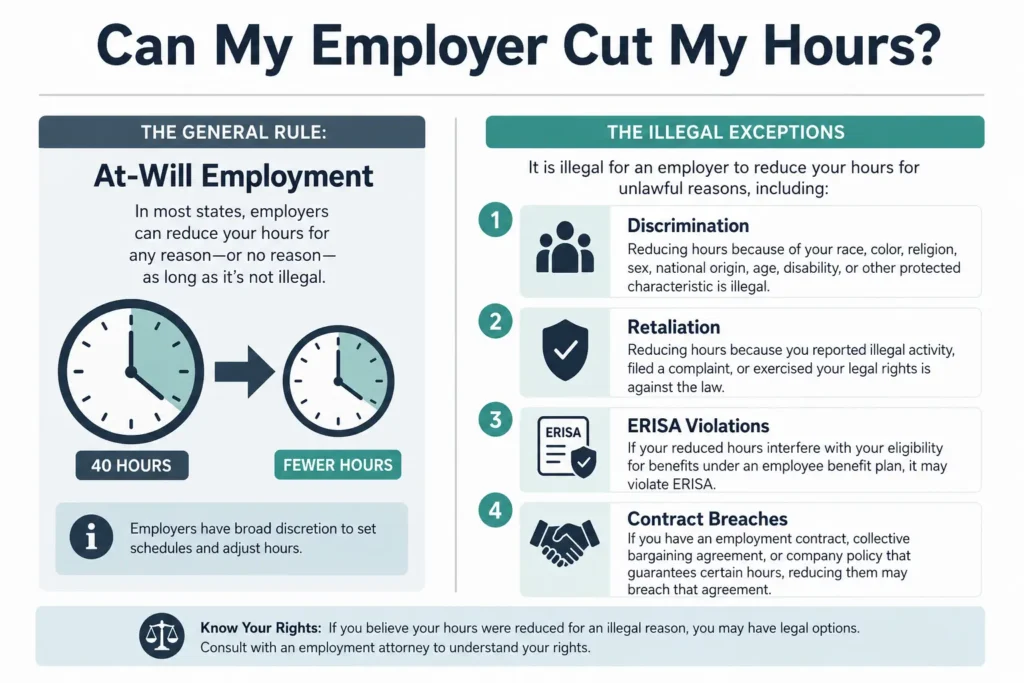
If you are a full-time employee, yes, your employer can legally cut your hours in most cases. However, this rule has massive exceptions. If your hours were slashed due to retaliation, discrimination, a breach of contract, or to avoid paying healthcare benefits, your employer may have broken federal or state labor laws.
Check out our Labor Rights & Hour-Cut Analyzer Tool at the end of this article
The General Rule: “At-Will” Employment and Your Schedule
To understand your rights, you must first understand the foundation of American labor law: at-will employment.
In 49 states (Montana is the lone exception), employment is inherently “at-will.” This means your employer can fire you, change your job duties, or reduce your schedule at any time, for any lawful reason, or for no reason at all. They do not need to give you a two-week notice or a written warning before slashing your hours.
Furthermore, federal law does not guarantee a 40-hour workweek. The Fair Labor Standards Act (FLSA) — the primary federal law governing wages and hours — does not define what “full-time” means. To the federal government, “full-time” is simply an internal company policy. If your company falls on hard times or experiences a seasonal slowdown, they are generally free to cut your hours from 40 down to 20, or even fewer.
When Cutting Your Hours is Illegal (The 4 Major Exceptions)
While employers hold immense power over schedules, they do not have a blank check. If your boss reduced your hours for any of the following four reasons, they have crossed into illegal territory.
1. Illegal Retaliation
Your employer cannot legally cut your hours to punish you for exercising your legal rights. This is known as workplace retaliation.
To build a strong case, you must show a direct timeline link between your protected activity and the schedule cut. For example, a court will look closely if your boss slashes your hours:
- Three weeks after you requested or returned from job-protected medical leave under the Family and Medical Leave Act (FMLA).
- Shortly after you filed a legitimate workers’ compensation claim for an on-the-job injury.
- Days after you reported wage theft, unpaid overtime, or unsafe working conditions to human resources or the Department of Labor.
In strict states like California, recent updates under Statute SB 497 create a automatic “rebuttable presumption” of retaliation if an employer cuts your hours within 90 days of you engaging in a protected activity. This shifts the legal burden onto the boss to prove they had a purely business reason for the cut.
2. Discrimination
Under federal laws enforced by the Equal Employment Opportunity Commission (EEOC), an employer cannot cut your hours based on your protected characteristics. This includes your race, skin color, national origin, religion, sex, gender identity, sexual orientation, age (40 or older), or disability status under the Americans with Disabilities Act (ADA).
If your supervisor reduces your schedule while keeping the hours of identical coworkers untouched, look for patterns. Did the cut happen after you announced your pregnancy? Did it happen after you requested a reasonable accommodation for a medical condition? If so, this constitutes illegal discrimination.
3. Breach of Contract or Union Agreement
Are you a member of a labor union? If so, you are protected by a Collective Bargaining Agreement (CBA). Most union contracts contain strict clauses that guarantee regular shift schedules or establish seniority-based rules for hour reductions. If a manager cuts your hours in violation of the CBA, contact your union steward immediately to file a formal grievance.
Similarly, if you signed an individual executive or employment contract that explicitly guarantees a set salary or a specific number of weekly hours, your employer cannot unilaterally cut your schedule without breaching that contract.
4. Benefit Dodging (ERISA Violations)
Under Section 510 of the Employee Retirement Income Security Act (ERISA), it is completely illegal for an employer to alter your employment status specifically to interfere with your attainment of employee benefits.
A classic corporate trick is reducing a full-time employee’s schedule to exactly 29 hours per week. Why? Because under the Affordable Care Act (ACA), companies with 50 or more full-time workers must offer health insurance to anyone working 30 or more hours. If your manager explicitly tells you or hints that your hours are being capped to save the company money on health insurance premiums, they have committed an ERISA violation.
| Reason for Hour Cut | Legal Status | Applicable Law / Doctrine |
| Lack of business / economic slowdown | LEGAL | At-Will Employment Doctrine |
| Filing a sexual harassment complaint | ILLEGAL | Title VII Retaliation |
| Intentionally dropping you to 29 hours to cancel health insurance | ILLEGAL | ERISA Section 510 |
| Violating a union’s seniority shift rules | ILLEGAL | Collective Bargaining Agreement |
Exempt vs. Non-Exempt: Does Being Salaried Protect Your Hours?
How an hour cut affects your paycheck depends entirely on your classification under the FLSA: exempt or non-exempt.
- Non-Exempt Employees (Hourly Workers): If you punch a timecard, you are only paid for the exact hours you work. If your boss cuts your schedule from 40 hours to 20 hours, your weekly paycheck will drop by half. This is completely legal, provided you are still paid at least the federal or state minimum wage for every hour worked.
- Exempt Employees (Salaried Workers): Being salaried changes the game completely. To be exempt, you must earn a guaranteed minimum salary (which increased significantly under recent Department of Labor updates) and perform specific professional or managerial duties.
Under federal law, an exempt employee must receive their full weekly salary for any workweek in which they perform any work, regardless of how few hours they actually clock. If your boss tells you to stay home on Thursday and Friday because business is slow, they cannot legally dock your salary for those two days. If they reduce your salary because they reduced your hours, they risk destroying your exempt status entirely, meaning they could owe you back-pay for past overtime.
Did They Give Notice? (Predictive Scheduling Laws)
While federal law does not require advance notice for schedule changes, local governments across the United States are fighting back against volatile scheduling.
If you work in the retail, fast-food, or hospitality industries, you may be protected by local Predictive Scheduling Laws. As of 2026, several jurisdictions strictly require employers to give workers advance notice of their shifts—usually 14 days. If an employer cuts your hours last-minute within that window, they must pay you a financial penalty called “predictability pay” (usually 1 to 4 hours of your regular wage).
States and cities with active predictive scheduling protections include:
- Oregon (Statewide)
- San Francisco, CA
- Los Angeles, CA
- Seattle, WA
- Chicago, IL
- New York City, NY
- Philadelphia, PA
If your workplace is located in one of these areas and your boss cancels your shift on your way to work without paying a penalty, they are violating local labor ordinances.
3 Steps to Take if Your Hours Are Slashed
If your schedule has been severely reduced and you are panicking about paying rent, you must pivot from panic to protection. Take these three concrete steps immediately:
1. Apply for Partial Unemployment Benefits
Many workers mistakenly believe they can only collect unemployment insurance if they are completely laid off. This is a myth. Nearly every state allows workers to claim partial unemployment benefits (often called underemployment benefits) if their hours are reduced through no fault of their own.
If your regular 40-hour schedule is cut down to 15 hours, your state’s department of labor treats this income drop as a partial job loss. File a claim immediately through your state’s unemployment portal. You will need to report your weekly earnings, and the state will offset your lost income with a partial benefit check.
2. Document Everything Intact
The moment your hours are cut, start archiving your evidence before you lose access to company systems.
- Save copies of your original hiring agreements, employee handbooks, and written schedule policies.
- Take screenshots of your past schedules proving you historically worked full-time hours.
- Export all emails, text messages, or Slack conversations where your manager discusses your schedule, performance, or benefits.
- Keep your pay stubs to track the exact drop in your gross wages.
Store these records on a personal device or printed out at home—never leave your only copies on a company computer or corporate cloud server.
3. Watch for Constructive Discharge
Did your employer cut your full-time hours down to a single 4-hour shift per week? This is a common, hostile tactic designed to force you to quit so the company doesn’t have to pay unemployment taxes.
In employment law, this is known as constructive discharge. The law recognizes that your employer didn’t technically fire you, but they made your working conditions so intolerable and financially impossible that any reasonable person would be forced to resign. If you can prove constructive discharge, the state will view your resignation as an involuntary termination, preserving your right to collect full unemployment benefits and pursue a wrongful termination lawsuit.
Labor Rights & Hour-Cut Analyzer
Find out if your schedule reduction violated US labor laws and estimate your eligibility for benefits.
Disclaimer: The information provided on this website does not, and is not intended to, constitute legal advice. All information, content, and materials available on this site are for general informational and educational purposes only. Laws regarding employment and labor rights frequently change, and while we strive to keep our content updated, the information on this website may not constitute the most up-to-date legal or other information.
Use of, and access to, this website or any of the links or resources contained within the site do not create an attorney-client relationship between the reader, user, or browser and the website authors, contributors, or its owners. We are an independent publishing platform, not a law firm.
Readers of this website should contact a qualified employment attorney in their specific state to obtain advice with respect to any particular legal matter. No reader or user of this site should act or refrain from acting on the basis of information on this site without first seeking legal advice from counsel in the relevant jurisdiction. Only your individual attorney can provide assurances that the information contained herein – and your interpretation of it – is applicable or appropriate to your particular situation.
Know your rights.