
Yes, a misdemeanor DUI can affect employment — it typically appears on criminal background checks and Motor Vehicle Records (MVR) for 7 to 10 years, depending on your state. However, unless your job requires driving, heavy machinery operation, or a professional license, a single first-time conviction will not automatically disqualify you. Federal law and EEOC guidance both require employers to evaluate your specific record in context before making a final decision.
Key Takeaways
- A misdemeanor DUI shows up on most criminal background checks and on your Motor Vehicle Record (MVR).
- Employers in most states cannot automatically reject you based on a DUI alone — they must weigh the nature of the offense, how long ago it happened, and how relevant it is to the job.
- Jobs that require driving (CDL, rideshare, delivery), professional licenses, or federal security clearances carry the highest risk of disqualification.
- Remote, tech, and office roles are the least likely to be affected.
- Several states now have “clean slate” laws that automatically seal or expunge certain DUI convictions after a waiting period.
- The FCRA (Fair Credit Reporting Act) gives you the right to see and dispute any background check report used against you.
Introduction
If you were just hit with a DUI charge — or you’re sitting on a conviction and wondering what it means for your paycheck — you’re not alone, and you’re not powerless. About 1.5 million DUI arrests happen in the United States every year. Many of those people have jobs, job applications in progress, or career goals that feel suddenly threatened.
Here’s what you need to hear right now: a misdemeanor DUI is not a career death sentence. Federal law, EEOC guidance, and a growing number of state statutes all place real limits on how employers can use your record against you. What happens next depends heavily on your industry, your state, and how you handle it.
This guide breaks it all down — what actually shows up on a background check, which jobs are most at risk, what your legal rights are, and exactly what to say in an interview if the topic comes up.
Does a Misdemeanor DUI Show Up on a Background Check?
Yes — but the answer is more nuanced than most people realize. There are actually two separate systems an employer might check, and they work differently.
Criminal Background Checks vs. Motor Vehicle Records (MVR)
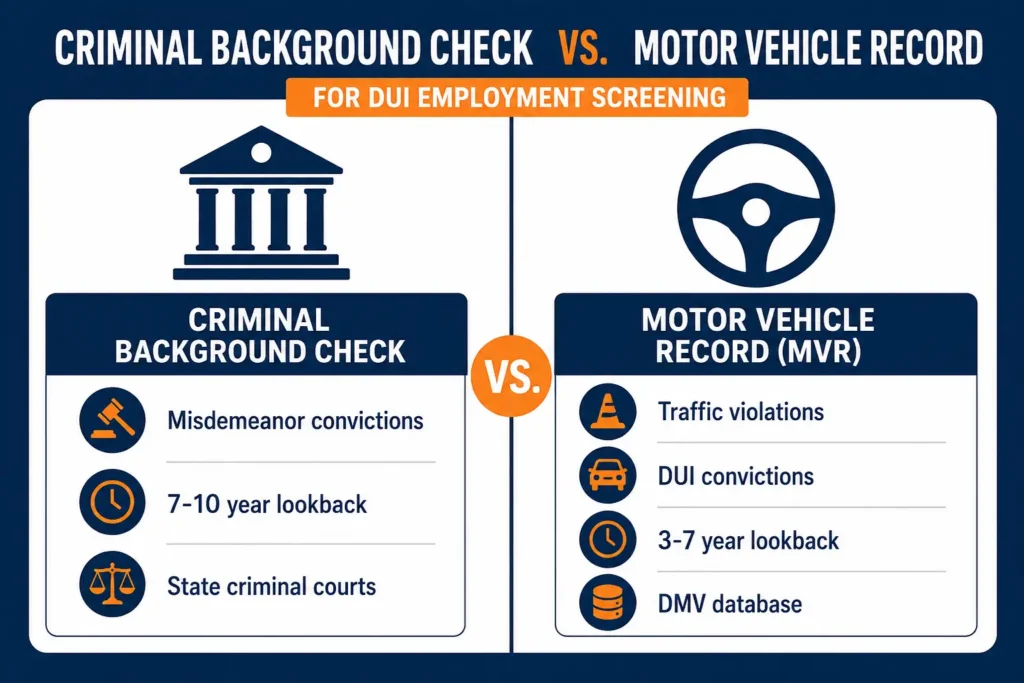
A criminal background check looks at court records from county, state, and sometimes federal databases. A misdemeanor DUI conviction appears here as a criminal offense. Most standard employment background checks have a 7-year lookback window — this comes from the Fair Credit Reporting Act (FCRA), a federal law that limits how far back a Consumer Reporting Agency (CRA) can report most criminal records for jobs paying under $75,000 per year. For higher-paying roles, there is no federal cap.
A Motor Vehicle Record (MVR) is a completely separate check pulled directly from your state’s DMV (Department of Motor Vehicles). Employers in transportation, delivery, and any driving-related role almost always run this. MVR lookback periods vary by state — typically 3 to 7 years — and they focus on your driving history, not your broader criminal record.
The key point: An employer hiring a warehouse manager will likely check criminal records. An employer hiring a delivery driver will check both. Know which one applies to your situation.
Conviction Records vs. Arrest Records
There is a critical legal difference between an arrest and a conviction. If you were charged but the case was dismissed, reduced, or you completed a diversion program, that arrest record is not the same as a conviction.
Under EEOC (Equal Employment Opportunity Commission) guidance, employers are discouraged from making hiring decisions based solely on an arrest that didn’t result in conviction. Several states go further and legally prohibit employers from even asking about arrests that didn’t lead to conviction. If your DUI charge was dismissed, reduced to a lesser offense, or expunged, you may have strong grounds to challenge an employer who uses that information against you.
| Record Type | Shows on Background Check? | Can Employer Use It? |
|---|---|---|
| DUI Conviction (misdemeanor) | Yes, typically 7–10 years | Yes, with limitations (EEOC/state rules apply) |
| DUI Arrest – No Conviction | Sometimes (varies by state) | Limited – EEOC discourages sole reliance on arrests |
| Dismissed or Expunged DUI | Generally no (state-dependent) | Generally no |
| DUI Diversion / Deferred Judgment | Varies | Varies by state |
Will You Be Fired from Your Current Job for a DUI?
This is the most urgent question for workers who already have jobs and just got arrested or convicted. The honest answer: it depends on your employer, your role, and your state.
At-Will Employment and Immediate Risks
Most U.S. workers are employed “at will,” which means your employer can legally fire you for almost any reason — or no reason at all — as long as it’s not an illegal reason (like discrimination based on race or disability). A DUI conviction is not a protected characteristic. That means your employer can fire you for a DUI, even if it happened off-the-clock on a Saturday night and has nothing to do with your job duties.
But there’s an important distinction between can and will. Most employers don’t fire people purely out of moral outrage. They fire people when the DUI creates a real business problem — and that’s where the next point matters.
The Hidden Threat: Corporate Fleet and Liability Insurance
Here’s the piece most articles don’t explain: your employer’s insurance policy may force their hand.
Many companies carry corporate fleet insurance or general liability policies that cover employees who drive on company business — even occasionally. When an employee is convicted of a DUI, that employee can become uninsurable under the company’s policy or trigger a sharp premium increase. In that situation, the employer doesn’t fire you because they’re angry — they fire you because their insurer demands it as a condition of coverage.
If your job involves driving a company vehicle, operating equipment, or even occasional client visits in your own car on company time, this is a real and immediate risk. Contact HR proactively before they find out on their own. Getting ahead of it gives you more control over the narrative.
What Industries Are Most (and Least) Affected by a DUI?
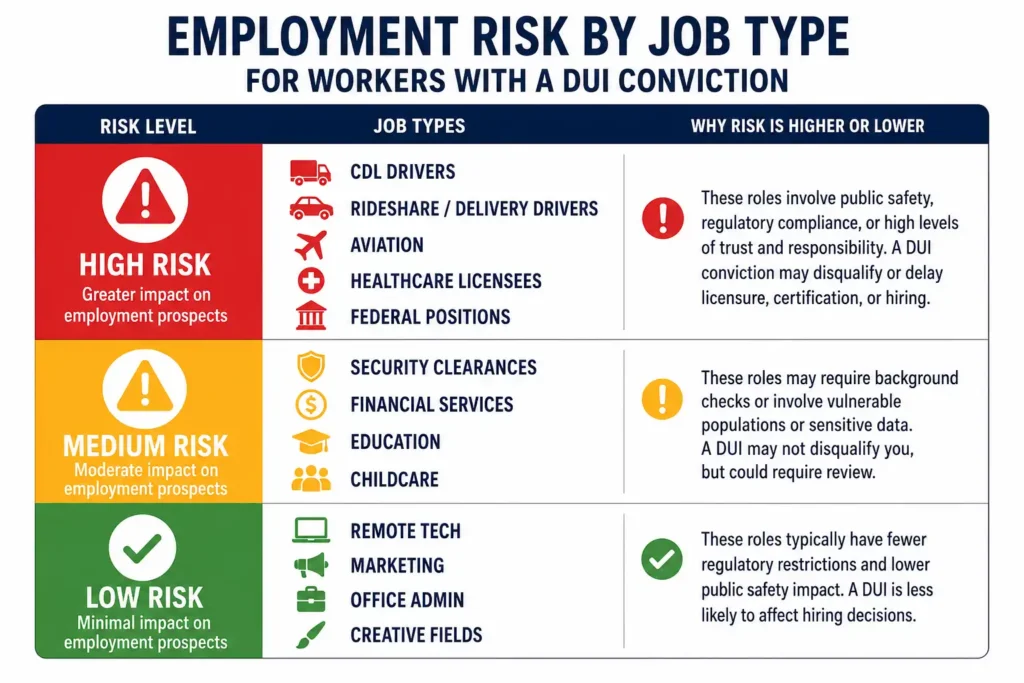
Your industry matters more than almost any other factor. Here’s how to think about your specific situation.
Dealbreakers: CDL, Gig Economy, and Aviation
Commercial Driver’s License (CDL) holders face the harshest consequences. Under Department of Transportation (DOT) regulations, a first DUI conviction disqualifies a CDL driver from operating a commercial vehicle for one year. A second conviction is a lifetime disqualification. These are federal rules — no state can override them.
Gig economy workers (Uber, Lyft, DoorDash, Amazon Flex, Instacart) face a different but equally severe problem: automated deactivation. These platforms run continuous MVR monitoring. When a DUI conviction posts to your DMV record, the platform’s algorithm flags it and deactivates your account — often without any human review. For Uber and Lyft specifically, the policy as of 2026 is that a DUI conviction within the last 7 years results in permanent deactivation.
Aviation workers holding FAA (Federal Aviation Administration) certificates — pilots, air traffic controllers, mechanics — must self-report a DUI arrest or conviction within 60 days under FAA regulations. Failure to report is a separate violation. A DUI doesn’t automatically revoke a certificate, but it triggers an FAA review.
Complicated Roles: Healthcare and Security Clearances
Healthcare workers — nurses, pharmacists, physical therapists, physicians — must often report criminal convictions to their state licensing board. A misdemeanor DUI typically doesn’t result in automatic license revocation, but the board may impose conditions, require monitoring, or require proof of rehabilitation. The outcome varies significantly by state and by board. If you hold a healthcare license, consult your state board’s specific policies and consider speaking with a licensing attorney.
Security clearance holders are required to self-report a DUI as a “reportable event.” A single misdemeanor DUI does not automatically result in clearance revocation — adjudicators weigh the full context — but undisclosed criminal activity is a much bigger problem than the DUI itself. Disclose it honestly.
Safe Havens: Remote Work and Tech
Here’s good news that most articles overlook: remote and laptop-class jobs are the least affected by a DUI, and the reason is simple — driving is irrelevant to the role.
A software developer, content strategist, data analyst, or graphic designer working remotely has no driving requirement embedded in their job duties. Under EEOC guidance (discussed below), employers must assess whether an offense is actually relevant to the job. For remote tech roles, it almost never is. The DUI will still appear on a background check, but it carries far less weight in the hiring decision.
What Are Your Legal Rights During a Background Check?
This is where you move from fear to power. Federal law and many state laws give you real, enforceable rights in this process.
The EEOC’s Nature-Time-Nature Test
The Equal Employment Opportunity Commission (EEOC) — the federal agency that enforces workplace discrimination law — has issued guidance stating that employers cannot have a blanket policy of rejecting all applicants with a criminal record. Doing so can constitute illegal discrimination under Title VII of the Civil Rights Act, particularly where it has a disproportionate impact on certain racial groups.
Instead, employers must conduct what’s known as an individualized assessment using three factors:
- The Nature of the crime — How serious was the offense? A misdemeanor DUI is far less serious than a violent felony.
- The Time elapsed — How long ago did it happen? A DUI from eight years ago carries less weight than one from eight months ago.
- The Nature of the job — Is the offense relevant to the position? A DUI is highly relevant for a delivery driver role but barely relevant for a remote marketing coordinator.
If an employer rejects you based on a background check, you have the right to ask for an individualized assessment under EEOC guidance.
2026 “Clean Slate” Laws and Ban-the-Box Updates
Several major states have significantly changed the rules in the past two years:
- “Clean slate” laws — States including Pennsylvania, Michigan, Utah, Colorado, and Delaware now have laws that automatically seal or expunge certain criminal records — including misdemeanor DUI convictions — after a defined waiting period (typically 7 to 10 years) without any petition required. If your DUI qualifies, it may already be sealed in a clean slate state without you knowing it.
- “Ban the box” laws — Over 35 states and 150+ cities now restrict when employers can ask about criminal history. In many jurisdictions, employers cannot ask about a criminal record until a conditional job offer has been made. California, New York, Illinois, and New Jersey have among the strongest protections.
Action step: Search “[your state] + clean slate law” or “[your state] + expungement eligibility” to see if your conviction qualifies for automatic sealing or petition-based expungement.
FCRA Compliance and Individualized Assessments
Under the Fair Credit Reporting Act (FCRA), if an employer plans to take an adverse action (not hiring you, or firing you) based on a background check, they are legally required to:
- Provide you with a copy of the background check report.
- Provide a written notice of your right to dispute inaccurate information.
- Give you a reasonable amount of time to respond before making the decision final.
If an employer skips these steps, they have violated federal law and you may have a claim. Errors in background check reports are also surprisingly common — DUI records from the wrong person, wrong dates, or convictions that were supposed to be sealed frequently appear. Always request and review your own background check report if you’re denied a job.
Practical Case Study: Navigating a DUI as a Non-CDL Professional
Here’s how this plays out in the real world.
Marcus is a 34-year-old office manager in Texas. Three years ago, he received a first-time misdemeanor DUI after a company holiday party. He completed his sentence — a fine, a short license suspension, and a mandatory alcohol education course. He now applies for an office manager role at a mid-size logistics firm.
What happens:
- The employer extends a conditional job offer — standard practice in ban-the-box compliant states.
- After the offer, they run a background check. The DUI appears.
- The employer’s HR team conducts an individualized assessment. The role doesn’t involve driving company vehicles. The offense is three years old. Marcus provides a brief written statement acknowledging the conviction, noting that he completed all required programs, and explaining that it doesn’t reflect his current conduct.
- Marcus also provides a reference letter from his previous supervisor and a certificate of completion from the alcohol education program as rehabilitation evidence.
- The employer hires Marcus.
The lesson: Marcus didn’t hide anything, and he didn’t grovel. He controlled the narrative by presenting the DUI in context before the employer could form an assumption. That approach — honest, brief, forward-looking — is what works.
How Do You Explain a DUI in a Job Interview?
Most articles give you this advice: “Just be honest.” That’s not wrong, but it’s not enough. You need a framework, not just an intention.
Proven Interview Scripts for Disclosing a Record
The goal is to do three things in 30 seconds: own it, contextualize it, close it.
Script 1 (if asked directly):
“Yes, I have a misdemeanor DUI from [year]. I take full responsibility for it — it was a serious lapse in judgment. Since then, I completed [the required program/counseling/etc.] and I haven’t had any issues since. It’s not something that reflects how I operate professionally, and I’m happy to provide references who can speak to my work.”
Script 2 (for roles where driving is not relevant):
“I do have a misdemeanor DUI on my record from [year]. Given that this role doesn’t involve driving, I want to be upfront about it rather than have it come as a surprise. It was a one-time mistake I’ve addressed fully. I’m confident my work record speaks for itself — would references be helpful at this point?”
Script 3 (if asked on an application before an offer):
In jurisdictions where disclosure is required pre-offer, keep written answers brief and factual: “Misdemeanor DUI conviction, [year], [state]. All requirements completed.”
What not to do:
- Don’t over-explain or apologize repeatedly — it signals insecurity.
- Don’t volunteer information beyond what’s asked (e.g., don’t mention the DUI if the question only asks about felonies and you have a misdemeanor).
- Don’t blame others or minimize the offense in a way that sounds unaccountable.
Frequently Asked Questions (FAQ)
How long does a misdemeanor DUI stay on your record?
A misdemeanor DUI typically stays on your criminal record permanently unless it is expunged or sealed. However, under the Fair Credit Reporting Act (FCRA), background check companies cannot report most criminal convictions older than 7 years for jobs paying under $75,000 annually. For higher-paying positions, older convictions may still appear. Your Motor Vehicle Record (MVR) has a separate lookback period — usually 3 to 7 years depending on your state — after which the DUI no longer affects your driving record.
Will a dismissed DUI show up on a background check?
A dismissed DUI charge may still appear on some criminal background checks as an arrest record, even without a conviction. However, many states restrict employers from using arrest records that did not result in conviction. If your DUI was dismissed, reduced, or resolved through a diversion program, consider petitioning for expungement to formally clear the record. Once expunged, most employers — and most background checks — will not see it.
Can I be fired for a first-time misdemeanor DUI?
Yes. In at-will employment states — which covers most of the U.S. — your employer can legally terminate you for a DUI conviction, even a first-time misdemeanor. However, they are not required to fire you, and many won’t unless the conviction directly affects your job duties or makes you uninsurable under a company liability policy. If your employer has a written policy about off-duty conduct or criminal convictions, that policy governs the situation. Review your employee handbook carefully.
Do I have to tell my current employer about a DUI?
In most cases, no — you are not legally required to self-disclose a DUI to a current employer unless your employment contract, a professional licensing requirement, or a security clearance requires it. If any of those three conditions apply to your role, check the specific requirement carefully. Otherwise, your employer will only learn of a conviction if they run a new background check or if the DUI affects your ability to perform your job (for example, a suspended license when driving is required).
What is the best state to be in after a DUI conviction as a job seeker?
States with strong “ban the box” laws and active “clean slate” programs offer the most protection. California, New York, New Jersey, Illinois, and Michigan have some of the strongest worker protections related to criminal history in hiring. States like Pennsylvania and Delaware have automatic expungement programs that may clear a misdemeanor DUI without requiring a court petition after a waiting period. Texas and Florida have fewer restrictions and employers there have more latitude to factor in criminal history.
Can a DUI affect my professional license?
Yes. Professionals holding state-issued licenses — nurses, pharmacists, teachers, real estate agents, contractors, attorneys — may be required to report a DUI conviction to their licensing board. The outcome varies by profession and state: some boards treat a single misdemeanor DUI as a minor issue requiring documentation; others may impose probationary conditions or suspend a license pending review. Contact your specific board or a licensing attorney before assuming the worst — or before assuming the best.
Does an expunged DUI show up on a background check?
In most states, an expunged DUI should not appear on a standard employment background check. However, expungement is not universal: certain government agencies, law enforcement employers, and professional licensing boards may still have access to expunged records. The level of protection expungement offers varies significantly by state. Always verify with a local attorney what an expungement in your state actually seals and from whom.
Conclusion
A misdemeanor DUI is a serious mistake, but it doesn’t have to define your career. The law gives you more protection than most people realize — and most employers are more pragmatic than most people fear.
Here’s your action plan in three steps:
- Know your record. Request your own background check and MVR so you know exactly what employers will see. Services like Checkr, Sterling, or your state court website can help. Dispute any errors immediately.
- Know your state’s laws. Search for your state’s clean slate, expungement, and ban-the-box rules. You may already have more protection than you think.
- Control the narrative. If a job requires disclosure or an interviewer asks, use one of the scripts above. Calm, accountable, and forward-looking wins every time.
Disclaimer: The information provided on this website does not, and is not intended to, constitute legal advice. All information, content, and materials available on this site are for general informational and educational purposes only. Laws regarding employment and labor rights frequently change, and while we strive to keep our content updated, the information on this website may not constitute the most up-to-date legal or other information.
Use of, and access to, this website or any of the links or resources contained within the site do not create an attorney-client relationship between the reader, user, or browser and the website authors, contributors, or its owners. We are an independent publishing platform, not a law firm.
Readers of this website should contact a qualified employment attorney in their specific state to obtain advice with respect to any particular legal matter. No reader or user of this site should act or refrain from acting on the basis of information on this site without first seeking legal advice from counsel in the relevant jurisdiction. Only your individual attorney can provide assurances that the information contained herein – and your interpretation of it – is applicable or appropriate to your particular situation.
Know your rights.