
- An EEOC complaint hurts an employer by forcing them to incur massive legal fees, triggering disruptive digital discovery, risking public relations damage, and opening the door to systemic federal audits—making early settlement highly attractive to the company.
If you are dealing with workplace discrimination, harassment, or retaliation, you might be wondering exactly how does an EEOC complaint hurt an employer. You are likely stressed, angry, and feeling like the company holds all the power. They have the money, the human resources (HR) department, and the expensive lawyers. But the moment you file a federal charge, that power dynamic instantly flips in your favor.
Filing a formal charge with the Equal Employment Opportunity Commission (EEOC) is not just a slap on the wrist for your boss. It is a costly, highly disruptive legal event for the company. This guide will show you exactly how your complaint hits their bottom line, how their own lawyers view the threat, and how you can use that corporate panic to negotiate a fair financial settlement.
What actually happens to a company after you file an EEOC charge?
Once you file an EEOC Charge of Discrimination establishing a prima facie case, the employer is legally forced to respond. They must hire defense counsel to draft a detailed Position Statement, immediately draining thousands of dollars in billable hours before the investigation even truly begins.
When you hit “submit” on your EEOC complaint, a ticking clock starts for your employer. Within 10 days, the EEOC sends a formal Notice of Charge of Discrimination to the company’s HR director or legal department.
They cannot simply throw this notice in the trash. If your claim makes sense “at first glance” (which the law calls a prima facie case), the federal government forces them to answer.
To answer properly, the company must submit a Position Statement. This is a highly detailed legal document defending their actions. Because a single mistake in this document can destroy the company in federal court later, HR will not write it themselves. They will hire outside employment defense attorneys.
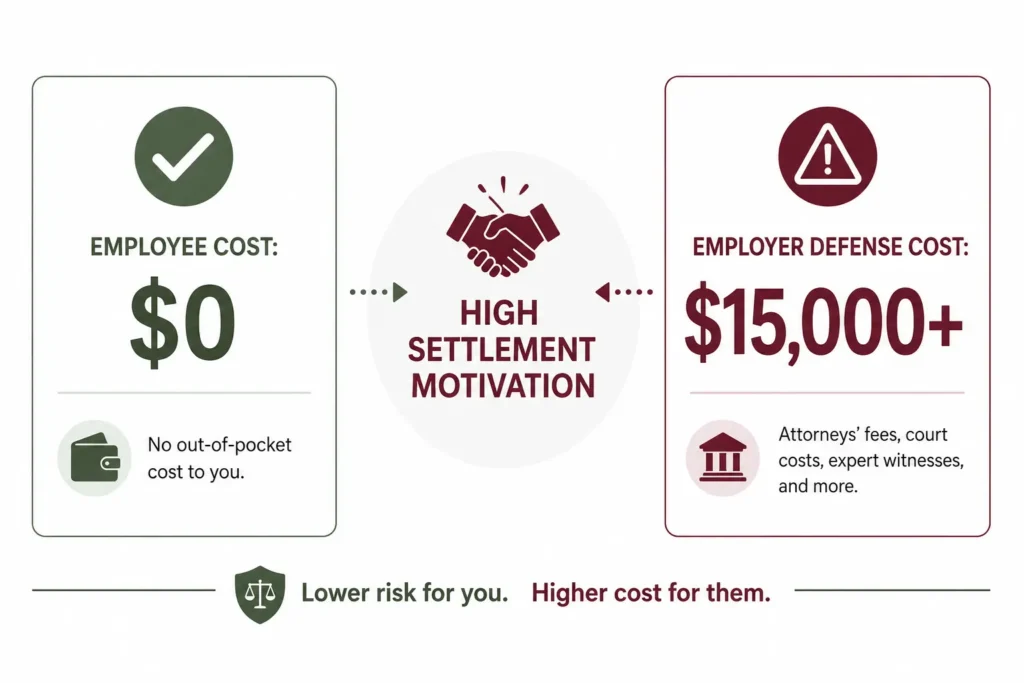
In 2026, corporate defense attorneys easily charge $400 to $800 an hour. Drafting a strong Position Statement, interviewing witnesses, and gathering initial documents usually takes 20 to 40 hours. This means your employer is suddenly bleeding $10,000 to $25,000 in billable hours just to reply to your initial complaint.
How does 2026 e-discovery and EEOC subpoena power cost the employer?
In 2026, the Equal Employment Opportunity Commission (EEOC) utilizes broad subpoena power to demand Electronically Stored Information (ESI). The operational nightmare of extracting, reviewing, and producing years of Slack messages and internal emails costs employers tens of thousands in unavoidable digital e-discovery fees.
If you are wondering how does an EEOC complaint hurt an employer beyond initial lawyer fees, you need to understand modern e-discovery.
If the EEOC decides to investigate deeply, they will use their federal subpoena power. They will demand evidence. Ten years ago, this meant handing over a few paper files. Today, it means searching digital servers.
The EEOC can demand every Slack message, Microsoft Teams chat, text message, and internal email related to you and your managers. Extracting this Electronically Stored Information (ESI) is an operational nightmare.
The company’s IT department has to halt their normal projects to pull the data. Then, the expensive defense lawyers have to read every single message to ensure they aren’t accidentally handing over unrelated corporate secrets. In 2026, standard digital discovery can easily cost an employer upwards of $50,000 before a lawsuit even begins. This massive disruption to their daily operations hurts the employer deeply.
Will my single complaint trigger a systemic investigation into the company?
Yes. A single complaint under Title VII of the Civil Rights Act or the Equal Pay Act can trigger a systemic investigation. If the EEOC suspects widespread discrimination, they can audit the company’s entire payroll, potentially turning your individual charge into a devastating class action.
Employers are terrified of the “contagion risk.” Let’s say you file a complaint alleging that you were paid less because of your gender. You might just want your back pay. But the EEOC’s mandate is to eliminate discrimination nationwide.
If the investigator suspects your company has a habit of underpaying women, they can launch a systemic investigation. They will demand the payroll records for every single employee in your department. Suddenly, the company isn’t just facing your $10,000 claim; they are staring down a multi-million dollar class-action audit.
Because one complaint can rip the roof off their entire HR operation, companies are highly motivated to quietly settle your claim before the EEOC starts digging into their files.
Do employers take EEOC complaints seriously, or will they just ignore it?
Employers take these charges extremely seriously. Ignoring it guarantees a loss. Furthermore, publicly traded companies often must report pending federal litigation on their ESG disclosures, meaning your discrimination complaint can directly threaten their corporate valuation, public relations, and future investor funding.
If your boss is a bully, they might act like your complaint means nothing. Do not let them bluff you. Behind closed doors, their corporate counsel is treating this as a severe threat.
In the modern corporate world, a federal discrimination charge is a toxic asset. If you work for a publicly traded company, or a startup looking for venture capital funding, they are heavily scrutinized on their ESG (Environmental, Social, and Governance) practices.
When investors run due diligence, or when a company files public financial reports, they often have to disclose pending federal employment litigation. A pending EEOC charge for racial discrimination or sexual harassment can tank a deal, hurt public relations, and cause executives to lose their bonuses. They cannot ignore you.
Why do companies push for early mediation and settlement agreements?
To avoid crushing legal fees and the threat of Federal District Court, employers heavily favor early mediation (or voluntary mediation). Offering a financial settlement agreement is usually much cheaper for the company than paying defense lawyers to fight a prolonged EEOC investigation.
Right after you file your charge, the EEOC will likely offer both you and your employer the chance to enter early mediation. This is a free, confidential meeting with a neutral mediator to try and resolve the issue without a drawn-out investigation.
Employers love mediation. Why? Because it stops the financial bleeding.
If they go to mediation, they can offer you a settlement agreement (usually a lump sum of money). In exchange, you agree to drop the EEOC charge and sign a Non-Disclosure Agreement (NDA) promising not to sue them or talk about the settlement. For the company, paying you $30,000 in mediation is a brilliant business decision if it saves them $60,000 in legal fees and keeps their name out of the public court records.
The Secondary Trap: Triggering an Illegal Retaliation Claim
You might be worried: What if I file the complaint and they just fire me out of spite?
If they do, they have stepped into a massive legal trap. The law strictly forbids employers from punishing workers for filing a charge. If they cut your hours, demote you, or fire you after they receive the EEOC notice, you instantly gain a retaliation claim.
Retaliation is actually the most frequently filed charge at the EEOC. It is often much easier to prove than the original discrimination. If your employer retaliates, they exponentially increase their financial liability and the amount of money you can demand in a settlement.
Practical Case Study: Leveraging the Threat of a Notice of Right to Sue
In discrimination claims, leverage is everything. When an older worker was fired after requesting an Americans with Disabilities Act (ADA) accommodation, they filed an Age Discrimination in Employment Act (ADEA) charge. Facing a brutal e-discovery process, the employer settled during mediation to prevent the EEOC from issuing a Notice of Right to Sue.
To understand exactly how does an EEOC complaint hurt an employer in the real world, let’s look at a practical, anonymized case study from 2026.
The Situation: “Marcus,” a 58-year-old warehouse supervisor, was suddenly fired and replaced by a 25-year-old manager just weeks after Marcus requested a stool to sit on due to a knee injury. The company claimed Marcus was fired for “poor performance,” despite him having flawless reviews for five years.
The Strategy: Marcus didn’t have money for a lawyer. Instead, he logged into the EEOC Public Portal and filed a dual charge for age discrimination under the ADEA and disability discrimination under the ADA.
The Employer’s Pain: The company received the notice. Their lawyers told them that fighting the claim would require pulling five years of Marcus’s performance reviews, interviewing the new 25-year-old manager, and paying at least $20,000 in upfront legal fees. Worse, if the EEOC investigation finished and issued Marcus a Notice of Right to Sue, Marcus could drag them into Federal District Court, where attorney fees could easily exceed $150,000.
The Result: The employer requested early mediation. Before the EEOC ever looked at a single piece of evidence, the company offered Marcus a $45,000 settlement to walk away quietly. Marcus accepted. He used the company’s fear of legal costs as his ultimate leverage.

Frequently Asked Questions (FAQ) About Employer EEOC Liability
If you are preparing to file, you likely still have a few anxieties about how the process impacts both you and the company. Here are the answers to the most common questions workers have.
Does an EEOC complaint go on a company’s public record?
No. During the administrative investigation phase, EEOC complaints are strictly confidential by federal law. The public cannot look up whether a company has a pending EEOC charge. However, if the mediation fails, the EEOC issues a Right to Sue, and you file a lawsuit in federal court, that lawsuit becomes 100% public record. This fear of public exposure is exactly why employers want to settle early.
What happens to the company after I file the charge?
Within 10 days of your filing, the EEOC sends a formal notice to the employer. The employer is then given a deadline to either accept an invitation to early mediation or submit a written Position Statement defending their actions. The company’s HR and legal teams will immediately begin pulling your personnel file to assess their legal risk.
Will my boss have to pay out of pocket if I win?
Generally, no. Under federal laws like Title VII, the ADA, and the ADEA, liability falls on the employer as a corporate entity, not the individual manager or supervisor who harassed or fired you. The company’s bank account (or their Employment Practices Liability Insurance) pays your settlement. This makes it easier for companies to agree to pay you, as it is treated as a corporate business expense.
Diclaimer: The information provided on this website does not, and is not intended to, constitute legal advice. All information, content, and materials available on this site are for general informational and educational purposes only. Laws regarding employment and labor rights frequently change, and while we strive to keep our content updated, the information on this website may not constitute the most up-to-date legal or other information.
Use of, and access to, this website or any of the links or resources contained within the site do not create an attorney-client relationship between the reader, user, or browser and the website authors, contributors, or its owners. We are an independent publishing platform, not a law firm.
Readers of this website should contact a qualified employment attorney in their specific state to obtain advice with respect to any particular legal matter. No reader or user of this site should act or refrain from acting on the basis of information on this site without first seeking legal advice from counsel in the relevant jurisdiction. Only your individual attorney can provide assurances that the information contained herein – and your interpretation of it – is applicable or appropriate to your particular situation.
Know your rights.