
If you are facing a nightmare workplace, you are probably asking yourself, “can I collect unemployment if I quit my job?” The short answer is yes, but it is an uphill battle. To qualify for benefits after a voluntary quit, you must prove to your state that you resigned for good cause. This means you had a compelling, urgent reason to leave, and your employer gave you no reasonable alternative.
Walking away from a steady paycheck is terrifying, especially when you cannot afford an attorney. Most workers assume that if they choose to leave, they lose all government support. The United States Department of Labor (USDOL) sets broad guidelines, but each State Workforce Agency (SWA)—like California’s EDD, Texas’s TWC, or New York’s DOL—actually writes the rules. This guide will walk you through the precise legal frameworks, the numeric thresholds, and the evidence you need to secure your cash safety net in 2026.
Can You Collect Unemployment Insurance Benefits After Quitting a Job?
Yes, you can collect unemployment benefits after a voluntary leaving, but only if you prove your resignation meets the state’s definition of good cause connected with the work. The baseline rule across the United States is that Unemployment Insurance (UI) is reserved for individuals who are out of work through no fault of their own. When you resign, the legal burden of proof flips. It is no longer your employer’s job to prove why they fired you; it is your job to prove why you were forced to walk away.
What Legally Qualifies as “Good Cause” to Quit Your Job?
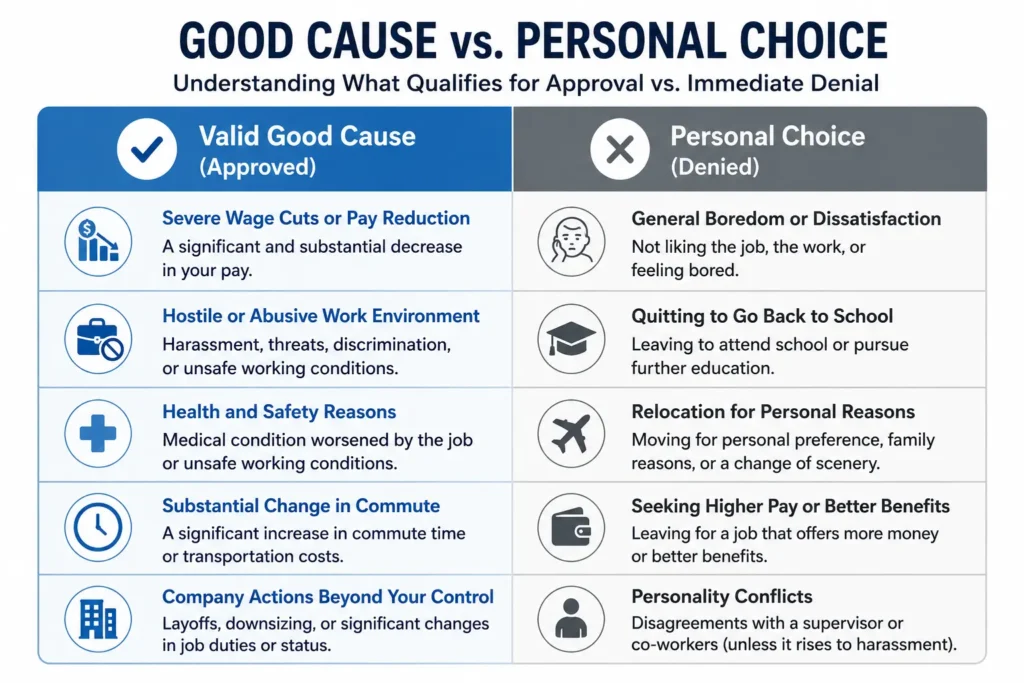
Your state’s claims examiner will not grant benefits just because your job is stressful or your manager is demanding. To establish good cause, your situation must meet an objective standard: would a reasonable, prudent person in your exact shoes feel they had absolutely no choice but to quit? State regulations divide these valid reasons into two primary categories.
Work-Related Good Cause Reasons and Unilateral Changes
A valid work-related reason usually involves a severe, adverse violation of your initial employment agreement by the employer. This is legally known as a substantial change to terms of hire. SWAs look for specific, objective changes:
- Drastic Pay Cuts: A sudden, unilateral reduction in your hourly wage or salary. Many states use a numeric threshold of 20% to 25% or greater as an automatic qualification for good cause.
- Severe Hours Reduction: Dropping your full-time schedule down to part-time hours without your consent. This directly reduces your earnings potential and alters your employment status.
- Geographic Relocation: If your employer moves your office and extends your daily commute by more than 50 miles or 1.5 hours round trip, most states consider this an unreasonable burden.
- Illegal Activity: Being ordered by management to violate local, state, or federal laws, or falsify financial or compliance records.
Compelling Personal Good Cause Exceptions
Sometimes, life events force a voluntary quit that has nothing to do with employer misconduct. Progressive state laws recognize specific personal emergencies as valid exceptions:
- Domestic Violence Protection: If leaving your job is necessary to escape an abusive situation or protect your children, state statutes shield your UI eligibility.
- Medical Necessity: A severe illness or injury that makes performing your core duties impossible. You must have a doctor’s explicit, written note advising you to leave the position.
- Military Spousal Transfer: If your spouse is in the military and undergoes a mandatory, permanent change of station (PCS), you can claim unemployment when you relocate with them.
How Do I Prove Constructive Discharge to a Claims Examiner?
If you are quitting because your workplace is genuinely intolerable, you are arguing a legal concept called constructive discharge. This doctrine means that even though you signed a resignation letter, the employer’s behavior effectively fired you. You are telling the claims examiner that management intentionally made conditions so miserable that any sane employee would run for the exits.
Meeting the Hostile Work Environment Threshold Under Title VII
A “toxic boss” is usually not enough to win an unemployment appeal. To qualify for benefits under a constructive discharge claim, the workplace environment must cross the legal line into a hostile work environment.
This means the toxic behavior must be severe, pervasive, and tied directly to a legally protected class under Title VII of the Civil Rights Act or state anti-discrimination laws. The hostility must stem from discrimination based on race, sex, gender, religion, national origin, age, or disability. This includes unaddressed sexual harassment or systemic racial slurs.
Furthermore, if your physical safety is threatened by uncorrected violations of Workplace Safety Standards, you can file a complaint with the Occupational Safety and Health Administration (OSHA) and resign with a highly defensible UI claim.
How to Build a Written Paper Trail and Meet Your Duty to Mitigate
This is the exact section where most workers lose their unemployment benefits before they even apply. To win a voluntary quit case, you must fulfill your legal duty to mitigate. This means you cannot just experience a terrible problem and quit the same day. You must give your employer a fair, formal opportunity to fix the issue before you resign.
The 3 Critical Steps to Documenting Your Workplace Grievances Before You Resign
If you do not document your complaints, your employer will tell the state workforce agency that they had no idea anything was wrong. Follow this exact blueprint to build an ironclad case:
- File an Explicit, Written Complaint: Send a clear email to your Human Resources (HR) department or upper management. State the exact problem, whether it is a missing paycheck, sexual harassment, or a dangerous physical hazard. Use objective, unemotional language.
- Explicitly Request a Remedy: Give management a clear timeline to address the issue. State clearly: “I want to continue working here, but I need these unsafe conditions or illegal pay practices resolved immediately.”
- Allow a Reasonable Window for a Fix: Give the company a reasonable timeframe—typically 5 to 10 business days—to investigate and correct the behavior. If they ignore your written notices, stall, or openly retaliate against you, your legal standing to quit and collect UI becomes incredibly strong.
Practical Case Study: How Alex Provenly Won an Unemployment Appeal
Let’s look at how this plays out in the real world with a practical example.
The Conflict
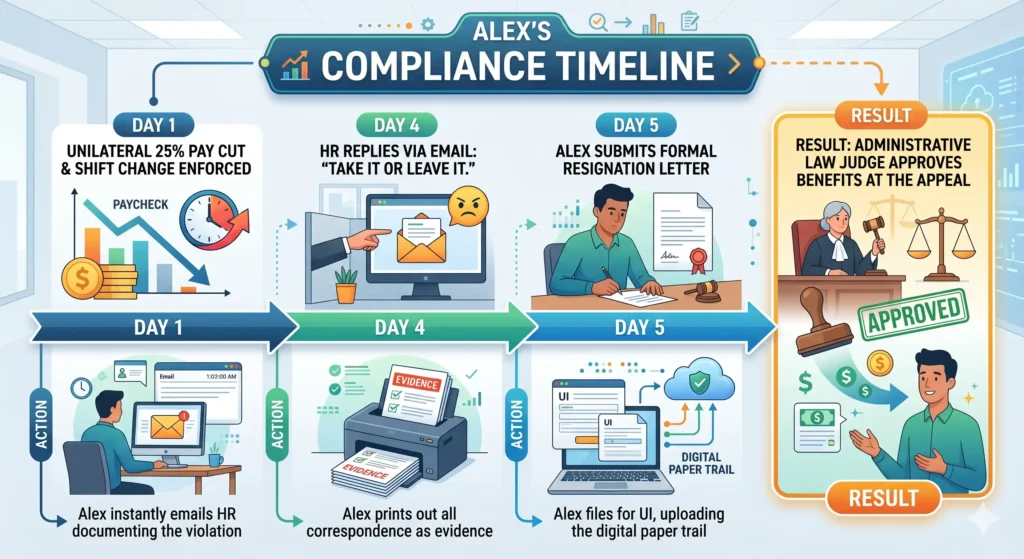
Alex worked as a senior logistics coordinator earning $2,500 every two weeks. Following a management shift, Alex’s direct supervisor unilaterally cut Alex’s pay by 25% down to $1,875. The supervisor also shifted Alex from a standard daytime schedule to a graveyard shift with no prior notice.
The Action Trail
Alex did not quit immediately. Instead, Alex texted and emailed the HR director that morning, noting the severe deviation from the original prevailing conditions of work standard. Alex wrote: “This 25% pay cut and sudden schedule flip creates an extreme financial hardship. I want to stay with the company, but I cannot sustain this. Please let me know if my original salary can be restored.” HR emailed back three days later, stating simply: “Take it or leave it.”
The Resolution
Alex resigned the following morning, citing a substantial change to terms of hire and an unresolved breach of contract. The employer contested the initial claim, triggering an appeals hearing before an Administrative Law Judge (ALJ).
Because Alex presented printed copies of the sent emails, the employer’s response, and pay stubs verifying the sudden 25% wage reduction, the ALJ ruled that Alex successfully met the duty to mitigate. The judge declared the resignation a valid constructive discharge. Alex was awarded full weekly benefits based on their historical base period earnings.
What Common Reasons for Quitting Will Cause an Immediate Denial?
Many workers quit for highly logical personal reasons, only to find out that their state’s workforce agency views those reasons as entirely disqualifying. If you quit for any of the following reasons, your initial claim will almost certainly face an immediate computer-generated rejection:
- Quitting for Career Growth: Leaving your job to search for a better position, look for a new career path, or launch a freelance business.
- Voluntary School Enrollment: Resigning your position to go back to college or attend a full-time vocational training program.
- General Burnout or Dissatisfaction: Quitting because you dislike your day-to-day duties, find the work boring, or have a general, non-discriminatory personality clash with your supervisor.
- Quitting to Avoid Being Fired: If you catch wind that management is planning to terminate you, and you resign first to “keep your record clean,” you forfeit your right to unemployment benefits. Let them fire you instead.
How Do States Reconsider and Purge a Voluntary Quit Disqualification?
What happens if you already handed in your resignation, applied for benefits, and received an official notice of disqualification in the mail? A denial is not necessarily a permanent life sentence.
States have explicit statutory provisions designed to re-evaluate and purge a voluntary quit disqualification. To clear a previous denial from your record, you must re-enter the workforce, find a new position, and work there long enough to meet your state’s unique requalification metrics.
While specific requirements vary by state, the standard formula requires you to work at a subsequent employer for a minimum duration—typically 4 to 8 weeks—and earn an amount equal to a specific multiple of your calculated Weekly Benefit Rate (WBR). In many jurisdictions, once you earn at least 10 times your WBR at a new job and are subsequently laid off from that position through no fault of your own, your past voluntary quit disqualification is completely wiped clean. Your state will then calculate your benefit amount using your broader historical base period wages.
How Do State Workforce Agencies Use AI to Evaluate Separation Claims in 2026?
The system you are dealing with is faster and more automated than ever before. In 2026, nearly all State Workforce Agencies (SWAs) utilize advanced artificial intelligence algorithms to screen initial applications. When you file a claim online, an AI system instantly parses your text fields and flags specific phrases like “I quit,” “resigned,” or “personal reasons.”
If the algorithm detects a voluntary leaving, it automatically generates a detailed fact-finding questionnaire to both you and your former employer. The system tracks inconsistencies between your answers and your company’s payroll data.
To survive this initial digital screening, you must be precise. Do not write a long, emotional narrative into the online portal. Use clear, objective legal terminology. State clearly that you were forced to leave due to a substantial change to terms of hire or uncorrected safety hazards, and immediately upload your digital PDF written paper trail to the portal.
Frequently Asked Questions About Unemployment After Resigning
Can I get unemployment if I quit because of mental health or stress?
Only if you have an active, documented medical paper trail. You must prove that the workplace actively caused or exacerbated a documented medical condition. You must also show that you requested a reasonable accommodation under the Americans with Disabilities Act (ADA), your employer denied it, and a licensed physician explicitly ordered you to resign for health reasons.
What happens if my employer contests my unemployment claim after I quit?
Your benefits will be temporarily placed on hold, and your state agency will schedule an administrative appeals hearing. This hearing is conducted over the phone or via video by an independent judge. You will both testify under oath. If you have a solid written paper trail proving you reported the issues and were ignored, you have an excellent chance of winning the appeal regardless of what your employer claims.
Can I claim UI if I quit because I lacked childcare or reliable transportation?
Generally, no. Most states view managing your personal commute and family schedule as the sole responsibility of the employee. If your car breaks down or your daycare closes and you quit, the state considers this a personal choice rather than an employer-driven cause. However, if your employer suddenly relocates your office or switches your shifts unexpectedly, that changes the dynamic to an employer-driven cause.
Disclaimer: This guide provides educational information regarding general U.S. labor principles and 2026 state unemployment frameworks. It does not constitute formal legal advice. Unemployment regulations are highly regionalized; always verify local statutory requirements with your specific State Workforce Agency or a licensed employment attorney before altering your employment status.