
- To report independent contractor misclassification to the IRS, file Form SS-8 to request an official determination of your worker status. To stop paying the employer’s share of taxes while you wait, file Form 8919 with your tax return. If you want to report the company anonymously, file Form 3949-A instead.
If you are working a full-time schedule, using company equipment, and following a boss’s orders, but you receive a 1099 tax form instead of a W-2, you are a victim of wage theft. Figuring out independent contractor misclassification how to report IRS violations is the critical first step to stopping your employer from illegally shifting their tax burden onto your shoulders.
This 2026 guide will teach you exactly how to fight back. We will break down the specific IRS tax forms you need to lower your tax bill today, expose the hidden “anonymous trap” that gets workers fired, and explain how to use the Department of Labor to recover years of unpaid overtime.

Why is 1099 misclassification considered financial theft?
When you are misclassified as an independent contractor, your employer illegally forces you to pay the 15.3% Self-Employment Tax. By avoiding their legal requirement to pay 7.65% of your FICA taxes, the company is effectively stealing thousands of dollars from your paycheck.
To understand why your boss gave you a 1099 instead of a W-2, you must follow the money.
When you are a legal W-2 employee, you and your employer split the cost of Medicare and Social Security taxes (known as FICA taxes). You pay 7.65% out of your check, and the company matches it by paying another 7.65% out of their own pocket.
When a company labels you an independent contractor (1099-NEC), they stop paying their half. Suddenly, the IRS requires you to pay the full 15.3% through the Self-Employment Tax. If you earn $50,000 a year, your boss just shifted nearly $4,000 of their corporate tax bill directly onto your shoulders. That is wage theft, and the IRS heavily penalizes it.
How to report independent contractor misclassification to the IRS (Form SS-8)
You report independent contractor misclassification to the IRS by filing Form SS-8. This form triggers an official federal investigation into your employment status. The IRS will review your working conditions and officially determine if you should be reclassified as a W-2 employee.
If you want the government to step in and fix your status, you must file IRS Form SS-8 (Determination of Worker Status for Purposes of Federal Employment Taxes and Income Tax Withholding).
This is a comprehensive, four-page questionnaire. It asks detailed questions to prove you are an employee, such as:
- Who gives you your work assignments?
- Does the company provide your laptop or tools?
- Can you suffer a financial loss if the business fails?
The Anonymous Trap: Many generic law blogs tell you to file this form immediately. They fail to mention a critical danger: Form SS-8 is not anonymous. Once you submit it, the IRS will literally mail a copy of your complaint directly to your boss to ask for their side of the story. If you are still working there, this can create an incredibly awkward or hostile environment.
How to save your tax bill immediately with Form 8919
While waiting months for an SS-8 determination, you can attach Form 8919 to your yearly tax return. This legal workaround allows you to calculate your taxes as an employee, paying only the 7.65% FICA rate and legally bypassing the 15.3% self-employment tax.
The IRS moves slowly. An SS-8 investigation can take six to twelve months. But what do you do if taxes are due next week, and you cannot afford the massive 15.3% self-employment bill?
You use IRS Form 8919 (Uncollected Social Security and Medicare Tax on Wages).
When you file your personal tax return, you attach Form 8919. You check the box labeled “Reason Code G” (which means: “I filed Form SS-8 and have not received a reply”). This form tells the IRS: “My boss misclassified me. I am only paying my 7.65% employee share. Go collect the rest from my employer.”
Filing Form 8919 saves you thousands of dollars immediately and ensures your earnings are correctly credited to your Social Security record.
Can I report independent contractor misclassification to the IRS anonymously?
Yes. If you fear retaliation from your employer, you must not use Form SS-8. Instead, you can anonymously report the company for tax fraud by filing IRS Form 3949-A, which triggers an audit without revealing your identity to the business owner.
If you cannot afford to get fired, the standard SS-8 process is too dangerous. Instead, you must report the company using the tax fraud route.
You can file IRS Form 3949-A (Information Referral). This is the official form used to report suspected tax law violations by a business. You can check the box for “Employment Tax Fraud” and explain that the company is systemically misclassifying its workforce to evade FICA taxes.
The IRS keeps Form 3949-A strictly confidential. They will never tell the employer who triggered the audit. However, because it is anonymous, the IRS will not send you updates on the investigation, and you cannot use this form to lower your personal tax bill (you still need Form 8919 for that).
How the 2026 DOL Economic Realities Rule helps your case
The 2026 Department of Labor “Economic Realities” rule makes it much easier to prove you are an employee. The strict test examines whether you are economically dependent on the employer, completely overriding any contract you signed claiming you were a 1099 contractor.
Employers love to say, “You signed a contract agreeing to be an independent contractor, so you can’t complain now.”
Under federal law, that contract is completely worthless. You cannot legally sign away your labor rights.
In recent years, the Department of Labor (DOL) heavily reinforced the “Economic Realities Test.” In 2026, the IRS and the DOL look at six strict factors to determine your status. The most critical factor is economic dependence. If 100% of your income comes from this one company, you are required to use their proprietary software, and you cannot actively market your services to other clients, the government will classify you as a W-2 employee, regardless of what your contract says.
Why you must also file an FLSA complaint for unpaid wages
Tax forms only fix your relationship with the IRS. To recover the overtime pay and minimum wage violations that occurred while you were misclassified, you must simultaneously file a complaint with the federal Wage and Hour Division (WHD) under the FLSA.
When researching independent contractor misclassification how to report IRS violations, workers often forget the bigger picture.
The IRS only cares about getting its tax money. They do not care if your boss made you work 60 hours a week without overtime.
Because independent contractors are exempt from the Fair Labor Standards Act (FLSA), misclassified workers are almost always owed massive amounts of unpaid overtime (time-and-a-half). To get that money, you must take a second step.
You must file a free, confidential wage claim with the Wage and Hour Division (WHD) of the Department of Labor. If the WHD determines you were actually an employee, they will force the employer to pay you back for all the overtime you worked over the last two to three years, plus liquidated damages (which doubles the payout).
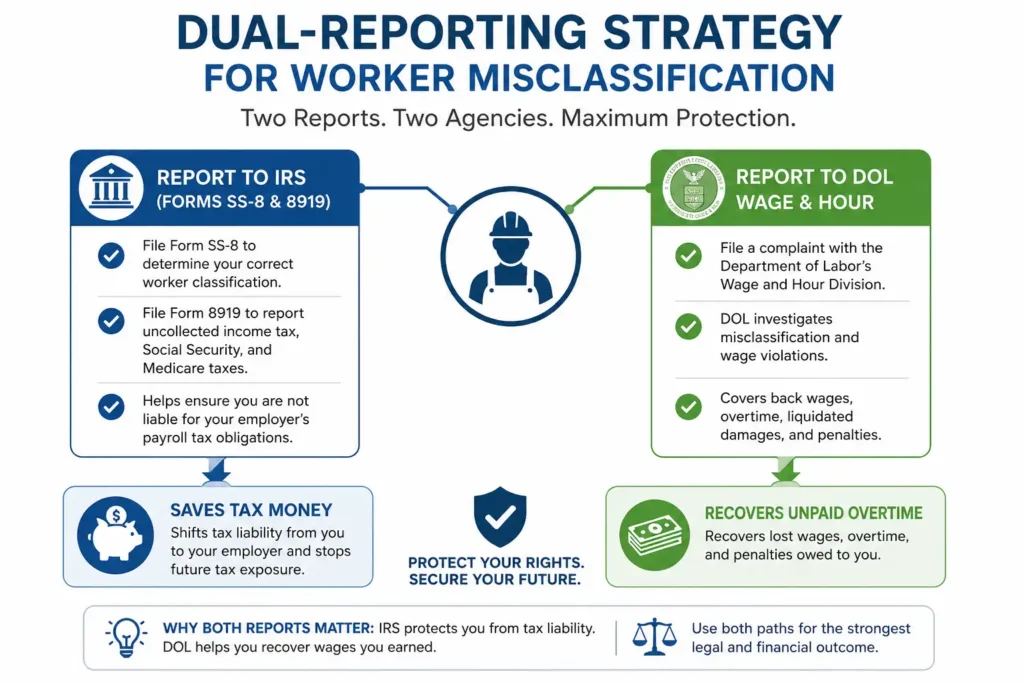
Practical Case Study: Fixing a $12,000 Tax Bill and Recovering Overtime
Understanding the exact sequence of forms is critical. A misclassified delivery driver successfully avoided a massive self-employment tax bill using Form 8919, while simultaneously using a DOL investigation to recover two years of unpaid overtime wages.
Let’s look at how a worker combined tax laws and labor laws to win.
The Situation: “David” was hired as a delivery driver. He drove the company van, wore the company uniform, and was required to work Monday through Saturday from 8 AM to 6 PM (60 hours a week). At tax time, the company handed David a 1099-NEC. His accountant told him he owed $12,000 in self-employment taxes. Furthermore, David had never been paid time-and-a-half for his 20 hours of weekly overtime.
The Action: David refused to pay the $12,000. He attached Form 8919 and Form SS-8 to his tax return. This allowed him to pay only the 7.65% employee share of taxes, cutting his tax bill in half instantly. He then filed a formal wage complaint with the federal Wage and Hour Division (WHD).
The Result: The WHD investigator audited the company. Using the Economic Realities Test, the DOL determined David was clearly an employee, not an independent business owner. The employer was forced to retroactively reclassify David, pay the IRS the missing FICA taxes, and cut David a massive settlement check for two years’ worth of unpaid overtime hours.
Frequently Asked Questions (FAQ) About Reporting Misclassification
Can I get a financial reward for reporting my employer to the IRS?
Yes. Under the IRS Whistleblower Program, if you file Form 211 and provide concrete evidence of systemic, multi-million dollar tax fraud (like a massive corporation misclassifying thousands of workers), you can receive between 15% to 30% of the total back taxes the IRS recovers. However, this program is generally for massive corporate cases, not individual disputes.
Is there a statute of limitations for getting my tax money back?
Yes. If you paid the 15.3% self-employment tax in the past because you didn’t know you were misclassified, you can file an amended tax return (Form 1040-X) alongside Form 8919 to get a refund. However, the IRS strict statute of limitations only allows you to claim refunds for the last three tax years. Do not wait to file.
Can my employer fire me for filing Form SS-8?
Technically, no. The FLSA and other federal labor laws have strict anti-retaliation provisions. If your employer fires you because they received a notice from the IRS that you filed an SS-8 or an 8919, it is illegal retaliation. You would then have grounds to sue the company for wrongful termination and punitive damages. However, because proving retaliation can take time, workers who fear immediate job loss should consider the anonymous Form 3949-A route first.
Disclaimer: The information provided on this website does not, and is not intended to, constitute legal advice. All information, content, and materials available on this site are for general informational and educational purposes only. Laws regarding employment and labor rights frequently change, and while we strive to keep our content updated, the information on this website may not constitute the most up-to-date legal or other information.
Use of, and access to, this website or any of the links or resources contained within the site do not create an attorney-client relationship between the reader, user, or browser and the website authors, contributors, or its owners. We are an independent publishing platform, not a law firm.
Readers of this website should contact a qualified employment attorney in their specific state to obtain advice with respect to any particular legal matter. No reader or user of this site should act or refrain from acting on the basis of information on this site without first seeking legal advice from counsel in the relevant jurisdiction. Only your individual attorney can provide assurances that the information contained herein – and your interpretation of it – is applicable or appropriate to your particular situation.
Know your rights.