
✅ ANSWER BOX
Yes, a sole proprietor can legally hire employees — with no cap on how many. But before you bring on your first worker, you must obtain an Employer Identification Number (EIN) from the IRS, set up formal payroll, withhold federal and state taxes, and carry workers’ compensation insurance. Because sole proprietors have no “corporate veil,” one workplace lawsuit can wipe out your personal savings. Many business owners convert to an LLC before hiring for exactly that reason.
KEY TAKEWAYS
- A sole proprietor can hire unlimited W-2 employees under federal law.
- You must get an EIN — your Social Security Number is no longer enough once you have employees.
- Misclassifying a worker as a 1099 contractor when they function as an employee can trigger IRS back taxes, DOL fines, and private lawsuits.
- Hiring your child under 18 exempts their wages from FICA (Social Security + Medicare) taxes — a powerful, legal tax break.
- Sole proprietors have zero personal liability protection — an LLC or S-Corp can shield your home and savings from employment claims.
Introduction
You built something from scratch — a cleaning business, a photography studio, a landscaping operation — and now it’s growing faster than one person can handle. You’re wondering: Can I even hire someone as a sole proprietor, or do I have to become a “real” company first?
The answer is yes, you can hire — and federal law is clear about it. But the gap between can and should is where most small business owners get into serious trouble. Missed payroll taxes, misclassified contractors, and zero liability protection have derailed businesses that were otherwise doing everything right.
This guide walks you through every legal and tax obligation you’ll face in 2026 — from your very first hire to the point where federal regulations like the FMLA (Family and Medical Leave Act) kick in. No jargon, no fluff. Just what you need to know to hire legally and protect what you’ve built.
Can You Legally Hire a W-2 Employee as a Sole Proprietor?
Yes — and there is no legal limit on how many employees a sole proprietor can hire. The IRS and U.S. Department of Labor do not require you to incorporate or form an LLC before bringing on workers. What they do require is that you follow the same payroll and tax rules as any other employer.
Here’s the critical point most guides skip: the moment you hire a W-2 employee (a worker whose hours, tools, and methods you control), your Social Security Number is no longer enough to run your business. You must apply for an Employer Identification Number (EIN) from the IRS — it’s free, takes about 10 minutes online at IRS.gov, and you’ll use it to file payroll taxes, open a business bank account, and issue W-2 forms at year-end.
Think of an EIN as your business’s Social Security Number — it separates your personal tax identity from your employer tax identity.
What “W-2 Employee” Actually Means
A W-2 employee is someone you pay regular wages or a salary, from whose paycheck you withhold:
- Federal income tax (based on their Form W-4)
- Social Security tax (6.2% you withhold + 6.2% you pay as the employer)
- Medicare tax (1.45% each side)
- State income tax (where applicable)
You also pay Federal Unemployment Tax (FUTA) — currently 6% on the first $7,000 of each employee’s wages — and register for your state’s unemployment insurance program separately.
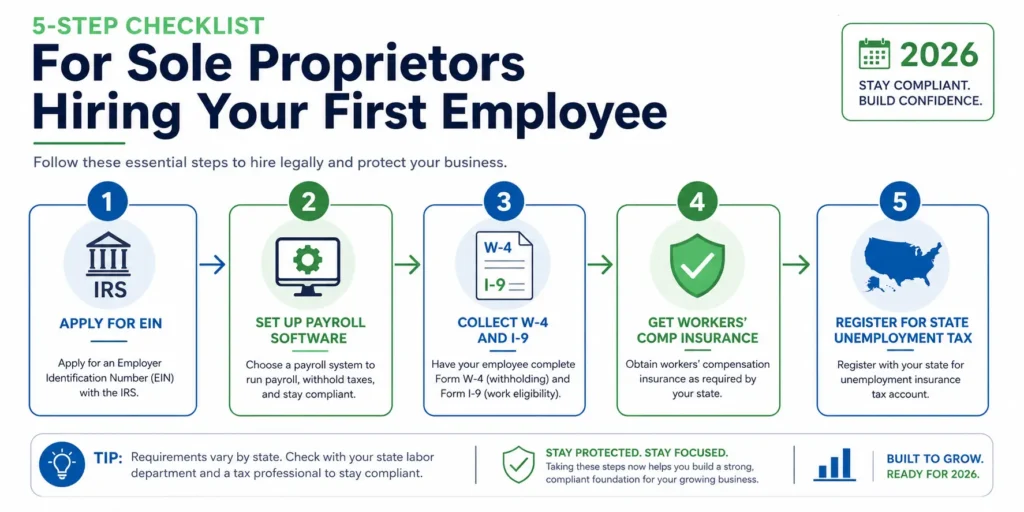
Your 5-Step Checklist Before Hiring
- Apply for an EIN at IRS.gov (free, instant).
- Set up a payroll system (Gusto, QuickBooks Payroll, or ADP handle withholding automatically).
- Collect Form W-4 and Form I-9 from every new hire before their first day.
- Purchase workers’ compensation insurance (required in 49 states — Texas is the only exception, and even there it’s highly recommended).
- Register for state unemployment insurance with your state’s labor department before your first payroll run.
How the 2026 DOL Rule Traps Employers with Independent Contractor (1099) Misclassification
Here’s where a lot of sole proprietors make a costly mistake: to avoid the complexity of payroll, they classify workers as independent contractors (1099) instead of employees (W-2). It feels simpler. And it is — until it isn’t.
The 2026 DOL “economic reality” test makes it significantly harder to justify contractor status than it was before 2024. The rule examines the actual nature of the working relationship, not just what you call it on paper. Factors include:
- Does the worker set their own hours and rates?
- Do they work for multiple clients, or only you?
- Do they use their own tools and equipment?
- Is the work integral to your core business?
If the answers point to an employee-style relationship, the DOL considers that person your W-2 employee — regardless of any contract you signed.
What Misclassification Actually Costs You
| Consequence | Estimated Cost |
|---|---|
| IRS back taxes (employee + employer share) | 100% of unpaid FICA, per worker, per year |
| IRS penalty for failure to withhold | Up to 35% of unpaid taxes |
| DOL back pay under FLSA | Up to 3 years of unpaid overtime + liquidated damages |
| State fines | $500–$25,000 per misclassified worker (varies by state) |
| Private lawsuit (attorney’s fees included) | Unlimited |
The single most expensive payroll mistake a sole proprietor can make is calling an employee a contractor to save on taxes.
For the current DOL rule details, see the Department of Labor’s independent contractor guidance.
What Is the “Family Employment Exemption” for Hiring Your Own Children?
Now for the good news — one of the most powerful and underused tax breaks in the entire tax code belongs exclusively to sole proprietors.
If you hire your child under age 18, their wages are exempt from FICA taxes (Social Security and Medicare), and you pay no FUTA on their wages either. Better yet, those wages are fully deductible on your Schedule C (Form 1040), reducing your self-employment taxable income dollar-for-dollar.
Here’s what that looks like in practice:
Maria runs a sole proprietor photography business earning $90,000/year. She hires her 16-year-old daughter to manage her social media for $12,000/year. Maria deducts the $12,000 from her Schedule C — lowering her taxable income by $12,000. Her daughter pays no tax on that income if it stays under the standard deduction ($14,600 in 2024). Neither pays FICA on it. Maria saves roughly $1,848 in FICA alone — before income tax savings.
Rules You Must Follow
- The work must be real and age-appropriate (the IRS scrutinizes this).
- Pay must be reasonable for the work performed — don’t pay $50/hour for filing.
- Issue a W-2 at year-end (the exemption doesn’t eliminate recordkeeping).
- The exemption ends at age 18 for FICA, and at age 21 for FUTA.
- This exemption applies only to sole proprietors and partnerships between spouses — it does not apply if your business is an LLC taxed as a corporation.
Source: IRS Publication 15 (Circular E), Employer’s Tax Guide
[INSIRA IMAGEM AQUI: Side-by-side comparison table graphic — Sole Proprietor with Employee vs LLC with Employee — showing liability exposure, tax treatment, and setup cost] Alt Text: “Sole proprietor vs LLC comparison for hiring employees — liability and taxes” Title Text: “Should a Sole Proprietor Form an LLC Before Hiring?” Toggle Caption: “Key legal and tax differences between hiring as a sole proprietor vs an LLC in 2026.” Image Specs: 1200 × 800 px | WebP 80–85% | Max 150 KB AI Image Prompt: “Clean two-column comparison infographic. Left column: ‘Sole Proprietor’ with a yellow warning icon at top. Right column: ‘LLC’ with a green shield icon. Rows compare: Personal Liability, Payroll Tax Treatment, Cost to Set Up, Protection from Lawsuits, Hiring Children Exemption. Modern sans-serif typography, white background, blue and amber color palette.”
Why CPAs Recommend Forming an LLC to Establish a Corporate Veil
Legally, you can hire as a sole proprietor. Practically, many CPAs and employment attorneys will tell you to think twice — or at least understand what you’re risking.
As a sole proprietor, you have no corporate veil — meaning there is no legal separation between you and your business. If an employee slips and falls, causes a car accident while on the job, or sues you for unpaid overtime, the plaintiff’s attorney can come after your personal bank account, your home, and your retirement savings.
An LLC (Limited Liability Company) creates that protective wall. For most states, forming one costs between $50 and $500, takes a few weeks, and dramatically limits your personal exposure to business liabilities.
Sole Proprietor vs. LLC: What’s Actually at Stake
| Factor | Sole Proprietor | LLC |
|---|---|---|
| Personal liability for lawsuits | Unlimited | Limited to business assets |
| Cost to set up | $0 | $50–$500 (state filing fee) |
| Complexity | Low | Moderate |
| Tax treatment | Schedule C | Pass-through (same as sole prop, by default) |
| Hiring your kids (FICA exemption) | ✅ Yes | ❌ No (if taxed as S-Corp) |
| Credibility with clients/banks | Moderate | Higher |
The bottom line: if you’re hiring anyone who interacts with customers, operates equipment, or works in a physical space, an LLC is cheap insurance against a life-changing lawsuit.
What Federal Employment Laws Trigger as Your Employee Headcount Grows
Hiring one employee is straightforward. But as your team grows, a new layer of federal law kicks in at specific headcount thresholds. These aren’t optional — violating them carries serious penalties.
Employee count is the single most important compliance variable for a growing sole proprietorship.
| Employees | Law That Applies | What It Requires |
|---|---|---|
| 1+ | Fair Labor Standards Act (FLSA) | Minimum wage, overtime pay, recordkeeping |
| 1+ | FUTA / FICA | Federal payroll tax withholding and deposits |
| 1+ | Form I-9 | Verify every employee’s right to work in the U.S. |
| 1+ | Workers’ Comp | Carry insurance (required in 49 states) |
| 15+ | Americans with Disabilities Act (ADA) | Reasonable accommodations for disabled workers |
| 15+ | Title VII (Civil Rights Act) | No discrimination by race, sex, religion, national origin |
| 20+ | Age Discrimination in Employment Act (ADEA) | Protects workers 40+ from age-based discrimination |
| 50+ | Family and Medical Leave Act (FMLA) | 12 weeks unpaid, job-protected leave per year |
Sources: EEOC, DOL Wage and Hour Division
The FLSA is your biggest immediate concern. It requires you to pay at least the federal minimum wage ($7.25/hr, though many states are higher) and pay overtime (1.5x) for any hours over 40 in a workweek to non-exempt employees — from day one.

Practical Case Study: Surviving a State Department of Labor Payroll Audit
The following is an anonymized scenario based on patterns common in state labor board cases.
The situation: A sole proprietor named “James” ran a home repair business in Ohio. He hired his first helper in March 2023 and paid him cash each Friday as a “subcontractor.” He never applied for an EIN, never withheld taxes, and never registered for Ohio’s unemployment insurance program.
In January 2024, the worker was laid off and filed for unemployment benefits. The Ohio Department of Job and Family Services (ODJFS) investigated — and immediately found James had never registered as an employer. The audit went back three years.
What the audit demanded:
- Proof of a valid EIN (James didn’t have one)
- Copies of Form I-9 for all workers (James had none)
- Records of wages paid (cash payments = no records)
- FUTA and state unemployment tax filings (never filed)
The result: James owed back unemployment taxes, penalties, and interest totaling over $14,000. Because the worker met the DOL’s “economic reality” test for an employee, James also faced a FLSA back-pay claim for unpaid overtime.
What would have saved him:
- Applied for an EIN before the first paycheck
- Collected Form I-9 and W-4 on day one
- Registered with Ohio’s unemployment system before the first payroll run
- Used a basic payroll app (even a $40/month tool like Gusto) to automate withholding
The lesson: the paperwork that feels like overkill on day one is the only thing that protects you on the day an audit letter arrives.
Frequently Asked Questions About Hiring as a Sole Proprietor
Do I have to pay my spouse if they help with my sole proprietorship?
You are not legally required to pay your spouse for helping with your business. However, if you do pay them, those wages are subject to all standard payroll taxes — including both FICA contributions — because the FICA family employment exemption does not extend to spouses, only to your minor children. Some sole proprietors choose to formalize spousal compensation anyway because it creates a documented business expense and may allow the spouse to contribute to a retirement account.
Can I run payroll from my personal checking account?
Technically, yes — nothing in federal law requires a separate business account. However, the IRS strongly recommends it, and commingling business and personal funds makes a tax audit exponentially harder to survive. Many business banks offer free checking for sole proprietors. Opening a dedicated account is the single easiest way to keep your records clean.
How much does workers’ compensation cost for one employee?
Workers’ compensation costs vary significantly by state and by the type of work involved. For a low-risk office worker, premiums can run as low as $0.75 per $100 of payroll. For a construction worker or roofer, rates can exceed $15 per $100 of payroll. The National Academy of Social Insurance estimates the average employer pays roughly $1.00 per $100 of payroll across all industries. Get quotes from your state’s assigned risk pool or a licensed commercial broker before your employee’s first day — coverage must be in place before any work begins.
Can I hire employees before I form my business legally?
Yes — sole proprietorships require no state registration to exist. You are legally a sole proprietor the moment you begin doing business under your own name. However, if you’re doing business under a name other than your own (like “Sunrise Cleaning Co.” instead of “Maria Santos”), most states require you to file a DBA (Doing Business As) or fictitious name registration. Check your county clerk’s office or state secretary of state website.
What’s the penalty if I don’t get an EIN before running payroll?
Operating payroll without an EIN exposes you to IRS penalties for late or incorrect tax deposits, failure-to-file penalties, and potential “trust fund recovery penalties” — which can make you personally liable for 100% of the withheld employee taxes that were never remitted. Apply for your EIN before you cut any paycheck.
Does a sole proprietor need to post workplace posters?
Yes. As soon as you have one employee, federal law requires you to display several posters in a location visible to all workers. These include the FLSA poster, the FMLA poster (if applicable at 50+ employees), the OSHA poster, and the anti-discrimination poster. All are available as free PDF downloads at DOL.gov/posters.
At what point should I stop being a sole proprietor and form an LLC or S-Corp?
Most CPAs recommend converting to an LLC when: (1) you hire your first non-family employee, (2) your net profit exceeds $40,000–$50,000/year (at which point an S-Corp election can reduce your self-employment tax), or (3) your work involves any public-facing risk (clients visiting your location, operating vehicles, handling client property). The cost of forming an LLC is almost always less than one hour of litigation fees.
Conclusion: Hire Smart, Protect What You Built
A sole proprietor can absolutely have employees — and doing it right is entirely within your reach. The process is more paperwork than complexity, and most of it can be handled in a single afternoon with the right tools.
Here’s your action plan:
- Get your EIN today at IRS.gov — it’s free and takes 10 minutes.
- Choose a payroll platform (Gusto, Wave Payroll, or QuickBooks) before your first hire.
- Collect Form I-9 and W-4 from every new employee before they start.
- Buy workers’ comp — call your business insurer today for a quote.
- Consider an LLC if your work involves any real liability exposure.
The difference between a business that survives an audit and one that doesn’t almost always comes down to one thing: paperwork you did before the first paycheck cleared.
You’ve built something worth protecting. Now hire the help you need — and do it right.
Diclaimer: The information provided on this website does not, and is not intended to, constitute legal advice. All information, content, and materials available on this site are for general informational and educational purposes only. Laws regarding employment and labor rights frequently change, and while we strive to keep our content updated, the information on this website may not constitute the most up-to-date legal or other information.
Use of, and access to, this website or any of the links or resources contained within the site do not create an attorney-client relationship between the reader, user, or browser and the website authors, contributors, or its owners. We are an independent publishing platform, not a law firm.
Readers of this website should contact a qualified employment attorney in their specific state to obtain advice with respect to any particular legal matter. No reader or user of this site should act or refrain from acting on the basis of information on this site without first seeking legal advice from counsel in the relevant jurisdiction. Only your individual attorney can provide assurances that the information contained herein – and your interpretation of it – is applicable or appropriate to your particular situation.
Know your rights.