If you just walked out of a toxic, discriminatory, or harassing workplace, you might be wondering if you sacrificed your legal rights to get your peace of mind back. Workers who flee abusive bosses often ask: can I file an EEOC complaint after I quit? You are likely stressed, worried about money, and wondering if your former employer just got away with breaking the law.
- Yes, you can file an EEOC complaint after you quit your job. Federal anti-discrimination laws protect former employees just as strongly as current ones. As long as the illegal harassment or discrimination occurred while you were employed, and you file within the strict 180-day or 300-day deadline, the EEOC will investigate your claim.
This 2026 legal guide will explain exactly how to hold your former employer accountable. We will break down the crucial difference between a standard resignation and a “constructive discharge,” explain how quitting impacts your financial payout, and reveal how to stop your old boss from sabotaging your new career through illegal post-employment retaliation.
Does quitting my job destroy my right to file an EEOC charge?
No. Quitting your job does not destroy your right to file a charge with the Equal Employment Opportunity Commission (EEOC). Title VII, the ADA, and the ADEA explicitly protect applicants, current employees, and former employees from discrimination. Your employment status at the time of filing is legally irrelevant.
One of the biggest myths in employment law is that you must endure the abuse to sue your abuser. This is false.
If your manager sexually harassed you, or if you were denied a promotion because of your race, the illegal act has already occurred. The fact that you subsequently handed in a resignation letter does not erase the employer’s liability. You still have the legal right to demand justice, trigger a federal investigation, and seek financial compensation for the emotional distress and damages you suffered while you were on the payroll.
What is a “Constructive Discharge” under federal law?
A constructive discharge occurs when an employer makes your working conditions so severely hostile, abusive, or discriminatory that any reasonable person would feel forced to quit. If proven, the EEOC treats your “voluntary” resignation legally as an illegal wrongful termination.
If you are researching can I file an EEOC complaint after I quit, you need to understand the concept of constructive discharge.
Employers often try to defend themselves by saying, “We didn’t fire them! They quit voluntarily!”
However, the law recognizes that sometimes employers intentionally make a job a living hell to freeze a worker out. If your boss slashed your hours in half after you announced your pregnancy, or allowed coworkers to hurl racial slurs at you daily despite your complaints to HR, you did not truly “quit.” You were forced out.
If you can prove constructive discharge, you unlock the ability to demand front pay and back pay—meaning you can sue the employer for the wages you would have earned if they hadn’t illegally forced you to leave.

The Danger of Subjective Unfairness
There is a massive legal catch in 2026: The courts use an objective “reasonable person” standard. You cannot claim constructive discharge just because your boss was a micromanager, or because you felt you were treated “unfairly.” The environment must be objectively, legally hostile based on a protected characteristic (race, gender, religion, age, or disability).
How does quitting without notice affect my financial compensation?
If you quit abruptly without a paper trail and fail to prove constructive discharge, you severely limit your financial compensation. While you can still sue for the initial harassment, you will generally forfeit your right to collect lost wages or back pay for the time after your resignation.
This is the hardest reality check for workers who storm out and yell, “I quit!”
If you leave without giving the company a formal chance to fix the issue, the EEOC and civil judges will likely rule that your resignation was truly voluntary.
- If you win a standard harassment claim (but not constructive discharge): You can win money for emotional distress and punitive damages related to the harassment.
- What you lose: You cannot force the company to pay your lost wages for the months you were unemployed after you quit.
This is why employment lawyers always advise workers to document the abuse in a written email to HR before handing in their keys. That paper trail is the golden ticket to proving you were forced out.
Can my former boss retaliate against me after I quit?
Yes, and post-employment retaliation is highly illegal. If your former employer provides maliciously false job references, intentionally interferes with your new employment, or blocks your earned benefits because you filed an EEOC complaint, you have grounds for a massive retaliation lawsuit.
Many workers hesitate to file an EEOC complaint after they leave because they are terrified their old boss will sabotage their future career.
Under federal law, anti-retaliation protections do not expire when you walk out the door. The Supreme Court has explicitly ruled that Title VII protects former employees.
If you file an EEOC charge, and your former manager gets angry and starts calling your new employer to spread lies about you, or intentionally gives a false, defamatory reference to prevent you from getting hired, they have committed post-employment retaliation.
Retaliation is the most frequently filed charge at the EEOC and is often much easier to prove than the original discrimination.
What is the strict deadline to file an EEOC complaint after quitting?
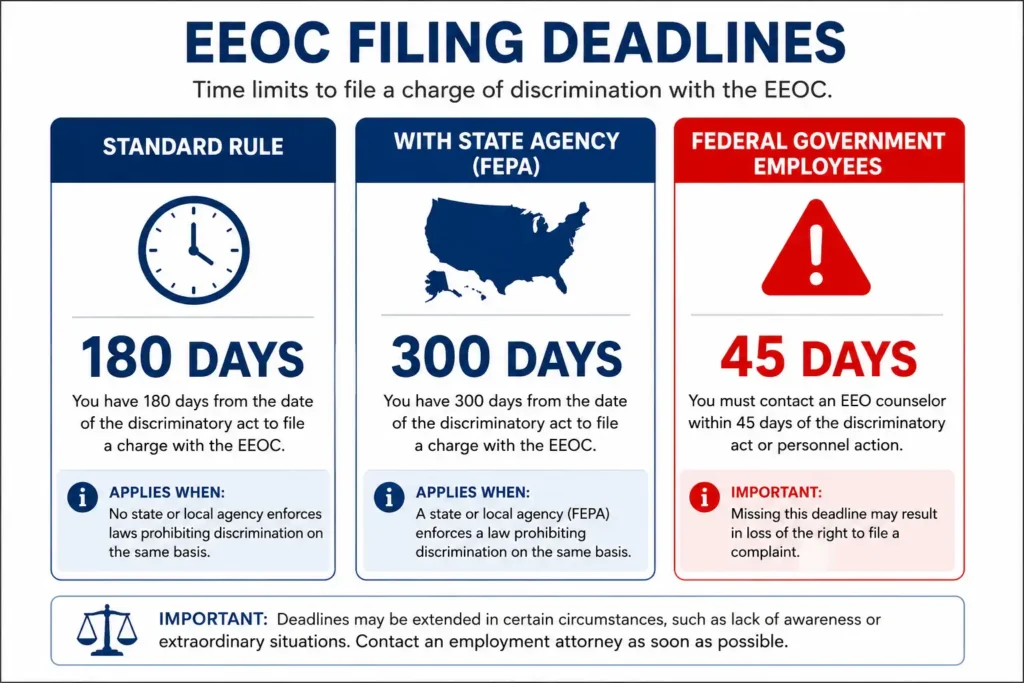
You must file your EEOC complaint within 180 days of the last discriminatory incident. This deadline is extended to 300 days if your state has a local anti-discrimination agency. For federal employees, the deadline to contact an EEO counselor is strictly 45 days.
You do not have unlimited time to seek justice. The clock starts ticking on the date of the last discriminatory act—which is often your final day of work or the day you handed in your resignation.
- The 180-Day Rule: In states without their own employment discrimination laws, you only have 180 calendar days to file a charge through the EEOC Public Portal
- The 300-Day Rule: If your state (like California or New York) has its own Fair Employment Practices Agency (FEPA), your deadline is extended to 300 days.
- The Federal Employee Trap: If you work for the U.S. government, the rules are brutal. You have exactly 45 days from the date of the incident (or your resignation) to contact your agency’s EEO Counselor. If you miss this window, your claim is dead.
Practical Case Study: Proving Constructive Discharge with Digital Evidence
In 2026, digital trails win cases. A remote worker successfully proved constructive discharge after quitting by submitting time-stamped Slack messages and Microsoft Teams logs showing her manager consistently bypassed her for projects after she reported sexual harassment.
Let’s look at how a worker successfully navigated filing after quitting in the modern remote-work era.
The Situation: “Elena” was a senior remote developer. After she reported a male director for making sexually explicit comments during a Zoom call, the retaliation began. The director didn’t fire her, but he froze her out. He locked her out of essential software repositories, stopped inviting her to client meetings, and repeatedly berated her performance in public Slack channels.
The Action: The environment became so toxic that Elena suffered severe anxiety and quit. She immediately filed an EEOC complaint for sexual harassment and retaliation, claiming constructive discharge.
The Result: The employer claimed Elena “voluntarily resigned” to pursue other opportunities. However, Elena provided the EEOC investigator with screenshots of the public Slack humiliation and access logs proving she was blocked from doing her job immediately after her initial HR complaint. The EEOC found the digital evidence overwhelming. They ruled that a reasonable person would have felt compelled to resign. The company, facing a massive federal lawsuit, settled for three years of Elena’s back pay and emotional distress damages.
Frequently Asked Questions (FAQ) About Quitting and EEOC Claims
If you have already left your job, you likely still have some tactical questions about how to handle the aftermath.
Should I tell HR in my resignation letter that I am quitting because of discrimination?
Yes. If you are quitting because of a hostile work environment, your resignation letter is your final piece of evidence. Keep it professional but factual. State clearly: “I am resigning because the ongoing racial harassment, which I reported on [Date], has not been resolved, making it impossible for me to continue working here.” This destroys the employer’s ability to claim you left for “personal reasons.”
Do I need an attorney to file an EEOC charge?
You are not legally required to have an attorney to file a charge through the EEOC portal. However, if you are claiming constructive discharge, the legal bar is incredibly high. An experienced employment lawyer knows exactly how to phrase your complaint to ensure the EEOC investigator takes it seriously. Most plaintiff attorneys work on a contingency basis, meaning they do not get paid unless you win your settlement.
What evidence should I gather if I have already quit?
Even if you no longer have access to your work computer, you can still build a case. Gather any text messages with coworkers discussing the harassment, your personal journal entries from the time, medical records showing treatment for workplace-induced stress, and copies of your performance reviews prior to the harassment starting.