If you have reached the point where you know you need professional help for a substance use disorder, you are already fighting a massive battle. You should not have to fight for your job, too. However, thousands of workers search the internet terrified, asking: can I get fired for going to rehab? The answer is not a simple yes or no—it depends entirely on when you ask for help and what substances are involved.
- You cannot be fired simply for going to rehab if you request leave under the FMLA before your employer disciplines you. However, you can be legally terminated if you are caught using drugs at work, fail a drug test, or violate company policy prior to asking for help.
This 2026 legal guide is your survival manual. We will explain how to use federal laws to force your employer to hold your job while you get clean, the dangerous “timing trap” you must avoid, and how to navigate HR confidentially so your boss never knows the details of your medical leave.
Do I have to tell my employer I am going to rehab?
No. You are not legally required to tell your boss or HR that you are going to rehab. Under the Family and Medical Leave Act (FMLA), your doctor only needs to certify that you require inpatient care or continuing treatment for a “serious health condition.”
The shame and stigma surrounding addiction keep many people sick. You might be terrified that if you ask for time off, the entire office will know you are an addict.
Federal privacy laws protect you. When you apply for a leave of absence under the Family and Medical Leave Act (FMLA), you must submit a medical certification form filled out by your healthcare provider. Your doctor does not have to write “heroin addiction” or “alcoholism” on the form. They can simply state that you are receiving intensive inpatient or outpatient medical treatment for a serious health condition and will be incapacitated for a specific number of weeks.
HR is legally prohibited from sharing your medical diagnosis with your direct manager. Your boss will only be told that you are on an “approved medical leave of absence.”

Can I be fired for going to rehab if I ask for FMLA leave?
If you qualify for FMLA, you cannot be fired for going to rehab. FMLA guarantees you up to 12 weeks of unpaid, job-protected leave for substance abuse treatment. Firing you for using this federal leave to attend a licensed rehabilitation program is illegal retaliation.
The FMLA is your absolute best legal shield. If your company has 50 or more employees within a 75-mile radius, and you have worked there for at least a year (logging 1,250 hours), you are covered.
Substance Use Disorder (SUD) is explicitly recognized as a serious health condition under the FMLA. If a licensed healthcare provider certifies that you need treatment, your employer must grant you up to 12 weeks off. They must keep your health insurance active, and they must return you to your exact job (or an equivalent one) when you get out.
However, there is one massive catch: FMLA only protects absences for treatment. It does not protect you if you miss work because you are hungover or high.
What is the “Timing Trap” and why must I race to HR?
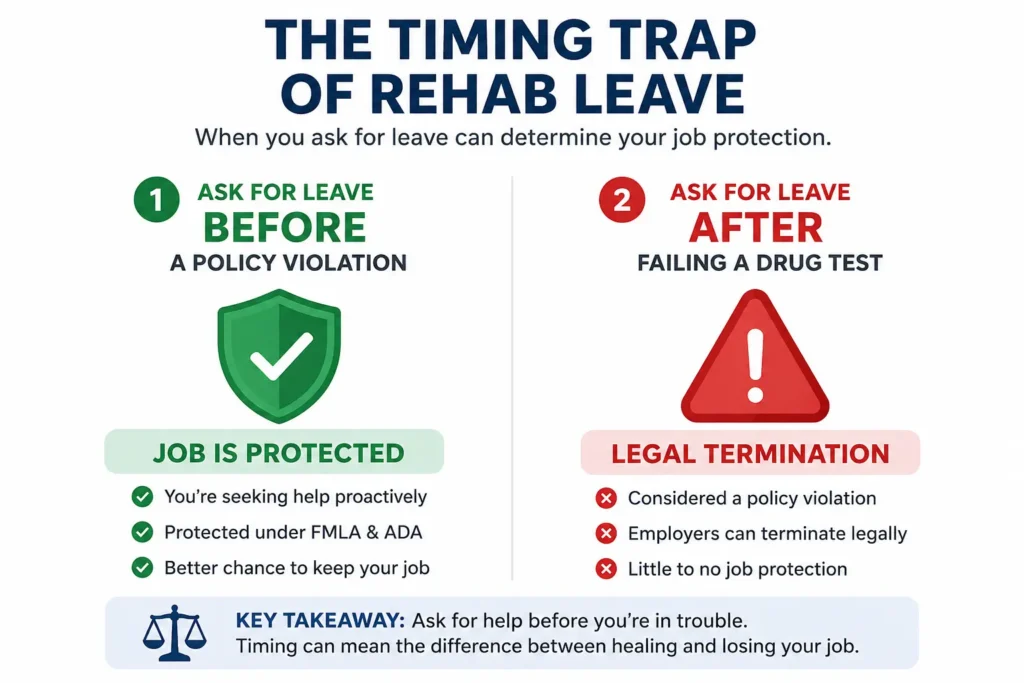
The timing trap means FMLA only protects you if you request rehab leave before your employer discovers your addiction. If you ask to go to rehab after you fail a random drug test or are caught intoxicated at work, your employer can legally fire you immediately.
This is the most critical technical detail that generic rehab blogs fail to explain. In employment law, timing is everything.
If you walk into HR on a Tuesday morning and say, “I have a substance abuse problem and I need to use FMLA to go to rehab,” your job is protected.
But if you get called into your manager’s office on a Wednesday afternoon because you smell like alcohol, or you fail a random drug test, and then you say, “Wait, don’t fire me, I need to go to rehab!”—it is too late.
The law allows employers to enforce their drug-free workplace policies. Asking for treatment does not erase a policy violation that has already occurred. You must win the race to HR. You must disclose your need for treatment before you get caught.
Alcohol vs. Illegal Drugs: How does the ADA protect me?
The Americans with Disabilities Act (ADA) treats alcohol differently than illegal drugs. Alcoholism is a protected disability even during active use, though you can still be fired for drinking at work. Conversely, any current illegal drug use immediately strips you of all ADA job protections.
If your FMLA leave runs out, or if you do not qualify for FMLA, you must rely on the Americans with Disabilities Act (ADA) to protect your job. But the ADA has very specific rules regarding substance abuse in 2026.
- Alcoholism: The ADA classifies alcoholism as a disability. Your employer cannot fire you simply because they find out you are an alcoholic. They must offer you “reasonable accommodations” to attend treatment. However, they can still hold you to the exact same performance standards as everyone else, and they can absolutely fire you if you drink on the job.
- Illegal Drugs: The ADA explicitly excludes anyone “currently engaging in the illegal use of drugs” from protection. If you are actively using cocaine, meth, or federally illegal marijuana, the ADA will not save your job. You only gain ADA protection after you have successfully entered a rehabilitation program and stopped using.
Can you get fired for failing a drug test but going to rehab?
Generally, yes. Failing a drug test violates standard workplace policies, giving employers the legal right to terminate you. However, some employers offer an Employee Assistance Program (EAP) or a Last Chance Agreement (LCA), allowing you to attend rehab instead of being fired.
If you fail a drug test, your at-will employment protections disappear. However, many modern corporations realize that firing and replacing workers is incredibly expensive. Instead of immediate termination, they may offer you a lifeline.
If you fail a test, immediately ask HR if they offer a Last Chance Agreement (LCA) or a Return to Work Agreement (RTWA).
By signing an LCA, the employer agrees to pause your termination and let you go to rehab (often unpaid). In exchange, you legally agree that your employment is on thin ice. An LCA usually dictates that upon your return, you must submit to random drug testing for a year. If you fail even one test, or relapse, you agree that you will be terminated immediately without the right to sue. It is a harsh contract, but it saves your paycheck.
Does FMLA cover outpatient rehab and telehealth in 2026?
Yes. In 2026, FMLA fully covers Intensive Outpatient Programs (IOP), Partial Hospitalization Programs (PHP), and certified telehealth rehab. You can use intermittent FMLA leave to leave work early a few days a week to attend therapy sessions without losing your job.
A massive misconception is that going to rehab means disappearing to a remote facility in the mountains for 30 days. Most workers cannot afford to do that.
The Department of Labor explicitly states that FMLA covers “continuing treatment by a health care provider.” This means you can utilize Intermittent Leave.
If your doctor prescribes an Intensive Outpatient Program (IOP) that meets three evenings a week, you can use intermittent FMLA to leave work two hours early on those specific days. Your employer cannot penalize you for these absences, nor can they hold them against you in a performance review. This allows you to keep working, keep earning a paycheck, and still get the life-saving treatment you need.
Practical Case Study: Using Intermittent FMLA for an IOP
Understanding how to apply these laws practically is vital. In a recent case, a logistics manager successfully used intermittent FMLA to attend an outpatient rehab program, protecting his job and forcing his employer to respect his medical privacy.
Let’s look at how these laws operate in a real-world corporate environment.
The Situation: “Marcus” was a logistics manager suffering from a severe opioid addiction following a surgery. He knew he needed help but could not afford to take 30 consecutive days off. His doctor recommended a certified Intensive Outpatient Program (IOP) that required him to attend therapy sessions every Monday, Wednesday, and Friday at 4:00 PM.
The Action: Marcus knew about the “timing trap.” Before his addiction affected his work performance, he went to HR. He did not say he was an addict. He simply submitted an FMLA medical certification form filled out by his doctor, stating he had a “serious health condition” requiring intermittent continuing treatment three days a week.
The Result: HR approved the intermittent FMLA leave. Marcus’s direct boss was frustrated that Marcus had to leave at 3:30 PM three days a week and tried to write Marcus up for “leaving early.” Marcus immediately reported this to HR as FMLA Interference. HR corrected the manager, voided the write-up, and Marcus successfully completed his IOP while maintaining his full salary and job security.
Frequently Asked Questions (FAQ) About Rehab and Job Security
Can my employer force me to sign a medical release form?
No. Your employer cannot force you to sign a HIPAA release form giving them unrestricted access to your medical records or rehab counselor’s notes. They are only entitled to the specific information required on the FMLA certification form or a basic “Fitness for Duty” certification when you return to work.
Do I get paid while I am in rehab?
FMLA is unpaid leave; it only protects your job title. However, you can use your accrued paid time off (PTO) or sick days while you are away. Additionally, many workers use Short-Term Disability (STD) insurance to receive a percentage of their paycheck while receiving inpatient treatment. Check your company’s benefits package immediately.
Can I be fired for going to AA or NA meetings?
If you are attending Alcoholics Anonymous (AA) or Narcotics Anonymous (NA) meetings on your own time (after work or on weekends), your employer cannot fire you for it. However, generic peer-led meetings do not usually qualify for FMLA leave during work hours unless they are officially mandated and supervised by a licensed healthcare provider as part of a formal treatment plan.
Diclaimer: The information provided on this website does not, and is not intended to, constitute legal advice. All information, content, and materials available on this site are for general informational and educational purposes only. Laws regarding employment and labor rights frequently change, and while we strive to keep our content updated, the information on this website may not constitute the most up-to-date legal or other information.
Use of, and access to, this website or any of the links or resources contained within the site do not create an attorney-client relationship between the reader, user, or browser and the website authors, contributors, or its owners. We are an independent publishing platform, not a law firm.
Readers of this website should contact a qualified employment attorney in their specific state to obtain advice with respect to any particular legal matter. No reader or user of this site should act or refrain from acting on the basis of information on this site without first seeking legal advice from counsel in the relevant jurisdiction. Only your individual attorney can provide assurances that the information contained herein – and your interpretation of it – is applicable or appropriate to your particular situation.
Know your rights.