Are you wondering, “Is pay transparency law in my state?” If you are applying for jobs in 2026, you are likely exhausted by hidden salaries. You spend hours tailoring your resume, completing multiple interview rounds, and taking assessments, only to discover the job pays far below your survival needs.
You do not have to accept this anymore. The legal landscape has shifted massively in favor of the American worker. This 2026 worker’s guide explains exactly how to leverage new state laws, weaponize remote job postings, and force employers to reveal what a job actually pays before you waste your time.
Is there a pay transparency law in my state?
As of 2026, 18 U.S. states plus Washington D.C. have enacted Pay Transparency laws. While progressive states mandate a Salary Range on every Job Advertisement, others only require disclosure Upon Request or at the time of an offer.
The 2026 state-by-state list for job postings vs. upon request disclosure
When you ask, “Is pay transparency law in my state?”, the answer depends heavily on when the employer must reveal the numbers. Do they have to post it publicly, or do you have to ask for it?
States requiring a Salary Range on the Job Advertisement:
- California
- Colorado
- Hawaii
- Illinois
- Massachusetts
- Minnesota
- New York
- Washington
- Vermont
- Virginia (Effective July 2026)
- Maine (Effective July 2026)
States requiring disclosure Upon Request or at an interview/offer:
- Connecticut
- Maryland
- Nevada
- Rhode Island
- New Jersey
New 2026 Employer Thresholds and laws in Virginia and Maine
The biggest 2026 updates expand your rights to the East Coast. Effective July 2026, both Virginia and Maine require employers to publish upfront pay ranges on all job listings.
However, you must check the Employer Threshold. Transparency laws rarely apply to micro-businesses. For example, California’s law applies to companies with 15+ employees. New York requires compliance if they have 4+ employees. Colorado applies if the employer has just 1 employee. Before demanding a pay range, check the company’s size on LinkedIn to ensure they meet your state’s legal threshold.
How does pay transparency apply to remote workers?
Yes, pay transparency applies to remote workers. Due to expanding Jurisdictional Application, if a remote job can be performed in a transparency state like New York or Washington, the employer must post the Pay Scale, regardless of where you currently live.
Using geographic scope to reveal salary ranges in non-transparency states
If you live in Texas or Florida, you might think pay transparency laws cannot help you. You are wrong. You can weaponize the Geographic Scope of remote work.
When a multi-state corporation posts a fully remote job, that job could theoretically be performed by someone sitting in California or Colorado. To comply with those state laws, the employer is legally forced to post the salary range publicly. You, the applicant in Texas, get to see the exact pay band because the law protects the job’s potential location. Use this data to negotiate aggressively.
Can my employer post an artificially wide salary range?
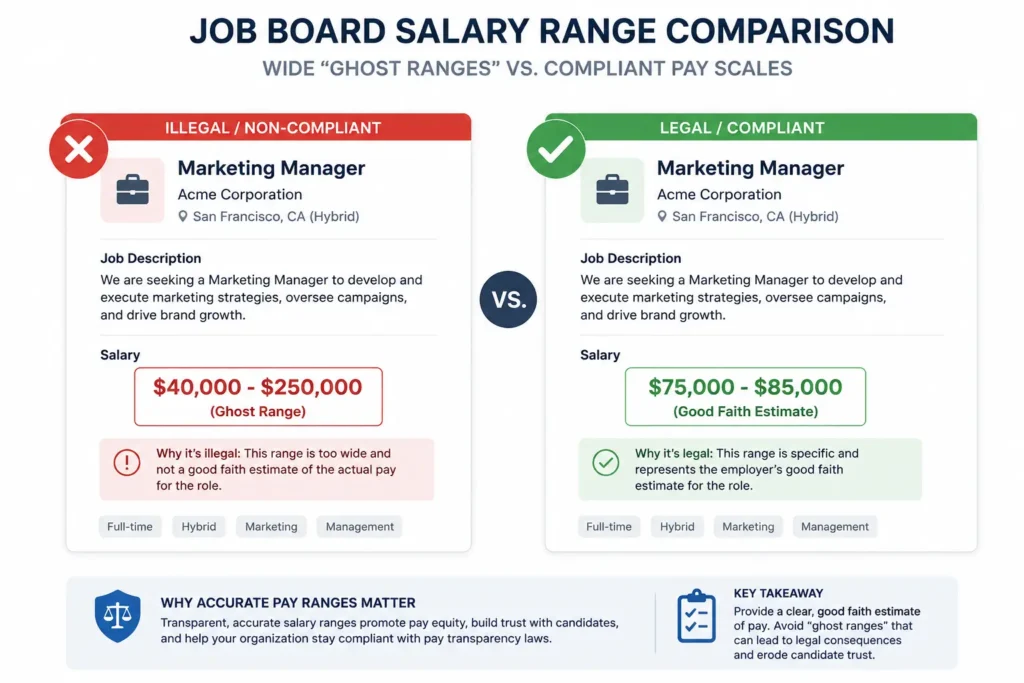
No. States are cracking down on useless “Ghost Ranges” (e.g., $50,000 to $250,000). Employers are legally required to provide a Good Faith Estimate of what they actually expect to pay the hired candidate.
How California SB 642 (2026) outlaws ghost ranges
Nothing is more insulting than seeing a job posted for “$40k – $200k depending on experience.” Lawmakers are actively closing this loophole.
The most aggressive update is California SB 642 (2026 Amendment). Effective January 1, 2026, this law redefines what a legal pay scale is. Employers must provide a true Good Faith Estimate of exactly what they expect to pay a new hire on day one. They can no longer post the absolute minimum and maximum possible earnings for the role’s entire lifespan. If you see a ridiculous ghost range in 2026, the employer is breaking the law.
Can a recruiter ask about my past pay during an interview?
In over 20 states, it is illegal for an employer to ask for your salary history. These states have enacted a strict Salary History Ban to prevent past wage suppression from dictating your future earnings.
Navigating the Salary History Ban and closing the wage gap
If an employer asks, “What did you make at your last job?”, they are likely trying to lowball you. In states with a Salary History Ban—including California, New York, Illinois, and Virginia—this question is strictly illegal.
These bans exist to achieve Pay Equity and close the systemic Wage Gap. If you are underpaid in one job, basing your next salary on that old number traps you in a cycle of poverty. If a recruiter asks this illegal question, politely reply: “I am looking for a salary that aligns with the market rate for this role. What is the approved budget for this position?”
Can my employer fire me for discussing my salary with coworkers?
Absolutely not. Regardless of state law, the federal National Labor Relations Act (NLRA) guarantees your absolute right to discuss your wages with coworkers. Punishing you for this is illegal Retaliation.
Your absolute right to protected concerted activity under the NLRB
Employers love to tell workers, “Discussing pay is against company policy.” That policy is federally illegal.
Under the National Labor Relations Act (NLRA), discussing your pay with colleagues is considered Protected Concerted Activity. The NLRB (National Labor Relations Board) strictly enforces this. Whether you live in a progressive state like New York or a conservative state like Alabama, your boss cannot fire, demote, or discipline you for asking a coworker what they make.
Practical Case Study: Using the Colorado Equal Pay for Equal Work Act to reveal a remote pay scale
Let’s look at how a worker can weaponize these laws in the real world of 2026.
Maria lives in Georgia, a state with no pay transparency laws. She found a fully remote Senior Designer role at a Chicago-based tech company. The job posting had no salary range listed.
Maria knew about the Colorado Equal Pay for Equal Work Act. She emailed the recruiter and said, “Since this is a remote role that could be performed by a Colorado resident, could you please provide the salary range as required by Colorado state law?”
The recruiter, realizing they were out of compliance, immediately provided the range ($95,000 – $115,000). Because Maria forced them to reveal their hand, she confidently negotiated a $110,000 offer. If she hadn’t known her rights, she would have asked for her previous salary of $85,000.
Frequently Asked Questions (FAQ) About Wage Transparency
What happens if an employer doesn’t post a salary range?
If an employer violates the law by hiding the pay scale, they face massive financial penalties. In California, fines range from $100 to $10,000 per violation. If you see a non-compliant job posting, you can report it, and the state will aggressively fine the company.
How do I report a violation to the State Department of Labor (DOL)?
You do not need a lawyer to report an employer. You can file a free, anonymous complaint directly with your State Department of Labor (DOL) or your state’s Labor Commissioner. Simply visit your state’s DOL website, locate the “Wage and Hour” division, and submit a digital complaint form with a link to the illegal job posting.
Does the federal Equal Pay Act of 1963 (EPA) mandate pay transparency?
No. This is a common legal misconception. The federal Equal Pay Act of 1963 (EPA) strictly prohibits paying men and women differently for substantially similar work. However, it does not require employers to post salary ranges upfront. This is exactly why state-level pay transparency laws are your most powerful weapon in 2026.
Disclaimer: The information provided on this website does not, and is not intended to, constitute legal advice. All information, content, and materials available on this site are for general informational and educational purposes only. Laws regarding employment and labor rights frequently change, and while we strive to keep our content updated, the information on this website may not constitute the most up-to-date legal or other information.
Use of, and access to, this website or any of the links or resources contained within the site do not create an attorney-client relationship between the reader, user, or browser and the website authors, contributors, or its owners. We are an independent publishing platform, not a law firm.
Readers of this website should contact a qualified employment attorney in their specific state to obtain advice with respect to any particular legal matter. No reader or user of this site should act or refrain from acting on the basis of information on this site without first seeking legal advice from counsel in the relevant jurisdiction. Only your individual attorney can provide assurances that the information contained herein – and your interpretation of it – is applicable or appropriate to your particular situation.
Know your rights.
References & Official Legal Resources
For more detailed information regarding your state’s pay transparency statutes, salary history bans, and federal labor rights, please consult the official U.S. government resources below:
-
National Labor Relations Board (NLRB) – Wage Discussion Rights:
Learn about your federal right to discuss pay with coworkers under Protected Concerted Activity rules. -
California Department of Industrial Relations (DIR):
Review state requirements for job posting salary ranges and SB 642 updates on the California Equal Pay Act FAQ. -
Colorado Department of Labor and Employment (CDLE):
Access official guidelines on job posting transparency under the Colorado Equal Pay for Equal Work Act. -
New York State Department of Labor (NYSDOL):
Understand employer disclosure requirements for remote and in-state job opportunities via the NY State Pay Transparency Portal. -
U.S. Department of Labor (DOL) – Women’s Bureau:
Explore data and statutory progress on equal pay and transparency across all U.S. jurisdictions at the DOL Equal Pay Rights page.