
Yes — employers can fire you for calling in sick too many times, BUT only if your absences are not legally protected. Federal laws like the Family and Medical Leave Act (FMLA) and the Americans with Disabilities Act (ADA) shield millions of workers from termination for illness-related absences. Many states add even stronger protections through mandatory paid sick leave laws. Before you assume you have no case, read this.
Key Takeaways
- At-will employment lets most employers fire you for excessive absences — but major exceptions exist.
- FMLA-protected leave cannot legally be counted against you in any attendance system.
- ADA disabilities may require your employer to give you extra unpaid leave instead of firing you.
- State paid sick leave laws (California, New York, Colorado, and 15+ others) make it illegal to discipline you for using accrued sick time.
- No-fault attendance point systems are not immune to the law — assigning points for protected leave is wrongful termination.
Introduction
If you’re reading this at midnight, shaking because your boss just threatened to fire you for missing too many days, take a breath. You’re not alone — and the law may be solidly on your side.
Under the Family and Medical Leave Act (FMLA), the Americans with Disabilities Act (ADA), and dozens of state sick leave statutes, firing a worker for illness-related absences can be a serious federal violation. But whether you’re protected depends on the specific facts of your situation, and the details matter enormously.
This guide breaks down every layer of the law in plain English. By the time you finish reading, you’ll know exactly where you stand, what your employer can and cannot do, and what steps to take right now to protect your job — or your right to compensation if it’s already gone.
Can My Employer Fire Me for Excessive Absenteeism If I Am an At-Will Employee?
Yes — in 49 U.S. states, the At-Will Employment Doctrine gives your employer broad power to fire you for excessive absenteeism, including calling in sick too many times, without needing a specific reason. Only Montana requires “good cause” for termination after a probationary period.
Here’s what at-will employment actually means in practice: your employer does not have to prove you did anything wrong. They do not have to give you a warning. They can simply decide you’ve missed too much work and let you go.
But — and this is critical — at-will employment has hard legal limits.
The law carves out protected categories that override your employer’s otherwise broad firing power. Those exceptions are where most workers find relief:
- Federal statutes (FMLA, ADA) that cover qualifying conditions
- State sick leave laws in 17+ states that prohibit retaliation for using accrued time
- Employment contracts or union agreements (CBAs) that require “just cause” for termination
- Anti-retaliation provisions when you’ve exercised a legal right (like filing a workers’ comp claim)
If your absence falls into any of these categories, firing you is not a “business decision” — it’s potentially an illegal act.
Does a Medical Certification or Doctor’s Note Legally Prevent Me from Being Fired?
No. A doctor’s note alone does not legally protect you from termination in an at-will state. This is the most dangerous myth in employment law, and believing it has cost workers thousands of dollars in lost claims.
A note from your physician proves you were sick — it does not, by itself, trigger any legal protection. What triggers protection is whether the underlying illness qualifies under a specific law.
Here’s the real-world breakdown:
| Document | What It Proves | Does It Protect Your Job? |
|---|---|---|
| Doctor’s note / medical certificate | You were ill | No — not by itself |
| FMLA medical certification (DOL Form WH-380) | Your illness is a “serious health condition” under federal law | Yes — if you meet FMLA eligibility |
| ADA medical documentation | Your condition is a disability requiring accommodation | Yes — triggers the interactive process |
| State sick leave documentation | You used accrued state-protected sick time | Yes — in states with mandatory leave laws |
The bottom line: get the right paperwork, not just any paperwork. If your condition might qualify for FMLA or ADA protection, ask your HR department for the official federal forms immediately. Do not assume your employer will do this for you — they often won’t.
How Do No-Fault Attendance Policies and Point Systems Violate the Law?
This is where millions of retail, warehouse, and healthcare workers get blindsided every year.
Many large employers — Amazon, Walmart, Target, major hospital systems — use a no-fault attendance policy, also called a “point system.” The concept sounds neutral: every absence gets a point, and enough points trigger progressive discipline up to termination. The word “no-fault” suggests the reason doesn’t matter.
But here’s the trap: it absolutely does matter under federal law.
If you call in sick on a day when your absence is legally protected — say, an FMLA-qualifying flare-up of your Crohn’s disease — and your employer assigns you an attendance point for that day, they have just committed a federal violation.
Under 29 CFR § 825.220(c), the FMLA regulations explicitly prohibit employers from counting FMLA leave as an absence in any no-fault attendance system. The DOL has made this clear in multiple opinion letters.
What this means for you:
- If you have an FMLA-qualifying condition, every point ever assigned to a protected absence may be legally invalid.
- If you were fired after accumulating those illegal points, your termination may be wrongful — even if your employer genuinely believed their policy was fair.
- Your employer’s own attendance records become evidence against them.
Can I Use Intermittent FMLA to Protect My Job If I Have a Chronic Illness?
Yes — and this is the most powerful and underused protection available to workers with unpredictable health conditions.
Most people think FMLA means taking six weeks off for surgery. In reality, the Family and Medical Leave Act allows something called Intermittent FMLA, which lets you take leave in small, sporadic blocks — even a single day or a few hours at a time — when your condition flares up.
To qualify for FMLA (any type), you must meet ALL of these:
- Your employer has 50+ employees within 75 miles of your worksite
- You have worked for the employer for at least 12 months
- You have logged at least 1,250 hours in the past 12 months
- Your condition qualifies as a “serious health condition” (inpatient care or continuing treatment by a healthcare provider)
Common conditions that frequently qualify: asthma, Crohn’s disease, migraines, diabetes, lupus, severe anxiety/depression, PTSD, and more.

How to File a Complaint with the U.S. Department of Labor (DOL) If Your FMLA Rights Are Violated
If your employer denies a valid FMLA request, retaliates against you for taking FMLA leave, or assigns attendance points to FMLA-protected days, here is exactly what to do:
- Document everything immediately. Write down dates, names, what was said, and save any emails or texts related to your leave request or discipline.
- Request your employer’s written FMLA denial. Ask HR for the specific reason your leave was denied — their response (or refusal) is evidence.
- Gather medical records confirming your condition and its ongoing treatment.
- Calculate your timeline. FMLA complaints must be filed within 2 years of the violation (3 years if willful).
- File a complaint with the DOL Wage and Hour Division. You can file a complaint online at dol.gov or call 1-866-4-US-WAGE. There is no fee. You do not need an attorney.
- Request a copy of your personnel file from HR. You have a right to this in most states, and it may contain the exact points record you need.
Filing a DOL complaint is completely free and creates an official federal record of your claim.
What If My Sickness Qualifies as a Disability Under the ADA?
If your frequent illness is caused by an underlying condition that substantially limits a major life activity — walking, breathing, working, sleeping — you may have ADA protection on top of, or instead of, FMLA coverage.
Under the Americans with Disabilities Act, enforced by the Equal Employment Opportunity Commission (EEOC), your employer must engage in an “interactive process” with you before making any termination decision based on attendance related to a disability.
That interactive process is a required, good-faith conversation about whether a reasonable accommodation exists that would allow you to do your job without the absences triggering discipline. Additional unpaid leave — beyond FMLA — is frequently granted as a reasonable accommodation.
What this means in practice: Your employer cannot simply hand you a termination letter the day you exhaust FMLA leave if your condition also qualifies as a disability. They must first explore whether more time off, a modified schedule, or remote work would solve the problem. Skipping that step is an ADA violation.
The EEOC’s charge process:
- File a charge at eeoc.gov or call 1-800-669-4000
- You generally have 180 days (or 300 days in states with their own fair employment agencies) from the discriminatory act
- Filing is free; you do not need an attorney to start
Can I Get Fired for Calling in Sick During My Probationary Period or First 90 Days?
Yes — and you are at your most vulnerable during this window. This is the harsh reality many new hires don’t know until it’s too late.
During a probationary period or your first 90 days, you almost certainly have not yet met the 12-month service requirement for FMLA. That eliminates your most powerful federal shield. You also likely haven’t accumulated enough service for ADA reasonable accommodation leave to be considered practical by a court.
What can protect you during probation:
| Protection | Available During First 90 Days? |
|---|---|
| FMLA | ❌ No — requires 12 months of service |
| ADA reasonable accommodation | ⚠️ Possibly — depends on the disability and employer size |
| State paid sick leave accrual | ✅ Yes — in most states, accrual starts day one |
| Workers’ compensation (work-related injury) | ✅ Yes — available from day one |
| Anti-retaliation (for reporting safety violations, etc.) | ✅ Yes — no tenure requirement |
If you are sick during probation: Use any accrued sick time your state law provides. Do not simply call out without invoking your state sick leave rights by name if your state has a paid sick leave law. Put your request in writing (even a text or email) so there’s a record.
Do State-Mandated Sick Leave Laws Override Company Attendance Policies?
Yes — state law always wins over a private company policy. A corporate HR manual is not a law. A state statute is.
As of 2026, at least 17 states plus Washington D.C. have mandatory paid sick leave laws, including California, New York, Illinois, Colorado, Washington, Massachusetts, New Jersey, Connecticut, and Oregon.
In these states, if you use legally accrued paid sick time, your employer cannot:
- Issue attendance points for that absence
- Issue a written warning
- Count it toward any progressive discipline threshold
- Fire you for it
The protections vary by state. Here’s a snapshot of key differences:
| State | Paid Sick Leave Accrual | Employer Size Minimum | Retaliation Prohibited? |
|---|---|---|---|
| California | 1 hr per 30 hrs worked | All employers | ✅ Yes |
| New York | 1 hr per 30 hrs worked | 5+ employees for paid | ✅ Yes |
| Colorado | 1 hr per 30 hrs worked | All employers | ✅ Yes |
| Illinois | 1 hr per 40 hrs worked (2024 expansion) | All employers | ✅ Yes |
| Texas | No statewide law | N/A | ❌ Limited |
| Florida | No statewide law | N/A | ❌ Limited |
If your state has a sick leave law and your employer disciplined you for using that time, you may have a retaliation claim against them right now — without any FMLA or ADA component needed.
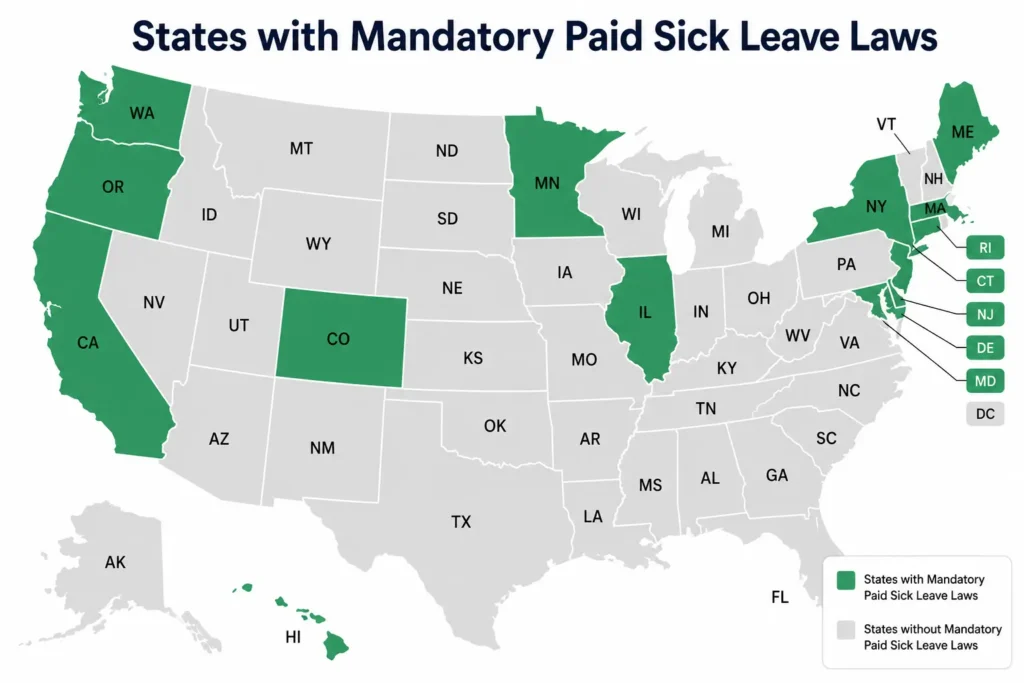
Practical Case Study: Fighting Retaliation Over an Intermittent FMLA Request
Here’s how this plays out in the real world — based on a composite of cases handled through the DOL complaint process.
The situation: Marcus worked as a warehouse associate at a national logistics company for three years. He had severe asthma that caused unpredictable flare-ups, especially in winter. In January 2025, his pulmonologist certified him for Intermittent FMLA, and Marcus submitted the paperwork to HR.
The problem: His direct supervisor was never properly notified by HR. Over the next four months, Marcus’s absences during asthma attacks were entered into the company’s automated attendance system as unexcused. He accumulated 7 points. The company’s policy called for termination at 9.
The violation: Marcus requested a printout of his attendance record and cross-referenced every point with his FMLA-certified dates. Six of the seven points were assigned to days when he had invoked his FMLA leave verbally and had medical documentation.
The outcome: Marcus filed a DOL Wage and Hour Division complaint. The investigator subpoenaed the company’s attendance system records — the same records that showed the illegal points. The case settled before going to formal proceedings. Marcus received back pay for the period of wrongful discipline, reinstatement of his clean attendance record, and a confidential monetary settlement.
The lesson: Your employer’s own data is often the most powerful evidence of their violation.
What made Marcus’s case winnable:
- He submitted FMLA paperwork in writing (not just verbally)
- He kept personal copies of all medical certifications
- He requested his attendance record before being fired
- He filed within the 2-year statute of limitations
- He did not quit — he waited for formal action
Frequently Asked Questions About Calling in Sick
Can my boss force me to find coverage when I’m sick?
No federal law requires employees to find their own replacement when calling in sick. Some employers include coverage requirements in their policies, but if enforcing that policy causes you to lose legally protected leave, the policy itself may be unenforceable.
Can I be fired via text message for calling in sick?
Yes — the method of communication does not determine the legality of a termination. Being fired by text is legal in at-will states. What matters is why you were fired. If the termination was triggered by legally protected absences, the delivery method is irrelevant to your legal claim.
Does my employer have to pay out my unused sick time if they fire me?
It depends entirely on your state. California, for example, treats accrued sick leave and vacation as earned wages — your employer must pay them out at termination. Most other states do not require sick leave payout unless your employer’s own written policy promises it. Check your state’s labor board website for the specific rule.
How many sick days can I take before getting fired?
There is no universal federal number. An employer can legally terminate for even one absence if it’s not protected — or cannot fire you for 50 absences if every one is FMLA-certified. The number is irrelevant; the legal status of each absence is what controls.
Can I be fired for calling in sick while on FMLA?
Not legally, as long as you are using FMLA leave properly. If you are fired during a properly requested FMLA leave period, that is textbook FMLA interference and/or retaliation — two separate federal causes of action. Document everything and file a DOL complaint immediately.
What counts as a “serious health condition” under the FMLA?
The FMLA defines a serious health condition as an illness, injury, or physical or mental condition that involves inpatient care OR continuing treatment by a health care provider. Continuing treatment generally means being incapacitated for more than three consecutive days AND receiving ongoing treatment, or a chronic condition (like asthma or diabetes) requiring periodic treatment.
Can my employer contact my doctor directly about my illness?
No. Under HIPAA (Health Insurance Portability and Accountability Act), your medical records are private. Your employer can request a medical certification form that your doctor fills out — but they cannot call your doctor directly or demand access to your medical records. A properly completed FMLA certification form does not reveal your diagnosis, only whether the condition qualifies.
Is there a difference between calling in sick and taking FMLA leave?
Yes — and the difference is legally significant. “Calling in sick” is an informal notice that triggers no legal protection by itself. FMLA leave requires formal eligibility, a medical certification, and proper employer notification. You can and should invoke FMLA at the time you call in sick — you don’t need to know the exact legal language, just communicate that the absence is for a serious health condition so your employer is on notice.
Conclusion
The short answer to “can I be fired for calling in sick too many times” is yes — but only if your absences fall outside the law’s protective reach. And that’s a big if.
Federal law (FMLA, ADA) and 17+ state sick leave statutes together cover an enormous range of workers and health conditions. Millions of Americans are fired every year for absences that were actually legally protected — often because they didn’t know their rights, didn’t file the right paperwork, or waited too long to act.
Here’s your action plan right now:
- Identify whether your condition might qualify for FMLA (12+ months employed, 50+ employee company, serious health condition) or ADA coverage.
- Request FMLA paperwork from HR in writing today — even a text or email creates a timestamp.
- Pull your attendance record and cross-reference every absence with a protected date.
- Check your state’s sick leave law — you may already have a retaliation claim.
- File a DOL or EEOC complaint if you’ve been terminated — it’s free, it creates a federal record, and it starts the clock on your employer’s obligations.
You have rights. The law put them there for situations exactly like yours.
Diclaimer: The information provided on this website does not, and is not intended to, constitute legal advice. All information, content, and materials available on this site are for general informational and educational purposes only. Laws regarding employment and labor rights frequently change, and while we strive to keep our content updated, the information on this website may not constitute the most up-to-date legal or other information.
Use of, and access to, this website or any of the links or resources contained within the site do not create an attorney-client relationship between the reader, user, or browser and the website authors, contributors, or its owners. We are an independent publishing platform, not a law firm.
Readers of this website should contact a qualified employment attorney in their specific state to obtain advice with respect to any particular legal matter. No reader or user of this site should act or refrain from acting on the basis of information on this site without first seeking legal advice from counsel in the relevant jurisdiction. Only your individual attorney can provide assurances that the information contained herein – and your interpretation of it – is applicable or appropriate to your particular situation.
Know your rights.
get fired, get fired for being sick, knowing your rights, protection legal protections, wrongful termination, paid sick, paid sick leave, at-will employment , reasonable accommodations, paid sick leave laws , use paid sick leave , sick leave policy , due to illness , taking sick leave , employers must provide , must provide , fire you for taking , lawyer can help , protections for sick employees , legal protections for employees, Can my boss fire me if I’m sick?, How many sick days can get you fired?, Can I be fired for being sick with a doctor’s note?, Can I get fired for calling out sick too much?, Can I Get Fired for Calling in Sick?, Can You Be Fired for Calling in Sick One Day?, Can You Get Fired for Being Sick?, Can You Be Fired for Being Sick?
job security, provide paid sick leave , eligible , employer may , 12 weeks , fmla and ada , eligible employees , job , duties , understand your rights , protect your rights , protect employees , take up to 12 weeks , employment lawyer, 12 weeks of unpaid leave , paid leave , must provide reasonable accommodations , employers are required , employment law attorneys , missing work , job-protected leave , work due , lost wages , employers must provide reasonable accommodations , fire an employee , employee for being sick , employers to provide paid sick , protect employees from being fired , use of paid sick leave , work due to illness , job protection , requires employers to provide , federal or state law , fire you for missing work , help employees perform their job , employees perform their job duties , employer for wrongful termination , illegal to fire , ensure that employees can take ,job performance , employer fires an employee , understand their rights , state and federal laws , even no reason , eligible employees , are entitled , employment lawyer can help , job position , could strengthen your case , cannot be fired , you’re fired for being sick , you’re fired , you’ve been fired, you’re sick , employer cannot fire