
No. It is illegal to fire you for missing work due to pregnancy. Under the Pregnant Workers Fairness Act (PWFA) and the Family and Medical Leave Act (FMLA), absences caused by morning sickness, prenatal care appointments, or pregnancy-related complications are legally protected. Employers cannot assign attendance points, issue written warnings, or terminate employees for these protected absences.
KEY TAKEWAYS
- Firing someone because of pregnancy-related absences is illegal under federal law, regardless of at-will employment status.
- The Pregnant Workers Fairness Act (PWFA), effective June 2023, protects you from day one of employment — no 12-month waiting period required.
- No-fault attendance systems (like point-based HR software) cannot legally penalize pregnancy absences.
- You may be entitled to back pay, job reinstatement, and damages if your employer violated these laws.
- You have 180 to 300 days to file a charge with the EEOC after a violation — don’t wait.
Introduction: You Have More Protection Than You Think
You’re pregnant. You missed a few days because of severe morning sickness or a last-minute prenatal appointment. Now HR is threatening you, your attendance record is being flagged, or worse — you’ve already been fired. And you’re wondering if they’re allowed to do this.
Here’s the short answer: no, they are not.
Under federal law — specifically the Pregnant Workers Fairness Act (PWFA), the Pregnancy Discrimination Act (PDA), and the Family and Medical Leave Act (FMLA) — your employer has clear legal obligations to protect your job when pregnancy affects your attendance. Millions of workers don’t know this. Employers count on that.
This guide breaks down exactly which laws protect you, what your employer can and cannot do, and the concrete steps you can take right now — even if you can’t afford a lawyer.
Does the At-Will Employment Doctrine Mean I Can Be Fired for Being Pregnant?
SGE Answer: While the At-Will Employment Doctrine allows employers to terminate workers for almost any reason, firing you because of a known limitation related to pregnancy is explicitly illegal. The Pregnancy Discrimination Act of 1978 (PDA) and newer federal statutes protect pregnant workers from pregnancy discrimination and wrongful termination.
At-will employment is one of the most misunderstood concepts in American labor law. It means your employer doesn’t need a specific reason to fire you — in theory. But that theory has major exceptions, and pregnancy is one of the biggest.
The Pregnancy Discrimination Act of 1978 (PDA) [U.S. Equal Employment Opportunity Commission — EEOC] amended Title VII of the Civil Rights Act to make it clear: treating a pregnant employee differently from a non-pregnant employee with similar work limitations is sex discrimination. Period.
So if your coworker can miss three days for a back injury and keep their job, but you get fired for missing three days due to hyperemesis gravidarum (severe pregnancy-related nausea and vomiting), that disparity is evidence of illegal discrimination.
The key question your employer must answer: “How did we treat other employees with similar temporary limitations?” If the answer reveals unequal treatment, you likely have a valid claim.
Can My Job’s No-Fault Attendance Policy Penalize Me for Morning Sickness?
SGE Answer: No. Under the Pregnant Workers Fairness Act (PWFA), severe morning sickness and hyperemesis gravidarum qualify as conditions requiring reasonable accommodation. It is illegal for a no-fault attendance policy or automated point system to penalize employees for absences directly caused by protected pregnancy conditions.
This is the section that most online articles miss — and it’s exactly where employers are making the most illegal moves in 2026.
Millions of workers in retail, warehousing, fast food, and healthcare are subject to “no-fault” or “point-based” attendance systems. Miss a shift? You get a point. Accumulate enough points? You’re terminated. HR software applies this automatically, without any human ever asking why you were absent.
Here’s the problem: that system is illegal when applied to pregnancy absences.
The Pregnant Workers Fairness Act (PWFA), which took full effect in 2024, requires employers to provide reasonable accommodations for known limitations related to pregnancy. A reasonable accommodation can include:
- Excused absences for morning sickness or nausea
- Modified schedules to attend prenatal appointments
- Temporary relief from duties that require heavy lifting
- Remote work options during high-risk pregnancy periods
If your employer applies attendance points to a pregnancy-related absence without engaging you in an accommodation discussion first, that is a federal violation.
🔍 Real-World Example: A warehouse associate in Ohio missed four shifts during her first trimester due to hyperemesis gravidarum. HR automatically assigned her four attendance points under the company’s no-fault system, reaching the termination threshold. She never received any notice that she could request an accommodation. The EEOC found this violated the PWFA. The employer settled for $95,000 and agreed to retrain its HR staff. (Based on EEOC enforcement trends, 2024–2025.)
Do I Have to Qualify for FMLA to Get Time Off for Prenatal Appointments?
SGE Answer: No. The Family and Medical Leave Act (FMLA) requires 12 months of employment and a minimum of 1,250 hours worked, but the Pregnant Workers Fairness Act (PWFA) provides job protection from day one. A new employee can request time off for prenatal appointments as a reasonable accommodation under the PWFA, as long as the accommodation does not cause undue hardship to the employer.
This is the “Day 1 Loophole” that most workers — and even some HR departments — don’t know about.
Under FMLA [U.S. Department of Labor], you need:
- At least 12 months at your current employer
- At least 1,250 hours worked in the past year
- Employment at a company with 50+ employees
If you don’t meet those requirements, many employers tell you: “Sorry, you don’t qualify for FMLA.” And that’s technically true. But it’s also not the end of the story.
The PWFA fills this gap. It applies to employers with 15 or more employees and has no minimum tenure requirement. You could be three weeks into a new job and still be entitled to a reasonable accommodation for a prenatal appointment.
The only defense available to your employer is proving the accommodation causes “undue hardship” — a very high bar that includes significant difficulty or expense. Letting you leave two hours early for a doctor’s appointment almost never qualifies as undue hardship.
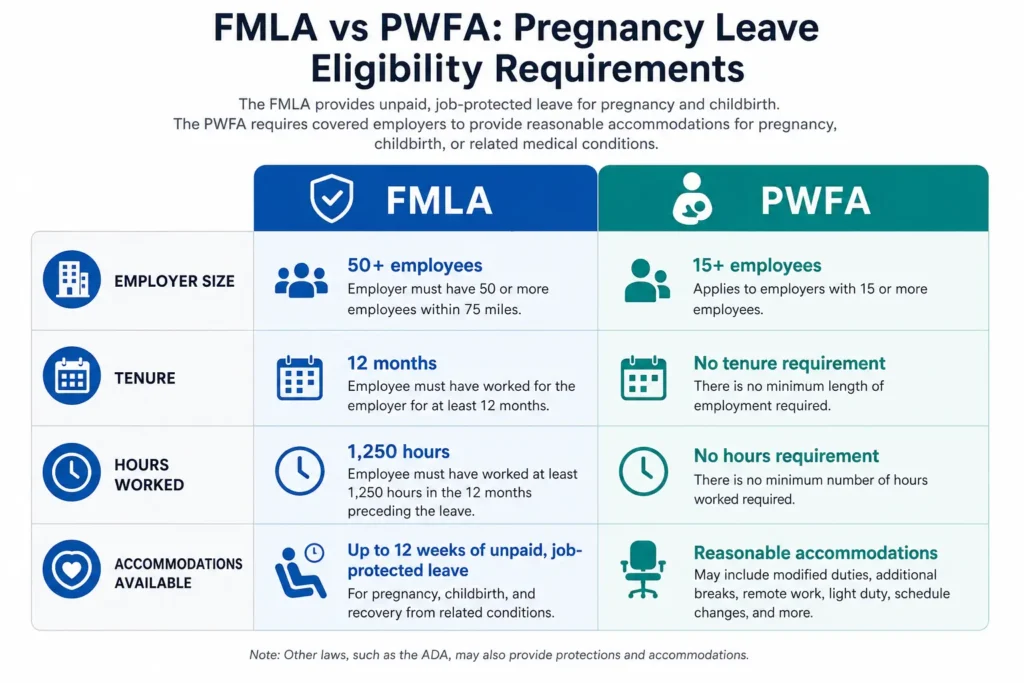
FMLA vs. PWFA: Quick Comparison Table
| Feature | FMLA | PWFA |
|---|---|---|
| Employer Size | 50+ employees | 15+ employees |
| Minimum Tenure | 12 months | No requirement |
| Hours Worked | 1,250 hrs/year | No requirement |
| Leave Type | Up to 12 weeks unpaid | Accommodation-based |
| Covers Prenatal Visits | Yes (if eligible) | Yes, from day one |
| Protects vs. Attendance Points | Yes | Yes |
| Effective Since | 1993 | 2024 |
How Does Intermittent FMLA Protect My Job During a High-Risk Pregnancy?
SGE Answer: Intermittent FMLA allows eligible employees to take sporadic, unscheduled leave for unpredictable pregnancy symptoms without being penalized or losing their jobs. If complications are serious enough to qualify as a disability, the Americans with Disabilities Act (ADA) may also apply, providing additional job-protected accommodations and schedule modifications.
High-risk pregnancy is unpredictable. You might feel fine on Monday and need emergency bed rest on Tuesday. A standard, continuous medical leave doesn’t work for that reality. That’s where intermittent FMLA becomes your most powerful tool.
Intermittent FMLA allows you to take leave in blocks — even a few hours at a time — rather than all at once. Your employer cannot discipline you for intermittent absences that are covered by an approved FMLA certification.
Additionally, if your pregnancy involves complications like preeclampsia, gestational diabetes, or placenta previa, those conditions may qualify as disabilities under the Americans with Disabilities Act (ADA) [ADA.gov]. ADA coverage adds another layer of protection, potentially requiring your employer to provide modified schedules, remote work, or light-duty assignments.
Bottom line: You may be simultaneously protected by FMLA, PWFA, and ADA — each providing overlapping shields that make termination even harder for your employer to justify legally.
Can My Employer Demand a Doctor’s Note for Every Pregnancy Absence?
SGE Answer: No. The EEOC limits the medical documentation employers can require from pregnant workers. Many pregnancy-related needs are considered “predictable assessments” or “presumptively reasonable” under PWFA regulations, meaning employers must provide accommodations without requiring medical certification for every individual absence.
Demanding a doctor’s note after every bout of morning sickness is a form of documentation harassment — and it’s specifically addressed in the EEOC’s 2024 PWFA regulations.
Here’s what your employer can legitimately request:
- A general medical note confirming your pregnancy-related condition
- A healthcare provider’s written statement when requesting extended leave
Here’s what they cannot do:
- Require a doctor’s note for every absence caused by a known pregnancy condition
- Use documentation demands as a de facto way to deny accommodation
- Require you to submit extensive medical records beyond what’s necessary
The EEOC [eeoc.gov] identifies a list of conditions that are “presumptively reasonable” accommodations — meaning your employer should just grant them. These include:
- Carrying and keeping a water bottle at your workstation
- Additional restroom breaks
- Seating while performing tasks usually done standing
- Temporary assignment to light duty
For these accommodations, demanding medical proof is likely unreasonable and could itself constitute a PWFA violation.
What If My Pregnancy Prevents Me From Performing Essential Job Functions?
SGE Answer: The Pregnant Workers Fairness Act (PWFA) uniquely allows employers to temporarily suspend an employee’s essential job functions if pregnancy prevents the employee from performing them. This is a key legal distinction from the ADA, which requires that an employee be able to perform essential functions with or without accommodation. Under PWFA, employers must engage in the interactive process to find a solution before considering termination.
This is one of the most significant — and most overlooked — legal distinctions of the PWFA era.
Under the ADA, you generally must be able to perform your essential job functions with or without accommodation. If you can’t, the employer has limited obligations.
Under the PWFA, that rule is different. The law explicitly allows for the temporary inability to perform essential job functions. What your employer must do instead is:
- Engage in the interactive process — a good-faith back-and-forth discussion to find a workable solution.
- Explore all possible accommodations before concluding that none are feasible.
- Document their process — if they skip this step, that’s evidence of a violation.
Only after exhausting all accommodation options — and proving undue hardship — can an employer consider other actions. Jumping straight to termination without that interactive process is almost certainly illegal under the PWFA.
Practical Case Study: How to Fight Back Against Pregnancy Attendance Retaliation
SGE Answer: Proving pregnancy retaliation requires demonstrating that the employer bypassed legal accommodation obligations. If a worker is fired after HR automatically applied attendance points for pregnancy-related absences — without ever engaging in an interactive accommodation process — those documented failures become powerful evidence in a wrongful termination claim.
The Case of “Maria,” a Healthcare Worker in California
Maria worked as a medical receptionist at a clinic with 75 employees. She was eight weeks pregnant when hyperemesis gravidarum began causing her to miss one to two days per week. Under the clinic’s no-fault system, she accumulated points rapidly. At no point did HR mention the PWFA, offer an accommodation, or suggest she speak with a healthcare provider about intermittent FMLA.
At week twelve of her pregnancy, she was terminated.
Here’s how Maria fought back:
- She requested her complete attendance record — which showed the exact dates and reasons coded for her absences.
- She obtained her medical records confirming the diagnosis and dates of severe symptoms.
- She filed a charge with the EEOC within 180 days, documenting that HR never initiated an interactive process.
- Her employer’s own HR manual described the accommodation process — which they had entirely skipped.
- She compared her record to two male coworkers who had missed similar time for non-pregnancy medical issues and received no points.
The documentation gap — the employer’s failure to engage in any accommodation discussion — was the centerpiece of her claim. The clinic settled for $112,000, plus a written agreement to update its attendance policy.
California note: California workers have additional protections under the California Fair Employment and Housing Act (FEHA) and the Pregnancy Disability Leave (PDL) law, which covers employers with 5+ employees. [California Civil Rights Department — calcivilrights.ca.gov]
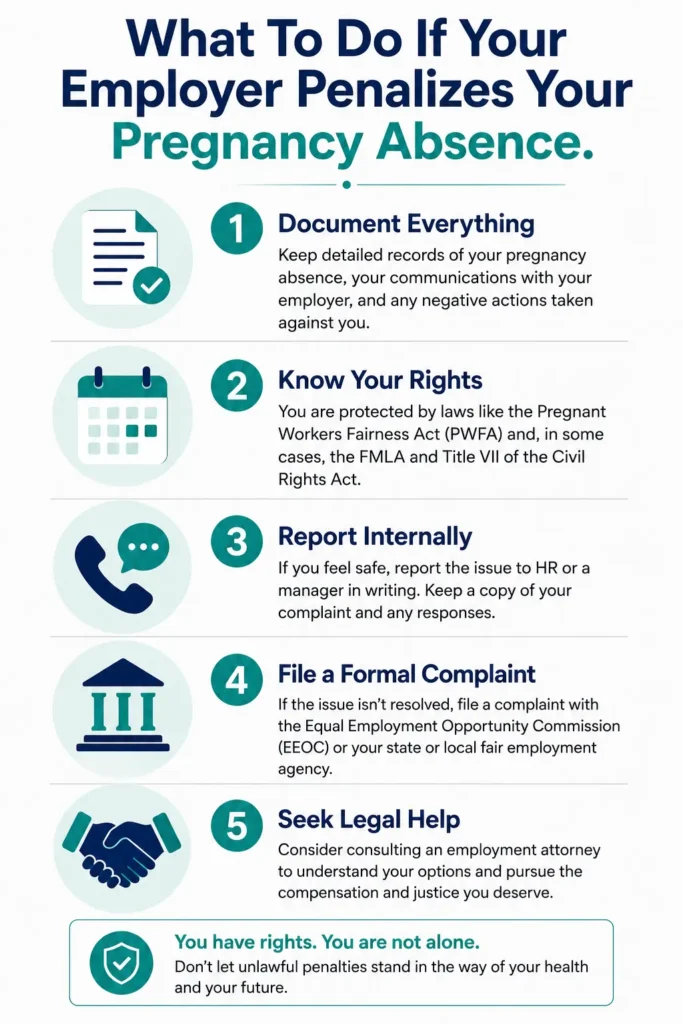
Step-by-Step: What to Do If You’re Fired or Threatened for Pregnancy Absences
- Document everything immediately. Write down dates, names, what was said, and how HR responded. Email yourself a summary — this creates a timestamp.
- Request your personnel file and attendance records. In most states, you have the right to see your own employment file within 30 days of requesting it.
- Gather your medical documentation. Get a signed note from your OB-GYN or midwife confirming your condition and the dates it affected your ability to work.
- Send a written accommodation request. Email HR directly — in writing — asking for a reasonable accommodation under the PWFA and/or FMLA. Keep the reply.
- File a charge with the EEOC. Visit eeoc.gov to file online. You have 180 days from the discriminatory act (or 300 days in states with their own anti-discrimination laws). This step is required before filing a federal lawsuit.
- Check your state’s laws. Many states offer stronger protections than federal law. California, New York, New Jersey, Illinois, and Washington are particularly robust.
- Contact a plaintiff-side employment attorney. Many work on contingency — you pay nothing unless you win.
When Do You Actually Need a Lawyer?
You don’t need an attorney to file an EEOC complaint — you can do that yourself for free. But consider consulting an employment attorney if:
- You’ve already been terminated and want to maximize your recovery
- Your employer is retaliating against you for requesting accommodation
- Your HR department is stonewalling or pressuring you to stay quiet
- Your state has additional laws that could increase your damages
- You’re calculating lost wages, benefits, and emotional distress for a potential lawsuit
Most plaintiff-side employment lawyers offer free initial consultations and work on contingency (meaning they only get paid if you win). You can find one through:
- National Employment Law Project (NELP)
- State bar referral services
- Local legal aid organizations if you have limited income
Frequently Asked Questions (FAQ) About Pregnancy and Missing Work
Do I have to tell my employer I’m pregnant to get legal protection?
You do not have to formally announce your pregnancy to receive protection under the PWFA or PDA. However, your employer must be aware of the pregnancy-related limitation to be obligated to provide accommodation. In practice, this means you or your healthcare provider should communicate the relevant condition — though you are not required to disclose more than necessary.
Can my employer put me on unpaid leave instead of accommodating my pregnancy?
An employer cannot force you onto unpaid leave if a reasonable accommodation — like a schedule change or light-duty assignment — is available. Placing a pregnant worker on mandatory unpaid leave when other options exist may itself violate the PWFA. Your employer must exhaust accommodation options before resorting to leave.
What happens to my health insurance if I’m fired while pregnant?
If you are fired — even wrongfully — your employer-sponsored health coverage typically ends at the end of the month in which you are terminated. You have the right to continue coverage under COBRA (Consolidated Omnibus Budget Reconciliation Act) for up to 18 months, though you’ll pay the full premium. You may also qualify for a Special Enrollment Period on the ACA marketplace within 60 days of losing coverage.
Can I be required to lift heavy boxes during pregnancy?
No. The PWFA specifically covers physical limitations caused by pregnancy, including lifting restrictions. If your job normally requires lifting above your medically recommended limit during pregnancy, your employer must provide a reasonable accommodation — such as light-duty work or a temporary role change — rather than force you to choose between your health and your job.
Can I be fired for taking intermittent FMLA for pregnancy complications?
No. Interfering with an employee’s right to take intermittent FMLA leave is illegal under the FMLA. If your employer fires you for taking FMLA-protected leave — even intermittent leave — you may have a claim for FMLA interference and retaliation, which can result in back pay, reinstatement, and additional damages.
What is the EEOC and how does it help me?
The EEOC — the Equal Employment Opportunity Commission — is the federal agency responsible for enforcing laws against workplace discrimination, including pregnancy discrimination. Filing a charge with the EEOC is the required first step before you can sue your employer in federal court. The EEOC may investigate your case, attempt mediation, or issue you a “right to sue” letter. You can file a charge at eeoc.gov.
What if my state has stronger pregnancy protections than federal law?
Many states do. California (PDL, FEHA), New York (NYCHRL, PFL), New Jersey (NJLAD), Illinois (IHRA), and Washington (WLAD) all provide protections that exceed federal minimum standards — including covering smaller employers, longer leave durations, or expanded definitions of qualifying conditions. Always check your state’s specific laws or consult a local employment attorney.
How much money can I recover if my employer illegally fired me for pregnancy?
Potential recovery in a pregnancy discrimination or PWFA case includes: back pay (wages lost since termination), front pay (projected future lost wages), reinstatement to your former position, compensatory damages for emotional distress, and potentially punitive damages. Under Title VII, compensatory and punitive damages are capped based on employer size — from $50,000 (employers with 15–100 employees) up to $300,000 (employers with 500+ employees). State law claims may have no such cap.
Conclusion: Your Pregnancy Is Not a Reason to Fire You — It’s a Reason You’re Protected
If your employer is threatening your job, assigning attendance points, or has already fired you because of pregnancy-related absences, understand this clearly: what they did is likely illegal.
The PWFA, FMLA, PDA, and ADA form an overlapping web of federal protection that most employers — and their HR software — routinely violate. You don’t have to accept it.
Your clearest next step: File a charge with the EEOC at eeoc.gov. It’s free, it’s your right, and it starts a legal clock that protects your ability to pursue full damages.
Bookmark this page. Share it with anyone you know who is pregnant and working. They deserve to know their rights too.
Diclaimer: The information provided on this website does not, and is not intended to, constitute legal advice. All information, content, and materials available on this site are for general informational and educational purposes only. Laws regarding employment and labor rights frequently change, and while we strive to keep our content updated, the information on this website may not constitute the most up-to-date legal or other information.
Use of, and access to, this website or any of the links or resources contained within the site do not create an attorney-client relationship between the reader, user, or browser and the website authors, contributors, or its owners. We are an independent publishing platform, not a law firm.
Readers of this website should contact a qualified employment attorney in their specific state to obtain advice with respect to any particular legal matter. No reader or user of this site should act or refrain from acting on the basis of information on this site without first seeking legal advice from counsel in the relevant jurisdiction. Only your individual attorney can provide assurances that the information contained herein – and your interpretation of it – is applicable or appropriate to your particular situation.
Know your rights.