- If your employer steals your tips, you can legally file a complaint with the federal Wage and Hour Division (WHD) or your State Department of Labor. You can also hire an employment lawyer to sue for back pay, and you may recover double your money through liquidated damages.
Working in the service industry is grueling. You deal with demanding customers, spend hours on your feet, and rely entirely on gratuities to pay your rent. If you have experienced employer stolen tips what can i do legally is the most important question you can ask to protect your livelihood. You are not powerless, and you do not have to accept wage theft.
This 2026 guide breaks down exactly how the law protects tipped workers. We will explain illegal tip pools, the limits on side work, and the exact steps you must take to get your stolen money back.
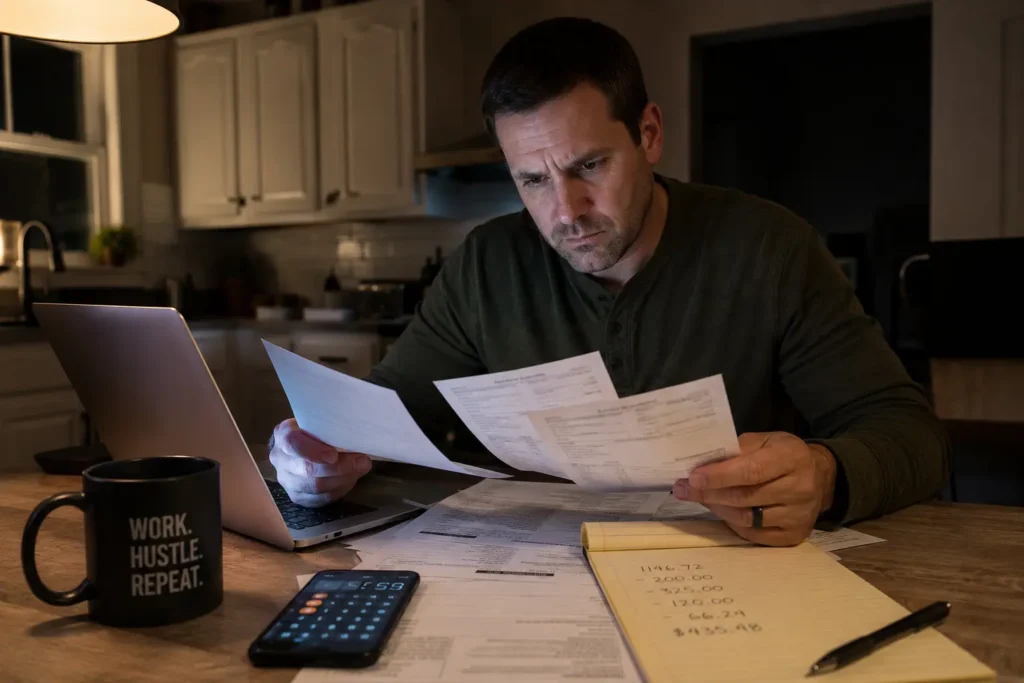
[INSERT IMAGE HERE: A realistic, high-quality photograph of a stressed American restaurant worker in an apron, looking at a short paycheck while sitting at a breakroom table. The lighting is slightly dim, conveying frustration but determination.]
- Prompt para criação da imagem: “A realistic, high-quality photograph of a stressed American restaurant worker wearing a black apron, sitting at a breakroom table. They are holding and examining a paper paycheck with a frustrated but determined expression. Cinematic lighting, conveying the emotional weight of wage theft. 1200×800 resolution, 3:2 aspect ratio.”
- Alt Text: Restaurant worker in an apron examining a short paycheck due to stolen tips.
- Title Text: Tipped Worker Dealing With Wage Theft
- Toggle Caption: Tip skimming is a form of illegal wage theft. You have the right to fight back and recover your earned money.
- Technical SEO: Size: 1200 × 800 px, Format: WebP, Max Size: 150 KB, Quality 80-85%.
What is the law on tip pooling, and can managers take my tips?
Under the Fair Labor Standards Act (FLSA), your tips belong entirely to you. While valid tip pooling is legal, employers, owners, and managers are strictly prohibited from taking any portion of an employee’s tips, even if the manager helped serve the customer.
Tip skimming is the most common form of wage theft in bars and restaurants. It is perfectly legal for a restaurant to require a “tip pool.” In a valid pool, servers share a percentage of their tips with bussers, hosts, or bartenders.
However, the Fair Labor Standards Act (FLSA) has a strict, unbreakable rule: Managers and owners can never keep a portion of a tip pool.
It does not matter if your shift manager ran food, cleared tables, or poured drinks. Because they have the power to hire, fire, or control your schedule, they cannot dip into the pool. If your boss forces you to tip them out at the end of the night, they are committing federal wage theft.
(Note: A manager can only keep a tip if a customer hands it directly to them for a service the manager provided entirely on their own, without anyone else’s help.)
How does the 2026 80/20 Rule protect my tipped minimum wage?
The 80/20 rule states that if your employer claims a tip credit to pay you $2.13 an hour, you cannot spend more than 20% of your shift performing non-tipped side work. If you do, they must pay you the full standard minimum wage.
In most states, employers can pay tipped workers a direct wage of just $2.13 per hour. This is called taking a tip credit. The law assumes your tips will make up the difference to reach the standard $7.25 minimum wage.
However, employers frequently abuse this to get cheap cleaning labor. They will pay you $2.13 an hour to roll silverware, sweep floors, or clean bathrooms for hours after the restaurant closes.
In 2026, the U.S. Department of Labor (DOL) strictly enforces the 80/20/30 rule:
- You must spend at least 80% of your time doing tip-producing work (taking orders, serving food).
- You cannot spend more than 20% of your shift doing “tip-supporting” side work.
- You cannot do side work for more than 30 continuous minutes.
If your boss breaks these rules, they lose the right to claim the tip credit. They legally owe you the full minimum wage for those hours.
Can I sue my employer for stolen tips and win liquidated damages?
Yes. You can file a claim with the Wage and Hour Division (WHD) or hire a lawyer to sue in civil court. If the court finds your employer committed wage theft, you can recover your stolen back pay plus an equal amount in liquidated damages.
When a business steals your tips, they owe you more than just an apology. They owe you money.
You have two main paths to recover your stolen wages:
- File a DOL Complaint: You can file a free, confidential complaint with the federal WHD or your State Department of Labor. Investigators can audit the restaurant’s payroll and force them to pay up.
- File a Private Lawsuit: You can hire an employment attorney. Most wage theft lawyers work on a contingency basis, meaning you pay nothing unless you win.
The biggest secret in employment law is liquidated damages. Under the FLSA, if your employer willfully steals your tips, the law penalizes them by doubling your payout. If your boss stole $5,000 in tips from you, a judge can order them to pay you $10,000 (your $5,000 back pay, plus $5,000 in liquidated damages).

How do I gather evidence if my employer controls the POS system?
Do not worry if you lack official records. Under the legal burden of proof, if your employer fails to keep accurate payroll records, your reasonable personal estimate of hours worked and tips earned is legally sufficient to trigger a federal wage investigation.
Many workers hesitate to take action because their boss controls the Point of Sale (POS) system. They think, “I can’t prove how much cash I made.”
Under the law, it is the employer’s job to keep flawless payroll records. If they try to hide their theft by deleting POS data or paying you under the table, the law protects you. This is known as the Mt. Clemens standard.
If the employer’s records are missing or fake, the burden of proof shifts. Your personal notes become primary evidence.
- What you should do today: Buy a small notebook. Every night, write down your clock-in time, clock-out time, total sales, and the exact amount of tips you took home. Take a photo of your checkout slip before handing it to your manager. This simple paper trail is enough to win a lawsuit.
Will I get fired for reporting tip skimming to the labor board?
No. Reporting tip theft to management, the DOL, or an attorney is a legally protected activity. If your employer retaliates by firing you, cutting your shifts, or demoting you, you gain grounds for a separate, highly lucrative wrongful termination lawsuit.
Fear is an employer’s best weapon. They rely on you being too afraid of losing your job to report them.
However, the FLSA explicitly prohibits retaliation. If you complain about your pay, you are engaging in a protected activity. If your manager suddenly cuts your weekend shifts or fires you the week after you ask about the tip pool, they have broken the law again. Retaliation cases are often easier to prove than the original wage theft, and they result in massive financial settlements.
Practical Case Study: Winning a Lawsuit Over Illegal Tip Pooling
Understanding how the law works in practice is crucial. In a recent case, a server was forced to tip out the kitchen staff while earning only $2.13 an hour. A DOL audit revealed illegal tip pooling, resulting in years of back pay and massive fines.
Let’s look at how these laws apply to a real-world restaurant scenario.
The Situation: “Maria” worked as a server at a popular local diner. The owner paid her the federal tipped minimum wage of $2.13 an hour. However, at the end of every shift, the owner forced Maria to put 20% of her tips into a pool. The owner then distributed this pool to the dishwashers, the line cooks, and himself.
The Violation: This breaks two massive federal laws. First, an owner can never take a cut of a tip pool. Second, if an employer pays the $2.13 tip credit wage, the tip pool can only include front-of-house staff who customarily receive tips (like bussers or bartenders). “Back-of-house” staff like cooks and dishwashers cannot be included.
The Action & Result: Maria kept a daily log of her tips and filed a complaint with the Wage and Hour Division. The DOL investigator audited the diner. The owner was forced to repay the stolen tips to Maria and every other server. Furthermore, because the tip pool was illegal, the owner lost the right to the tip credit entirely. He had to retroactively pay every server the full $7.25 minimum wage for every hour they had worked over the past two years, plus liquidated damages.
Frequently Asked Questions (FAQ) About Tip Theft
Can my boss take my tips to pay for a customer walkout or a broken glass?
Absolutely not. Tips are your property. Under the FLSA, an employer cannot deduct the cost of a dine-and-dash, a register shortage, or a broken plate from your tips. Even deducting these costs from your hourly wage is illegal if it drops your pay below the standard minimum wage.
Is it legal for my employer to deduct credit card processing fees from my tips?
In many states, yes. If a customer leaves a $10 tip on a credit card, the credit card company charges the restaurant a processing fee (usually around 3%). Under federal law, the employer is allowed to deduct that exact 3% fee (so you would get $9.70). However, they cannot deduct a penny more than the actual fee charged by the bank. Note: A few states (like California) ban this practice entirely and require the employer to eat the fee.
How far back can I claim stolen tips in a lawsuit?
Under federal law, the statute of limitations is two years. If you can prove the wage theft was a willful violation (your boss knew the law and broke it anyway), the window extends to three years. This means you must act quickly. Every day you wait is another day of stolen tips you can no longer recover.
Diclaimer: The information provided on this website does not, and is not intended to, constitute legal advice. All information, content, and materials available on this site are for general informational and educational purposes only. Laws regarding employment and labor rights frequently change, and while we strive to keep our content updated, the information on this website may not constitute the most up-to-date legal or other information.
Use of, and access to, this website or any of the links or resources contained within the site do not create an attorney-client relationship between the reader, user, or browser and the website authors, contributors, or its owners. We are an independent publishing platform, not a law firm.
Readers of this website should contact a qualified employment attorney in their specific state to obtain advice with respect to any particular legal matter. No reader or user of this site should act or refrain from acting on the basis of information on this site without first seeking legal advice from counsel in the relevant jurisdiction. Only your individual attorney can provide assurances that the information contained herein – and your interpretation of it – is applicable or appropriate to your particular situation.
Know your rights.