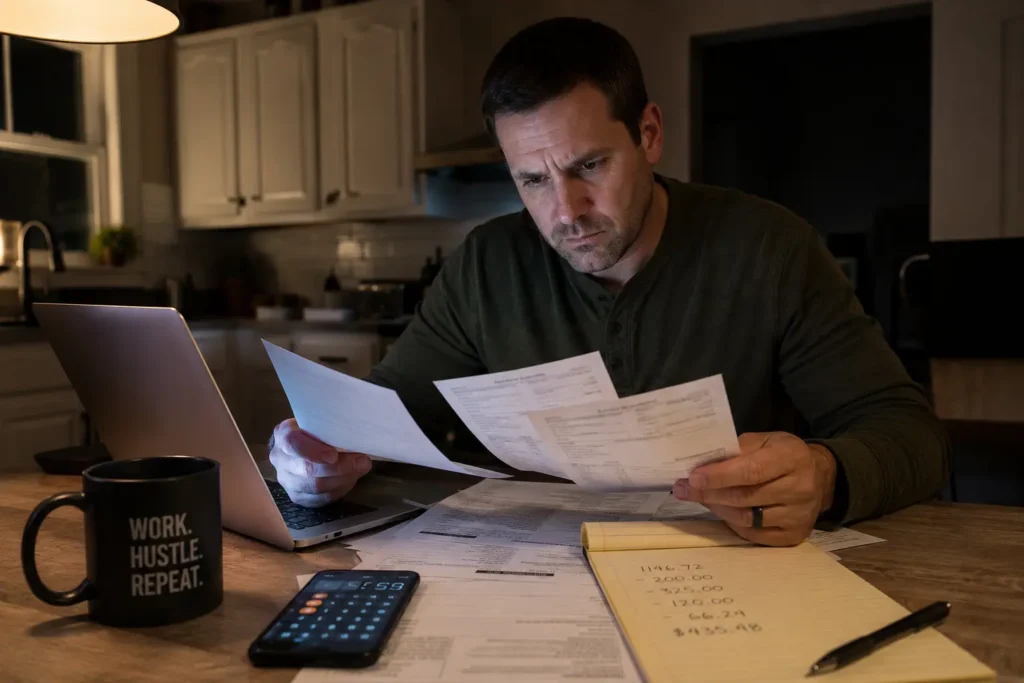
Under federal law, your employer cannot legally delay your paycheck past your established payday — not even by one day. The Fair Labor Standards Act (FLSA) requires payment on the regular payday your employer set. Missing that deadline is a wage violation. You have the right to file a complaint with the U.S. Department of Labor or your state labor board and recover back pay, plus penalties, immediately.
KEY TAKEWAYS
- Zero grace period: Federal law sets no grace period. Your payday is a legal deadline, not a target.
- State law governs pay frequency (weekly, biweekly, twice a month) — but once the payday is set, it is binding.
- Willful violations extend your legal window to 3 years and may entitle you to double your owed wages (liquidated damages).
- Final paycheck rules vary sharply by state — California demands same-day payment if you’re fired; other states allow up to 30 days.
- 1099 misclassification is a common tactic to delay pay using contractor invoice schedules — it may still be illegal wage theft.
If your employer hasn’t paid you, you’re not just dealing with a cash-flow problem — you’re dealing with a federal and state labor law violation. Under the FLSA, the law is blunt: employers must pay you on your regular, established payday. Full stop. No excuses, no grace period, no “the checks are in the mail.”
This guide breaks down exactly how long an employer can legally not pay you (spoiler: zero days past payday), what the rules are for your final paycheck when you’re fired or quit, how to spot illegal wage-delay tactics like misclassification, and — most importantly — step-by-step how to get your money back. We cover federal law and highlight key state differences so you know exactly where you stand tonight.
How many days late can a paycheck be under the FLSA Prompt Payment Rule?
The answer is zero. The Fair Labor Standards Act (FLSA — the federal law that governs minimum wage and overtime) requires employers to pay wages on the regular payday they established. There is no federally mandated grace period. If your employer told you payday is every Friday, then Friday is the legal deadline — not Saturday, not “next week when the bank clears.”
What the FLSA does not do is tell your employer how often to pay you. That’s left to each state. Most states require at least semi-monthly (twice a month) pay. Some require weekly pay for certain industries. But once your employer sets that schedule, the FLSA locks it in as a legal obligation.
Legal Definition: Wage Theft
When an employer deliberately fails to pay wages owed on time, that is called wage theft. According to the Economic Policy Institute, wage theft costs U.S. workers more than $50 billion per year — more than all property crime combined. It’s not a billing dispute. It’s illegal.
The “Reasonably Necessary” Exception for Overtime (29 CFR § 778.106)
There is one narrow federal loophole — and employers love to abuse it. Under 29 CFR § 778.106, an employer may delay paying a portion of your overtime wages if it is “reasonably necessary” to compute complex overtime or commission calculations. If your pay involves intricate piece-rate commissions or variable bonuses, your employer may have a brief window to finalize the exact amount.
Here’s what that exception does not mean:
- It does not excuse missing your entire paycheck.
- It does not allow delay past your next regular payday.
- It does not apply to your regular hourly wages — only the overtime portion that is genuinely difficult to calculate.
If your employer is holding your full check because of “payroll issues,” that is not covered by this exception. That is a violation.
Does a third-party payroll outage excuse an employer from paying on time?
No. Unequivocally, no. This is one of the most important things to understand in 2026, because payroll software cyberattacks have surged. In 2024–2025, attacks on payroll vendors like UKG, Kronos, and smaller SaaS providers left millions of workers without checks for weeks. Employers used these incidents to shrug and say “it’s the software company’s fault.”
The law disagrees. Your employer chose that payroll vendor. They signed that contract. The FLSA creates a strict liability standard for wage payment — meaning courts do not care whose fault the delay was. Your employer must find an alternative way to get you paid on your scheduled payday. That means:
- Cutting manual paper checks
- Wire transfers or ACH pushes to your bank account
- Cash payments (with a written receipt)
- Coordinating with a backup payroll provider
If your boss says “we’re waiting on [Payroll Company]” as a reason you haven’t been paid, that is not a legal defense. Document that statement in writing (an email reply or text) immediately. It becomes evidence.
What are the final paycheck rules if you resign or are terminated?
This is where state law creates the biggest differences — and where workers lose the most money by not knowing their rights. Federal law only requires that your final paycheck be delivered by your next regular payday. But many states are far stricter, especially when you’re fired.
| State | If You’re Fired | If You Quit | Penalties for Violation |
|---|---|---|---|
| California | Same day | 72 hours (or same day with 72-hr notice) | Waiting time penalties: 1 day’s wages per day late, up to 30 days |
| New York | Next regular payday | Next regular payday | Up to $20,000 in liquidated damages per violation |
| Texas | Within 6 days | Next regular payday | 1–30% penalty on owed wages + attorney fees |
| Florida | Next regular payday | Next regular payday | Court can award double the owed wages |
| Illinois | Next scheduled payday | Next scheduled payday | 2% per month penalty + court costs |
| Washington | End of next pay period | End of next pay period | Exemplary damages up to double the owed wages |
| Federal (FLSA) | Next regular payday | Next regular payday | Back pay + liquidated damages (up to double) if willful |
California workers have the strongest final paycheck protections in the country. If you’re fired in California and your employer hands you your last check even one day late, you’re entitled to one full day of wages for each day it’s late — up to 30 days. On a $250/day salary, that’s $7,500 in penalties. This is called a waiting time penalty, and California’s Labor Commissioner enforces it aggressively.
How do employers use 1099 misclassification to justify wage arrears?
Here’s a tactic that’s exploded in the gig economy — and it’s largely illegal. An employer hires you to work set hours, at their office, using their equipment, under their direct supervision. But instead of giving you a W-2 (which would make you an employee with full legal protections), they hand you a 1099 and call you an “independent contractor.”
Why does this matter for pay? Because contractors are billed on invoice schedules — net-30, net-60, even net-90. Your employer can now legally tell you “your invoice is due in 60 days” instead of paying you every Friday like a real employee. This is how illegal misclassification becomes wage theft.
Are You Misclassified? The IRS 3-Factor Test
The IRS and DOL use several factors to determine if you’re truly an independent contractor. The biggest ones: (1) Does the company control how you do your work (not just the end result)? (2) Does the company provide your tools or equipment? (3) Is this work central to the company’s core business? If you answered yes to any of these, you may legally be an employee — regardless of what your contract says.
If you’re misclassified, you can file a complaint with the IRS (Form SS-8), the DOL’s Wage and Hour Division, or your state labor board — and potentially recover years of back pay, plus employer-side payroll taxes they should have paid on your behalf.
Can I refuse to work if I am not paid, or is it job abandonment?
This is the question workers search for at 2 a.m., and it deserves a straight answer. You cannot simply stop showing up without risk — in most at-will employment states, walking off the job without notice can be treated as voluntary resignation (abandonment), which may disqualify you from unemployment benefits.
However, there are two important exceptions:
- Constructive Discharge: If your employer’s failure to pay you is so severe — say, three unpaid paychecks in a row — that a reasonable person would feel financially forced to quit, courts may treat your resignation as an involuntary termination. This is called constructive discharge (or “constructive dismissal”). It preserves your right to unemployment benefits and potentially a wrongful termination claim.
- Section 7 of the NLRA: The National Labor Relations Act protects your right to take “concerted action” with co-workers about wages. If multiple employees collectively refuse to work because of unpaid wages, that may be legally protected activity under federal labor law.
What to Do Instead of Walking Out
File a wage complaint first. You can continue working while your claim is processed, which is far safer. Your employer is also legally prohibited from retaliating against you for filing a wage claim — firing or disciplining you for reporting late pay is a separate federal violation.
Practical Case Study: Proving a Willful Violation to secure Liquidated Damages
Anonymized Real-World Scenario — Composite Case Based on DOL Filing Patterns
“The Banking Error” That Wasn’t
Maria worked as an office manager at a 40-person logistics company in Ohio. For three consecutive months in 2024, her paycheck arrived 8–12 days late. Each time, her CFO told her: “We had a banking error — your direct deposit got bounced back. We’re so sorry.”
Maria started documenting everything. She screenshot every pay stub showing the late payment date. She replied to every explanation via email, creating a paper trail of the CFO’s responses. Then, through an unrelated public records request in an EEOC matter, she discovered internal emails showing that company leadership had been deliberately floating payroll — using delayed employee pay as a short-term cash buffer — for over a year.
The “banking error” was a lie. The violation was willful.
Under the FLSA, a willful violation extends the statute of limitations from 2 years to 3 years. Maria was able to file claims for all three years of delayed pay. Because the violation was willful, she was also entitled to liquidated damages — meaning the company had to pay her double the total owed wages. On a salary of $62,000/year with consistent 10-day delays, her recoverable damages exceeded $18,000, plus attorney fees.
Her documentation — those email replies and pay stub screenshots — were the difference between a small claim and a major recovery.
How do I recover unpaid wages through the DOL Wage and Hour Division?
You have three main legal paths. Here’s each one, step by step.
- Document everything before you fileGather your pay stubs, bank deposit records, time sheets or clock-in logs, and any written communication from your employer about the late pay. Screenshot everything. Save it somewhere your employer can’t access (personal email, cloud drive).
- Calculate what you’re owedTotal up every paycheck that was late or missing. Include overtime. Note the exact dates each payment was due vs. actually received. This number is your “back pay” — the base of your claim.
- File with the DOL Wage and Hour Division (WHD)Go todol.gov/agencies/whdand submit a complaint online, by phone (1-866-487-9243), or at a local WHD office. There’s no filing fee. The WHD investigates on your behalf, contacts your employer, and can recover your wages without you needing a lawyer. This is free.
- File with your State Labor Board / Labor CommissionerDo this simultaneously — state claims often move faster and come with stronger penalties (especially California, New York, Illinois). Search “[your state] labor commissioner wage claim” to find your state’s specific portal.
- Request a right-to-sue letter if neededIf WHD doesn’t resolve your claim quickly enough or you want to pursue maximum damages, you can hire an employment attorney to file a private lawsuit. Many wage-theft attorneys work on contingency — they only get paid if you win. Under the FLSA, your employer must also pay your attorney fees if you win.
Critical: Don’t Miss the Statute of Limitations
Under the FLSA, you generally have 2 years from the date of the violation to file a federal wage claim. If the violation was willful (your employer knowingly broke the law), that window extends to 3 years. State deadlines vary — California allows 3 years; New York now allows 6 years under state law. File as soon as possible. Every day you wait shortens your recoverable period.
Frequently Asked Questions About Delayed Wages
What happens if payday falls on a weekend or federal holiday?
If your regular payday falls on a Saturday, Sunday, or federal holiday, your employer must pay you on the last business day before that date — not the next business day after. Most states codify this rule explicitly. Paying you the Monday after a Friday holiday is technically a violation, though enforcement varies.
Can my employer pay me in gift cards, store credit, or goods instead of money?
No. The FLSA requires wages to be paid in cash or its equivalent (check, direct deposit, prepaid debit card in limited circumstances). Paying you in company gift cards, store credit, or merchandise violates federal law and most state laws. This practice is illegal regardless of how your employment agreement is written.
Will I get fired if I report my boss for paying me late?
Retaliating against an employee for filing a wage complaint is a separate federal violation under Section 15(a)(3) of the FLSA. If your employer fires, demotes, reduces your hours, or threatens you after you report late pay, you have an additional retaliation claim. Document any changed treatment immediately after you file your complaint.
My employer says they’re going bankrupt — can I still recover my wages?
Yes. Unpaid wages are considered priority claims in bankruptcy proceedings, meaning you get paid before most other creditors. You can file a proof of claim in the bankruptcy case. Additionally, if your employer is a corporation, individual officers or managers who controlled payroll decisions can sometimes be held personally liable for unpaid wages under state law.
How long can an employer not pay you if you’re a tipped worker?
Tipped workers are subject to the same payday deadlines as all other employees. If your tips plus the tipped minimum wage ($2.13/hr federally, or higher in many states) don’t add up to the full minimum wage for that pay period, your employer must make up the difference by your regular payday. Failing to do so is a minimum wage violation.
Can my employer withhold my paycheck because I didn’t turn in a timesheet?
No. Your employer is responsible for tracking your hours under the FLSA. They cannot withhold your paycheck as punishment for missing a timesheet. They can discipline you through normal HR processes, but your wages for hours already worked must be paid on your regular payday. Withholding pay as leverage is illegal.
What if I’m a salaried exempt employee — do the same rules apply?
Yes and no. Exempt salaried employees are not covered by FLSA overtime rules, but they are still entitled to receive their full agreed salary on the scheduled payday. In fact, docking an exempt employee’s salary improperly can cause the employer to lose the exemption entirely — suddenly making that employee eligible for overtime back pay for the prior year.
Is there a minimum amount I need to be owed before I can file a wage claim?
No. The DOL’s Wage and Hour Division accepts wage claims for any amount. There is no minimum threshold. If you’re owed $80 in late wages, you can file a claim. State labor boards similarly have no minimum. Don’t let a small amount stop you — and remember, if you’re owed it, your co-workers likely are too.
Diclaimer: The information provided on this website does not, and is not intended to, constitute legal advice. All information, content, and materials available on this site are for general informational and educational purposes only. Laws regarding employment and labor rights frequently change, and while we strive to keep our content updated, the information on this website may not constitute the most up-to-date legal or other information.
Use of, and access to, this website or any of the links or resources contained within the site do not create an attorney-client relationship between the reader, user, or browser and the website authors, contributors, or its owners. We are an independent publishing platform, not a law firm.
Readers of this website should contact a qualified employment attorney in their specific state to obtain advice with respect to any particular legal matter. No reader or user of this site should act or refrain from acting on the basis of information on this site without first seeking legal advice from counsel in the relevant jurisdiction. Only your individual attorney can provide assurances that the information contained herein – and your interpretation of it – is applicable or appropriate to your particular situation.
Know your rights.
employer, employer not pay, long can an employer, contractor, lawyer, must pay, employers must pay, earn, federal law, penalty, wage laws, consultation, independent contractors, unpaid wage claim, What happens if I don’t get paid on payday?, What can I do if my employer always pays me late?, Can I Sue My Employer for Not Paying Me?, Can you sue a company for not paying you what it owes you?
pay employees, overtime pay, civil, required to pay, minimum wage act, wage and hour disputes, payment terms, least twice a month, unpaid overtime, time limit, state and federal laws, deny, allows employees, sue for, unpaid wages, willfully, earned wages, promptly, classification, intentional, case involves, unfair, six years, take action, legal options