
Getting fired is devastating. It threatens your livelihood, your family, and your peace of mind. When that firing feels deeply unfair, discriminatory, or retaliatory, your first instinct is to fight back. But if you live in the Sunshine State, you are likely hitting a wall of confusing legal jargon about “at-will” employment.
You need answers, not legal theory. Can I sue for wrongful termination in Florida? Yes, but you must know exactly how to navigate the system. The rules have changed drastically this year. This 2026 legal guide breaks down exactly what makes a firing illegal, how to gather the evidence you need in the first 48 hours, and how to hold your employer accountable under current Florida law.
Can you sue for wrongful termination in an at-will state like Florida?
Yes. While the At-Will Doctrine means Florida employers can legally fire you for any reason—or no reason at all—they cannot fire you for an illegal reason. You can sue if your termination was motivated by Discrimination, illegal Retaliation, or a Breach of Contract.
What makes a termination illegal under Florida employment law?
Employers rarely admit to breaking the law. They will not hand you a termination letter stating they are firing you because of your age, your pregnancy, or your whistleblower complaint. To win, you must categorize your firing into one of these specific legal exceptions to the at-will rule.
Discrimination and Disparate Treatment (FCRA & Title VII)
It is highly illegal to fire someone because of their race, color, religion, sex, national origin, age, disability, or marital status. These protections are enforced by the federal Title VII of the Civil Rights Act and the state-level Florida Civil Rights Act (FCRA).
To prove discrimination, employment lawyers look for Disparate Treatment. This means proving you were treated worse than similarly situated coworkers outside of your protected class (known as Comparators). For example, if you are fired for arriving late, but a younger coworker with the same manager is chronically late and only receives a verbal warning, you have strong evidence of disparate treatment.
The “Actual Violation” standard for Whistleblowers in 2026
Florida has seen a massive legal shift in 2026 regarding whistleblower protections. In May 2026, the Florida Supreme Court issued a landmark ruling in Gessner v. Southern Company.
Previously, employees could sue if they were fired for reporting something they reasonably believed was illegal. That is no longer enough. Under the new interpretation of the Florida Private Sector Whistleblower’s Act (FWA), you must prove an Actual Violation of a law, rule, or regulation occurred. If you reported what you thought was fraud, but a court later determines the employer’s action was technically a legal loophole, your wrongful termination lawsuit will fail.
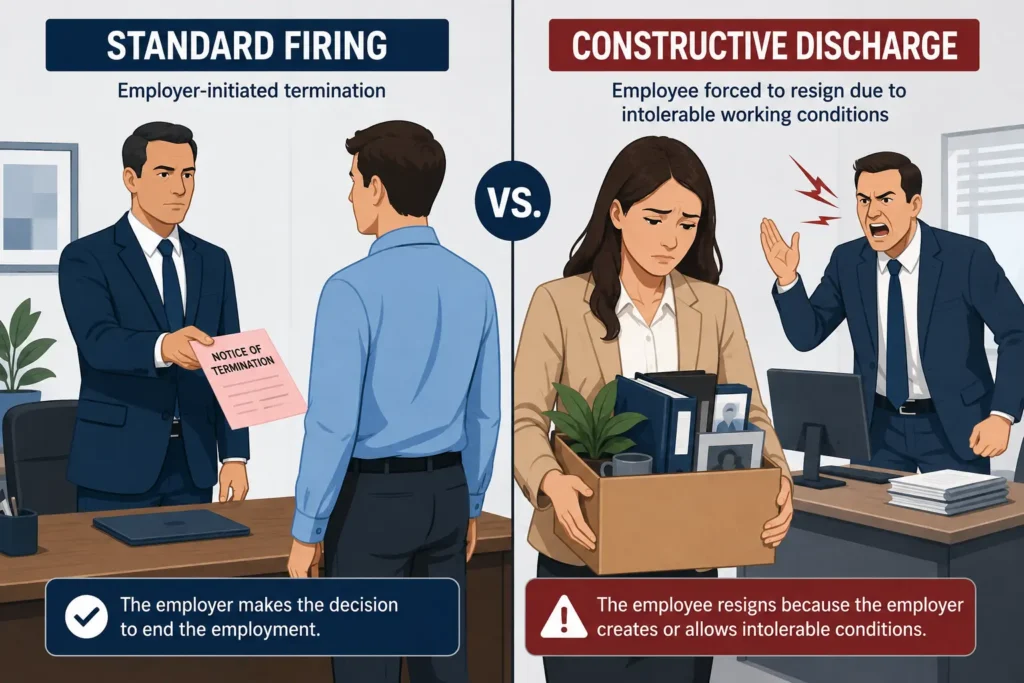
The Constructive Discharge loophole (when you are forced to quit)
Many workers suffer through a hostile work environment until they simply cannot take it anymore and resign. Employers think this protects them from a lawsuit. It does not.
Under Florida law, if your employer makes your working conditions so severely hostile and legally intolerable (like ignoring severe sexual harassment) that a reasonable person would feel forced to quit, this is called a Constructive Discharge. The law treats this exactly the same as if you were officially fired.
What are the first steps to prove wrongful termination in Florida?
The first 48 hours after losing your job are critical. You must secure evidence before your employer realizes you are preparing a lawsuit.
Requesting your personnel file to expose “Pretext”
When an employer fires someone for an illegal reason (like retaliation), they will invent a fake, legal reason to cover it up—such as suddenly claiming you had “poor performance.” This fake excuse is legally called a Pretext.
To expose pretext, immediately request a copy of your complete personnel file in writing. You are looking for a history of positive performance reviews. If you received glowing reviews for three years, complained about unpaid overtime on a Tuesday, and were fired for “poor performance” on a Friday, the timeline exposes their pretext.
Why you should never sign a severance agreement immediately
If your employer hands you a Severance Agreement on your way out the door, do not sign it immediately. Employers use severance money to buy your silence and force you to waive your right to sue for wrongful termination.
Furthermore, recent National Labor Relations Board (NLRB) rulings have cracked down on overly broad Non-Disparagement Clauses hidden in these agreements. You have the right to take the document home, review it, and consult an employment attorney.
How long do you have to sue for wrongful termination in Florida?
Your Statute of Limitations (your legal deadline to sue) is extremely strict. In employment law, you cannot just walk into a courthouse and sue. You must complete an Administrative Prerequisite by filing a charge with a government agency first.
The new 2026 HB 1407 deadlines for FCHR and EEOC claims
In Florida, you typically have 300 days from the date of your firing to file a discrimination charge with the federal Equal Employment Opportunity Commission (EEOC).
However, state-level claims filed with the Florida Commission on Human Relations (FCHR) just received a massive update. As of July 1, 2026, the new HB 1407 law eliminates years of legal confusion. Under the new rule, if the FCHR fails to make a determination within 180 days of you filing your complaint, you have a strict 18-month deadline from the date of filing to commence your civil lawsuit. Do not wait; evidence disappears quickly.
How much is a wrongful termination lawsuit worth in Florida?
Is a lawsuit actually worth the stress? If you win your wrongful termination case, the courts can award you several types of financial compensation.
Calculating Back Pay, Front Pay, and Punitive Damages
The value of your lawsuit depends on your specific financial losses and the severity of the employer’s conduct:
- Back Pay: The wages and benefits you lost from the date you were fired until the date of the court judgment.
- Front Pay: Compensation for future lost wages if you cannot find a comparable job or if returning to your old employer is impossible.
- Punitive Damages: Extra money designed specifically to punish the employer for intentionally malicious or reckless illegal behavior.
(Bonus Tip for calculating your damages: If you need to verify your exact lost wages for your lawsuit, you might ask: How many work weeks in a year? This ensures your attorney requests the correct amount of back pay).
Practical Case Study: Winning a Florida Retaliation Claim in 2026
Let’s look at how these legal entities work in the real world.
Sarah worked as an accountant for a Miami logistics firm. Her mother fell severely ill, so Sarah formally requested protected leave under the Family and Medical Leave Act (FMLA) via email to HR. Three days later, her manager fired her, claiming she was “not a cultural fit.”
Sarah knew Florida was an at-will state, but she also knew FMLA retaliation is illegal. She did not sign her severance agreement. Instead, she provided an attorney with her timestamped FMLA request and her last three performance reviews, which were excellent.
Her lawyer proved the “cultural fit” excuse was a Pretext. Because Sarah documented her timeline and refused to be intimidated by the at-will doctrine, she successfully sued for wrongful termination, winning her back pay, attorney’s fees, and damages for emotional distress.
Frequently Asked Questions (FAQ) About Florida Wrongful Termination
Can I sue if my boss fired me for a false reason?
Usually, no. Because Florida is an at-will state, your employer can fire you for a totally false, unfair, or dumb reason (e.g., claiming you stole a stapler when you did not). The firing only becomes a wrongful termination if the false reason is used as a pretext to cover up an illegal motive, like discrimination or retaliation.
Do I need to file with the EEOC or the FCHR first?
Florida has a “work-sharing” agreement between the federal EEOC and the state FCHR. When you file a discrimination charge with one agency, you can indicate that you want it dual-filed with the other. This ensures you protect your rights under both federal and state laws while fulfilling your administrative prerequisite.
Can my employer fire me to avoid paying a bonus?
While Florida is at-will, courts generally recognize an “implied covenant of good faith and fair dealing.” If you earned a specific performance bonus or commission, and your employer fires you the day before it is paid solely to avoid paying you the money you already earned, you may have grounds for a lawsuit based on unpaid wages and breach of contract.
Disclaimer: The information provided on this website does not, and is not intended to, constitute legal advice. All information, content, and materials available on this site are for general informational and educational purposes only. Laws regarding employment and labor rights frequently change, and while we strive to keep our content updated, the information on this website may not constitute the most up-to-date legal or other information.
Use of, and access to, this website or any of the links or resources contained within the site do not create an attorney-client relationship between the reader, user, or browser and the website authors, contributors, or its owners. We are an independent publishing platform, not a law firm.
Readers of this website should contact a qualified employment attorney in their specific state to obtain advice with respect to any particular legal matter. No reader or user of this site should act or refrain from acting on the basis of information on this site without first seeking legal advice from counsel in the relevant jurisdiction. Only your individual attorney can provide assurances that the information contained herein – and your interpretation of it – is applicable or appropriate to your particular situation.
Know your rights.