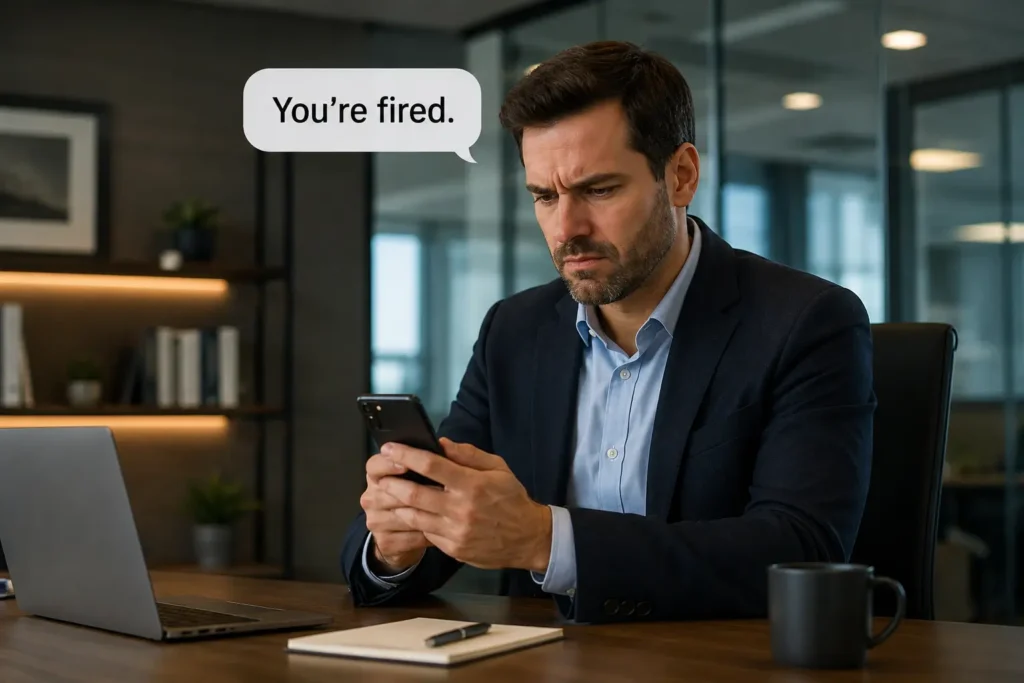
Getting fired is incredibly stressful. Getting fired via a quick SMS message on your phone feels disrespectful, cowardly, and unprofessional. But is it legal to fire someone over text? Yes, in the vast majority of cases in the United States, it is entirely legal. However, your employer’s lazy approach to letting you go just handed you a massive strategic advantage.
In this 2026 guide, we break down exactly how to use a text message termination to protect your legal rights. You will learn how to secure your final paycheck, guarantee your unemployment benefits, and identify if that text message crossed the line into illegal wrongful termination.
Is it legal to fire someone over text in the U.S.?
Yes, it is generally legal to fire someone over text in the U.S. because of the At-Will Employment Doctrine. This legal standard means employers can terminate you for any reason, at any time, using any method of Electronic Communication. However, that text message now serves as undeniable, timestamped proof of an Involuntary Termination.
What should you do in the first 5 minutes after being fired via text?
When you see that termination text pop up, your heart rate will spike. You will want to defend yourself. Do not. Current HR blogs give employers advice on how to fire people, but they ignore the worker’s reality. Here is your immediate crisis management plan.
The “Do Not Reply” protocol and preserving Timestamped Evidence
Do not reply in anger. If you text back swearing or insulting your boss, the company can use your reply to claim “misconduct” and fight your unemployment claim.
Instead, immediately take screenshots of the text message. Make sure the screenshots capture the sender’s contact name, phone number, and the exact time and date. By doing this, you are preserving Timestamped Evidence and securing a Digital Trail before your company can lock you out of internal communication apps. Send these screenshots to your personal email address right away.
Handling Digital Offboarding and returning Company Property
When you are fired by text, companies often instantly lock you out of your work email and internal systems. This makes returning your remote work equipment complicated.
Send a formal email from your personal account to the company’s HR department. State clearly: “I received a text message from [Boss’s Name] on [Date] at [Time] terminating my employment. I am locked out of the company network. Please provide a prepaid shipping box so I can return my company laptop and property.” This creates a paper trail proving you did not steal Company Property during your Digital Offboarding.
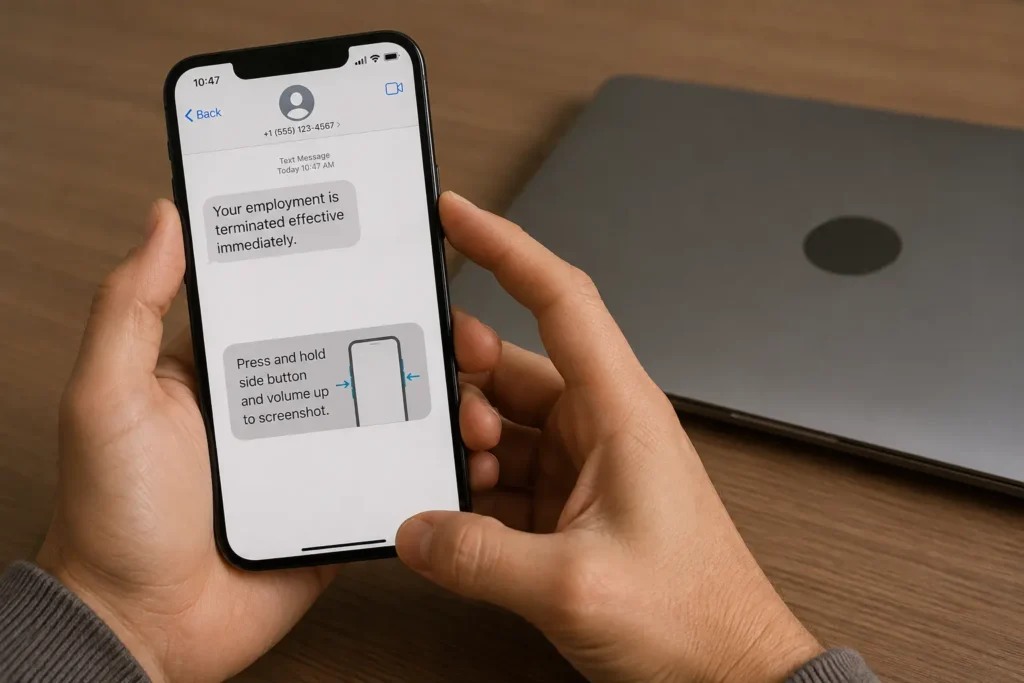
When does a text message firing become illegal Wrongful Termination?
While the medium of the firing (the text) is legal, the motive behind it might not be. If the reason you were fired violates state or federal law, it becomes Wrongful Termination.
FMLA violations and EEOC discrimination protections
Your employer cannot fire you over text because of your race, gender, religion, or disability. This is strictly prohibited by Title VII of the Civil Rights Act and enforced by the Equal Employment Opportunity Commission (EEOC). Furthermore, if you are out on protected medical leave under the Family and Medical Leave Act (FMLA), waking up to a termination text is a massive legal red flag that frequently triggers federal lawsuits.
OSHA retaliation and whistleblower protections
Did you complain about unpaid overtime yesterday? Did you report a dangerous safety hazard to the Occupational Safety and Health Administration (OSHA) last week? If your boss responds by texting you that you are fired, that is illegal Retaliation. Firing an employee for engaging in a Protected Activity is unlawful in all 50 states.
Breach of an Employment Contract or Collective Bargaining Agreement (CBA)
If you signed a specific Employment Contract or if you belong to a union covered by a Collective Bargaining Agreement (CBA), the at-will doctrine usually does not apply. These contracts typically require a formal grievance process, written warnings, and official paper notices. Firing a contracted or union worker via SMS directly breaches these agreements.
How does a text termination protect your Unemployment Insurance (UI) claim?
Here is the biggest silver lining to getting fired over text: It practically guarantees your unemployment benefits.
To collect Unemployment Insurance (UI), you generally must prove you lost your job through no fault of your own (an Involuntary Dismissal). Many shady employers will fire a worker verbally, and then lie to the State Workforce Commission, claiming the employee simply “quit” or “stopped showing up.”
They cannot do that to you. You have a screenshot. When you apply for unemployment, you will upload that text message as irrefutable written proof that the employer initiated the separation.
Does a text firing change your Final Paycheck and Severance deadlines?
No, a text message termination does not give your employer extra time to pay you. In fact, abrupt firings often cause employers to miss strict payroll deadlines.
Department of Labor (DOL) rules vs. State Labor Board deadlines
Under federal Department of Labor (DOL) rules, you must be paid by the next regular payday. But state laws are much stricter. In California, if you are involuntarily terminated, your Final Paycheck is due that exact same day. If your boss impulsively fires you via text on a Tuesday night and does not overnight your final check, they accrue daily waiting time penalties enforced by the State Labor Board.
(Pro Tip: Need to verify your final prorated salary or check if you were underpaid? Many workers ask, “How many work weeks in a year?” The answer is 52.14 weeks. If you are calculating severance or double-checking your final wages, use a 2026 salary calculator. Divide your annual salary by 52 to find your exact gross weekly pay rate).
Reviewing Severance Agreements before signing
Sometimes, a termination text will include a link to a Severance Agreement. Do not click the link on your phone and quickly e-sign it. These documents often contain strict non-compete clauses or waivers preventing you from suing for unpaid wages. You have the right to request a physical or PDF copy of the Severance Pay offer and review it carefully before giving away your rights.
Practical Case Study: Turning a Text Firing into an EEOC Retaliation Win
Consider the case of Marcus, a warehouse worker. Marcus noticed that several emergency exits were constantly blocked by pallets. He emailed his manager to report the safety violation. Three hours later, Marcus received a text message from his manager: “Don’t bother coming in tomorrow. We are letting you go.”
If Marcus had been fired verbally in a closed room, it would be a “he-said, she-said” situation. Instead, Marcus screenshotted the text. He did not reply. He filed a complaint with the EEOC and OSHA, providing the time-stamped email he sent about the safety issue, followed by the time-stamped text message firing him three hours later. Because the manager used a text message, Marcus had a perfect, undeniable timeline proving illegal retaliation.
Frequently Asked Questions (FAQ) About Electronic Terminations
Can my boss fire me over text on my day off?
Yes. Because of at-will employment, your employer can terminate you at any time, including on your scheduled days off, weekends, or even while you are on vacation.
Is it legal to fire a whole group of employees via a mass text?
Usually, no. If a company has over 100 employees and lays off 50 or more workers, they are heavily regulated by the Worker Adjustment and Retraining Notification (WARN) Act. The WARN Act explicitly requires employers to provide 60 days of advance written notice. Firing a massive workforce via a sudden group text message without providing 60 days of pay often violates federal law.
Does a text message legally count as written notice?
Yes. In modern business law, electronic communications—including emails, Slack messages, and SMS text messages—are generally recognized as legally binding written documents. This is why you must treat a termination text as a formal HR document and preserve it immediately.
Disclaimer: The information provided on this website does not, and is not intended to, constitute legal advice. All information, content, and materials available on this site are for general informational and educational purposes only. Laws regarding employment and labor rights frequently change, and while we strive to keep our content updated, the information on this website may not constitute the most up-to-date legal or other information.
Use of, and access to, this website or any of the links or resources contained within the site do not create an attorney-client relationship between the reader, user, or browser and the website authors, contributors, or its owners. We are an independent publishing platform, not a law firm.
Readers of this website should contact a qualified employment attorney in their specific state to obtain advice with respect to any particular legal matter. No reader or user of this site should act or refrain from acting on the basis of information on this site without first seeking legal advice from counsel in the relevant jurisdiction. Only your individual attorney can provide assurances that the information contained herein – and your interpretation of it – is applicable or appropriate to your particular situation.
Know your rights.