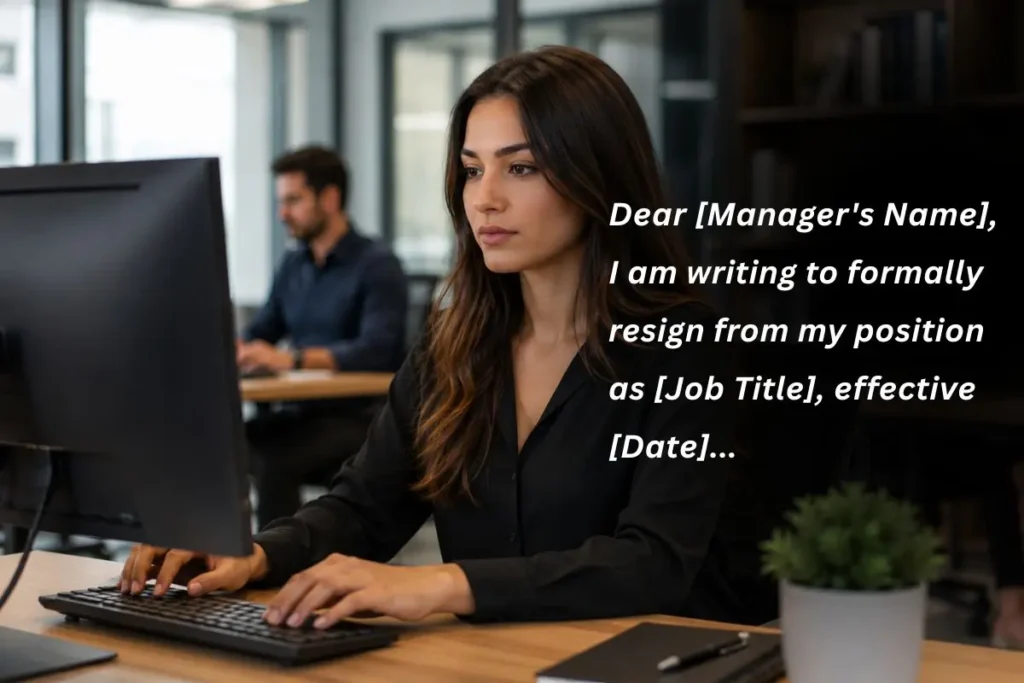
You are ready to leave. Maybe you found a better opportunity. Maybe you are escaping a toxic boss, unpaid wages, or a hostile work environment. Whatever your reason, handing in your quit job letter is a critical legal moment. It is not just a polite goodbye. It is a formal document. It dictates when you get your final paycheck. It determines your unemployment eligibility. It protects your legal rights under U.S. labor law. Here’s how to write a quit job letter.
In this guide, we break down exactly how to write a resignation letter that protects you. We include 2026 legal updates and simple copy-paste templates to secure your exit.
What is the legal purpose of a quit job letter?
A quit job letter, legally known as a Notice of Resignation, serves a very specific purpose. It formally establishes your Effective Date (your final day of work). This date triggers the payroll cutoff for your Final Paycheck. More importantly, it officially classifies your departure as a Voluntary Termination in your HR file.
This HR classification directly impacts your eligibility for unemployment benefits. Submitting a clear letter prevents your employer from claiming you abandoned your job. It stops them from twisting the narrative of your departure.
What exactly must you include in your notice of resignation?
Your resignation letter does not need to be a novel. In fact, saying less is legally safer. To protect yourself, your letter must include three basic facts: your clear intent to resign, your exact final working date, and a neutral transition statement.
The standard “Burning No Bridges” template
If you are leaving on good terms, keep your letter simple and professional. This standard quit job letter ensures a smooth Transition of Duties and clearly marks your final day.
Dear [Manager’s Name],
Please accept this letter as formal notification that I am resigning from my position as [Job Title] at [Company Name]. My last day of employment will be [Date, usually 2 weeks out].
Thank you for the opportunities I have had during my time here. I am committed to ensuring a smooth transition of my duties before my departure.
Sincerely,
[Your Name]
The remote worker template (handling company property)
Remote work adds a layer of legal risk. You must document your plan to return Company Property and complete Remote Offboarding. This prevents employers from illegally withholding your final pay for “lost” digital equipment.
Dear [Manager’s Name],
I am writing to formally resign from my position as [Job Title], effective [Date].
Before my final day, I will ensure all digital files are transferred. Please provide a prepaid shipping label and instructions for returning my company laptop, security keys, and any other company property by [Date]. I also request that my system access be formally revoked at the end of my final shift.
Sincerely,
[Your Name]
The immediate effect template (health or emergency)
Sometimes, you simply cannot wait. If a health crisis or severe emergency forces you out, use this immediate resignation letter.
Dear [Manager’s Name],
Please accept this letter as formal notice that I am resigning from my position as [Job Title], effective immediately, today, [Date].
Due to unforeseen personal circumstances, I am unable to provide standard notice. I will return all company property via certified mail by [Date]. Please mail my final paycheck to [Your Address].
Sincerely,
[Your Name]
When is a two weeks’ notice legally required?
Under the U.S. At-Will Employment Doctrine, two weeks’ notice is a professional courtesy, not a federal law. Because employment is “at-will,” you can legally quit your job at any time, without notice. The only exceptions are if you signed a specific employment contract guaranteeing notice, or if you are part of a union with a Collective Bargaining Agreement (CBA).
How do you write a resignation letter for a hostile work environment?
This is where American workers make the biggest mistake. If you are forced to quit because of severe harassment, discrimination, or unpaid wages, you are experiencing a Constructive Discharge. If you use a generic template thanking them for “the great opportunity,” you can destroy your own legal case.
Protecting your EEOC claims and unemployment eligibility
When escaping a Hostile Work Environment, your quit job letter must be factual, neutral, and highly protective. Do not express gratitude. Document that you are being forced out. This helps protect your Equal Employment Opportunity Commission (EEOC) claims and preserves your Unemployment Benefits.
Dear [HR Director/Manager],
I am writing to resign from my position as [Job Title], effective [Date].
Please note that I consider this a constructive discharge. I am forced to resign due to the ongoing, unresolved hostile work environment, which I previously reported to HR on [Date of your previous complaint]. The working conditions have become intolerable, leaving me no choice but to end my employment.
Sincerely,
[Your Name]
What happens if your employer fires you when you give notice?
You hand in your two weeks’ notice, and your boss tells you to pack your desk and leave immediately. This is a common retaliation tactic. Are you fired or did you just quit?
Understanding Garden Leave vs. Involuntary Termination
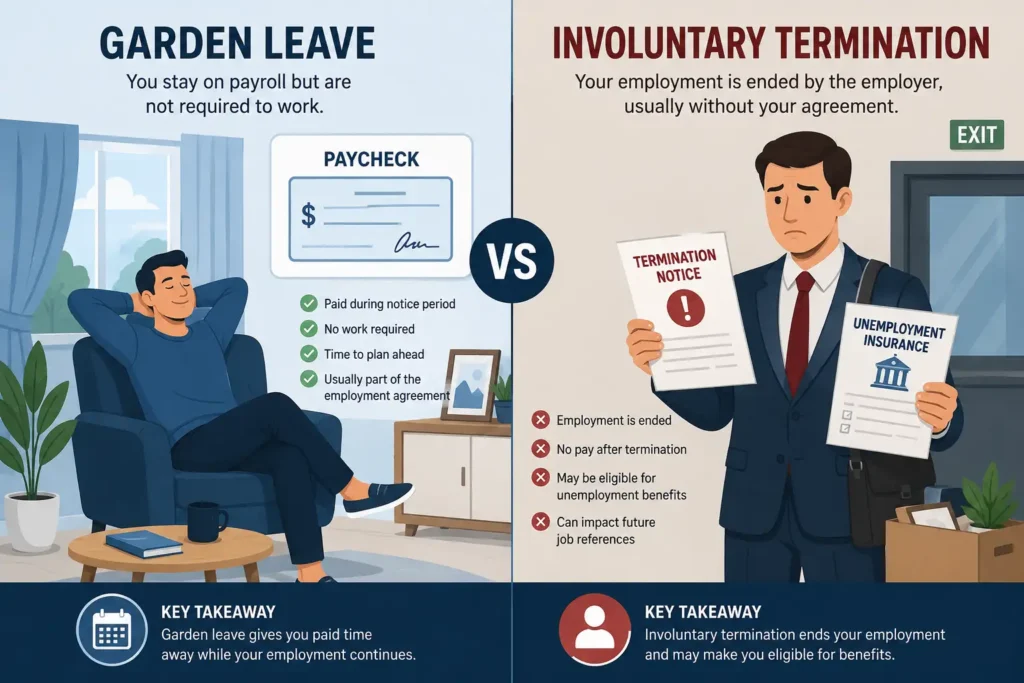
If your employer asks you to leave immediately but still pays your normal wages for your two-week notice period, this is called Garden Leave. You are still technically employed for those two weeks.
However, if they tell you to leave and refuse to pay out your notice period, your voluntary resignation has legally converted into an Involuntary Termination (a firing). In most states, this immediate termination makes you eligible to file for Unemployment Insurance (UI).
When will you receive your final paycheck and accrued PTO?
Your final paycheck is heavily regulated by law. You do not have to wait for the company’s convenience to get paid what you earned.
(Bonus 2026 Salary Calculator tip: Need to verify your final prorated salary? Ask yourself: How many work weeks in a year? The answer is 52.14 weeks. Simply divide your annual salary by 52 to find your baseline weekly rate before taxes to ensure your final check is accurate).
Federal FLSA rules vs. State payout laws
Under the federal Fair Labor Standards Act (FLSA), the Department of Labor (DOL) requires your final paycheck by the next regular payday. However, state laws are often much stricter.
For example, under California law, if you quit with at least 72 hours of notice, your final paycheck is due on your exact last day. Furthermore, states like California, Colorado, and Montana have strict Use-it-or-lose-it Policies bans. This means your Accrued PTO (Vacation Payout) must be paid out in your final check as earned wages.
What to do if they withhold your final wages
Never let an employer hold your final paycheck hostage. If they miss the legal deadline, contact your State Labor Board immediately. In strict states, employers can face severe Waiting Time Penalties or Treble Damages—forcing them to pay up to 30 days of additional daily wages just for delaying your final check.
How do non-compete agreements affect your resignation in 2026?
If you are writing a quit job letter in 2026, you must understand the current rules around Non-Compete Agreements (NCC). In September 2025, the Federal Trade Commission (FTC) formally abandoned its legal appeal to enforce a nationwide ban on non-competes.
Because the federal ban failed, non-competes and Non-Disparagement Clauses attached to a Severance Agreement are entirely regulated by individual state laws. Before you quit to join a competitor, review your contract and check your local state laws, as several states strictly prohibit or limit them.
Practical Case Study: Navigating a Constructive Discharge Resignation
Let’s look at a real-world scenario. Sarah worked as a graphic designer. For six months, her boss continuously made discriminatory remarks. Sarah reported this to HR, but nothing changed. Her mental health plummeted, and she decided she had to leave.
If Sarah used a standard quit job letter (“Thank you for the wonderful opportunity”), the company’s lawyers would use that exact letter against her. They would claim the environment wasn’t truly hostile because she left “on good terms.”
Instead, Sarah used our Constructive Discharge template. She explicitly stated she was resigning due to the unresolved discrimination she previously reported. Because she documented the reality of her departure, Sarah successfully filed an EEOC claim and secured her unemployment benefits while looking for a safe workplace.
Frequently Asked Questions (FAQ) about Quitting Your Job
Can I quit my job via email or text message?
Yes, you can absolutely quit via email or text message. A digital quit job letter is legally valid. In fact, an email is highly recommended because it provides a clear, timestamped paper trail. This proves exactly when you gave notice, which protects your final paycheck timeline.
Do I get paid for unused vacation time when I quit?
It depends entirely on your state. Federal law does not require employers to pay out accrued PTO. However, nearly half of U.S. states legally classify earned vacation time as wages that cannot be taken from you. Check your state’s specific labor laws.
Should I sign exit documents attached to my resignation acknowledgment?
No. Never sign exit documents on the spot. Employers often try to slip new non-compete clauses, liability waivers, or unfair severance restrictions into your exit paperwork. You have the legal right to take those documents home, review them, and consult an attorney before signing away your rights.
Disclaimer: The information provided on this website does not, and is not intended to, constitute legal advice. All information, content, and materials available on this site are for general informational and educational purposes only. Laws regarding employment and labor rights frequently change, and while we strive to keep our content updated, the information on this website may not constitute the most up-to-date legal or other information.
Use of, and access to, this website or any of the links or resources contained within the site do not create an attorney-client relationship between the reader, user, or browser and the website authors, contributors, or its owners. We are an independent publishing platform, not a law firm.
Readers of this website should contact a qualified employment attorney in their specific state to obtain advice with respect to any particular legal matter. No reader or user of this site should act or refrain from acting on the basis of information on this site without first seeking legal advice from counsel in the relevant jurisdiction. Only your individual attorney can provide assurances that the information contained herein – and your interpretation of it – is applicable or appropriate to your particular situation.