
If you are dealing with a severe medical condition, the last thing you need is the terror of losing your job. You are probably wondering: how long can an employee be on LTD before termination under U.S. law? The reality is that the United States legal system treats your disability insurance check and your job security as two completely different things.
If you are relying on internet searches, be incredibly careful. Most of the top articles regarding this topic are written by Canadian law firms discussing Canadian labor tribunals. That advice will ruin an American worker’s case. In this 2026 guide, we provide the exact U.S. federal laws, protections, and timelines you need to secure your financial survival and understand your real rights.
How long can an employee be on LTD before termination in the U.S.?
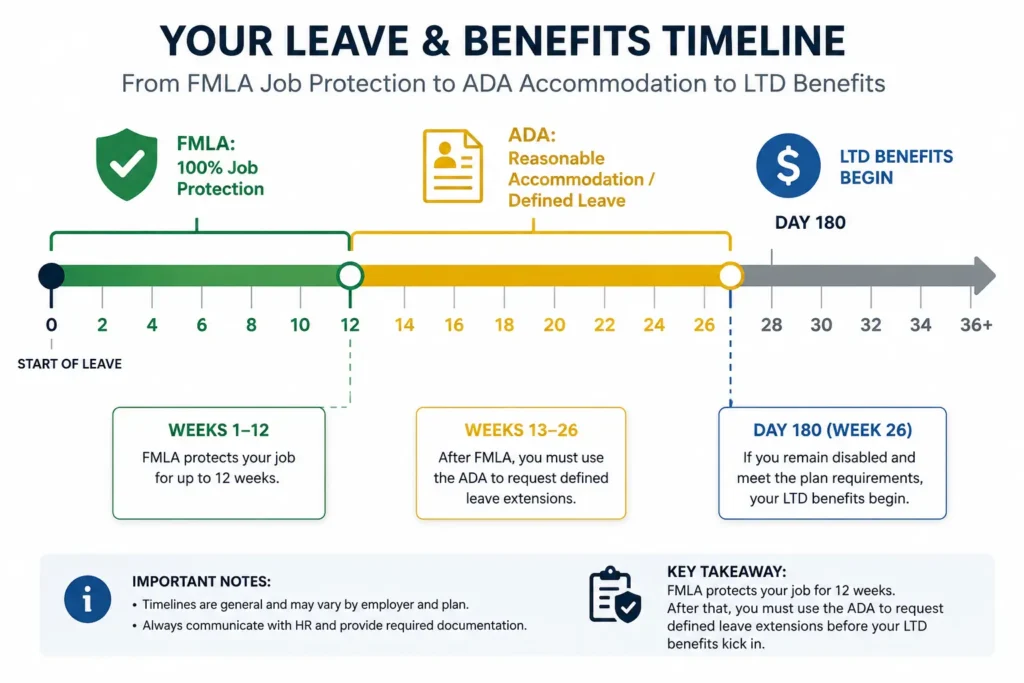
In the U.S., there is no specific time limit you can be on LTD before termination. Long-Term Disability provides income, not job protection. Your job is typically only protected for the first 12 weeks under FMLA, after which your employer can terminate you if holding your position creates an “undue hardship” under the ADA.
What is the difference between LTD benefits and legal job protection?
The biggest mistake American workers make is confusing an insurance policy with a federal law. When you ask how long can an employee be on LTD before termination, you must separate the money from the job.
Long-Term Disability (LTD) is a private insurance policy. It replaces a percentage of your salary when you cannot work. It does absolutely nothing to protect your physical job. Your Job Protection comes entirely from federal labor statutes.
The FMLA 12-week cliff (When your job protection ends)
The only absolute, federally guaranteed job protection most Americans have is the Family and Medical Leave Act (FMLA). Administered by the Department of Labor (DOL), FMLA guarantees that an eligible worker can take exactly 12 weeks of unpaid leave, and their employer must hold their job (or an equivalent one) open for them.
Once you hit week 13, that absolute legal shield evaporates. Because FMLA only lasts 90 days, and the typical Elimination Period (the waiting time before LTD benefits begin) is often 90 to 180 days, you are in a highly vulnerable gap.
The ADA and the “Indefinite Leave” trap
When FMLA expires, your employer does not automatically have to fire you. The Americans with Disabilities Act (ADA) steps in. Under the ADA, granting a worker extended medical leave can be considered a legally required Reasonable Accommodation.
However, there is a massive legal trap: Indefinite Leave. If your doctor fills out your medical paperwork and writes “Return to work date: Unknown,” courts consistently rule that your employer can legally fire you. U.S. judges agree that holding a job open indefinitely causes an Undue Hardship on the business.
Can your employer fire you while you are on the LTD elimination period?
Yes, your employer can legally terminate you while you are waiting out your LTD elimination period if your FMLA has run out and keeping you on the payroll constitutes an undue hardship.
Providing a “defined return-to-work date” to delay termination
To stop a Termination of Employment while you wait for your LTD approval, you must engage in the Interactive Process with your employer’s HR department. This is a mandatory, documented conversation about what accommodations you need.
The secret to delaying termination is providing a Defined Return-to-Work Date. Never let your doctor say they do not know when you will be back. Instead, have your doctor request a specific, finite extension. For example: “The patient requires an additional 30 days of leave to complete physical therapy, with a projected return date of October 1st.” Courts heavily favor workers who provide a specific timeline over employers who rush to terminate.
2026 PWFA protections for pregnant workers on LTD
If you are on disability due to severe pregnancy complications (like hyperemesis gravidarum) or postpartum issues, the rules shifted significantly in your favor. Thanks to the expanded enforcement of the Pregnant Workers Fairness Act (PWFA) in 2026, the Equal Employment Opportunity Commission (EEOC) requires employers to temporarily suspend essential job functions for up to 40 weeks during pregnancy, plus additional recovery time postpartum.
This means pregnant workers have significantly stronger extended-leave protections to delay termination than standard ADA disability claimants.
What happens to your LTD checks and health insurance if you are fired?
If you are eventually terminated, your immediate panic will be about money and medicine. The good news is that losing your job does not mean you lose your approved disability income.
Why your vested LTD benefits continue after termination (ERISA rules)
Most private LTD policies are governed by the federal Employee Retirement Income Security Act (ERISA). Under ERISA law, if you became disabled while you were an active employee covered by the policy, your benefits are considered Vested Benefits.
This means the insurance company is legally on the hook to pay you according to the policy’s maximum benefit period (which is often until you reach Social Security Retirement Age), regardless of whether the employer eventually fires you for being absent. A Medical Termination cuts your ties with the company, not with the insurance carrier.
Preparing for COBRA healthcare premiums
While your LTD check is safe, your health insurance is not. When you are fired, your employer stops subsidizing your medical premiums. You will instantly be transitioned to COBRA.
COBRA allows you to keep your exact same health plan, but you must pay 100% of the premium, plus a 2% administrative fee. This causes massive sticker shock for workers who are now living on 60% of their former income through LTD. You must factor this explosive healthcare cost into your financial survival plan the moment your 12-week FMLA runs out.
Practical Case Study: Navigating the FMLA to LTD Transition
Let’s look at a realistic 2026 scenario of an American worker managing this crisis.
David, an IT manager, suffered a severe spinal injury. His employer’s LTD policy required a 180-day Elimination Period before it paid out. For the first 12 weeks (84 days), David’s job was completely shielded by FMLA.
At week 13, his HR department called, implying they needed to fill his role. Knowing he could not provide an “indefinite leave” request, David’s doctor provided a written ADA accommodation request for an additional 90 days of leave, projecting a specific return-to-work date. The company legally had to grant this because replacing an IT manager temporarily did not cause an “undue hardship.”
At day 180, David’s LTD benefits finally kicked in. Because his injury was so severe, his doctor confirmed he could never return to his “Own Occupation.” At this point, the company officially enacted a Medical Termination because holding the role open for years was impossible. David lost his job, but because he handled the timeline correctly, his Vested Benefits triggered, and he now receives his monthly LTD checks while recovering at home.
Frequently Asked Questions (FAQ) About LTD and Job Security
Does my long-term disability stop if I get fired?
No. Under ERISA regulations, if you were covered by the employer’s LTD policy on the date you became disabled, your right to receive benefits is vested. Your employer firing you for exhausting your medical leave does not cancel your insurance payout. You will continue to receive checks as long as you meet the policy’s medical definition of disability.
Do I get a severance package if I am terminated while on LTD?
Sometimes, but you must be incredibly careful. If your employer offers severance during a medical termination, do not blindly sign the release form. Some poorly drafted severance agreements include broad waivers that force you to give up your rights to future ERISA appeals if the insurance company suddenly denies your LTD claim. Always have an employment lawyer review a severance offer while on disability.
Does Canadian “frustration of contract” law apply in the U.S.?
Absolutely not. Many top search results for “how long can an employee be on ltd before termination” direct users to Canadian law firms talking about “frustration of contract” or the “duty to accommodate under the Human Rights Code.” These concepts do not exist in U.S. federal labor law. Relying on Canadian advice will severely damage your American FMLA, ADA, and ERISA claims. Always consult U.S.-specific employment statutes.
Disclaimer: The information provided on this website does not, and is not intended to, constitute legal advice. All information, content, and materials available on this site are for general informational and educational purposes only. Laws regarding employment and labor rights frequently change, and while we strive to keep our content updated, the information on this website may not constitute the most up-to-date legal or other information.
Use of, and access to, this website or any of the links or resources contained within the site do not create an attorney-client relationship between the reader, user, or browser and the website authors, contributors, or its owners. We are an independent publishing platform, not a law firm.
Readers of this website should contact a qualified employment attorney in their specific state to obtain advice with respect to any particular legal matter. No reader or user of this site should act or refrain from acting on the basis of information on this site without first seeking legal advice from counsel in the relevant jurisdiction. Only your individual attorney can provide assurances that the information contained herein – and your interpretation of it – is applicable or appropriate to your particular situation.
Know your rights.
References & Legal Resources
For more detailed information regarding your federal rights, job protection, and disability benefits, please consult the official U.S. government resources below:
-
U.S. Department of Labor (DOL) – FMLA Guidelines:
Learn more about the 12-week job protection rules under the Family and Medical Leave Act. -
U.S. Equal Employment Opportunity Commission (EEOC) – ADA Protections:
Understand how reasonable accommodations and extended medical leave work under the Americans with Disabilities Act (ADA). -
Department of Labor (DOL) – ERISA Regulations:
Review your federal rights regarding vested benefits and long-term disability insurance claims under the Employee Retirement Income Security Act (ERISA). -
U.S. Equal Employment Opportunity Commission (EEOC) – PWFA:
Read the 2026 enforcement updates regarding extended leave for pregnancy and postpartum recovery under the Pregnant Workers Fairness Act (PWFA). -
U.S. Department of Labor – COBRA Continuation Coverage:
Learn how to maintain your health insurance after a medical termination through COBRA.