
Are you asking yourself, “can disabled veterans work?” You are not alone. Thousands of veterans want to return to the workforce, but they are terrified of losing their benefits. You fought for this country, and you should not have to choose between earning a living and keeping the financial compensation you deserve.
This 2026 legal survival guide will give you the exact numbers and rules. We will show you how to navigate VA income limits, protect your rating from unprompted medical reviews, and leverage legal loopholes to earn what you are worth.
Can disabled veterans work full-time?
Yes, disabled veterans can work. If you have a standard Schedular VA Disability Rating (0% to 100%), there are absolutely no income limits. However, if you receive Total Disability based on Individual Unemployability (TDIU), you cannot maintain Substantially Gainful Employment above the poverty threshold.
100% Schedular VA Disability Rating vs. TDIU Rules
The Department of Veterans Affairs (VA) has two different ways of paying veterans at the 100% rate. Understanding the difference is crucial.
If you reached a 100% Schedular VA Disability Rating by combining various service-connected conditions (like 50% for PTSD, 30% for migraines, and 20% for a back injury), the VA places no cap on your income. You can work full-time and make millions of dollars without losing a single cent of your VA compensation.
However, if your combined rating is lower (like 70%), but your conditions make it impossible to hold a job, the VA pays you at the 100% rate through Total Disability based on Individual Unemployability (TDIU). Because this program is specifically designed for veterans who cannot work, the VA strictly limits how much money you can earn.
Why Permanent and Total (P&T) Status Protects Your Rating
A major fear among veterans is that getting a full-time job will trigger a VA investigation. Will they think you are suddenly “cured” because you are working?
If you hold Permanent and Total (P&T) Status, you are generally safe. P&T means the VA recognizes your disabilities will not medically improve over your lifetime. Holding this status shields you from routine medical re-evaluations. You can re-enter the civilian workforce full-time without the constant fear that the VA is going to lower your rating just because you got a job.
How much can a veteran earn on TDIU in 2026?
To keep TDIU benefits, veterans must restrict earnings to Marginal Employment. Under 38 CFR § 4.16, this means your annual income cannot exceed the 2026 Federal Poverty Threshold ($15,960) set by the U.S. Census Bureau, unless you work in a highly accommodated setting.
The 2026 TDIU “Safe Income” Cheat Sheet (Marginal Employment)
If you are on TDIU, you are legally allowed to maintain Marginal Employment. This means your gross annual income must stay strictly under the official poverty line for a single person.
For 2026, the Department of Health and Human Services (HHS) and the Census Bureau set this poverty threshold at exactly $15,960 for the lower 48 states.
Here is what that limit actually looks like if you want to work part-time:
- At $10.00/hour: You can work about 30 hours per week ($15,600/year).
- At $15.00/hour: You can work about 20 hours per week ($15,600/year).
- At $20.00/hour: You can work about 15 hours per week ($15,600/year).
- At $25.00/hour: You can work about 12 hours per week ($15,600/year).
Note: Always track your gross income (before taxes) to ensure you never cross the $15,960 limit.
Surviving the SSDI Substantial Gainful Activity (SGA) Crossfire
Many 100% disabled veterans collect both VA benefits and Social Security Disability Insurance (SSDI). If this is you, you must navigate a dangerous bureaucratic crossfire.
The VA limits your annual income to $15,960. However, the Social Security Administration (SSA) has its own completely separate rules. To keep SSDI, you must stay below their SSDI Substantial Gainful Activity (SGA) limit. For 2026, the SGA limit is $1,690 per month.
You must constantly monitor your paychecks to ensure you never violate the VA’s annual poverty threshold or the SSA’s monthly SGA limit. If you mess up one, you could trigger an audit from both agencies.
What qualifies as a protected work environment?
A Protected Work Environment is a TDIU exception allowing you to earn above the poverty line if your employer makes extreme, unreasonable accommodations for your disabilities. Because the business absorbs your unproductivity, the VA does not consider this substantially gainful employment.
Using Lay Statements to Prove Extreme Employer Accommodations
This is the most powerful legal loophole for veterans on TDIU. The VA realizes that some veterans can only hold a job because a family member or a deeply sympathetic boss bends all the rules for them.
A Protected Work Environment exists when your employer makes extreme accommodations that a normal business would never tolerate. For example:
- You are allowed to leave work unannounced for days at a time during PTSD episodes.
- Your employer pays you full-time wages even if you only complete half the work.
- You are exempted from all basic productivity standards.
To prove this to the Department of Veterans Affairs (VA), you must submit detailed Lay Statements / Buddy Statements from your employer. These official statements must legally document exactly how they accommodate you and prove that they are essentially subsidizing your income despite your severe service-connected disabilities.
Can getting a job trigger a Routine Future Examination (RFE)?
Yes. Unless you hold P&T status, returning to physically demanding work can trigger Routine Future Examinations (RFE). The VA may reduce your schedular rating if your new job proves your service-connected conditions have medically improved since your last evaluation.
Returning to the Workforce Safely Through VR&E (Chapter 31)
If you do not have Permanent and Total (P&T) Status, you must be incredibly careful. Let’s say you have a 90% rating primarily for severe degenerative disc disease. If the VA discovers you are suddenly working 40 hours a week as a roofer, they will trigger a Routine Future Examination (RFE). They will argue your back has medically improved, and they will lower your rating.
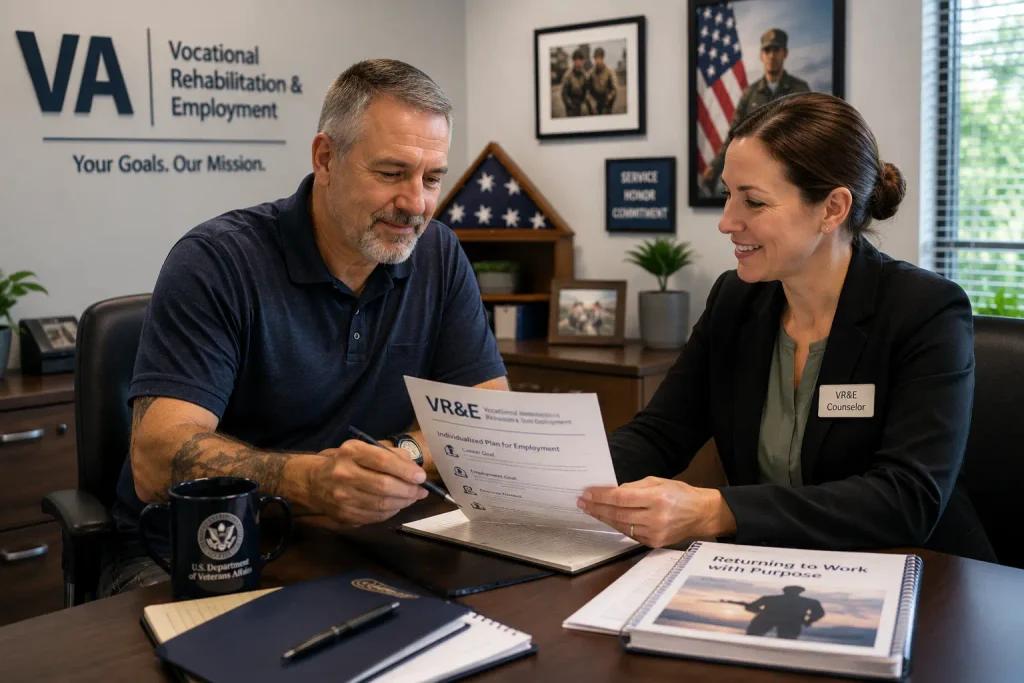
The absolute safest way to test your ability to return to work is by using the official Veteran Readiness and Employment (VR&E / Chapter 31) program. By working with a VA vocational counselor, you create a documented, protected rehabilitation plan. This shows the VA you are struggling to re-enter the workforce through official channels, which helps shield you from unprompted re-evaluations.
Practical Case Study: Keeping TDIU Benefits While Earning Above the Poverty Line
Let’s look at a real-world 2026 example of how to leverage the Protected Work Environment loophole.
Michael is a veteran receiving TDIU due to severe combat-related PTSD and traumatic brain injury (TBI). He cannot handle loud noises, strict schedules, or interacting with the public.
His uncle owns a private landscaping business and offered Michael a job mowing lawns for $30,000 a year. This salary is nearly double the 2026 Federal Poverty Threshold ($15,960).
Normally, the VA would revoke his TDIU benefits for engaging in Substantially Gainful Employment. However, Michael’s uncle submitted a sworn Lay Statement to the VA detailing his extreme accommodations:
- Michael is allowed to walk off the job at any moment if he feels a panic attack starting.
- He is never penalized for missing weeks of work during depressive episodes.
- He is isolated from all customers.
The VA reviewed the evidence and determined Michael worked in a Protected Work Environment. Because a traditional landscaping company would have fired him immediately, his job did not count as substantially gainful employment. Michael kept his $30,000 salary and his 100% TDIU compensation.
Frequently Asked Questions (FAQ) About Veteran Employment
Does working affect my VA Pension?
Yes, dramatically. There is a massive difference between VA Disability Compensation and a VA Pension. VA Disability is based purely on your service-connected injuries and, unless you are on TDIU, has no income limits. A VA Pension, however, is a strict, needs-based program for wartime veterans. Your VA Pension is reduced dollar-for-dollar by almost any income you earn from working.
Can I work part-time on TDIU?
Yes, but you must strictly limit your hours to ensure your gross annual income stays below the poverty line. To maintain Marginal Employment in 2026, your total earnings before taxes cannot cross the Department of Health and Human Services (HHS) / Census Bureau poverty threshold limit of $15,960. Use the hourly cheat sheet provided above to cap your weekly shifts safely.
Disclaimer: The information provided on this website does not, and is not intended to, constitute legal advice. All information, content, and materials available on this site are for general informational and educational purposes only. Laws regarding employment and labor rights frequently change, and while we strive to keep our content updated, the information on this website may not constitute the most up-to-date legal or other information.
Use of, and access to, this website or any of the links or resources contained within the site do not create an attorney-client relationship between the reader, user, or browser and the website authors, contributors, or its owners. We are an independent publishing platform, not a law firm.
Readers of this website should contact a qualified employment attorney in their specific state to obtain advice with respect to any particular legal matter. No reader or user of this site should act or refrain from acting on the basis of information on this site without first seeking legal advice from counsel in the relevant jurisdiction. Only your individual attorney can provide assurances that the information contained herein – and your interpretation of it – is applicable or appropriate to your particular situation.
References & Official Legal Resources
For official federal guidelines, regulatory definitions under Title 38 of the Code of Federal Regulations, and current poverty thresholds regarding veteran employment, please consult the authoritative resources below:
-
VA Individual Unemployability (TDIU) Regulations:
Review official eligibility requirements, marginal employment rules, and 38 CFR § 4.16 guidelines at the VA Individual Unemployability Portal. -
U.S. Department of Health and Human Services (HHS) Poverty Guidelines:
Verify the official federal poverty thresholds used by the VA to define marginal employment limits via the HHS Federal Poverty Guidelines. -
VA Veteran Readiness and Employment (VR&E / Chapter 31):
Learn about official vocational rehabilitation programs and safe workforce re-entry support on the VA VR&E Official Portal. -
Social Security Administration (SSA) SGA Limits:
Cross-reference monthly earnings limits for veterans who collect both VA compensation and SSDI at the SSA Substantial Gainful Activity Page. -
VA Disability Compensation vs. Pension Rules:
Understand the statutory differences between service-connected disability pay and needs-based pension benefits at the VA Disability Compensation Overview.