
If you were recently fired or discriminated against, you are likely overwhelmed. You are searching for answers at midnight. You want justice, but you cannot afford an expensive hourly attorney. You might be wondering: can the EEOC sue on my behalf? You want the federal government to step in, fight your former boss, and win your case for free.
This is a common hope. Unfortunately, the legal system rarely works this way. Relying entirely on the government to fight your personal legal battle is a dangerous mistake. In this 2026 worker survival guide, we will give you the brutal, honest truth about federal discrimination claims. We will show you how to protect your rights, avoid bureaucratic traps, and successfully take your employer to court.
Can the EEOC file a lawsuit against my employer on my behalf?
Yes, the Equal Employment Opportunity Commission (EEOC) has the legal authority to sue your employer on your behalf. However, this is extremely rare. The EEOC litigates less than 1% of charges. In most cases, they will investigate and issue you a Notice of Right to Sue.
Why Exhaustion of Administrative Remedies is mandatory
If the government will not sue for you, why bother filing? Because you have no choice. Under federal law, you cannot just walk into a courthouse and sue your employer for discrimination.
You must first file a formal charge. This legal rule is called the Exhaustion of Administrative Remedies. It forces you to give the government a chance to fix the problem first. Only after the EEOC finishes processing your claim can you hire a private lawyer to fight your boss in a federal courtroom.
How does the EEOC decide which cases to litigate in 2026?
The EEOC uses its limited budget to pursue high-profile, high-impact cases rather than single-plaintiff disputes. They prioritize Systemic Discrimination, widespread violations of the Pregnant Workers Fairness Act (PWFA), and emerging issues like algorithmic AI hiring bias that affect large classes of workers.
The difference between single-plaintiff disputes and Systemic Discrimination
Many workers feel crushed when the EEOC drops their case. They think it means their case was bad. Usually, it just means you are a single plaintiff.
A single-plaintiff dispute involves one worker and one bad manager. Systemic Discrimination involves a company-wide policy that hurts hundreds of people. For example, if a corporate AI resume scanner automatically rejects minority applicants, the EEOC will sue. That is a systemic issue. If your specific boss fired you for reporting sexual harassment, your case is valid, but the EEOC expects you to hire a private attorney to handle it.
What does a Dismissal and Notice of Rights actually mean?
A Dismissal and Notice of Rights does not necessarily mean your case is legally weak. Often, it simply means the agency lacks the resources to investigate further. This letter officially clears the administrative path for you to file a private lawsuit in federal court.
Decoding the Letter of Determination and the Conciliation Process
What happens in the rare event the EEOC believes you? They issue a Letter of Determination. This letter states there is “reasonable cause” to believe your employer broke the law.
Next, the EEOC attempts the Conciliation Process. This is a mandatory, good-faith effort to force your employer to settle the case out of court. If your employer refuses to settle, the EEOC will finally decide whether to file a lawsuit on your behalf or hand the case back to you.
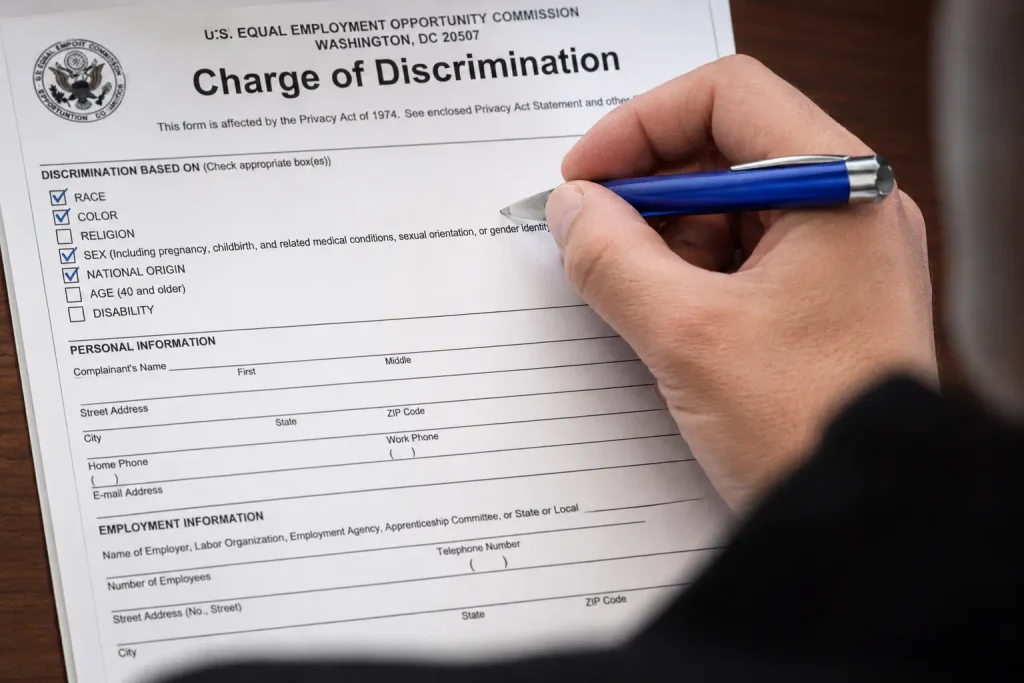
How does your initial EEOC Charge of Discrimination limit your lawsuit?
The exact wording of your EEOC Charge of Discrimination permanently dictates your future lawsuit. If you omit specific claims—like retaliation—on the initial form, a federal judge will likely dismiss those claims later. This is a very common trap for unrepresented workers.
Avoiding the “Drafting Trap” under Title VII, the ADA, and ADEA
When you fill out your initial form, you must check every applicable box.
If you suffered race discrimination under Title VII of the Civil Rights Act of 1964, check the race box. If you were also mocked for a disability under the Americans with Disabilities Act (ADA), check the disability box. If you were replaced by a younger worker under the Age Discrimination in Employment Act (ADEA), check the age box.
If you only complain about age discrimination on your EEOC form, but try to sue for disability discrimination later, the judge will throw out your disability claim. You failed to “exhaust your administrative remedies” for that specific issue.
What is the 90-day pre-planning strategy for filing a private lawsuit?
Once you receive your Notice of Right to Sue, a strict 90-Day Statute of Limitations begins ticking. Because this deadline is unforgiving, you must start interviewing private employment attorneys while your EEOC investigation is still ongoing to properly prepare your case.
Securing a Contingency-Fee Arrangement before the clock starts
You do not need thousands of dollars to hire an employment lawyer. Most worker rights attorneys operate on a Contingency-Fee Arrangement. This means they do not charge you upfront hourly rates. They only get paid a percentage of the money if they win your case or secure a settlement.
Do not wait for your right to sue letter to arrive. Start calling lawyers now. Show them your evidence. When the government letter finally comes in the mail, your lawyer will be ready to strike.
Practical Case Study: Bypassing the EEOC backlog to win a private settlement
Consider a 2026 worker who suffered Title VII violations. The EEOC issued a dismissal due to backlog. Because the worker preemptively hired an attorney through their state’s Fair Employment Practices Agency (FEPA), they filed a private federal lawsuit immediately, forcing a rapid, lucrative settlement.
Let’s look at a real-world example. Mark was fired after reporting severe racial harassment. He filed an EEOC Charge of Discrimination. He knew the agency was backlogged. He asked himself, can the EEOC sue on my behalf? He realized the odds were terrible.
Instead of waiting, Mark hired a private contingency lawyer. Six months later, the government issued a Dismissal and Notice of Rights. Mark did not panic. His lawyer immediately filed a lawsuit in federal court. Because Mark preserved his evidence and hired counsel early, his former employer panicked and offered a $150,000 settlement to avoid a public trial.
Frequently Asked Questions (FAQ) About EEOC Lawsuits and Procedures
If you recently filed a charge of discrimination, you likely have urgent questions about the legal process, timelines, and whether the government will represent you. Below, we answer the most common concerns regarding EEOC investigations, right to sue letters, and hiring private counsel.
Does the EEOC always issue a right to sue letter?
Yes, for almost 99% of workers. Whether the agency investigates your claim for two weeks or two years, the process almost always ends with this letter. The government simply does not have the lawyers or the funding to take every discriminatory employer to court. Getting this letter is a normal, necessary step in your journey to a private lawsuit.
What happens if the EEOC finds cause?
If the government issues a “Cause Determination,” you have incredible leverage. It means federal investigators reviewed the facts and agreed that your employer broke the law. Even if the EEOC ultimately decides they cannot sue on your behalf, you can take that “Cause Determination” straight to a private employment attorney. Employers are terrified of these letters. They often offer massive, rapid settlements to make the case disappear before you file a private lawsuit.
Disclaimer: The information provided on this website does not, and is not intended to, constitute legal advice. All information, content, and materials available on this site are for general informational and educational purposes only. Laws regarding employment and labor rights frequently change, and while we strive to keep our content updated, the information on this website may not constitute the most up-to-date legal or other information.
Use of, and access to, this website or any of the links or resources contained within the site do not create an attorney-client relationship between the reader, user, or browser and the website authors, contributors, or its owners. We are an independent publishing platform, not a law firm.
Readers of this website should contact a qualified employment attorney in their specific state to obtain advice with respect to any particular legal matter. No reader or user of this site should act or refrain from acting on the basis of information on this site without first seeking legal advice from counsel in the relevant jurisdiction. Only your individual attorney can provide assurances that the information contained herein – and your interpretation of it – is applicable or appropriate to your particular situation.
Know your rights.
References & Official Legal Resources
For official federal guidelines, litigation statistics, and statutory information regarding EEOC charges and private lawsuits, please consult the authoritative resources below:
-
EEOC Official Litigation Overview & Statistics:
Learn how the federal government selects cases for litigation and review official enforcement statistics on the EEOC Official Litigation Portal. -
EEOC – What You Can Expect After You File a Charge:
Understand the step-by-step investigation process, conciliation efforts, and the issuance of right to sue letters via the EEOC Post-Filing Guidance Page. -
EEOC Systemic Discrimination Enforcement:
Discover how the agency prioritizes class-action lawsuits, algorithmic bias, and systemic violations at the EEOC Systemic Discrimination Portal. -
Title VII of the Civil Rights Act of 1964:
Review the foundational statutory text granting the EEOC authority to enforce anti-discrimination laws via the EEOC Title VII Statutory Portal. -
EEOC Strategic Enforcement Plan (SEP):
Explore the agency’s official litigation and enforcement priorities for federal discrimination claims through EEOC Official Strategic Guidance.