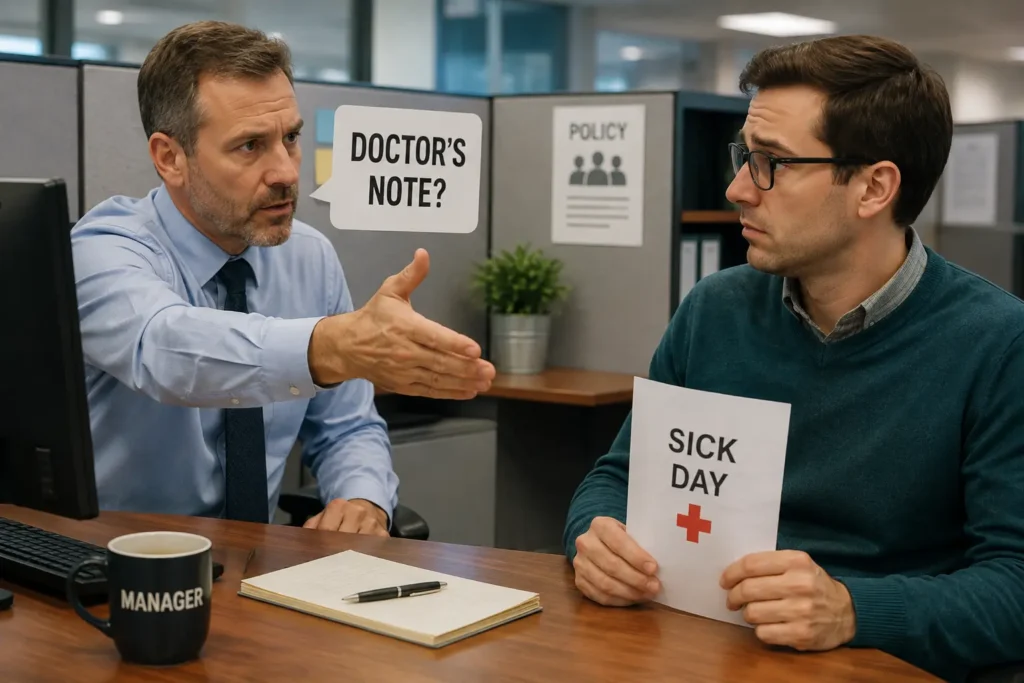
If you are sick in bed wondering, “can my employer ask for a doctor’s note,” the short answer is usually yes. However, their right to demand a note is heavily restricted by new state laws and federal privacy rules. You do not have to hand over your entire medical history just because you caught the flu.
Many workers panic, fearing they will be fired or forced to pay huge urgent care copays. But the rules have changed in 2026. This guide will show you exactly what your boss is legally allowed to see, how new state sick leave laws protect you from unfair demands, and how to defend your medical privacy.
Does the At-Will Employment Doctrine allow employers to require medical documentation?
Yes. Under the At-Will Employment Doctrine, your boss can generally set strict attendance policies as a condition of your employment. This includes requiring medical documentation or a medical excuse when you call out sick, as long as the rule applies equally to everyone.
Distinguishing Between Attendance Verification and Diagnostic Privacy
There is a massive difference between verifying your absence and invading your privacy. Your employer is allowed to ask for attendance verification. They can require a doctor to confirm you were seen and state how long you need to be off work.
However, they cannot demand to know your specific medical diagnosis. Your diagnostic privacy is protected. Your manager does not need to know if you have a stomach bug, COVID-19, or are dealing with a severe anxiety attack. They only need to know you are medically excused.

Is it a HIPAA violation for my boss to ask for a doctor’s note?
No. This is a very common myth. The HIPAA Privacy Rule applies to healthcare providers, not employers. It is not a HIPAA violation for your boss to ask for a note. However, HIPAA prevents your doctor from releasing your medical records to your employer without your written consent.
How Title I of the Americans with Disabilities Act (ADA) Actually Protects You
While HIPAA does not stop your boss from asking, the Americans with Disabilities Act (ADA) does protect you from invasive questions. Title I of the ADA strictly limits an employer’s ability to make medical inquiries.
Your employer cannot ask questions likely to reveal a disability unless it is strictly job-related and consistent with business necessity. If your boss demands a detailed medical history just because you missed a shift, they are likely violating the ADA, not HIPAA.
How do 2026 state sick leave laws and the “3-Day Rule” limit employers?
In 2026, many states prohibit employers from demanding a doctor’s note for short absences. If you work in states like California, New York, Washington, or New Jersey, strong paid sick leave laws enforce the “3-Day Rule.” Employers cannot require a note unless you miss more than three consecutive days.
Consecutive Absences and Out-of-Pocket Expense Reimbursement
The legal trigger point for requiring a note is usually three consecutive absences. If you call out on a Tuesday, your boss cannot legally force you to bring a note on Wednesday in these protected states.
Furthermore, acquiring a note is a real out-of-pocket expense. In some jurisdictions and under many modern union contracts, if an employer mandates a doctor’s note to prove illness, the employer must reimburse you for your urgent care copay. Check your local State Department of Labor (State DOL) guidelines to see if your employer owes you money for that clinic visit.
Can HR call your doctor to verify a telehealth or clinic note?
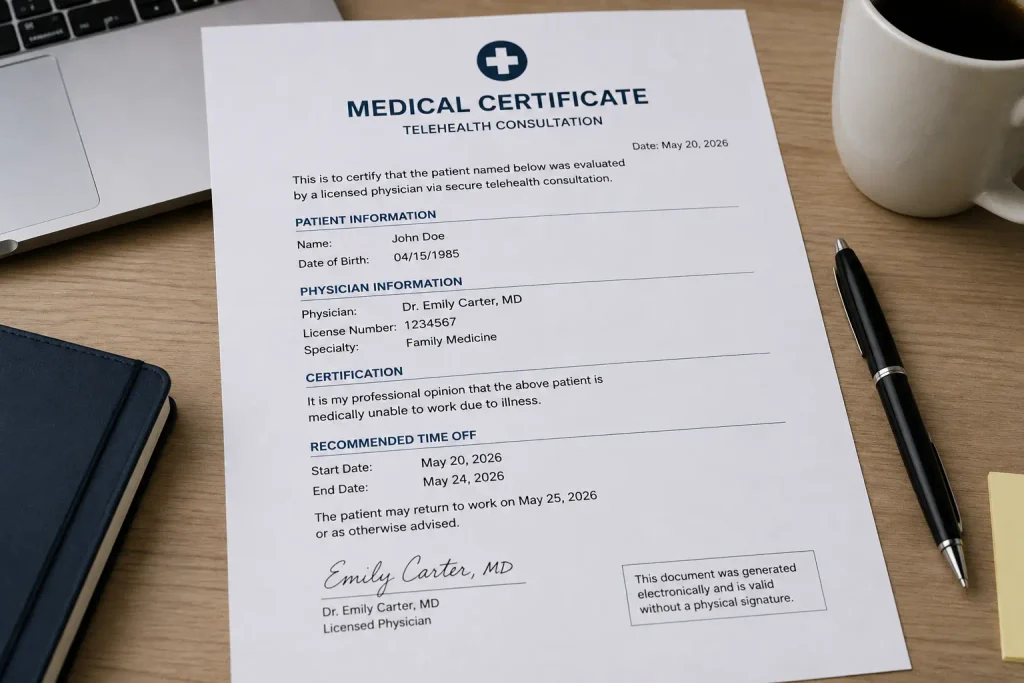
Yes, Human Resources (HR) can call the doctor’s office or clinic to verify the note’s authenticity. They can confirm the document is not forged. However, they cannot ask the doctor any questions about your health, your symptoms, or your diagnosis. Telehealth / Telemedicine certificates are entirely valid and legally binding.
What the Note Actually Needs to Say for Fitness-for-Duty Certification
A standard sick note is very brief. If you are returning from a longer illness, your employer may require a Fitness-for-Duty Certification.
This document only needs to state three things:
- The dates you were evaluated.
- The dates you are excused from work.
- Any physical restrictions upon your return (e.g., “cannot lift over 20 lbs for one week”).
If you use a telehealth app to get your note, ensure the digital PDF clearly states these three points.
Practical Case Study: Navigating the 3-Day Rule and Reasonable Accommodation in 2026.
Let’s look at a real-world scenario to understand how state laws and federal protections overlap when you are forced to prove your illness.
The Scenario: A Manager Demands a Note for a One-Day Absence
David works retail in California. He wakes up with a migraine and uses his legally accrued paid sick leave for a single Tuesday shift. His manager texts him: “You must bring a doctor’s note tomorrow or you will be written up.”
David cannot afford a $50 copay for a one-day migraine. He is stressed and worried about losing his job.
The Resolution: Escalating to the State DOL and Requesting ADA Accommodation
David knows his rights. He emails HR, citing the California paid sick leave law. He explains that under the 3-day rule, the manager’s demand for a one-day note is illegal. HR immediately cancels the write-up.
Because David’s migraines are chronic, he also initiates a formal request for a reasonable accommodation under the ADA. He provides a single, one-time letter from his neurologist stating he requires occasional unpaid time off for migraines. This single document protects his job moving forward, completely eliminating the need for daily urgent care notes.
Frequently Asked Questions: Protecting your rights when calling out sick.
Can I be fired for refusing to provide a doctor’s note?
Yes. In an at-will state, if your employer makes a lawful request for a medical excuse based on company policy, refusing to provide it is considered insubordination. Unless a specific state sick leave law protects your short absence, you can be legally terminated for refusing.
Does FMLA require a different type of medical paperwork?
Yes. A standard urgent care note is not enough for the Family and Medical Leave Act (FMLA). If you need long-term job-protected leave, you must submit a formal FMLA Medical Certification. This is a standardized Department of Labor (DOL) form your doctor must fill out, detailing your serious health condition.
Do I need a doctor’s note to take a mental health day?
If you miss enough consecutive days to trigger your company’s note policy, yes. However, the note does not need to specify “mental health.” A licensed therapist, psychiatrist, or telehealth provider can simply write that you are “under medical care” and unable to work. Your mental health diagnosis remains completely private.
Disclaimer: The information provided on this website does not, and is not intended to, constitute legal advice. All information, content, and materials available on this site are for general informational and educational purposes only. Laws regarding employment and labor rights frequently change, and while we strive to keep our content updated, the information on this website may not constitute the most up-to-date legal or other information.
Use of, and access to, this website or any of the links or resources contained within the site do not create an attorney-client relationship between the reader, user, or browser and the website authors, contributors, or its owners. We are an independent publishing platform, not a law firm.
Readers of this website should contact a qualified employment attorney in their specific state to obtain advice with respect to any particular legal matter. No reader or user of this site should act or refrain from acting on the basis of information on this site without first seeking legal advice from counsel in the relevant jurisdiction. Only your individual attorney can provide assurances that the information contained herein – and your interpretation of it – is applicable or appropriate to your particular situation.
Know your rights.
Official Resources and Legal References
If you need to verify your rights regarding medical privacy, doctor’s notes, or statutory sick leave, please consult the following official U.S. government and legal databases:
- U.S. Department of Health & Human Services (HHS): Official guidance explaining Employers and Health Information under the HIPAA Privacy Rule.
- U.S. Equal Employment Opportunity Commission (EEOC): Enforcement guidance on Disability-Related Inquiries and Medical Examinations of Employees under the ADA.
- U.S. Department of Labor (DOL): Standardized forms and instructions for FMLA Medical Certifications.
- Job Accommodation Network (JAN): Comprehensive guidelines on Medical Inquiry and Documentation for Reasonable Accommodations.
Disclaimer: This article is for informational and educational purposes only and does not constitute formal legal advice. Always consult with a qualified employment attorney or your state’s labor board regarding your specific workplace situation.
Can my employer as for a doctor’s note
keywords: can my employer ask for a doctor’s note, is asking for a doctor’s note a HIPAA violation, 3 day rule doctor note state law, can employer call my doctor to verify note, can employer call my doctor to verify note, can you be fired for no doctor note, ADA title I medical inquiry limits, fitness for duty certification requirements, FMLA medical certification vs doctor note, doctor note for mental health day, out of pocket copay reimbursement doctor note, at will employment attendance policy medical excuse
Can My Employer Ask for a Doctor’s Note, Can My Employer Ask for a Doctor’s Note, Can My Employer Ask for a Doctor’s Note, Can My Employer Ask for a Doctor’s Note, Can My Employer Ask for a Doctor’s Note,