
If you are an exempt worker asking, “how does intermittent fmla work for salaried employees,” you are likely about to discover a shocking truth. Yes, your employer can legally dock your fixed salary. Unpaid FMLA leave is the one major federal exception to the laws that usually protect your guaranteed paycheck.
But you are not powerless. You do not have to accept unfair pay deductions or illegal demotions just because you need medical care. This 2026 guide explains exactly how to protect your paycheck, how to prove your eligibility even if you never punch a clock, and how to stop HR from weaponizing your health against your career.
Can my employer dock my salary for partial-day FMLA absences?
Yes. If you take unpaid intermittent leave, your employer can legally dock your pay for those specific hours. This is the only major exception to federal wage laws that otherwise protect a salaried worker’s fixed, guaranteed weekly paycheck.
The FLSA “Salary Basis” Rule and Proportionate Salary Deductions
Under normal circumstances, the Fair Labor Standards Act (FLSA) enforces the “salary basis” rule. This means if you have salaried exempt status, you must receive your full salary whether you work 35 hours or 55 hours in a week.
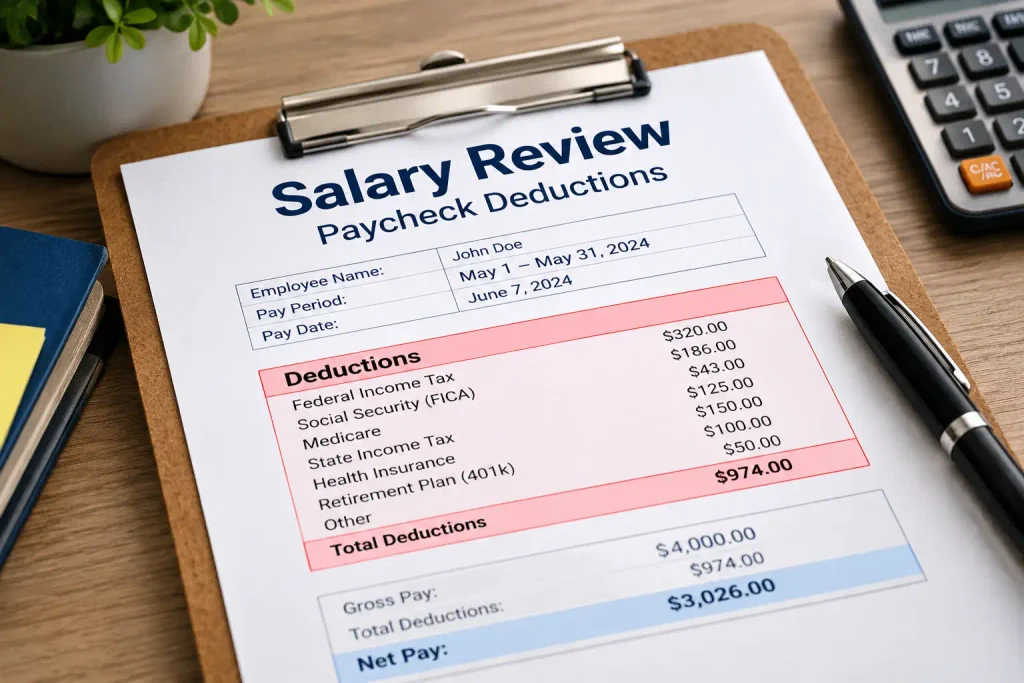
However, FMLA is the grand exception. If you take four hours off on a Tuesday for a medical treatment, HR can make proportionate salary deductions (often called pay docking). If you earn $2,000 for a standard 40-hour week ($50/hour), they can legally deduct $200 from your next paycheck for those four partial-day absences.
How do you prove the 1,250-hour requirement if you don’t punch a clock?
You do not have to prove it; your employer does. If your company does not track your daily work hours, federal law automatically presumes you met the 1,250-hour threshold as long as you have been employed there for 12 months.
The Department of Labor (DOL) Burden of Proof on Employers
The 1,250-hour requirement is mandatory to qualify for FMLA. But salaried professionals rarely use timecards. So, how do you prove you worked enough?
To protect workers, the Wage and Hour Division (WHD) of the Department of Labor (DOL) places the burden of proof entirely on the employer. If HR wants to deny your leave by claiming you only worked 1,100 hours last year, they must produce exact time records to prove it. If they failed to track your hours, you win by default.
How is your total FMLA time bucket calculated if you work 50+ hours a week?
Your 12-week FMLA bucket is based on your actual average workweek, not a standard 40-hour week. If you consistently work 55 hours a week, you are legally entitled to 660 hours of intermittent leave, not 480.
Establishing a Written Schedule Agreement for Intermittent Leave
Employers often try to shortchange overworked managers by giving them a standard 480-hour bucket. To stop this, you and HR must create a written schedule agreement.
This internal document establishes your true “average workweek.” If you regularly put in 55 hours, this agreement ensures your reduced schedule leave is calculated fairly, giving you the exact amount of time you have legally earned.
Can HR force you to use PTO or convert your pay to hourly during FMLA?
Yes, HR can mandate that you drain your accrued paid time off to cover FMLA absences. Shockingly, they can also temporarily transfer you to an hourly role to make tracking easier, provided your base pay rate and benefits remain identical.
Concurrent Leave, PTO Exhaustion, and Hourly Conversion
Employers hate the logistical nightmare of tracking partial days for salaried staff. Their first tactic is concurrent leave (also known as PTO exhaustion). They will legally force you to use your sick and vacation days to cover your missed FMLA hours so they do not have to dock your pay.
If you run out of PTO, they might initiate an alternative position transfer or hourly conversion. They can temporarily move you to a different role or pay you hourly to make payroll easier. However, the law dictates that the new setup must offer equivalent pay, benefits, and status. It cannot be used to punish or demote you.
Practical Case Study: Navigating Salary Deductions and Job Transfers in 2026.
Let’s look at how these complex rules play out in the real world for a salaried professional trying to balance their health and their career.
The Scenario: A Manager Needs Weekly Medical Treatments
Sarah is a salaried Marketing Director earning $104,000 a year. She was recently diagnosed with a condition requiring chemotherapy every Friday morning. She applies for intermittent FMLA for these recurring partial-day absences.
Her HR department approves the leave but tells her she will be transferred to a lower-level “hourly analyst” role because tracking a director’s missed hours is “too complicated.”
The Resolution: Negotiating Hourly Conversions and Pay Protection
Sarah knows her rights. She cites the DOL rule stating that an alternative position transfer cannot be a demotion.
She negotiates a strict compromise. She agrees to a temporary hourly conversion for payroll purposes (calculated precisely at her $50/hour rate), but she legally retains her Director title, her office, and her executive benefits. Once her Friday treatments conclude, her employer is legally required to restore her full salaried status.
Frequently Asked Questions: Protecting your paycheck and career during FMLA.
What is the exact definition of a partial-day absence under intermittent leave?
A partial-day absence is any time taken off that is less than a full workday. Employers can track this in the smallest increment their payroll system allows. If their timekeeping software tracks in 15-minute increments, they can dock your salary for exactly 15 minutes of missed work.
Does the Family and Medical Leave Act (FMLA) require a specific medical certification?
Yes. You must provide a formal Medical Certification from your healthcare provider. This form confirms to HR that your condition requires unpredictable symptom flare-ups or scheduled medical treatments. It does not, however, give your employer the right to access your entire medical history.
Can I be fired or demoted for taking reduced schedule leave?
Absolutely not. The Family and Medical Leave Act (FMLA) strictly prohibits employer retaliation. While a company can temporarily transfer you to better accommodate your unpredictable schedule, it must be to an equivalent role. You must be fully reinstated to your original position when your leave concludes.
Disclaimer: The information provided on this website does not, and is not intended to, constitute legal advice. All information, content, and materials available on this site are for general informational and educational purposes only. Laws regarding employment and labor rights frequently change, and while we strive to keep our content updated, the information on this website may not constitute the most up-to-date legal or other information.
Use of, and access to, this website or any of the links or resources contained within the site do not create an attorney-client relationship between the reader, user, or browser and the website authors, contributors, or its owners. We are an independent publishing platform, not a law firm.
Readers of this website should contact a qualified employment attorney in their specific state to obtain advice with respect to any particular legal matter. No reader or user of this site should act or refrain from acting on the basis of information on this site without first seeking legal advice from counsel in the relevant jurisdiction. Only your individual attorney can provide assurances that the information contained herein – and your interpretation of it – is applicable or appropriate to your particular situation.
Know your rights.
Official Resources and Legal References
To verify the exact federal regulations regarding FMLA intermittent leave, salary deductions, and hour calculation methods for exempt employees, please consult the following official U.S. government resources:
- U.S. Department of Labor (DOL): Fact Sheet #28I explaining Calculation of Leave under the FMLA, including guidelines for workers who regularly average over 40 hours per week.
- Wage and Hour Division (WHD): Fact Sheet #17G detailing Salary Basis Requirements and FLSA Exceptions, clarifying why docking pay during FMLA leave is legally permitted.
- Electronic Code of Federal Regulations (eCFR): Title 29 § 825.205 on How Intermittent Leave or a Reduced Leave Schedule is Calculated.
- DOL FMLA Portal: Downloadable, official FMLA Medical Certification Forms (WH-380-E) for employee serious health conditions.
Disclaimer: This article is for informational and educational purposes only and does not constitute formal legal advice. Always consult with a qualified employment attorney or your state’s labor board regarding your specific workplace situation.
Keywords: how does intermittent fmla work for salaried employees, can employer dock salary for intermittent FMLA, FLSA salary basis rule FMLA exception, 1250 hours salaried exempt FMLA burden of proof, intermittent FMLA hourly conversion, forcing PTO for intermittent FMLA salaried, partial day absences intermittent FMLA, reduced schedule leave salaried exempt, written schedule agreement FMLA workweek, DOL WHD intermittent FMLA calculation, intermittent FMLA protection against demotion,
how does intermittent fmla work for salaried employees, how does intermittent fmla work for salaried employees, how does intermittent fmla work for salaried employees, how does intermittent fmla work for salaried employees, how does intermittent fmla work for salaried employees, how does intermittent fmla work for salaried employees, how does intermittent fmla work for salaried employees, how does intermittent fmla work for salaried employees