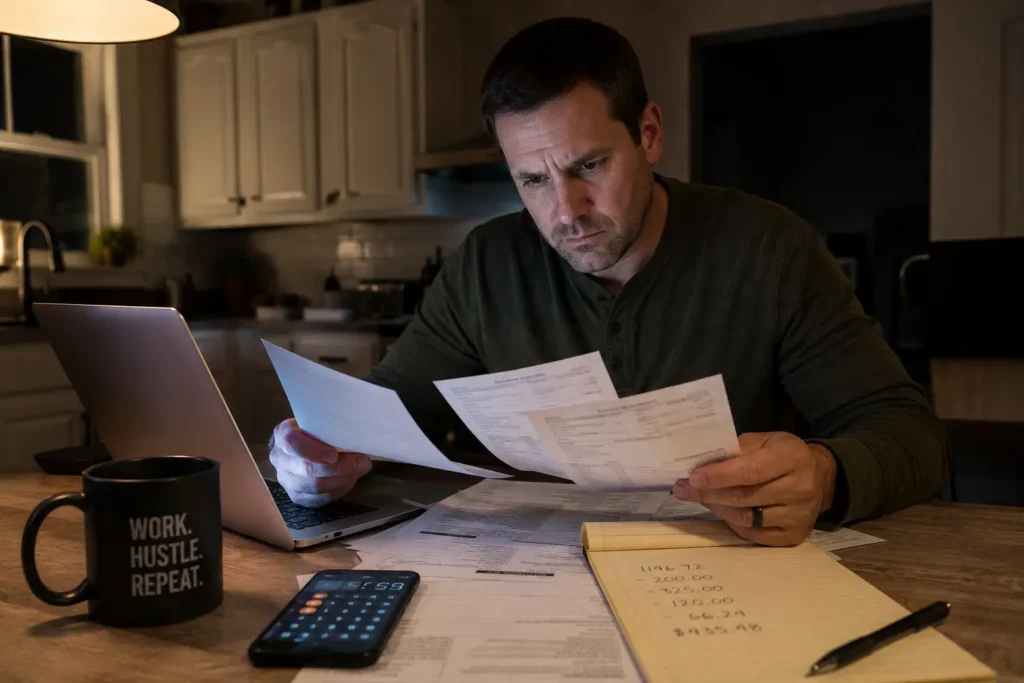
If you are searching for an employment lawyer for unpaid wages, what should you know first is simple: you do not need money upfront to hire one. Most wage and hour attorneys work on a contingency fee basis, meaning they only get paid if you win. Better yet, federal law often forces your employer to pay your legal fees on top of your stolen wages.
Right now, you might be staring at a short paycheck, calculating unpaid overtime hours, or wondering how to pay rent after an unfair firing. You have powerful legal rights under the Fair Labor Standards Act (FLSA) and state labor laws. This guide breaks down when to hire a wage theft attorney, when to file a free government claim yourself, and how much money you can actually recover in 2026.
Should You Hire an Employment Lawyer or File a Wage Claim Yourself?
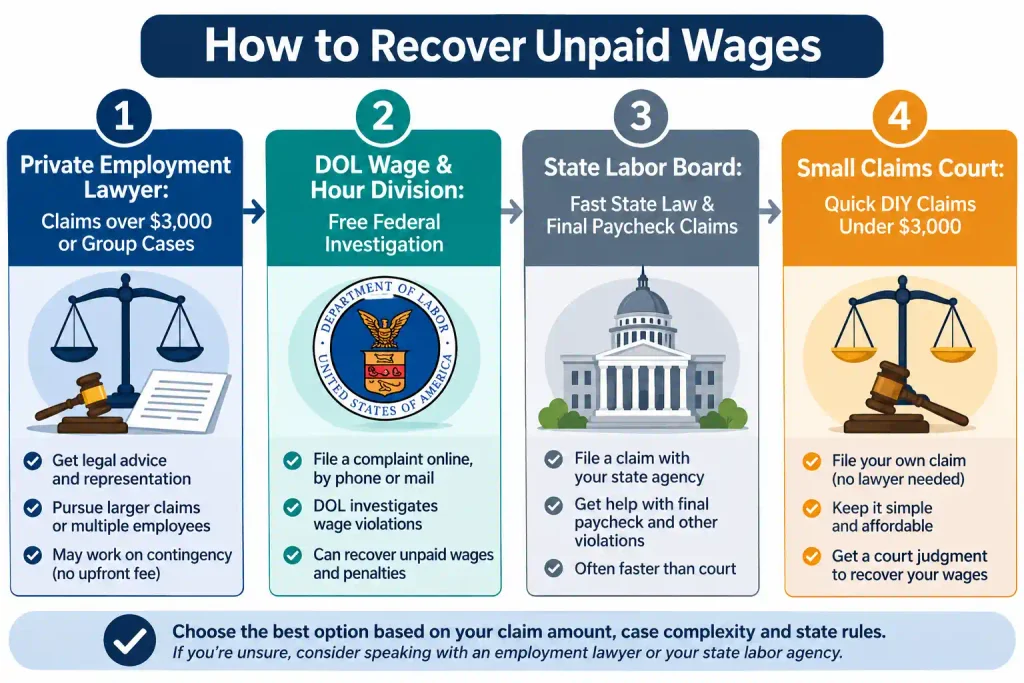
You should hire a private employment lawyer for unpaid wages if your missing pay exceeds $3,000 to $5,000, affects multiple coworkers, or involves workplace retaliation. For smaller, standalone paycheck disputes under $3,000, filing a free administrative claim with the U.S. Department of Labor (DOL) or your state labor commissioner is usually faster and puts more money in your pocket.
Law firm blogs rarely tell you this truth: private attorneys have high overhead costs. If an employer shorted your final paycheck by $900, most private lawyers will politely decline your case because the legal hours required outweigh the recovery. Knowing which path fits your situation saves you weeks of frustration.
| Recovery Channel | Best For | Upfront Cost | Typical Timeline | Key Advantage |
| Private Wage & Hour Lawyer | Claims over $3,000, complex misclassification, or coworker-wide theft | $0 (Contingency: 33%–40%) | 4 to 18+ months | Aggressive negotiation, double damages, and class/collective action power |
| DOL Wage & Hour Division (WHD) | Federal minimum wage or overtime violations of any dollar size | $0 (Free federal agency) | 3 to 9 months | Government auditors investigate payroll records without you paying fees |
| State Labor Commissioner | Strict state laws (meal breaks, daily overtime, late final paychecks) | $0 (Free state agency) | 2 to 12 months | Enforces state penalties that exceed federal protections |
| Small Claims Court | Simple unpaid bills or small final paychecks (usually under $5,000–$10,000) | $30 to $100 filing fee | 1 to 3 months | Fast judgment without needing formal legal representation |
When a Private Wage and Hour Attorney Makes Financial Sense
Hire an unpaid wages attorney immediately if any of these red flags apply to your job:
- Your losses are substantial: Unpaid overtime or off-the-clock work spanning months or years easily crosses $5,000.
- Coworkers suffer the same violation: If your company forces an entire shift to work off the clock, a lawyer can file an FLSA collective action (an opt-in group lawsuit) or a Rule 23 class action.
- You were misclassified: Your boss calls you a “salaried manager” or a “1099 independent contractor” to avoid paying overtime.
- Your employer retaliated: You were fired, demoted, or had your hours cut after asking about missing pay.
How to File a Free Claim with the DOL Wage and Hour Division (WHD) or State Labor Board
If your claim is straightforward and under $3,000, government agencies work for free. The U.S. Department of Labor Wage and Hour Division (WHD) investigates federal minimum wage and overtime violations confidentially. You do not even need to tell your boss you filed.
If you live in a state with strong worker protections—like California, New York, Illinois, or Washington—file directly with your State Labor Commissioner (such as the California Labor Commissioner’s Office). State agencies enforce higher minimum wages and strict penalties for bounced or late final paychecks.
Using Small Claims Court for Low-Dollar Final Paycheck Disputes
Did you quit a job and your former boss refuses to hand over your last $1,200 paycheck? Small claims court lets you sue without a lawyer. Filing costs around $50, and a judge usually hears your case within 60 days. Bring your offer letter, pay stubs, and text messages demanding payment.
How Much Does an Employment Lawyer Cost for Unpaid Wages?
Most plaintiff-side employment lawyers charge $0 upfront and work on a contingency fee agreement, taking 33% to 40% of your final settlement only if they win your case. Furthermore, under FLSA statutory fee-shifting (29 U.S.C. § 216(b)), a losing employer is legally required to pay your attorney’s fees separately from your back pay.
Many scared workers delay calling an unpaid overtime lawyer because they assume attorneys charge $400 an hour. While corporate defense lawyers bill by the hour, lawyers who represent workers take the financial risk themselves. If you lose, you owe them nothing for their time.
Contingency Fee Agreements vs. FLSA Statutory Fee-Shifting Explained
Understanding how your lawyer gets paid protects you during contract signing:
- Pure Contingency Split: In an out-of-court settlement, your lawyer typically takes one-third (33.3%) of the total pot, rising to 40% if the case goes to trial or formal arbitration.
- Statutory Fee-Shifting: Federal law includes a powerful weapon for workers. Under the Fair Labor Standards Act, if you win in court, the judge orders your employer to pay your lawyer’s reasonable hourly fees on top of what they owe you. Your lawyer uses this rule as leverage during settlement talks so your take-home payout stays high.
Who Pays Court Costs, Filing Fees, and Arbitration Expenses?
Every lawsuit carries hard expenses, such as U.S. District Court filing fees ($405), deposition transcripts, and expert payroll audits. Reputable wage attorneys advance these costs for you and deduct them from the settlement at the end. Always ask during your consultation: “If we lose, am I responsible for reimbursing case costs?” Look for a firm that absorbs costs if there is no recovery.
What Counts as Illegal Wage Theft Under Federal and State Law in 2026?
Wage theft occurs whenever an employer fails to pay you the full wages, overtime, tips, or benefits guaranteed by the Fair Labor Standards Act (FLSA) or state labor statutes. Common 2026 violations include unpaid off-the-clock labor, misclassifying hourly workers as salaried or 1099 contractors, illegal tip pooling, and withholding final paychecks.
Wage theft is rarely dramatic. Usually, it happens quietly through payroll policies that shave 15 minutes off your day or label you “exempt” so you never see an overtime check.
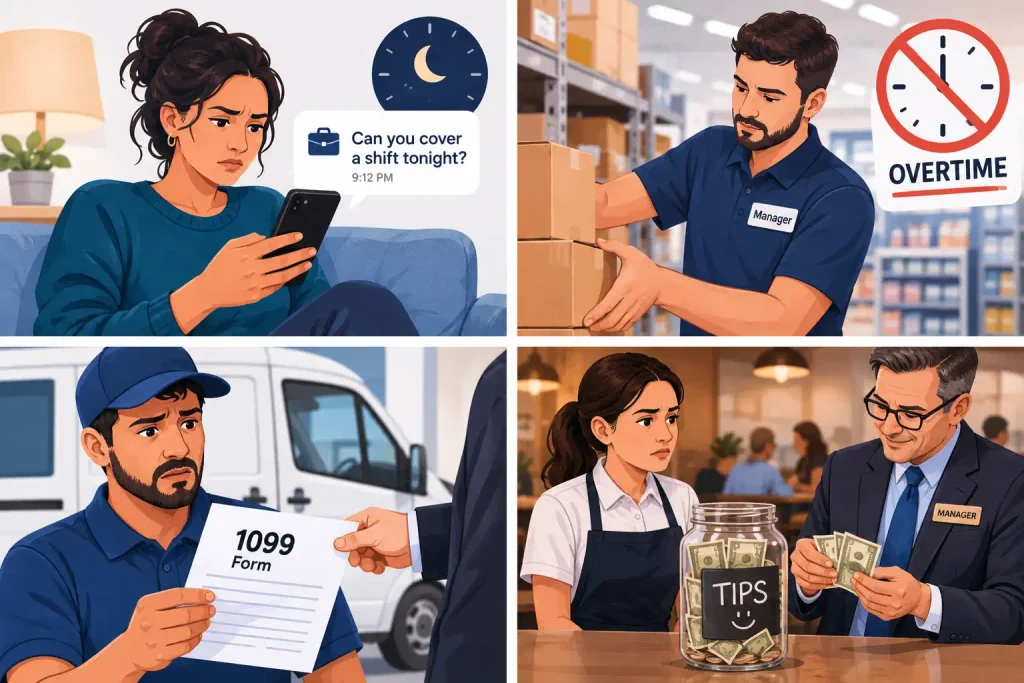
Off-the-Clock Work, Unpaid Meal Breaks, and Pre-Shift Setup
If your boss requires your time or attention, the law considers you on the clock. You must be paid for:
- Booting up computer systems, logging into software, or putting on mandatory safety gear before clocking in.
- Locking doors, setting alarms, or counting cash registers after clocking out.
- Working through an unpaid 30-minute meal break (for example, eating at your desk while answering customer calls).
- Answering emails, Slack messages, or work texts on your day off.
Salary Misclassification and the 2026 FLSA Overtime Threshold ($684/Week)
One of the biggest myths in American workplaces is that salaried employees never get overtime. Under federal law, being paid a salary does not make you exempt from overtime.
To legally deny you overtime under the FLSA White-Collar Exemptions (Executive, Administrative, or Professional), your employer must prove two things in 2026:
- The Salary Test: You earn at least $684 per week ($35,568 per year) on a guaranteed salary basis. (Note: Following federal court rulings that vacated earlier 2024 DOL threshold hikes, $684/week remains the enforced federal floor in 2026, though states like California, New York, and Washington enforce much higher salary thresholds exceeding $65,000–$80,000 per year).
- The Duties Test: Your primary daily job actually involves executive management, independent business judgment, or advanced professional knowledge. Giving a cashier the title “Assistant Manager” while they spend 90% of their shift stocking shelves is illegal misclassification.
1099 Independent Contractor Misclassification Under the 2026 DOL Economic Reality Rule
Some companies hand workers a 1099 tax form instead of a W-2 to dodge payroll taxes, workers’ compensation, and overtime pay. In November 2026, the U.S. Department of Labor finalized an updated rule under the FLSA that sharpens the Economic Reality Test around two core questions:
- Control: How much control does the company exercise over when, where, and how you perform your work?
- Opportunity for Profit or Loss: Can you genuinely earn more profit or suffer a loss based on your own business initiative and investment, or are you simply paid by the hour or per shift?
If you wear a company uniform, follow a mandatory schedule, and work exclusively for one business, you are likely an employee owed back overtime—regardless of what your contract says.
Tip Credit Abuse, Tip Pooling Violations, and Withheld Final Paychecks
Service workers face strict legal rules that employers frequently break:
- Tip Credit Shortfalls: Under federal law, employers can pay tipped workers $2.13/hour only if tips bring their average hourly pay up to at least $7.25/hour (or the higher state minimum wage). If a slow Tuesday leaves you short, your boss must pay the difference.
- Illegal Tip Pooling: Managers and supervisors are strictly barred from taking any share of an employee tip pool under federal law.
- Held Final Paychecks: An employer cannot hold your final paycheck hostage until you return a uniform, laptop, or keys. In states like California, every day your final check is late triggers waiting time penalties equal to a full day’s pay (up to 30 days).
How Much Money Can You Recover in an Unpaid Wages Lawsuit?
In an FLSA unpaid wages lawsuit, you can recover 100% of your unpaid back pay plus an equal amount in liquidated damages—effectively doubling your stolen wages. Depending on your state, you may also collect daily waiting time penalties, statutory interest, and reimbursement for all attorney’s fees.
Back Pay, Liquidated (Double) Damages, and State Waiting Time Penalties
When calculating what a wage theft lawyer can demand on your behalf, look at three distinct buckets of money:
- Back Pay: Every dollar of unpaid minimum wage, overtime, commissions, or stolen tips owed to you.
- FLSA Liquidated Damages (Double Damages): Federal law automatically awards an additional 100% of your unpaid wages as liquidated damages to compensate you for the delay in receiving your pay. An employer can only escape double damages if they prove in court that they acted in “good faith” and had reasonable grounds to believe they followed the law.
- State Statutory Penalties: State laws often stack extra penalties on top. For example, New York Labor Law awards 100% liquidated damages plus 9% annual interest and specific fines for missing wage notices.
The “Regular Rate of Pay” Trap: How Bonuses and Shift Differentials Increase Overtime
Most workers assume overtime is simply 1.5 times their base hourly wage. That assumption leaves thousands of dollars on the table.
Under the FLSA, your employer must calculate overtime using your Regular Rate of Pay, not your base rate. Your regular rate includes all non-discretionary bonuses (such as attendance bonuses, safety incentives, and production bonuses), commissions, and night-shift differentials.
Quick Example: Suppose you earn $20/hour base pay, work 50 hours in a week, and earn a $100 weekly production bonus.
- Total straight-time earnings: $(50 \text{ hours} \times \$20) + \$100 = \$1,100$.
- True Regular Rate: $\$1,100 \div 50 \text{ hours} = \$22.00/\text{hour}$.
- Overtime premium owed for those 10 extra hours: $10 \text{ hours} \times \$11.00 \text{ (half-time)} = \$110$ (instead of the $100 your boss probably paid).
Practical Case Study: How Off-the-Clock Work Compounds Into a $31,200 Claim
Small daily wage violations add up fast over time. If an employer forces a $20-per-hour worker to perform just 1 hour of unpaid pre-shift setup each day (5 hours per week), that missing pay compounds into $15,600 in unpaid overtime over three years—and $31,200 total once federal liquidated damages are applied.
Let’s walk through a real-world scenario to see how an employment lawyer for unpaid wages values a case.
The Situation: Maya works full-time (40 scheduled hours/week) at a logistics warehouse earning $20/hour. Her manager requires her to arrive 30 minutes early every morning to inspect equipment and attend a shift huddle before clocking in, and stay 30 minutes after clocking out to lock up and file reports. That equals 5 hours of unpaid work every week.
Step-by-Step Damages Breakdown (2-Year Standard vs. 3-Year Willful FLSA Window)
Because Maya already works 40 clocked hours, every single off-the-clock hour counts as overtime at 1.5x her regular rate ($30/hour):
- Weekly Unpaid Overtime: $5 \text{ hours} \times \$30/\text{hour} = \$150/\text{week}$.
- Annual Unpaid Overtime: $\$150/\text{week} \times 52 \text{ weeks} = \$7,800/\text{year}$.
- Standard 2-Year FLSA Recovery: $\$15,600 \text{ back pay} + \$15,600 \text{ liquidated damages} = \mathbf{\$31,200}$.
- Willful 3-Year FLSA Recovery: If Maya’s lawyer proves management knew they were violating the law (for instance, emails telling supervisors to “keep payroll under 40 hours”), the recovery window expands to 3 years: $\$23,400 \text{ back pay} + \$23,400 \text{ liquidated damages} = \mathbf{\$46,800}$ (plus attorney’s fees).
How Burden-Shifting Protects You When Your Employer Hides Time Records (Mt. Clemens Rule)
Workers often panic because they didn’t keep formal punch cards for off-the-clock work. Don’t worry. Under a landmark U.S. Supreme Court doctrine (Anderson v. Mt. Clemens Pottery Co.), the law places the legal duty to keep accurate time records squarely on the employer, not the worker.
If your employer failed to record your true hours, you only need to provide a reasonable, good-faith estimate of your schedule (backed by personal notes, texts, or coworker testimony). The burden then shifts to your employer to disprove your numbers—which is nearly impossible if they deleted or falsified logs.
What Should You Prepare Before Calling an Employment Lawyer?
Before contacting an employment lawyer for unpaid wages, gather your recent pay stubs, W-2 or 1099 tax forms, offer letter, personal logs of hours worked, and any text messages or emails discussing your schedule. Most importantly, pull your onboarding paperwork to check if you signed a mandatory arbitration agreement or class action waiver.
Essential Documents and Digital Evidence to Save Before You Lose System Access
If you are still employed, collect your proof today—before HR locks your company email or payroll portal:
- Pay Stubs & W-2/1099 Forms: Download at least 12 to 24 months of earnings statements showing hourly rates, overtime hours, and deductions.
- Personal Time Journal: Write down your actual daily start times, break interruptions, and end times in a personal notebook or phone app (never on a work computer).
- Written Proof of Hours: Save emails, Slack threads, shift schedules, or GPS location history showing when you arrived at and left the workplace.
- Coworker Contact Info: Write down the personal phone numbers of coworkers who witnessed the same pay practices.
Why You Must Check Your Onboarding Paperwork for Mandatory Arbitration Clauses
Many U.S. employers bury a mandatory arbitration agreement and class action waiver inside the digital onboarding forms you signed on your first day. These clauses require you to resolve pay disputes in private arbitration rather than public federal court, and prevent you from joining a group lawsuit.
Do not let an arbitration clause stop you from calling a lawyer. Experienced wage attorneys know how to file mass individual arbitrations—where the company is forced to pay thousands of dollars in arbitration filing fees for each worker—which often pressures employers into fast, generous settlements.
5 Questions to Ask During Your Free Legal Consultation (and Red Flags to Avoid)
Treat your initial consultation like a job interview where you are hiring the lawyer. Ask these five questions:
- “What percentage of your practice is dedicated specifically to plaintiff-side wage and hour law?”
- “Based on my state’s laws, is it better to file under the federal FLSA or state labor statutes?”
- “What is your contingency fee percentage before and after a lawsuit is filed?”
- “Who covers court filing fees and litigation costs if we do not win?”
- “Will a senior partner handle my case, or will it be passed off to a junior associate or paralegal?”
Red Flag: Walk away immediately from any lawyer who demands an upfront “retainer fee” just to review your pay stubs or send a standard demand letter.
How Long Do You Have to File an Unpaid Wages Claim?
Under the federal Fair Labor Standards Act, you have 2 years from the date of each missed paycheck to file an unpaid wages claim, or 3 years if your employer’s violation was willful. However, many states grant much longer filing deadlines—ranging from 3 years in California to 6 years in New York.
Federal FLSA Deadlines (2-Year vs. 3-Year Willful Standard) vs. Longer State Statutes
Every payday that passes without full payment starts a separate legal clock. If your employer has been stealing overtime from you for four years and you live in a state governed strictly by federal FLSA limits, you can only reach back 2 or 3 years from the exact day your lawsuit is filed in court. Waiting another month means losing another month of recoverable pay forever.
Frequently Asked Questions About Hiring an Unpaid Wages Lawyer
Can my employer fire me for hiring an employment lawyer or filing a wage claim?
No. Under federal anti-retaliation law (29 U.S.C. § 215(a)(3)), it is strictly illegal for an employer to fire, demote, cut hours, or threaten you for asking about unpaid wages, hiring an attorney, or filing a DOL complaint. If they retaliate, you can sue for reinstatement, lost future wages, and additional punitive damages.
What is the minimum amount of unpaid wages worth suing for?
Most private employment lawyers look for individual claims worth at least $3,000 to $5,000 in unpaid wages before liquidated damages. However, if your employer is shorting dozens of coworkers by just $500 each, an attorney can combine those claims into a lucrative class or collective action.
Does the EEOC handle unpaid overtime and missing paycheck claims?
No. The Equal Employment Opportunity Commission (EEOC) only handles workplace discrimination, harassment, and gender-based wage disparities under the Equal Pay Act. General unpaid wages, minimum wage violations, and unpaid overtime are enforced by the U.S. Department of Labor (DOL) and private wage and hour attorneys.
What if I was paid cash under the table or don’t have exact timecards?
You still have full legal protection. The FLSA protects all employees—including cash workers and undocumented workers—regardless of how they were paid. Because federal law requires employers to maintain accurate payroll records, your testimony, text messages, and personal notes are valid evidence in court.
How long does an unpaid wages settlement or lawsuit take?
Straightforward wage claims often settle within 2 to 6 months after your attorney sends a formal demand letter auditing your unpaid hours. If your employer refuses to negotiate and your lawyer files a lawsuit in U.S. District Court or arbitration, expect the process to take 12 to 24 months.
Disclaimer: The information provided on this website does not, and is not intended to, constitute legal advice. All information, content, and materials available on this site are for general informational and educational purposes only. Laws regarding employment and labor rights frequently change, and while we strive to keep our content updated, the information on this website may not constitute the most up-to-date legal or other information.
Use of, and access to, this website or any of the links or resources contained within the site do not create an attorney-client relationship between the reader, user, or browser and the website authors, contributors, or its owners. We are an independent publishing platform, not a law firm.
Readers of this website should contact a qualified employment attorney in their specific state to obtain advice with respect to any particular legal matter. No reader or user of this site should act or refrain from acting on the basis of information on this site without first seeking legal advice from counsel in the relevant jurisdiction. Only your individual attorney can provide assurances that the information contained herein – and your interpretation of it – is applicable or appropriate to your particular situation.
Know your rights.
Sources & Official Legal References
To verify your workplace rights or file an administrative wage complaint directly, consult these official federal and state legal resources:
- U.S. Department of Labor (DOL) – Wage and Hour Division: Fair Labor Standards Act (FLSA) Overview & Compliance Guide
- U.S. Department of Labor – Worker Protections: Federal Anti-Retaliation Protections Under the FLSA
- U.S. Code (Cornell Legal Information Institute): 29 U.S.C. § 216 – Penalties, Liquidated Damages, and Statutory Fee-Shifting
- U.S. Department of Labor – Classification Rules: Employee vs. Independent Contractor Misclassification Guidelines
- U.S. Equal Employment Opportunity Commission (EEOC): Equal Pay and Compensation Discrimination Jurisdiction
- California Department of Industrial Relations (DIR): State Final Paycheck & Waiting Time Penalty Rules
Keywords: employment lawyer for unpaid wages, unpaid wages attorney, wage theft lawyer, unpaid overtime lawyer, how much does an employment lawyer cost for unpaid wages, wage and hour attorney, sue employer for unpaid wages, FLSA liquidated damages, how to file a wage claim, off the clock work lawsuit, contingency fee employment lawyer, final paycheck laws