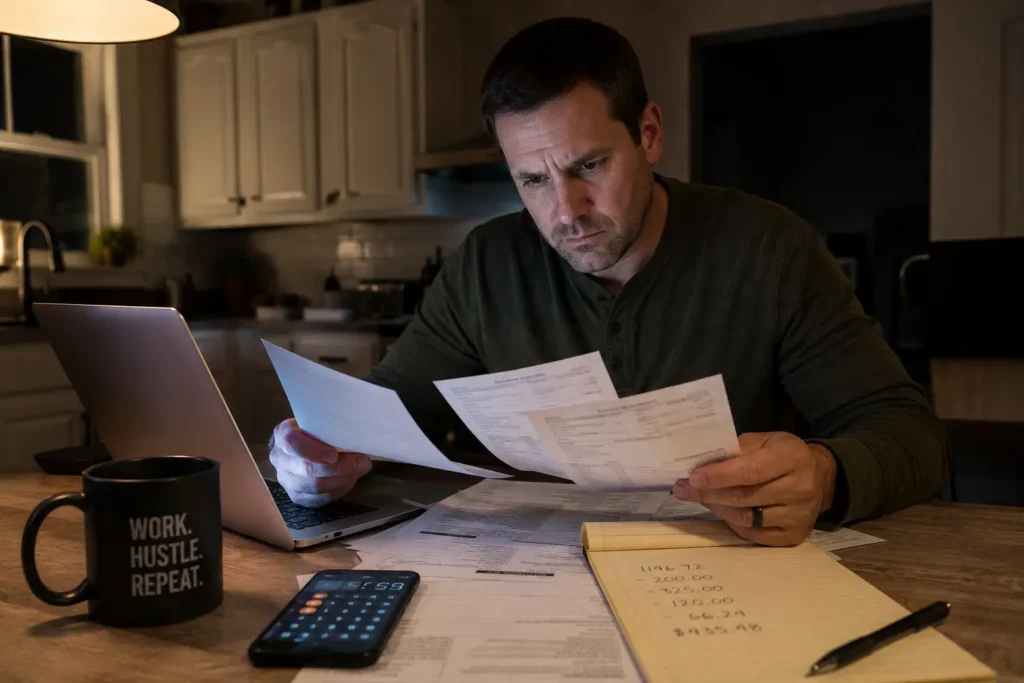
If your manager forces you to show up 10 or 15 minutes early every day for a “quick huddle” before you are allowed to punch the clock, you are right to be angry. Sitting up late wondering is it legal for employer to require unpaid pre-shift meetings is exhausting when you feel like your time is being stolen—and you cannot afford a private attorney to fight back.
Here is the direct answer: No. Under the federal Fair Labor Standards Act (FLSA), requiring non-exempt hourly workers to attend unpaid pre-shift meetings, roll calls, safety briefings, or shift handoffs is illegal off-the-clock work. Even a “mandatory 5-minute check-in” before clocking in violates federal wage laws and can entitle you to double back pay. Let’s break down the exact rules, the major 2026 Department of Labor updates, and how you can recover every dollar owed to you.
Can an employer require you to attend unpaid pre-shift meetings before clocking in?
No. Under the Fair Labor Standards Act (FLSA), requiring non-exempt employees to attend pre-shift meetings, huddles, or briefings before clocking in is illegal off-the-clock work. Any time your employer requires you to be on duty counts as compensable Hours Worked.
The FLSA “Suffer or Permit to Work” standard and non-exempt vs. exempt status
Federal wage law uses a broad rule called the “suffer or permit to work” standard. Under this rule, if your boss requires—or even knowingly allows—you to be at the workplace listening to instructions, preparing equipment, or attending a briefing, that time is paid hours worked.
This protection applies to all non-exempt employees. If you are paid by the hour (or earn a salary below the federal overtime threshold and do not meet strict executive, administrative, or professional duties tests), your employer must pay you for every minute of pre-shift meeting time. Properly classified salaried-exempt employees, by contrast, receive a fixed weekly salary covering all hours worked and do not earn extra hourly pay for early meetings.
The 4-factor federal test (29 C.F.R. § 785.27) that destroys the “voluntary meeting” excuse
Managers love to dodge wage laws by calling pre-shift huddles “voluntary” or “optional.” Under federal regulation 29 C.F.R. § 785.27, a meeting or training session can only be unpaid if all four of these conditions are true at the exact same time:
- Outside regular hours: The meeting takes place outside your normal scheduled shift.
- Genuinely voluntary: Attendance is truly optional, meaning skipping it will not hurt your evaluations, reduce your scheduled hours, or trigger discipline.
- Not directly job-related: The meeting teaches a general life skill unrelated to your daily duties (for example, an optional personal financial wellness class).
- No productive work performed: You do not perform any work, review daily assignments, or receive shift instructions during the session.
If a pre-shift meeting fails even one of these four tests—such as discussing daily sales targets, safety updates, or customer complaints—it is 100% paid work time, regardless of what your manager calls it.

What did 2026 DOL guidance change about roll calls, shift handoffs, and 5-minute huddles?
In 2026, the U.S. Department of Labor (USDOL) confirmed in Opinion Letter FLSA2026-3 that mandatory 15-minute pre-shift roll calls are paid Hours Worked. Separate 2026 guidance clarified that shift handoffs are integral and indispensable and narrowed the de minimis defense for daily huddles.
2026 DOL Opinion Letter FLSA2026-3 and “integral and indispensable” Portal-to-Portal handoffs
Employers used to argue that short pre-shift briefings fell outside paid work under the Portal-to-Portal Act of 1947 (29 U.S.C. § 254). Two major 2026 USDOL Wage and Hour Division rulings shut down those excuses:
- DOL Opinion Letter FLSA2026-3 (Roll Calls Are Paid Time): Issued in early 2026, this federal opinion letter confirmed that a mandatory 15-minute pre-shift “roll call” or briefing constitutes compensable hours worked under the FLSA and must be counted toward weekly overtime thresholds.
- Pre-Shift Handoffs Are “Integral and Indispensable”: Mid-2026 DOL guidance reaffirmed that shift-change handoffs—such as nurses receiving patient updates, cashiers counting drawers, or technicians reviewing open tickets—are intrinsic elements of the job. Because you cannot safely or effectively perform your shift without them, they must be paid from the very first minute.
Why employers can no longer hide behind the de minimis rule or timeclock rounding abuse
For decades, companies claimed that a 5- to 7-minute morning huddle was too trivial—or de minimis (29 C.F.R. § 785.47)—to track on payroll. 2026 DOL guidance makes clear that when modern digital timeclocks record punches to the exact minute and pre-shift huddles occur regularly every shift, employers cannot use the de minimis excuse to shave pay.
Watch out for timeclock rounding abuse (29 C.F.R. § 785.48). While federal law allows neutral 15-minute rounding in limited cases, an employer breaks the law if it forces you to arrive at 7:48 AM for a pre-shift huddle and uses a 7-minute rounding rule to push your paid start time forward to 8:00 AM every single day. In states like California (Troester v. Starbucks), courts have banned both the de minimis defense and timeclock rounding for shift punches altogether.
How much money do unpaid pre-shift meetings actually cost you—and what can you recover?
A mandatory 15-minute unpaid daily meeting steals 65 hours of pay per year, often triggering unpaid 1.5x overtime. Under 29 U.S.C. § 216(b), workers can recover 100% matching liquidated damages (double back pay) across a 3-year willful lookback period.
Annual wage theft math: how 15-minute daily huddles trigger 1.5x overtime pay
Ten or fifteen minutes sounds small on a Tuesday morning, but across 260 workdays a year, off-the-clock huddles quietly drain thousands of dollars from your paycheck. Even worse, if you already work a 40-hour schedule, those pre-shift minutes push you past 40 hours—meaning every single meeting minute must be paid at 1.5x your regular overtime rate.
| Hourly Pay Rate | Unpaid Meeting Length | Unpaid Hours per Year (260 Shifts) | Stolen Straight-Time Pay (1 Year) | Stolen Overtime Pay at 1.5x (1 Year) | Total Recovery with FLSA Double Damages (1 Year) |
| $16.00 / hr | 10 mins / day | 43.3 hours | $693.33 | $1,040.00 | $2,080.00 |
| $16.00 / hr | 15 mins / day | 65.0 hours | $1,040.00 | $1,560.00 | $3,120.00 |
| $20.00 / hr | 15 mins / day | 65.0 hours | $1,300.00 | $1,950.00 | $3,900.00 |
| $25.00 / hr | 15 mins / day | 65.0 hours | $1,625.00 | $2,437.50 | $4,875.00 |
Liquidated damages (double back pay) and the 3-year willful violation window
Under 29 U.S.C. § 216(b) of the FLSA, you do not just recover the unpaid wages your employer withheld. Federal law awards 100% matching liquidated damages—meaning your employer owes you double back pay—plus mandatory employer-paid attorney’s fees and court costs.
While standard FLSA claims cover 2 years of unpaid meetings, proving that management knowingly required off-the-clock attendance extends the lookback window to 3 full years for willful violations. States like New York, Massachusetts, and California impose even steeper statutory waiting-time and wage-notice penalties through your State Labor Commissioner / State Department of Labor.
What should you do if your manager forces you to attend unpaid pre-shift meetings?
Do not refuse to attend on the spot, which risks termination for insubordination. Instead, follow the “obey now, grieve later” rule: log exact meeting times on a personal device, save written schedules, and file a confidential claim with the USDOL Wage and Hour Division.
Step-by-step evidence checklist and NLRA Section 7 group complaint protections
Follow these four steps starting on your very next shift to build an airtight wage claim without putting your job at immediate risk:
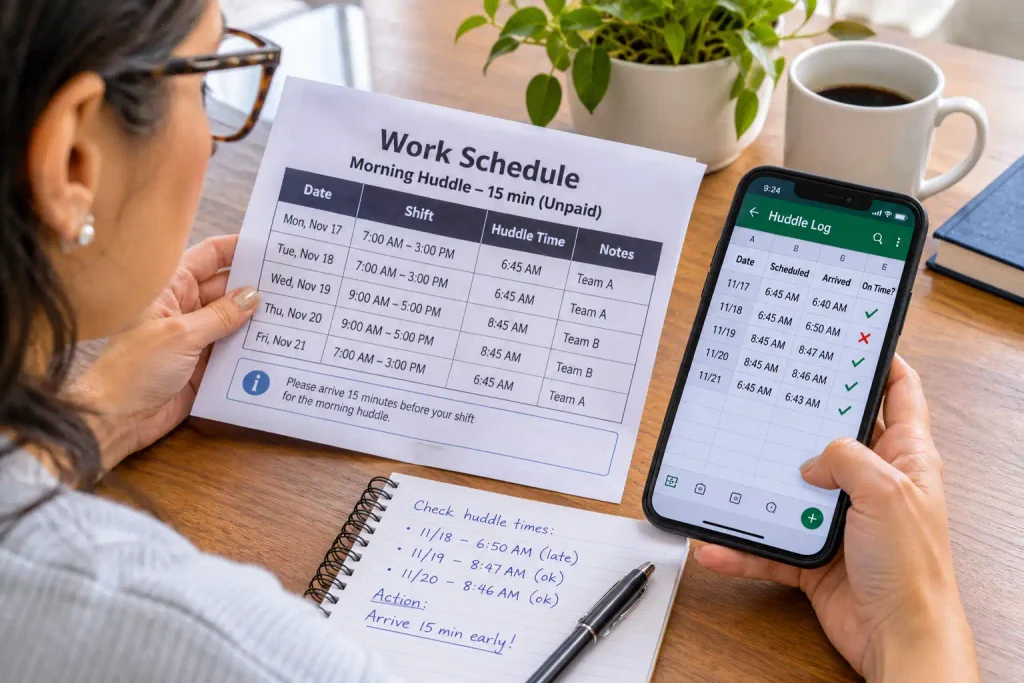
- Keep a contemporaneous personal time log: Write down the exact date, the time you arrived for the meeting, the time the meeting ended, the time you were allowed to clock in, and the manager’s name in a personal notes app or notebook at home.
- Save written proof of the mandate: Screenshot text messages, group chat announcements, emails, or posted schedules saying “Everyone must be on the floor at 7:45 AM for huddle before clocking in.”
- Use location timestamps as backup: Google Maps Timeline or arrival photos outside your workplace can independently corroborate that you arrived 15 minutes before your official timecard punch.
- Talk to trusted coworkers together (NLRA Shield): Under Section 7 of the National Labor Relations Act (NLRA), enforced by the National Labor Relations Board (NLRB), when two or more non-union employees join together to question or protest unpaid pre-shift meetings, that group action is legally protected concerted activity. Firing workers for raising a shared pay complaint violates federal labor law.
How to file a confidential back-wage complaint with the USDOL Wage and Hour Division
You do not need money or a lawyer to launch a federal investigation. The USDOL Wage and Hour Division (WHD) investigates off-the-clock meeting claims completely free of charge and keeps your identity confidential during initial employer audits. Under 29 U.S.C. § 215(a)(3), it is a separate federal offense for your employer to fire, demote, or cut your hours because you filed a wage complaint.
Practical Case Study: Recovering $4,680 in Double Back Pay from Mandatory 10-Minute Morning Huddles
Consider a warehouse associate required to arrive 10 minutes early every shift for an unpaid safety huddle. Over two years, those 86 unpaid overtime hours totaled $2,340 in stolen wages—doubling to $4,680 after a USDOL Wage and Hour Division audit.
Let’s look at how this plays out in real life. Elena worked full-time (40 scheduled hours per week) as an order picker earning $18.00/hour ($27.00/hour overtime rate). Her shift supervisor texted the team every Sunday: “Be at the loading bay at 6:50 AM sharp for safety huddle—do not clock in until 7:00 AM.”
For two years (104 weeks), Elena worked 50 minutes of unpaid pre-shift huddles every week—totaling 86.67 unpaid overtime hours. Elena saved the supervisor’s Sunday texts and kept a simple spreadsheet on her personal phone. After she submitted an online complaint to the USDOL Wage and Hour Division, investigators audited the warehouse’s badge-swipe entry logs against payroll punches. The company was ordered to pay Elena $2,340 in unpaid overtime plus $2,340 in matching liquidated damages—putting $4,680 directly in her pocket, along with back wages for 14 coworkers.
Frequently Asked Questions (FAQ) About Unpaid Pre-Shift Meetings
Employers frequently disguise off-the-clock meetings as “team building” or claim short huddles are too brief to count. Below, we answer the most urgent questions hourly workers ask about pre-shift briefings, clock-in rounding, and retaliation protections.
What if my boss says the pre-shift meeting is “voluntary” or “optional”?
Under federal regulation 29 C.F.R. § 785.27, calling a meeting “optional” does not make it unpaid if you face subtle pressure, missed shift assignments, or negative evaluations for skipping—or if the meeting covers job duties, daily goals, or safety rules. Failing any one of the four federal prongs makes the meeting paid work.
Does the 7-minute timeclock rounding rule allow unpaid 5-minute pre-shift huddles?
No. Under 29 C.F.R. § 785.48 and 2026 USDOL guidance, timeclock rounding is illegal whenever it systematically favors the employer by shaving recurring daily pre-shift minutes. When digital timeclocks track exact punches and daily huddles happen every shift, employers cannot hide behind rounding or the de minimis excuse.
Can my employer fire me for reporting unpaid pre-shift meetings to the Department of Labor?
No. Section 15(a)(3) of the Fair Labor Standards Act (29 U.S.C. § 215(a)(3)) strictly prohibits employers from firing, cutting hours, or retaliating against any worker who questions unpaid wages or files a complaint with the USDOL Wage and Hour Division or a state labor agency.
Disclaimer: The information provided on this website does not, and is not intended to, constitute legal advice. All information, content, and materials available on this site are for general informational and educational purposes only. Laws regarding employment and labor rights frequently change, and while we strive to keep our content updated, the information on this website may not constitute the most up-to-date legal or other information.
Use of, and access to, this website or any of the links or resources contained within the site do not create an attorney-client relationship between the reader, user, or browser and the website authors, contributors, or its owners. We are an independent publishing platform, not a law firm.
Readers of this website should contact a qualified employment attorney in their specific state to obtain advice with respect to any particular legal matter. No reader or user of this site should act or refrain from acting on the basis of information on this site without first seeking legal advice from counsel in the relevant jurisdiction. Only your individual attorney can provide assurances that the information contained herein – and your interpretation of it – is applicable or appropriate to your particular situation.
Know your rights.
References & Official Federal Labor Sources
Verify federal wage-and-hour statutes, review official Department of Labor opinion letters, and file a free, confidential back-wage claim through these official U.S. government resources:
-
U.S. Department of Labor (USDOL) – Fact Sheet #22: Hours Worked Under the FLSA:
Review federal rules establishing that mandatory pre-shift meetings, roll calls, and shift handoffs count as paid work time at the USDOL Wage and Hour Division Fact Sheet #22. -
Code of Federal Regulations (29 C.F.R. § 785.27 & § 785.48) – Meetings & Timeclock Rounding:
Read the exact four-factor federal test governing unpaid meetings and timekeeping rounding limits on the Official eCFR Title 29 Part 785 Portal. -
U.S. Department of Labor (USDOL) – FLSA Opinion Letters & 2026 Guidance:
Access official federal administrative rulings on mandatory pre-shift roll calls, shift handoffs, and de minimis limits via the USDOL FLSA Opinion Letters Database. -
U.S. Department of Labor (USDOL) – How to File a Wage Complaint:
Submit a confidential claim to recover unpaid pre-shift wages and liquidated damages at the USDOL Wage and Hour Division Complaint Center. -
National Labor Relations Board (NLRB) – Protected Concerted Activity:
Learn how federal law protects non-union and union coworkers who raise collective pay and scheduling complaints together on the NLRB Employee Rights Portal.
Keywords: is it legal for employer to require unpaid pre-shift meetings,working off the clock before clocking in, can my employer require me to come in early unpaid, is it legal for employer to require unpaid pre-shift meetings, mandatory unpaid pre shift meetings flsa, 29 cfr 785.27 unpaid meetings four factor test, unpaid 15 minute morning huddle overtime, de minimis rule unpaid work 2026 dol