
You’re reading this because your paycheck doesn’t add up. Maybe you’re working 55-hour weeks on a “salary” and haven’t seen a dime of overtime. Maybe HR just told you that you’re “exempt” and that was the end of the conversation. You deserve a real answer, not corporate jargon.
Here’s the short version: does an exempt employee get overtime? Under federal law, the answer is no — if, and only if, your employer has correctly classified you. Millions of American workers are misclassified as exempt every year, and that mistake (or manipulation) costs them thousands of dollars in unpaid wages. This guide breaks down exactly how the test works, what the 2026 salary numbers are in your state, and what to do if you think you’ve been shortchanged.
Key Takeaways
- Federal law sets $684/week ($35,568/year) as the minimum salary to be exempt — but several states require much more.
- Your job title means nothing. The law looks at what you actually do all day, not what’s printed on your badge.
- Five states — California, Colorado, Maine, New York, and Washington — require salaries far above the federal floor as of January 2026.
- If you’re misclassified as exempt, you can recover up to two years of unpaid overtime (or three years if the violation was willful) through the Department of Labor.
- Employers can legally give exempt workers bonuses or extra pay without losing the exemption — but they still can’t dock your pay for a slow week.
So, no — a truly exempt employee does not get overtime pay under the Fair Labor Standards Act (FLSA), even if they work more than 40 hours a week. But being paid a salary does not automatically make you exempt. Your employer must also pay you at least $684 per week (or a higher state minimum) and prove your actual job duties meet a specific legal test. If either piece is missing, you’re likely owed overtime.

Does an Exempt Employee Get Overtime Under the FLSA?
No — true exempt employees do not receive overtime pay under the Fair Labor Standards Act (FLSA), the federal law that governs minimum wage and overtime in the United States. But that answer only applies to workers who are correctly classified. Being paid a salary, by itself, does not make you exempt. Your employer must prove two separate things: that you’re paid enough, and that your actual daily work matches one of the legally defined exempt categories. Skip either step, and you’re non-exempt — meaning you’re owed time-and-a-half for every hour over 40 in a week.
This is the single biggest misunderstanding in American workplaces. Employers routinely tell workers “you’re salaried, so no overtime” as if that settles it. It doesn’t. The law requires two separate tests to be passed before an employer can legally withhold overtime pay: the Salary Level Test and the Duties Test. Fail either one, and the exemption doesn’t apply — no matter what your offer letter says.
What Are the 2026 Salary Level Test Requirements for Exempt Workers?
The federal salary threshold has been through real turbulence, and most competitor articles are still quoting outdated 2024 numbers. Here’s what’s actually true right now.
In 2024, the DOL issued a rule that would have sharply raised the salary threshold for exempt status. In November 2024, a federal court in Texas vacated that rule, ruling that the DOL had overstepped its authority. The DOL eventually dropped its appeal, and on May 14, 2026, the U.S. Department of Labor issued a technical amendment formally restoring the pre-2024 standard.
As of 2026, the federal minimum to pass the Salary Level Test is $684 per week, or $35,568 per year. If you earn less than that, you are automatically non-exempt — full stop — regardless of your job duties. There’s a second, higher tier too: the Highly Compensated Employee (HCE) exemption, which requires total annual compensation of at least $107,432, combined with a simplified duties test.
Bold takeaway: If your annual salary is under $35,568, you cannot legally be classified as exempt, no matter what your job title says.
Which 2026 State Minimum Salary Thresholds Override Federal Law?
State Departments of Labor can — and often do — set stricter salary thresholds than the federal government, and when state law is more protective, it wins. The federal $684/week floor hasn’t moved much, so several high-cost states have pulled far ahead, and if you work in one of them, the federal number is basically irrelevant to you.
High-Threshold States (California, New York, Washington)
| State | Weekly Minimum | Annual Minimum | Notes |
|---|---|---|---|
| Federal (FLSA) | $684 | $35,568 | Applies unless your state sets a higher bar |
| California | $1,352.00 | $70,304 | Set at 2x the state minimum hourly wage for 40 hours/week |
| Washington | $1,541.70 | $80,168.40 | Highest state threshold in the country for 2026 |
| New York – NYC, Long Island, Westchester | $1,275.00 | $66,300 | Regional tier for downstate employers |
| New York – Rest of State | $1,199.10 | $62,353.20 | Applies outside NYC/LI/Westchester |
| Colorado & Maine | Varies | Rising annually | Both index thresholds to inflation |
Bold takeaway: If you work in California, Washington, or downstate New York, your employer must pay you nearly double the federal minimum before you can even be considered for exempt status.
Even in a high-threshold state, salary alone still isn’t enough. You still have to clear the Duties Test — which is where most misclassification actually happens.
How Does the Duties Test Trap Lead to Illegal Misclassification?
Here’s the question that keeps workers up at night: “But my title is Manager, why am I stocking shelves?” The answer is that job titles carry zero legal weight. The Duties Test looks at what you actually spend your time doing, not the title printed on your name badge or offer letter.
The Executive, Administrative, and Professional (EAP) Exemptions
Federal law recognizes three main “white-collar” categories, often shortened to EAP (Executive, Administrative, and Professional):
- Executive exemption: You must regularly supervise at least two full-time employees and have real authority to hire, fire, or promote — not just relay instructions from someone else.
- Administrative exemption: Your primary duty must involve office or non-manual work directly related to business operations, and you must exercise independent judgment on significant matters.
- Professional exemption: Your work must require advanced knowledge in a field of science or learning, typically gained through specialized education (think nurses, engineers, or accountants).
If your actual day-to-day work doesn’t clearly fit one of these buckets — even if your paycheck and title suggest otherwise — you may legally be non-exempt, and entitled to overtime.
The Danger of Misclassification and Unpaid Overtime
Misclassification isn’t just a paperwork error — it’s a wage violation with real financial consequences for employers. If the Wage and Hour Division (WHD) finds that a worker was misclassified as exempt, that worker is generally entitled to back pay for unpaid overtime, plus an equal amount in liquidated damages — effectively doubling what’s owed. Claims typically reach back two years, or three years if the employer’s violation was willful.
Can Employers Voluntarily Pay Exempt Employees Extra Compensation?
Employers are not legally required to pay exempt employees time-and-a-half, but they can voluntarily offer bonuses, shift differentials, or straight-time extra pay without jeopardizing the exemption. This surprises a lot of workers who assume any extra pay must come with overtime attached.
As long as the employee’s guaranteed base salary still meets the Salary Basis Test — meaning it doesn’t fluctuate based on hours or performance — an employer can add discretionary bonuses on top without converting the worker to non-exempt status. This also applies to Highly Compensated Employees, who can receive additional incentive pay without disturbing their HCE exemption.
What Is the Fluctuating Workweek Method for Non-Exempt Salaried Workers?
Here’s a category almost nobody explains clearly: you can be paid a salary and still be legally entitled to overtime. This is where the Fluctuating Workweek (FWW) method comes in.
Under the FWW method, a non-exempt employee whose hours vary week to week receives a fixed salary that covers straight-time pay for all hours worked, plus an extra “half-time” premium for every hour over 40. This is different from the standard time-and-a-half formula, but it’s still legally required overtime — just calculated differently. If your paycheck looks flat every week but your hours swing wildly, ask your employer directly whether you’re being paid under this method, because it changes your math.
The Computer Employee and Fee Basis Exceptions
Two other niche categories exist outside the standard salary structure. Computer employees can qualify for exemption either through the standard salary threshold or an hourly rate of at least $27.63. Fee basis workers — often found in specialized trades — are paid a flat sum for a single job regardless of hours, and can qualify as exempt if that fee, translated into a weekly rate, meets the salary threshold.
Practical Case Study: Fighting Misclassification and Recovering Unpaid Overtime
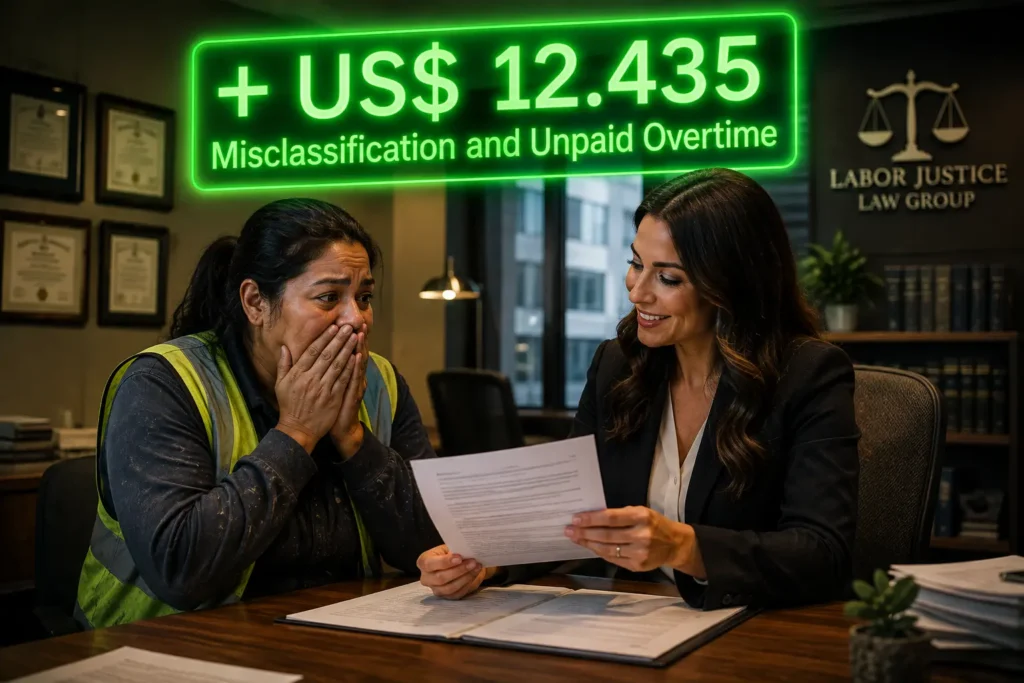
Consider a real-world pattern the DOL sees constantly. A retail worker — call her an “Assistant Manager” — earned $40,000 a year and regularly worked 55-hour weeks. Her offer letter listed “supervisory duties,” and her employer told her that came with the exempt territory.
In reality, roughly 90% of her time was spent ringing up customers, stocking shelves, and covering shifts on the sales floor. She rarely made hiring or scheduling decisions — those came from a regional manager. When she filed a claim with the Department of Labor’s Wage and Hour Division, investigators applied the Duties Test and found she failed the executive exemption entirely: her primary duty was non-managerial work, not supervision. She recovered two years of unpaid overtime, calculated retroactively at time-and-a-half for every hour over 40, plus liquidated damages.
Bold takeaway: A fancy title and a salary don’t protect an employer from a misclassification claim — the actual work you perform does all the talking.
When Do You Need an Employment Lawyer?
Not every wage question needs a lawyer, and filing a free DOL complaint is often enough for straightforward cases. But you should consider talking to an employment attorney if your employer retaliates after you raise the issue, if the unpaid amount is large, or if your case involves a group of coworkers in the same situation (which can become a class or collective action). Most employment lawyers who handle wage claims work on contingency, meaning you pay nothing unless you win. You have the right to consult one before signing any severance or settlement agreement tied to a misclassification dispute.
Frequently Asked Questions About Exempt Status and Overtime
Can my boss force me to work 60 hours if I am exempt?
Federal law does not cap the number of hours a truly exempt employee can be required to work in a week. There’s no legal maximum. However, your employer’s own policies, an employment contract, or state-specific labor rules may limit mandatory hours, so it’s worth checking your offer letter and state labor board rules.
What is the difference between being salaried and being exempt?
Being “salaried” only describes how you’re paid — a fixed amount each pay period, regardless of hours. Being “exempt” is a legal classification that requires passing both the Salary Level Test and the Duties Test. You can be salaried and still be legally non-exempt, meaning you’re still owed overtime.
Can my employer dock my exempt salary if I work fewer than 40 hours?
Generally, no. Under the Salary Basis Test, exempt employees must receive their full guaranteed salary for any week in which they perform any work, regardless of hours actually worked, with narrow exceptions like full-day absences for personal reasons or unpaid FMLA leave. Improper deductions can actually void the exemption entirely.
Does a high salary automatically mean I’m exempt?
No. Even highly paid workers must still meet the Duties Test unless they qualify under the Highly Compensated Employee exemption, which has its own $107,432 annual threshold plus a simplified duties standard.
What happens if my employer misclassifies me as exempt?
You may be entitled to recover unpaid overtime going back two years (three if the violation was willful), plus an equal amount in liquidated damages. You can file a free complaint with the DOL Wage and Hour Division or consult an employment attorney.
Are commission-only salespeople exempt from overtime?
Outside salespeople have a separate exemption category with no salary minimum, but inside salespeople and commission-based retail workers often don’t qualify and may still be owed overtime, depending on the duties test and applicable state rules.
Can part-time workers be classified as exempt?
Technically yes, but it’s rare in practice. Most part-time workers don’t meet the minimum weekly salary threshold, since exempt salary minimums are based on a full weekly amount, not an hourly rate.
How do I find out my state’s exempt salary threshold?
Check your state Department of Labor website directly, since thresholds change annually and vary widely — from the $684/week federal floor up to over $1,500/week in states like Washington.
Bottom Line: Know Your Number, Know Your Duties
Does an exempt employee get overtime? No — but that only matters if your employer has actually earned the right to classify you that way. Check your salary against your state’s 2026 threshold, then honestly compare your job description to your actual daily tasks. If either one doesn’t line up, you may be owed real money.
Your single next step: pull your last three pay stubs, calculate your actual weekly salary, and compare it against your state’s threshold in the table above. If you’re underpaid or your duties don’t match your title, file a free complaint with the DOL Wage and Hour Division today — it costs nothing to ask.
Disclaimer: The information provided on this website does not, and is not intended to, constitute legal advice. All information, content, and materials available on this site are for general informational and educational purposes only. Laws regarding employment and labor rights frequently change, and while we strive to keep our content updated, the information on this website may not constitute the most up-to-date legal or other information.
Use of, and access to, this website or any of the links or resources contained within the site do not create an attorney-client relationship between the reader, user, or browser and the website authors, contributors, or its owners. We are an independent publishing platform, not a law firm.
Readers of this website should contact a qualified employment attorney in their specific state to obtain advice with respect to any particular legal matter. No reader or user of this site should act or refrain from acting on the basis of information on this site without first seeking legal advice from counsel in the relevant jurisdiction. Only your individual attorney can provide assurances that the information contained herein – and your interpretation of it – is applicable or appropriate to your particular situation.
Know your rights.