
- Under U.S. at-will employment, you can legally be suspended without pay if you are an hourly worker. However, you retain the right to union representation, the right to be free from discriminatory investigations, and the right to file for unemployment if the unpaid suspension is prolonged indefinitely.
If your manager just told you to hand over your laptop, go home, and wait for a phone call, you are likely panicked and searching: suspended from work pending investigation what are my rights? Many top search results will tell you that you are legally entitled to full pay and a fair process. Unfortunately, most of those articles are written for workers in the UK.
In the United States, at-will employment makes the rules much harsher. You can be suspended, and it can financially devastate you. But you are not entirely powerless. This 2026 legal guide breaks down your actual federal rights. We will explain when your employer must pay you, how to survive a digital lockout, and how to spot if the “investigation” is actually illegal retaliation.

Can I be suspended without pay? (The FLSA Rules)
Yes, if you are an hourly (non-exempt) worker, your employer can legally suspend you without pay for any amount of time. If you are a salaried (exempt) worker, you must generally be paid your full weekly salary unless you are suspended for a full workweek for a serious conduct violation.
The biggest shock for an American worker is realizing that a suspension is usually a massive financial hit. The Fair Labor Standards Act (FLSA) sets the rules for who gets paid during an investigatory suspension.
- Hourly (Non-Exempt) Workers: Employers only have to pay you for the hours you actually work. If they suspend you on a Tuesday and tell you to stay home for three days, they do not have to pay you for those missed shifts.
- Salaried (Exempt) Workers: The law is much stricter here. If you are salaried, your employer must pay your full salary for any week in which you perform any work. They cannot dock your pay for a partial-week suspension. They can only suspend you without pay if they suspend you for one or more full workweeks, and only if the suspension is a good-faith penalty for violating a written workplace conduct rule (like sexual harassment or workplace violence).
If your employer illegally docks your salary for a two-day suspension, they violate the FLSA and risk destroying your exempt status, which means they could suddenly owe you years of unpaid overtime.
The “Digital Lockout” Protocol: What should I do?
During a suspension, your employer will likely deactivate your email, Slack, and internal network access. Do not attempt to bypass these lockouts, download company files to a personal device, or delete data, as this can turn a standard investigation into a legal termination for data theft.
In 2026, getting suspended means getting digitally erased. The moment you leave the HR meeting, IT will lock your accounts to “preserve evidence.”
If you panic and try to log in from a personal device, or ask a coworker to forward you emails to “prove your innocence,” you are making a fatal mistake. The company’s IT security tools will flag this immediately.
Even if the initial investigation clears you of wrongdoing, the employer can legally fire you for violating company data security policies during the suspension.
Your Action Plan:
- Hand over your company devices peacefully.
- Provide HR with a personal email address or phone number to contact you.
- Do not log into any company portals unless explicitly instructed by HR.
- Write down everything you remember about the incident on a personal notepad while it is fresh in your mind.
Do I have the right to union representation?
If you are a member of a labor union, you have federal “Weingarten Rights.” You have the absolute legal right to demand that a union representative be present during any investigatory interview that you reasonably believe could lead to discipline or termination.
If you are called into a room with HR and security, and you are in a union, you must invoke your Weingarten Rights immediately.
The employer is not legally required to inform you of this right. You must ask for it. You should state clearly: “If this discussion could in any way lead to my being disciplined or terminated, I request that my union representative be present. Until they arrive, I choose not to participate in this interview.”
If the employer denies your request and forces you to answer questions anyway, they are committing an unfair labor practice under the National Labor Relations Act (NLRA), and any discipline that results can often be overturned.
(Note: In 2026, Weingarten rights generally do not apply to non-union employees).
Can my employer place a “gag order” on me?
Employers frequently order suspended workers not to discuss the investigation with coworkers. However, recent National Labor Relations Board (NLRB) rulings heavily restrict blanket confidentiality rules. You often retain the right to discuss your working conditions and discipline with your colleagues.
Before you leave the building, HR will usually hand you a letter stating, “You are strictly prohibited from discussing this investigation with any current employees.”
This is a standard intimidation tactic, but it is often legally unenforceable.
Under Section 7 of the NLRA, all non-management employees (union and non-union) have the protected right to engage in “concerted activity.” This includes discussing wages, discipline, and workplace conditions with coworkers.
The NLRB heavily scrutinizes blanket confidentiality rules. An employer can only demand silence if they can prove a specific, legitimate business justification—such as protecting witnesses from physical retaliation or preventing the destruction of evidence. They cannot silence you simply to protect the company’s reputation.
Is the investigation actually illegal retaliation?
Employers sometimes use a “pending investigation” as a pretext to illegally punish a worker. If you were suspended immediately after reporting harassment, requesting FMLA leave, or complaining about unpaid wages, the suspension is likely illegal retaliation.
You must look closely at the timeline of your suspension. Why is the company investigating you now?
If you had a flawless performance record for three years, but you are suddenly suspended for “inventory discrepancies” two days after you reported your supervisor for sexual harassment, you are a victim of retaliation.
Federal laws like Title VII, the ADA, and the FLSA make it highly illegal to punish an employee for engaging in a protected activity. If you suspect the investigation is a fake pretext to freeze you out, immediately email HR (from your personal email): “I believe this sudden suspension is in direct retaliation for the harassment complaint I filed on Tuesday.” This forces the company to document your retaliation claim, which is critical evidence if you need to file an EEOC charge later.
Can I get unemployment if my suspension is unpaid?
Yes. If your employer places you on an indefinite unpaid suspension, the law eventually treats this as a “constructive discharge.” You can file for unemployment benefits, as the employer has effectively severed the employment relationship by cutting off your wages.
Employers will sometimes put a worker on an unpaid suspension and simply “forget” to conclude the investigation. They want you to get desperate, run out of money, and voluntarily quit so they do not have to pay unemployment.
Never say the words “I quit.”
If you have been sitting at home for two or three weeks with no pay and no updates, you are no longer suspended. You have been subjected to a constructive discharge.
You should file for unemployment immediately. When the state asks why you are not working, you state that you were placed on an indefinite unpaid suspension and have been functionally terminated. The burden of proof then shifts to the employer to explain to the state why they took away your livelihood.
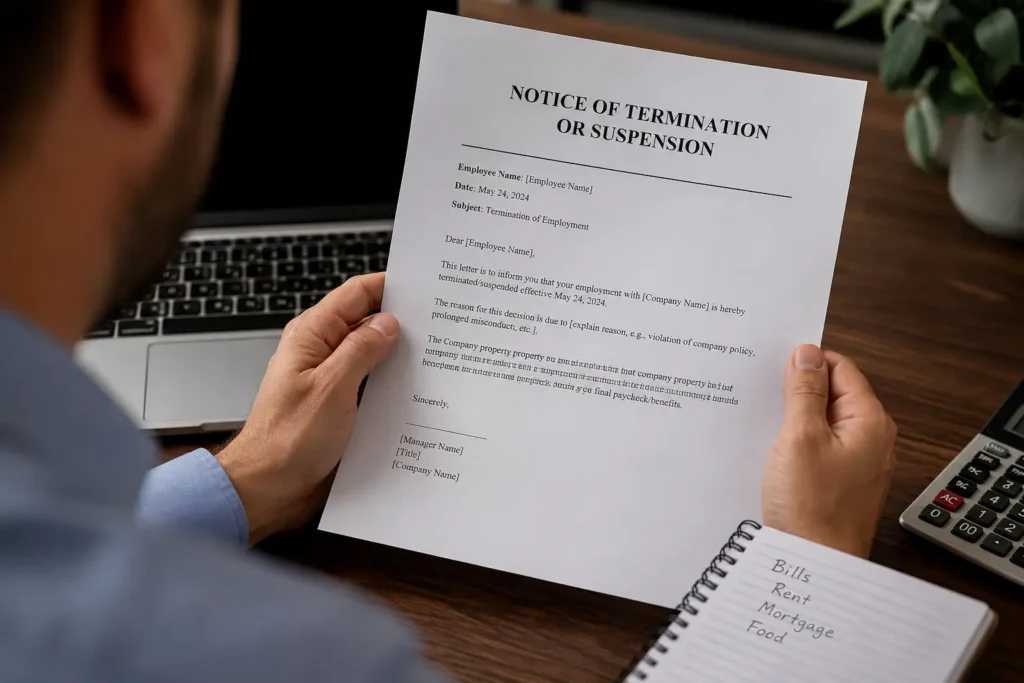
Practical Case Study: Winning Unemployment During Limbo
Understanding how to act during an indefinite suspension is vital. A retail worker successfully secured unemployment benefits after being placed on a four-week unpaid suspension, proving the employer was using the “investigation” to force a resignation.
Let’s look at how a worker used the system to survive an employer’s freezing-out tactic.
The Situation: “Sarah” was an hourly retail supervisor. After complaining that her manager was shaving hours off her timecard, she was abruptly suspended without pay pending an “investigation into her leadership style.”
The Action: Sarah waited one week. When HR refused to answer her emails regarding a timeline, Sarah did not quit. Instead, she filed for state unemployment benefits. She provided the state investigator with her suspension letter and her emails proving the company was ignoring her.
The Result: The employer tried to block her unemployment claim, stating Sarah was “still employed, just suspended.” The state Department of Labor ruled in Sarah’s favor. They determined that an unpaid suspension lasting more than two weeks without a disciplinary conclusion constituted a functional termination. Sarah received retroactive unemployment checks and subsequently filed an FLSA retaliation lawsuit for the initial timecard wage theft.
Frequently Asked Questions (FAQ) About Workplace Suspensions
Do I have to answer my phone if my boss calls during an unpaid suspension?
If you are an hourly worker and you are not being paid, you are completely off the clock. Your employer cannot legally require you to remain “on-call” or force you to answer work questions without paying you for that time. However, ignoring a scheduled call with HR to discuss the investigation itself can be viewed as insubordination and lead to your firing.
Should I hire a lawyer during the investigation?
If the investigation involves severe allegations (such as embezzlement, theft, or physical assault) that could lead to criminal charges, you should absolutely consult an attorney before speaking to HR or corporate security. Anything you say in that room can be handed over to the police.
Can I get a new job while suspended?
Yes. Because at-will employment works both ways, you can apply for and accept a new job while suspended. However, if you start a new full-time job, you have effectively resigned from your old one. This means you will forfeit any back pay you might have won if the investigation cleared you.
Disclaimer: The information provided on this website does not, and is not intended to, constitute legal advice. All information, content, and materials available on this site are for general informational and educational purposes only. Laws regarding employment and labor rights frequently change, and while we strive to keep our content updated, the information on this website may not constitute the most up-to-date legal or other information.
Use of, and access to, this website or any of the links or resources contained within the site do not create an attorney-client relationship between the reader, user, or browser and the website authors, contributors, or its owners. We are an independent publishing platform, not a law firm.
Readers of this website should contact a qualified employment attorney in their specific state to obtain advice with respect to any particular legal matter. No reader or user of this site should act or refrain from acting on the basis of information on this site without first seeking legal advice from counsel in the relevant jurisdiction. Only your individual attorney can provide assurances that the information contained herein – and your interpretation of it – is applicable or appropriate to your particular situation.
Know your rights.