
ANSWER BOX — Read This First If you suspect wrongful termination, take these five immediate steps:
- Do not sign any severance agreement or release of claims right now.
- Request the reason for your firing in writing before you leave the building.
- Ask for your personnel file — you have a legal right to it in most states.
- File for unemployment as soon as possible to protect your financial and legal position.
- Consult an employment attorney before contacting the EEOC — sequence matters.
KEY TAKEAWAYS
- Signing a severance agreement too fast can permanently waive your right to sue.
- Forwarding company emails to yourself can kill your case and expose you to federal criminal liability.
- Being forced to quit can legally count as a firing — it’s called constructive discharge.
- You must file an EEOC complaint within 180 to 300 days of the discriminatory act — the clock starts now.
- Courts use the timing between your protected activity and your firing to prove retaliation.
Introduction
You just lost your job — and something feels deeply wrong about how it happened. Maybe your firing came one week after you reported harassment. Maybe your boss suddenly invented “performance issues” that never came up in your last review. Maybe you were the only person in your department who didn’t look like everyone else in management.
You may have been fired illegally. And the next 48 hours are the most important of your entire case.
Under federal and state labor law, workers have powerful protections against illegal termination — but those rights can be waived, expired, or accidentally destroyed if you move in the wrong order. This guide gives you the exact wrongful termination checklist you need: what to do first, what to do next, and what never to do under any circumstances.
No legalese. No hedging. Just the clearest roadmap you’ll find.
What Is the First Step in a Wrongful Termination Claim?
The first step is to protect your rights during and immediately after the termination meeting — before you sign anything.
Most workers make a critical mistake in their first hour: they sign whatever HR puts in front of them because they’re in shock, embarrassed, or afraid. Don’t. That document may be a release of claims — legal language (plain English: a contract where you permanently give up your right to sue in exchange for a severance payment).
Here’s what to do in the room:
- Stay calm. Do not argue, threaten, or make accusations. You’re gathering information.
- Ask for the reason in writing. Say: “Can I get the reason for this decision in writing?” If they refuse, note who was present and what was said out loud.
- Do not sign anything today. You are allowed to take documents home to review. Say: “I’d like to have my attorney review this before I sign.” You do not need an attorney yet — this is a standard, legal delay tactic.
- Request a copy of your personnel file. In many states, you have a statutory right to your file within a few business days. We’ll cover this more below.
- Collect your personal belongings only. Do not take company property, files, or data.
The 2026 NLRB Rules on Non-Disparagement and Confidentiality Clauses
Before you sign that severance agreement, understand this: sweeping non-disparagement and confidentiality clauses may be legally unenforceable against you.
In McLaren Macomb (2023) and its continuing enforcement impact through 2026, the National Labor Relations Board (NLRB) — the federal agency that enforces workers’ right to organize and speak collectively — ruled that severance agreements cannot legally prohibit employees from:
- Discussing their working conditions with coworkers or the public
- Filing charges with the NLRB itself
- Cooperating with government investigations
Why does this matter to you? Because many standard severance agreements contain clauses that are broader than the law allows. Signing one doesn’t automatically make those clauses enforceable — but it can create legal confusion that hurts you later. An employment attorney can identify illegal clauses in about 30 minutes. Many offer free consultations.
Under Section 7 rights under the NLRA, most private-sector employees have the right to discuss wages, working conditions, and workplace grievances. Your employer cannot take that away with a piece of paper — even after you’re fired.
How Do You Gather Evidence Without Violating the Computer Fraud and Abuse Act (CFAA)?
Write everything down from memory. Do not forward a single company email to your personal account.
This is the mistake that kills cases. Workers who suspect wrongful termination sometimes forward emails, download client lists, or copy internal documents to “prove” what happened. This can expose you to a federal lawsuit under the Computer Fraud and Abuse Act (CFAA) — a 1986 law originally written for hackers that has been used aggressively by employers against fired workers.
Employers have sued terminated employees for:
- Forwarding emails from a company account to a personal Gmail
- Downloading performance reviews or HR records from the company server
- Copying contact lists or client databases before leaving
Even if the information was technically accessible to you as an employee, using it after termination or without authorization can be treated as unauthorized access.
What you CAN safely do within the first 48 hours:
- Write a detailed timeline from memory. Date, time, location, what was said, who was present. Do this today, while it’s fresh.
- Preserve personal communications. Text messages and emails sent to or from your personal accounts and devices are yours.
- Screenshot any public-facing records. Public LinkedIn endorsements, company announcements you were tagged in, performance awards posted on internal bulletin boards you photographed on your phone before termination.
- Note physical documents you already had at home. Any paper you legitimately took home before termination may be usable.
- Write down the names of witnesses — coworkers who observed the events leading to your firing.
What Are the Signs of Wrongful Termination vs. a Standard At-Will Firing?
Under the at-will employment doctrine — which covers most U.S. workers — your employer can fire you unfairly. But “unfair” and “illegal” are not the same thing.
Most Americans are at-will employees, meaning they can be terminated at any time, for any reason or no reason at all. Your boss can fire you because they don’t like your laugh, because they want to hire their nephew, or because business is slow. That’s legal.
What’s not legal:
| Legal Reason to Fire (At-Will) | Illegal Reason to Fire (Wrongful Termination) |
|---|---|
| Poor performance (documented) | Race, sex, age, religion, disability (Title VII, ADA, ADEA) |
| Company downsizing | Retaliation for reporting discrimination or harassment |
| Personality conflict | Retaliation for OSHA, FMLA, or wage complaints |
| Business restructuring | Whistleblowing on illegal employer activity |
| No reason given | Violation of an employment contract or union agreement |
| Choosing a replacement | Firing just before pension vests (ERISA violation) |
The single biggest red flag: a sudden “performance problem” that appears right after you did something protected.
If your last performance review was solid and you were fired two weeks after filing an internal HR complaint, that is a textbook pretext — a fake justification used to mask an illegal motive. Courts look for this pattern constantly.
What If I Wasn’t Formally Fired but Was Forced to Quit?
If your employer made your job so unbearable that any reasonable person would have quit, the law may treat your resignation as a firing.
This is called constructive discharge — and it carries the same legal weight as being formally terminated. You retain the same rights to file an EEOC complaint, pursue a lawsuit, and collect unemployment benefits.
Common examples of constructive discharge:
- Sudden demotion to a humiliating role after reporting harassment
- Cutting your hours to near-zero without cause
- Reassigning you to an impossible workload designed to guarantee failure
- Creating a hostile work environment based on your race, sex, or disability
- Refusing to investigate your formal complaint, leaving you to face a harasser daily
The legal bar is “intolerable conditions that a reasonable person could not endure.” It’s not just “my job got harder.” It means your employer deliberately engineered the situation to force you out — usually to avoid paying severance or to circumvent termination procedures.
If this sounds like your situation, treat your resignation date as your “termination date” for all filing deadlines.
Can You Collect Unemployment if You Were Wrongfully Terminated?
Yes — and filing immediately is not just about paying your bills. It’s a legal strategy.
File for unemployment benefits through your State Department of Labor as soon as possible after being fired. Here’s why this matters beyond the obvious financial relief:
It fulfills your legal duty to “mitigate damages.”
In employment law, mitigation of damages means you are legally required to make reasonable efforts to replace your lost income. If you win a wrongful termination lawsuit, the court calculates how much money you lost — but it reduces that number by what you should have earned if you had tried to find work.
Employers’ attorneys will argue that you sat home for two years and did nothing. Filing for unemployment the same week you were fired is documented proof that you actively sought income from day one. It strengthens your damages claim.
One important note: If you were fired “for cause” — meaning your employer claims misconduct — your unemployment claim may initially be denied. Fight it. The standard for unemployment denial is different from the standard for wrongful termination. An employer can lie about the reason and still lose the unemployment hearing. That hearing transcript, where your employer must testify under oath, can become powerful evidence in your civil case.
Practical Case Study: Using Temporal Proximity to Prove Retaliation
Here’s a real-world pattern that plays out in employment courts every week — and understanding it could be the difference between a settlement and a dismissed case.
The Scenario:
Maria worked as a warehouse supervisor for a regional logistics company. In October, she filed a formal complaint with OSHA — the Occupational Safety and Health Administration, the federal agency that enforces workplace safety — after two workers were injured due to unsafe forklift conditions.
On November 3rd — 11 days after filing — she was called into HR and told her position was being “eliminated due to restructuring.”
Her performance record: two commendations in the prior 12 months. Zero written warnings. A 4.2/5 rating on her most recent review.
What the law sees:
Courts call this temporal proximity — the suspicious closeness in time between a protected act (filing the OSHA complaint) and an adverse employment action (being fired). In Clark County School District v. Breeden (2001), the Supreme Court recognized that very close timing between a protected activity and a firing can, by itself, constitute evidence of retaliation.
What Maria did right:
- She wrote down the entire timeline from memory the day she was fired
- She saved the OSHA complaint submission confirmation (personal email)
- She contacted three coworkers who had witnessed the unsafe conditions
- She filed for unemployment immediately — and won, because the “restructuring” was pretextual
- The unemployment hearing forced her former employer to testify — and their story about the “restructuring” fell apart under oath
Maria’s case settled for $187,000 before trial.
The lesson: The gap between your protected act and your firing is evidence. Document the dates. Write down every interaction. The timeline is your case.
When Should I File a Formal Complaint with the EEOC?
If your firing involved discrimination or retaliation, you must file an EEOC charge within 180 to 300 days — and the clock is already running.
The EEOC (Equal Employment Opportunity Commission) is the federal agency that enforces anti-discrimination laws including Title VII, the ADA (Americans with Disabilities Act), the ADEA (Age Discrimination in Employment Act), and the Equal Pay Act. Before you can sue your employer in federal court for discrimination or retaliation, you must first file a Charge of Discrimination with the EEOC.
The deadline:
- 180 days from the discriminatory act if your state does not have its own anti-discrimination agency
- 300 days if your state has a comparable agency (most do) — this is the more common deadline
After you file, the EEOC will investigate. Once it concludes — whether or not they find a violation — they will issue a Right-to-Sue letter, which authorizes your attorney to file a civil lawsuit against your employer in federal court.
File with the EEOC before you consult an attorney if: you’re running close to the 300-day deadline and can’t get an appointment.
File with an attorney first if: you have time — because an attorney can identify whether you have additional state law claims with different (sometimes longer) deadlines, and can help you frame the charge strategically.

When You DO Need a Lawyer — And When You Don’t
You do not need to hire an attorney on day one. But there are clear moments when going it alone will cost you the case.
You can handle yourself:
- Filing for unemployment
- Requesting your personnel file
- Writing your evidence timeline
- Filing an EEOC charge (the EEOC will even help you complete the form)
You need an attorney when:
- You’ve been asked to sign a severance agreement
- The EEOC has issued your Right-to-Sue letter
- Your employer filed a counterclaim against you (for the CFAA, trade secrets, etc.)
- Your damages are significant — lost wages, benefits, emotional distress
- You’re a whistleblower under a federal protection statute (OSHA, SEC, False Claims Act)
How to find one affordably:
- Most employment attorneys work on contingency — they get paid only if you win (typically 30–40% of the settlement). You pay nothing upfront.
- Your state bar association’s referral service can connect you to a free 30-minute consultation
- The EEOC’s website lists legal aid organizations by state
Frequently Asked Questions About Wrongful Termination
Do I need a lawyer before I attend my termination meeting?
No. Most workers don’t know the meeting is coming. If you find out in advance, consulting an attorney can help — but it’s not required. What matters most in the meeting is that you do not sign anything, you request the reason in writing, and you stay calm enough to remember what was said.
Can HR deny my request for my personnel file?
It depends on your state. More than 25 states have laws requiring employers to provide employees — including terminated ones — with access to their personnel file within a set number of days (commonly 7 to 30 business days). States including California, Illinois, Michigan, and Washington have strong personnel file access laws. Some states have no such requirement. Check your state’s Department of Labor website or ask an employment attorney.
How long do I have to decide on a severance package?
Under the Older Workers Benefit Protection Act (OWBPA), if you are 40 or older, your employer must give you at least 21 days to consider a severance agreement and 7 days to revoke your signature after signing. For workers under 40, there is no federal minimum — but you can almost always negotiate more time. Any employer who pressures you to sign “right now or never” is using a tactic, not a legal requirement.
What is the difference between wrongful termination and unfair termination?
Unfair termination means your employer treated you badly or made a judgment call you disagree with. That’s legal in an at-will state. Wrongful termination means your employer violated a specific law — federal or state — when they fired you. The distinction is entirely legal, not moral. Many illegal firings feel “fair” and many unfair firings are legal.
Does wrongful termination only apply to discrimination cases?
No. Wrongful termination covers a broader range of illegal acts, including: retaliation for whistleblowing, firing someone for taking FMLA (Family and Medical Leave Act) leave, violating a written employment contract, firing an employee to prevent pension vesting, and terminating someone for serving on jury duty or in the military (USERRA protections).
Can I be fired while on FMLA leave?
Not because of the FMLA leave itself. The Family and Medical Leave Act protects eligible employees from being fired, demoted, or penalized for taking up to 12 weeks of unpaid medical leave per year. However, you can be fired for a legitimate, unrelated reason while on leave. If your employer fires you and cites your leave — or fires everyone except the people who didn’t take leave — that’s likely FMLA retaliation.
What if my employer says I was fired “at will” — does that end my case?
No. At-will employment is a default rule, not a shield against illegal conduct. “At-will” means they didn’t need a reason. It does not mean they can fire you for an illegal reason. Think of it this way: you can drive on any road in America — but that doesn’t mean you can run a red light.
Conclusion: The Clock Is Running — Start Your Checklist Now
Being wrongfully terminated is one of the most destabilizing things that can happen in your professional life. The anger, fear, and financial stress are real. But so are your rights — and so are the deadlines that can eliminate them if you wait too long.
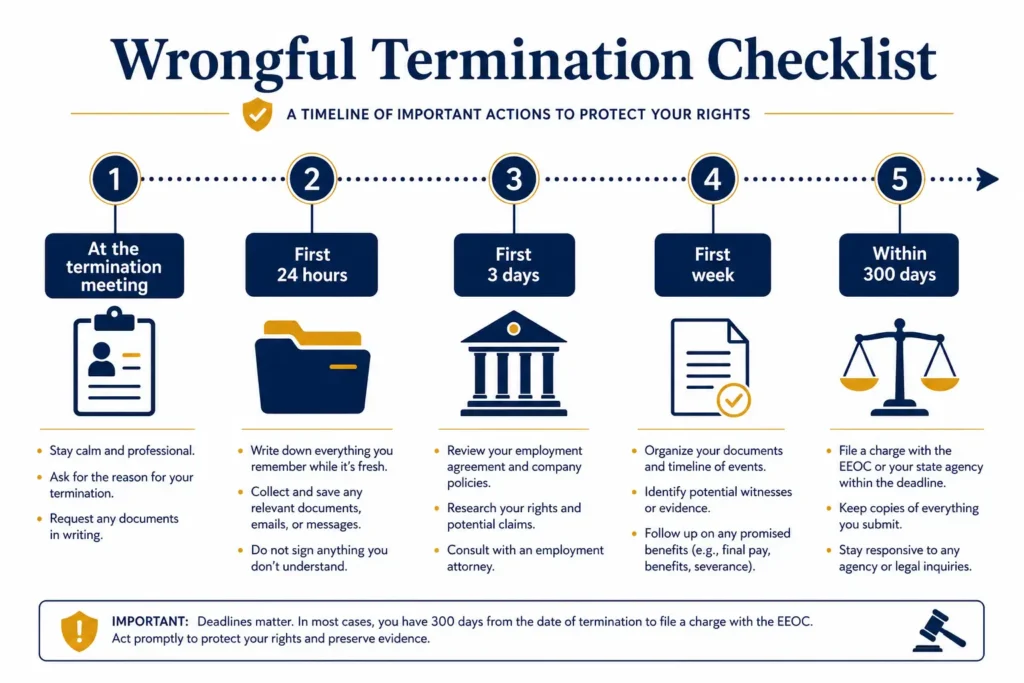
Your wrongful termination checklist at a glance:
- Hour 1: Don’t sign. Request reason in writing. Collect personal belongings only.
- Day 1: Write your evidence timeline from memory. Note every witness.
- Day 2–3: Request your personnel file. File for unemployment.
- Week 1: Consult an employment attorney (free consultation). Review any severance offer.
- Within 300 days: File a Charge of Discrimination with the EEOC if discrimination or retaliation is involved.
The workers who protect their rights are the ones who act systematically, not emotionally. You have the right to answers. You have the right to your file. You may be entitled to substantial compensation. The first step is knowing the rules — and now you do.
Diclaimer: The information provided on this website does not, and is not intended to, constitute legal advice. All information, content, and materials available on this site are for general informational and educational purposes only. Laws regarding employment and labor rights frequently change, and while we strive to keep our content updated, the information on this website may not constitute the most up-to-date legal or other information.
Use of, and access to, this website or any of the links or resources contained within the site do not create an attorney-client relationship between the reader, user, or browser and the website authors, contributors, or its owners. We are an independent publishing platform, not a law firm.
Readers of this website should contact a qualified employment attorney in their specific state to obtain advice with respect to any particular legal matter. No reader or user of this site should act or refrain from acting on the basis of information on this site without first seeking legal advice from counsel in the relevant jurisdiction. Only your individual attorney can provide assurances that the information contained herein – and your interpretation of it – is applicable or appropriate to your particular situation.
Know your rights.
Sources:
- U.S. Equal Employment Opportunity Commission (EEOC) — Filing a Charge
- U.S. Department of Labor — Unemployment Insurance
- National Labor Relations Board — Employee Rights
- McLaren Macomb, 372 NLRB No. 58 (2023)
- Clark County School District v. Breeden, 532 U.S. 268 (2001)