If you are missing hours on your paycheck or working off the clock, you are likely wondering exactly how to report wage theft to Department of Labor authorities without risking your livelihood. You are not alone, and you do not need to hire an expensive attorney to get your money back. The system is designed for workers to navigate on their own, provided they know which levers to pull.
- To report wage theft, you should gather your available pay records and contact the federal Wage and Hour Division (WHD) at 1-866-487-9243 or your State Department of Labor. Filing is protected, and you may recover back pay plus liquidated damages.
This guide is your 2026 action plan. Whether you are dealing with a boss paying cash under the table or a modern app algorithm shaving minutes off your digital timecard, we will walk you through exactly who to call, what to say, and how to protect yourself from retaliation.
What qualifies as wage theft under the Fair Labor Standards Act (FLSA)?
Under the Fair Labor Standards Act (FLSA), wage theft occurs when an employer fails to pay the legally required minimum wage or unpaid overtime. In 2026, this also heavily includes independent contractor misclassification, digital time-shaving, and forcing employees to perform illegal off-the-clock work.
Wage theft rarely looks like a boss physically stealing cash from your wallet. Instead, it happens in the margins. The FLSA—the primary federal law establishing minimum wage and overtime pay—covers the vast majority of U.S. workers.
Here is exactly what wage theft looks like in 2026:
- Unpaid Overtime (Time-and-a-half): If you work over 40 hours in a single workweek, your employer must pay you 1.5 times your regular rate. Paying “straight time” for hour 41 is illegal.
- Digital Time-Shaving: Modern HR software is often rigged. If your employer’s app automatically rounds your clock-in time from 8:52 AM to 9:00 AM, but rounds your clock-out time from 5:08 PM down to 5:00 PM, they are systematically stealing your time.
- Independent Contractor Misclassification (1099 Misclassification): If your boss controls your schedule, provides your tools, and dictates how you do your job, you are a W-2 employee. Labeling you a “1099 contractor” simply to avoid paying overtime and payroll taxes is illegal.
- Off-the-Clock Work: If you are required to answer Slack messages on your commute, put on safety gear before punching in, or close the store after punching out, that time must be paid.
Wage Theft & Damages Calculator
Estimate your unpaid overtime and potential liquidated damages under the FLSA. (Calculated at 1.5x your regular rate).
Can I file a claim with the Wage and Hour Division (WHD) without pay stubs?
Yes. Under the burden of proof established by the Mt. Clemens standard, if your employer illegally fails to keep accurate time records, your reasonable estimate of hours worked is legally sufficient to trigger a U.S. Department of Labor (DOL) investigation to recover wage arrears.
One of the biggest lies terrible bosses tell is, “You can’t prove anything because I didn’t give you pay stubs.” This is legally false.
The U.S. Supreme Court case Anderson v. Mt. Clemens Pottery Co. established a powerful rule for workers. By law, it is the employer’s duty to keep accurate payroll records. If they fail to do so—perhaps by paying you in cash or refusing to issue a W-2—the law does not punish you.
Instead, the burden of proof shifts. If you present a reasonable estimate of your hours, the DOL will accept your numbers unless the employer can provide ironclad proof you are lying.
How to document your time without official records
If you lack official pay stubs, gather circumstantial evidence to support your estimate:
- Google Maps Location History: Proves what time you arrived and left the job site.
- Text Messages: Texts to your boss saying “I just locked up” or “I am opening the store now.”
- Personal Notes: A physical notebook where you write down your start and end times every day.
Should I report wage theft to the federal WHD or my State Department of Labor?
You can report to the federal Wage and Hour Division (WHD) or your State Department of Labor. State agencies often provide stronger worker protections, including higher waiting time penalties and a longer statute of limitations for filing your claim to recover your unpaid wages.
When figuring out how to report wage theft to Department of Labor officials, you actually have two choices: federal or state. Which one should you pick?
- The Federal WHD: Filing with the federal government is best if your employer is violating standard FLSA overtime or minimum wage rules. It is also highly effective if your employer is a large, multi-state corporation. You can start the process by calling 1-866-487-9243.
- Your State Department of Labor: In many cases, your state agency is the better option. States like California, New York, and Colorado have labor laws that are much stricter than federal laws.
For example, federal law does not require an employer to give you paid breaks. But if you work in California and your boss denies your meal break, the State Labor Commissioner can force the employer to pay you a penalty of one hour of regular pay for every day a break was missed. States also frequently enforce waiting time penalties, where your boss owes you a full day’s wages for every day your final paycheck is late.
How does a willful violation affect the statute of limitations and liquidated damages?
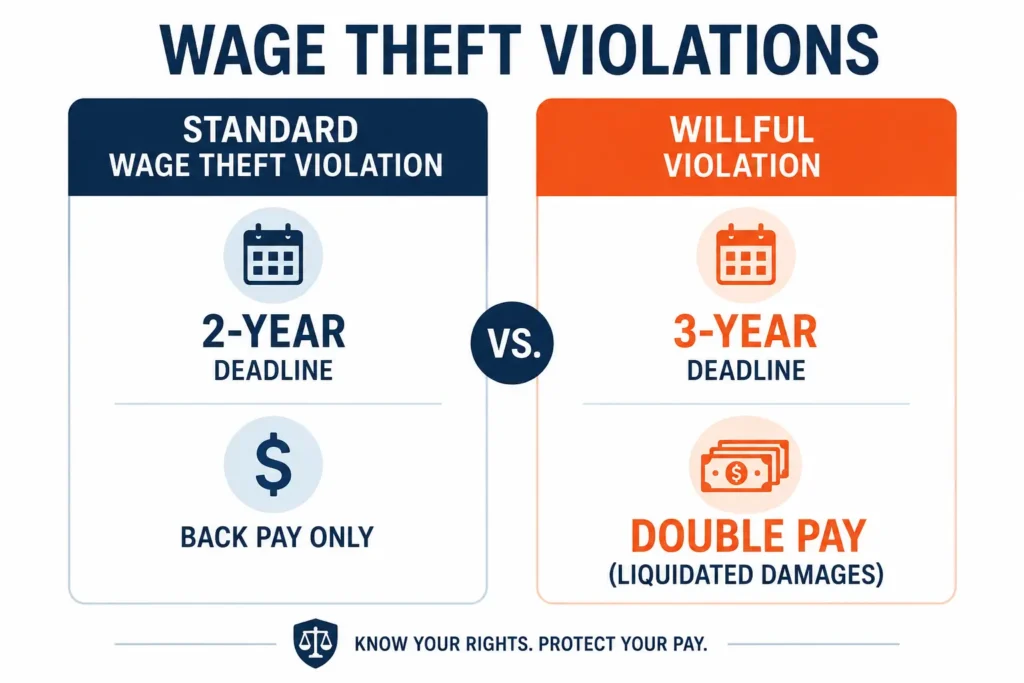
Typically, the statute of limitations for wage theft is two years. However, if you prove a willful violation—meaning your employer knowingly broke the law—it extends to three years. You may also be awarded liquidated damages, effectively doubling the back pay your employer owes you.
Time is your biggest enemy in a wage dispute. The statute of limitations is the legal deadline for you to file a claim. Under standard FLSA rules, you can only look back two years to recover stolen wages. Any unpaid wages older than two years vanish forever.
However, if the DOL determines your boss committed a willful violation (they knew the rules and broke them anyway), you can recover three years of back pay.
The “Double Pay” Secret
When you file a claim, you are not just fighting for your back pay (the actual money stolen from you). The FLSA strongly favors workers by allowing for liquidated damages.
Liquidated damages act as a penalty against the employer. Unless the employer can prove they made an honest, good-faith mistake, the DOL or the court will force them to pay double. If they stole $3,000 from you, they must pay you your $3,000 back, plus another $3,000 in liquidated damages, totaling $6,000.
Can my employer fire me for filing a DOL wage claim?
No. Filing a wage complaint is a legally protected activity. If your employer fires or retaliates against you for reporting wage theft, you have strong legal grounds for a separate retaliation lawsuit and should promptly request a Right to Sue from the investigating agency.
This is the number one reason workers hesitate to learn how to report wage theft to Department of Labor investigators. They need the job, and they are terrified of being fired.
Under the FLSA, complaining about your pay—whether you file a formal DOL complaint or simply send an email to HR asking for your overtime—is a protected activity.
If your boss cuts your hours, demotes you, changes your schedule to an awful shift, or fires you shortly after you complain, they have committed illegal retaliation. In fact, retaliation claims are often easier to prove than the original wage theft claim. If the DOL cannot force a settlement, they will issue you a Right to Sue letter, allowing you to hire a private attorney to sue your boss in federal court for wrongful termination.
Practical Case Study: Winning a Claim Over Digital Time-Shaving and Misclassification
Reporting wage theft can be daunting, but the law is on your side. In a recent case, an employee proved their boss used software for digital time-shaving and illegal 1099 misclassification. The Wage and Hour Division audited the payroll, securing full restitution and damages.
Let’s look at a real-world scenario of how a federal wage claim actually plays out in 2026.
The Situation: “Sarah” worked remotely as a customer service representative. Her company classified her as a 1099 Independent Contractor, paying her a flat $600 a week. However, they required her to log into their proprietary software from 8:00 AM to 6:00 PM (50 hours a week). To make matters worse, the software automatically deducted 30 minutes of pay anytime her mouse went idle for more than 5 minutes.
The Action: Sarah realized this was illegal. She compiled screenshots of her schedule, her software login times, and a copy of her 1099 tax form. She filed a confidential complaint online via the DOL’s WHD portal.
The Audit:
- The Initial Conference: A DOL investigator contacted Sarah to confirm the details.
- The Surprise Audit: The investigator then showed up at the employer’s office (unannounced) and demanded to see the payroll records and software logs.
- The Result: The investigator quickly determined Sarah was actually a W-2 employee because the company controlled her schedule. The DOL forced the company to reclassify her, pay back the 10 hours of overtime she missed every week for two years, and cover the illegally deducted “idle time.” Because the violation was so blatant, the employer also had to pay liquidated damages. Sarah walked away with over $18,000 without ever having to step foot in a courtroom.
Frequently Asked Questions (FAQ) About Reporting Wage Theft
If you are still unsure about the process, here are the most common questions American workers ask before filing a claim.
Can I report my employer anonymously to the DOL?
Yes, all complaints with the Wage and Hour Division are kept confidential. The DOL will not tell your boss who filed the complaint. However, if the DOL only audits your specific timesheets, your boss might figure it out.
How long does a federal wage theft investigation take?
It varies widely depending on the region and agency backlog. A simple claim might be resolved through a phone call to the employer in a few weeks. A full company-wide audit can take anywhere from six months to over a year.
Will the labor board help me if I am an undocumented worker?
Yes. The FLSA applies to all employees working in the United States, regardless of immigration status. The Department of Labor enforces wage laws and does not ask about or report your immigration status to ICE. Your right to be paid for the hours you work is absolute.
Diclaimer: The information provided on this website does not, and is not intended to, constitute legal advice. All information, content, and materials available on this site are for general informational and educational purposes only. Laws regarding employment and labor rights frequently change, and while we strive to keep our content updated, the information on this website may not constitute the most up-to-date legal or other information.
Use of, and access to, this website or any of the links or resources contained within the site do not create an attorney-client relationship between the reader, user, or browser and the website authors, contributors, or its owners. We are an independent publishing platform, not a law firm.
Readers of this website should contact a qualified employment attorney in their specific state to obtain advice with respect to any particular legal matter. No reader or user of this site should act or refrain from acting on the basis of information on this site without first seeking legal advice from counsel in the relevant jurisdiction. Only your individual attorney can provide assurances that the information contained herein – and your interpretation of it – is applicable or appropriate to your particular situation.
Know your rights.