
- You cannot legally be fired in retaliation for reporting a workplace injury or filing a workers’ compensation claim. However, because of at-will employment, you can still be terminated if you cannot perform essential job functions after reaching maximum medical improvement, or if your FMLA leave expires.
If you are lying in bed with a back injury, missing paychecks, and terrified your boss is going to replace you, you are probably searching the internet at midnight asking: can I get fired for getting hurt at work? It is a terrifying position to be in. You are in pain, and you need your job to survive.
The short answer is that employers cannot punish you for getting injured. But the laws protecting you are complicated. They rely on a mix of workers’ compensation, federal leave laws, and disability rights. This 2026 guide is your legal shield. We will break down exactly what your employer can and cannot do, how to protect your income, and how to fight back if you are wrongfully terminated.
Can you be fired while on workers’ comp?
Yes. Because of at-will employment, your employer can legally terminate you while on a workers’ compensation claim for reasons unrelated to your injury, such as company layoffs or poor performance. However, firing you specifically as retaliation for getting hurt is illegal wrongful termination.
Most states operate under at-will employment. This means your boss can fire you at any time, for almost any legal reason. Just because you have an open workers’ compensation claim does not give you an absolute forcefield against being fired.
If your company lays off 50 people, and you are one of them, that is legal. If you were caught stealing before you got hurt, they can still fire you.
However, the law draws a hard line at retaliation. If your boss fires you because you reported a safety hazard, got injured, or filed a claim to get your medical bills paid, that is illegal. This is called wrongful termination. If they punish you for using your legal rights, you can sue them for massive financial damages.
Does FMLA and the ADA protect my job after an injury?
Yes. The Family and Medical Leave Act (FMLA) protects your job for up to 12 weeks while you recover. Furthermore, the Americans with Disabilities Act (ADA) requires your employer to offer a reasonable accommodation if your injury substantially limits a major life activity.
Many workers think workers’ comp protects their actual job position. It does not. Workers’ comp only pays your medical bills and a portion of your lost wages.
To actually protect your job title and desk, you must use federal laws:
- Family and Medical Leave Act (FMLA): If your company has 50 or more employees, and you have worked there for a year, you qualify for FMLA. This federal law guarantees you up to 12 weeks of unpaid, job-protected leave. Your boss cannot legally replace you during this 12-week window while you recover.
- Americans with Disabilities Act (ADA): If your injury turns into a long-term disability, the ADA kicks in. The ADA forces your employer to engage in an “interactive process” to find a reasonable accommodation. This could mean buying you an ergonomic chair, altering your schedule, or moving you to a desk job while your back heals.

Can my employer fire me while I am on light duty?
An employer cannot fire you simply because they do not want to accommodate light duty or restricted duty ordered by your doctor. However, if your restrictions prevent you from performing the essential job functions, they may legally place you on unpaid leave.
When you get hurt, your doctor will likely release you back to work with restrictions. This is called light duty or restricted duty. For example, your doctor might say, “No lifting over 10 pounds.”
If your company has a light-duty program, they must let you use it. They cannot fire you just because you are temporarily less productive.
However, there is a catch. You must still be able to perform your essential job functions. If you are a warehouse worker hired exclusively to lift 50-pound boxes, and you can no longer lift 10 pounds, you cannot do the essential functions of the job. In this case, the employer does not have to invent a fake job for you. They can legally place you on leave until you are fully healed.
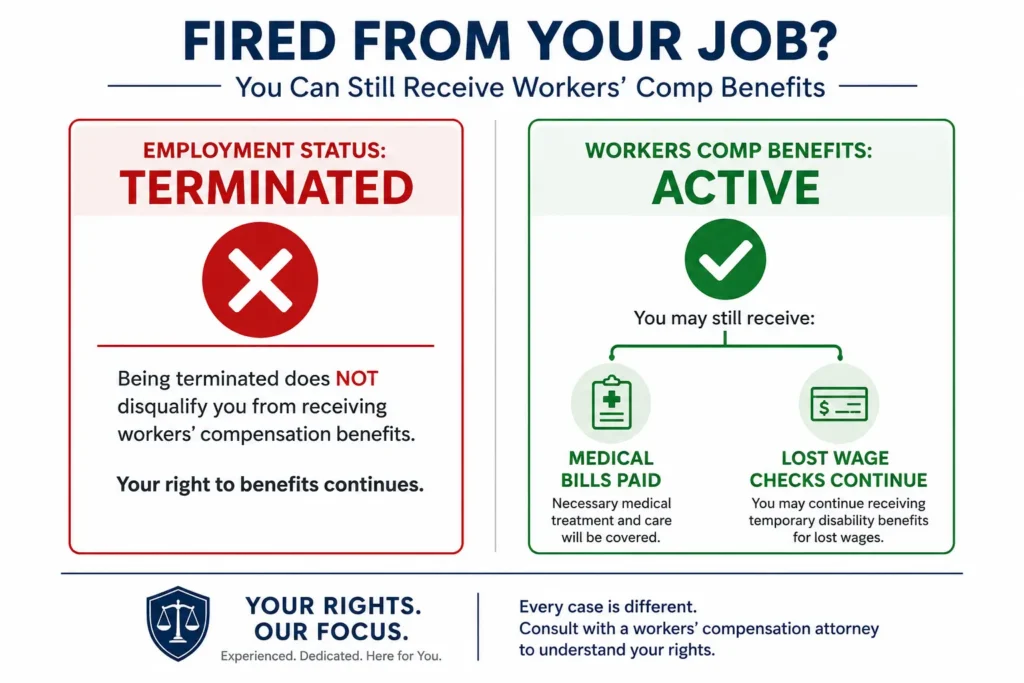
What happens to my workers’ comp benefits if I am terminated?
If you are fired while recovering, your medical treatments and wage replacement checks from the insurance company will continue until you reach Maximum Medical Improvement (MMI). A termination ends your employment, but it does not erase the insurance carrier’s legal obligation to heal you.
This is the biggest fear workers have. If you get fired for getting hurt at work, do you suddenly have to pay for your own surgery? Do you lose your income?
No. Your workers’ compensation benefits are tied to the injury, not your employment status.
Even if your boss fires you the day after your accident, the workers’ compensation insurance company must still pay for your hospital bills, physical therapy, and a percentage of your lost weekly wages. These benefits continue until your doctor declares you have reached Maximum Medical Improvement (MMI). MMI means your body has healed as much as it ever will.
Can I be fired for refusing to do a job that is unsafe?
No. Under Occupational Safety and Health Administration (OSHA) regulations, you have the legal right to refuse dangerous work if you believe it poses an immediate risk of serious injury. Firing you for reporting or refusing an unsafe task is illegal retaliation.
Many workplace injuries happen because a boss forces a worker to do something dangerous. Maybe they tell you to climb a broken ladder or operate a forklift without training.
If you refuse, and they fire you, they are breaking federal law. The Occupational Safety and Health Administration (OSHA) grants workers specific whistleblower protections. You have the right to a safe workplace.
If you are fired for complaining about safety hazards, you can file an official whistleblower complaint with OSHA. You must do this quickly, as you often only have 30 days from the date you were fired to file the OSHA retaliation claim.
What is the Texas Non-Subscriber loophole for work injuries?
Unlike other states, Texas allows employers to opt out of traditional workers’ compensation, making them “non-subscribers.” If you get hurt at a non-subscriber company, you have the right to sue your employer directly for negligence, which vastly changes your legal protections and financial recovery.
If you work in Texas in 2026, the rules are entirely different. Texas is the only state that does not force private employers to carry traditional workers’ comp insurance. Companies like Amazon, Walmart, and Target often act as “non-subscribers” in Texas.
If you are injured at a non-subscriber company, you do not use the standard state workers’ comp system. Instead, if the company was even 1% at fault for your injury (e.g., they didn’t clean up a spill, or gave you broken equipment), you can hire a personal injury lawyer and sue the company directly in civil court for negligence.
This loophole removes the damage caps that normally limit workers’ comp payouts, allowing injured Texas workers to sue for massive pain and suffering damages.
Practical Case Study: Proving Pretextual Firing After a Light Duty Request
When an injured warehouse worker requested light duty, the company immediately fired him, claiming he was “late twice last month.” An employment lawyer proved this was a pretextual firing meant to cover up illegal retaliation, resulting in a massive settlement for the worker.
Employers know they cannot legally fire you for getting hurt. So, they lie. They use a pretextual firing. This means they invent a fake, legal excuse to cover up their illegal retaliation.
The Situation: “David” injured his shoulder pulling pallets. He filed a workers’ comp claim and his doctor gave him a light-duty note limiting him to desk work. Three days later, HR fired David. They claimed he was being fired because he was five minutes late to work twice in the previous month.
The Action: David hired an employment lawyer and filed a claim with his State Labor Board. His lawyer argued the concept of “temporal proximity.” This means the timing was incredibly suspicious. David had worked there for three years, and they never cared about him being five minutes late until the exact moment he asked for light duty.
The Result: During the legal discovery process, David’s lawyer found emails from the manager saying, “We don’t have time for David’s shoulder issues, just find a reason to let him go.” Because the employer’s excuse was proven to be a fake pretext, David won a massive wrongful termination settlement.
Frequently Asked Questions (FAQ) About Getting Hurt at Work
If you are still anxious about your job security, here are quick answers to the most common questions injured workers ask.
How long does an employer have to hold my job while on workers’ comp?
If you qualify for FMLA, your employer must hold your job for 12 weeks. If you do not qualify for FMLA, or your 12 weeks run out, the employer is generally not legally required to hold your specific position open forever. Once they need to fill the role to keep their business running, they can legally replace you.
Do I need an attorney if I am fired after an injury?
Yes. If you are fired shortly after an injury, you should immediately consult an employment lawyer or a workers’ compensation attorney. Most offer free consultations and work on contingency (you pay nothing unless you win). Proving retaliation is complex and requires subpoenaing company emails and HR records.
Can I collect unemployment if I am fired while injured?
It depends on your medical clearance. To collect unemployment, you must be physically “ready, willing, and able to work.” If your doctor says you are 100% disabled and cannot work at all, you cannot get unemployment. However, if your doctor clears you for light-duty work, and your boss fires you instead of accommodating you, you can usually collect unemployment while you look for a new desk job.
Diclaimer: The information provided on this website does not, and is not intended to, constitute legal advice. All information, content, and materials available on this site are for general informational and educational purposes only. Laws regarding employment and labor rights frequently change, and while we strive to keep our content updated, the information on this website may not constitute the most up-to-date legal or other information.
Use of, and access to, this website or any of the links or resources contained within the site do not create an attorney-client relationship between the reader, user, or browser and the website authors, contributors, or its owners. We are an independent publishing platform, not a law firm.
Readers of this website should contact a qualified employment attorney in their specific state to obtain advice with respect to any particular legal matter. No reader or user of this site should act or refrain from acting on the basis of information on this site without first seeking legal advice from counsel in the relevant jurisdiction. Only your individual attorney can provide assurances that the information contained herein – and your interpretation of it – is applicable or appropriate to your particular situation.
Know your rights.