
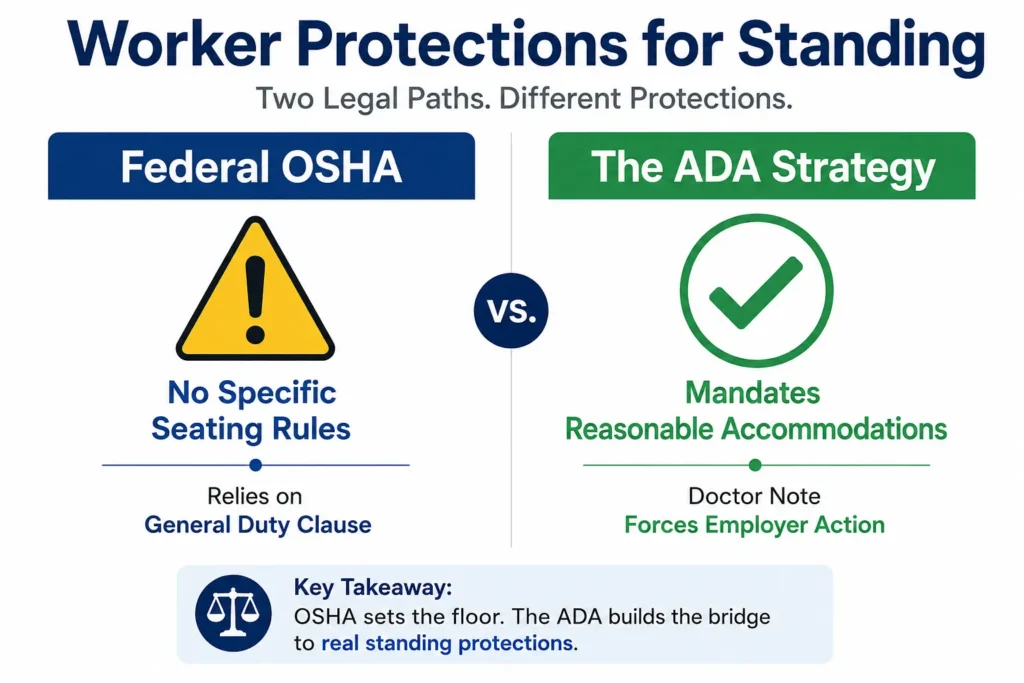
- There are no specific federal OSHA regulations that dictate how many hours an employee can stand at work. However, OSHA’s General Duty Clause requires employers to mitigate recognized ergonomic hazards. To legally force your boss to provide a chair or anti-fatigue mat, you must usually rely on state “Right to Sit” laws or the Americans with Disabilities Act (ADA).
If your feet are throbbing, your lower back is in agony, and you are forced to stand behind a cash register for eight hours straight, you are likely searching for OSHA regulations for standing at work all day. It feels like torture, and it seems like it should be highly illegal to force a human being to stand in one spot when a simple stool would solve the problem.
Unfortunately, federal occupational safety laws are painfully outdated when it comes to standing. But that does not mean you are powerless. This 2026 legal survival guide will explain how to bypass OSHA’s blind spots. We will teach you how to use modern state seating laws, how to leverage the ADA, and the exact steps to force your employer to provide ergonomic relief.

Does OSHA have a specific rule about standing all day?
No. The Occupational Safety and Health Administration (OSHA) does not have a specific standard that legally limits how many hours you can stand, nor do they explicitly mandate that employers provide chairs for retail or assembly line workers.
When workers look for OSHA regulations for standing at work all day, they expect to find a strict rule saying, “Employers must provide a chair after 4 hours.” That rule does not exist at the federal level.
However, OSHA does enforce the General Duty Clause. This foundational safety law states that an employer must provide a workplace “free from recognized hazards that are causing or are likely to cause death or serious physical harm.”
Medical science universally recognizes that prolonged standing causes severe ergonomic hazards, including:
- Chronic lower back pain.
- Plantar fasciitis and joint damage.
- Cardiovascular issues, such as pooling blood and varicose veins.
If a company forces workers to stand in one spot for 10 hours without breaks, causing a spike in medical complaints, OSHA can cite them under the General Duty Clause for failing to mitigate a known ergonomic hazard.
Does OSHA require employers to provide anti-fatigue mats?
OSHA does not specifically mandate anti-fatigue mats. However, under OSHA Standard 1910.22, employers must maintain safe walking-working surfaces. Providing anti-fatigue mats is the primary way employers prove they are mitigating the ergonomic hazards of standing on concrete.
If your boss refuses to buy a $40 rubber mat and forces you to stand on raw concrete, they are playing a dangerous legal game.
While the word “anti-fatigue mat” is not explicitly written in the OSHA rulebook, the agency heavily recommends them. Under Standard 1910.22, walking surfaces must be safe. Furthermore, under the General Duty Clause, employers must minimize ergonomic stress.
If an OSHA inspector audits a factory and sees workers developing musculoskeletal disorders from standing on concrete, the inspector will demand to know why the employer has not implemented basic administrative controls—like anti-fatigue mats, footrests, or sit-stand stools.
State “Right to Sit” Laws: The 2026 Legal Shift
Because federal OSHA is silent on seating, many states have passed “Right to Sit” laws. In states like California and Florida, employers are legally required to provide a suitable seat if the nature of the work reasonably allows for seated work.
The biggest legal shift in 2026 is happening at the state level. Workers are tired of waiting for OSHA, and state lawmakers are stepping in.
If you live in a state with a Right to Sit law, federal OSHA rules do not matter. State law overrides the federal silence.
- California: The Supreme Court of California has aggressively enforced their suitable seating law. If you are a cashier, a bank teller, or working a reception desk, your employer must provide a chair. They cannot force you to stand simply because it “looks more professional.”
- The 2026 Movement: States like Illinois (with the proposed HB3249 Right to Sit at Work Act) and New York are actively pushing legislation to heavily fine employers who design workspaces that require standing when sitting is perfectly feasible.
If you live in a Right to Sit state, you do not call OSHA. You file a wage and labor claim with your state’s Department of Labor.
How to use the ADA to get a chair at work
If your state lacks a Right to Sit law, your best legal weapon is the Americans with Disabilities Act (ADA). If prolonged standing causes you severe chronic pain, your doctor can diagnose the condition, forcing your employer to provide a stool as a “reasonable accommodation.”
This is the ultimate legal loophole. If OSHA cannot help you, use the ADA.
You do not need to be in a wheelchair to qualify for ADA protections. If standing all day has destroyed your knees, or caused severe plantar fasciitis, you now have a protected medical condition.
The Strategy:
- Go to your doctor and explain the severe physical pain caused by standing at work.
- Have the doctor write a simple note stating: “Due to a chronic musculoskeletal condition, this patient requires a sit-stand stool to alternate postures while working.”
- Submit this note to HR as a formal request for a Reasonable Accommodation under the ADA.
Under federal law, your employer must grant this request unless they can prove that buying a $50 stool will cause the company “undue hardship” (which is virtually impossible for a corporation to prove). If they deny the stool, they are committing illegal disability discrimination.
Practical Case Study: Bypassing OSHA to Secure a Sit-Stand Stool
Understanding how to pivot your legal strategy is crucial. A pharmacy technician successfully forced her corporate employer to provide a stool by abandoning OSHA complaints and filing a targeted ADA reasonable accommodation request.
Let’s look at how a worker used modern labor laws to beat a stubborn employer.
The Situation: “Maria” was a pharmacy tech required to stand in one spot for 9 hours a day on a concrete floor. She developed severe sciatica. She complained to her manager, asking for a stool. The manager refused, stating, “Company policy says standing looks more attentive to customers, and OSHA doesn’t say we have to give you a chair.”
The Action: Maria knew the manager was right about OSHA, so she changed tactics. She went to an orthopedist who diagnosed her with chronic sciatica. The doctor wrote a note requiring “the ability to sit for 15 minutes every hour.” Maria emailed this to Corporate HR, officially invoking the Americans with Disabilities Act.
The Result: Corporate HR immediately overruled the local manager. They knew that denying a documented medical accommodation over a “company appearance policy” was a fast track to a massive EEOC discrimination lawsuit. Maria was provided with an adjustable sit-stand stool within 48 hours, entirely bypassing the weak OSHA standing regulations.
Frequently Asked Questions (FAQ) About Standing at Work
Can I be fired for sitting down at work?
If you do not have a medical accommodation (ADA) and you do not live in a “Right to Sit” state, your employer can legally fire you for sitting down on the job under at-will employment laws. This is why securing a doctor’s note is critical to protecting your paycheck.
Does OSHA regulate what shoes I can wear?
OSHA requires employers to ensure workers use appropriate Personal Protective Equipment (PPE), which includes safety footwear (like steel-toe boots) if crushing hazards exist. However, OSHA does not mandate that employers buy you comfortable orthopedic sneakers for general standing.
Are employers required to give me extra breaks if I stand all day?
Surprisingly, federal law does not mandate rest breaks or meal periods for adult workers, regardless of how long they stand. However, many states (like California, Washington, and New York) have strict state labor laws requiring paid 10-minute rest breaks for every four hours worked.
Disclaimer: The information provided on this website does not, and is not intended to, constitute legal advice. All information, content, and materials available on this site are for general informational and educational purposes only. Laws regarding employment and labor rights frequently change, and while we strive to keep our content updated, the information on this website may not constitute the most up-to-date legal or other information.
Use of, and access to, this website or any of the links or resources contained within the site do not create an attorney-client relationship between the reader, user, or browser and the website authors, contributors, or its owners. We are an independent publishing platform, not a law firm.
Readers of this website should contact a qualified employment attorney in their specific state to obtain advice with respect to any particular legal matter. No reader or user of this site should act or refrain from acting on the basis of information on this site without first seeking legal advice from counsel in the relevant jurisdiction. Only your individual attorney can provide assurances that the information contained herein – and your interpretation of it – is applicable or appropriate to your particular situation.
Know your rights.