Quick Answer: Yes, you can be legally fired for slapping someone at work. Under at-will employment — the law in 49 of 50 U.S. states — your employer can terminate you for almost any reason, including a single physical incident. Striking a coworker violates nearly every company’s zero-tolerance workplace violence policy, making immediate termination both expected and legally defensible.
Key Takeaways
- Firing is almost always legal. At-will employment gives employers broad authority to terminate after any physical incident.
- Self-defense does not protect your job. It may protect you from criminal charges, but it does not override HR policy.
- Unemployment is likely denied. A slap is typically classified as gross misconduct, which disqualifies you in most states.
- Criminal charges are possible. A slap can legally constitute assault and battery — the victim can press charges and sue.
- Provocation matters — but not where you think. If a coworker’s illegal harassment provoked you, your employer may face serious legal liability even if your firing stands.
You snapped. Maybe you were pushed, grabbed, or harassed for months before it happened. Maybe it was pure impulse. Either way, you’re now staring at a termination notice and asking yourself: Can they really do this? What happens next? Did I just ruin my life?
Take a breath. This guide gives you the complete legal picture for 2026 — what your employer can do, what you can do, and what moves to make right now. Under federal law and the employment laws of most U.S. states, your situation is serious — but it is not necessarily hopeless.
Can You Be Legally Fired for Slapping Someone at Work?
Yes — and in most cases, the firing is completely legal.
The United States operates under a doctrine called at-will employment, which means your employer can terminate you at any time, for almost any reason, as long as that reason isn’t illegal discrimination (based on race, sex, religion, disability, etc.). Only Montana has meaningful at-will exceptions as a default for all employees. (U.S. Department of Labor)
Physical violence at work falls squarely within the category of conduct that zero-tolerance policies are designed to address. Most employee handbooks include language that makes workplace violence an immediate, terminable offense — no second chances, no progressive discipline.
The bottom line: a single slap gives your employer all the legal ammunition they need to fire you on the spot.
Even if you had a spotless 10-year record. Even if the other person started it. Even if no one was seriously hurt.
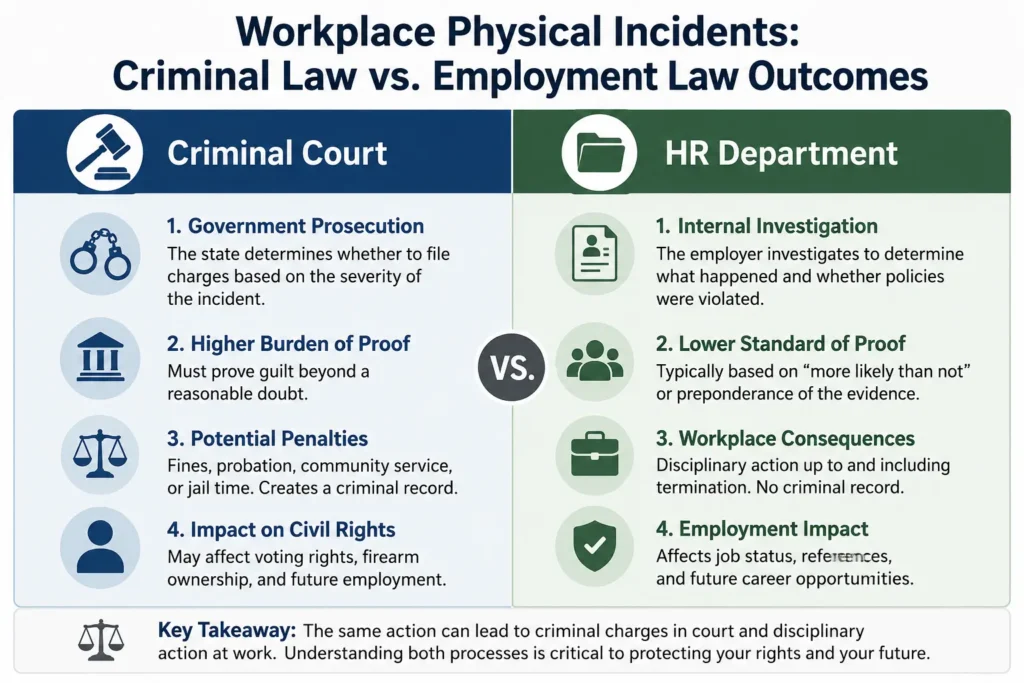
This is one of the starkest differences between employment law and criminal law. In a court, context matters enormously. In HR, results matter most — and a physical altercation creates a legal and reputational risk that companies move quickly to eliminate.
Why Does HR Fire Employees Who Act in Self-Defense?
This is the question most workers ask — and most articles never fully answer.
Self-defense may protect you from criminal prosecution. It does not protect your job.
Here’s the corporate logic: imagine your employer keeps you on after you slapped a coworker, even claiming self-defense. Three months later, another incident happens. The victim sues the company, arguing management knew about your violent history and did nothing. This is called negligent retention — and it’s one of the most expensive liability traps in employment law. Jury verdicts in negligent retention cases frequently exceed $1 million. (Society for Human Resource Management)
HR’s job is to protect the company, not to be fair to you. When they fire everyone involved in a physical altercation — regardless of who “started it” — they are following a liability-minimization playbook that courts have consistently upheld.
This is why even documented self-defense rarely saves a job after a workplace fight.
What you can do: if you genuinely acted in self-defense, document everything immediately — write down the sequence of events, gather any witnesses, and preserve any physical evidence (surveillance footage requests should go to HR in writing within 24 hours, before recordings are overwritten).
What If the Slap Was Provoked by Severe Harassment?
This is where your situation gets more complicated — and potentially more powerful for you.
If you reacted physically because a coworker was sexually assaulting you, making severe racial slurs, or engaging in conduct that rises to the level of a hostile work environment under Title VII of the Civil Rights Act, the legal picture changes significantly.
Here’s what you need to understand:
- You will still likely be fired for the physical act. That part almost never changes.
- But your employer may have broken the law first. Under Title VII, employers are legally required to maintain a workplace free from severe or pervasive harassment based on race, color, religion, sex, or national origin. (U.S. Equal Employment Opportunity Commission)
- If management knew about the harassment and failed to act, your firing could be seen as retaliation for opposing illegal conduct — which is itself a federal violation.
This means you may have grounds to file an EEOC charge even if the firing itself was technically legal. And critically: the EEOC filing deadline is 180 days from the discriminatory act in most states (300 days in states with their own agencies). If harassment provoked your reaction, start that clock now.
Real Scenario: A warehouse worker — we’ll call her M. — was grabbed inappropriately by a supervisor for the third time in six weeks. She slapped him. She was fired the next day. The supervisor was not fired. M. filed an EEOC charge for sexual harassment and retaliation. The EEOC issued a right-to-sue letter, and M.’s attorney negotiated a confidential settlement. Her firing was not reversed — but she was compensated for the hostile work environment that led to it.
Are You Guilty of Criminal Assault and Battery for a Slap?
Possibly yes — and this is the part most guides skip over.
In legal terms, assault is the intentional act that causes another person to reasonably fear immediate harm. Battery is the actual physical contact. A slap covers both: the moment you raised your hand (assault) and the moment it connected (battery).
Whether the police get involved depends on:
- Whether the other party presses charges
- The severity of any injury
- Whether the incident occurred in a state with mandatory reporting for workplace violence
Even a minor slap can result in criminal charges. Misdemeanor assault and battery convictions carry penalties including fines, probation, and up to one year in county jail — though first-offense outcomes are often lighter with no prior record.
The victim can also file a civil lawsuit against you personally for damages, including medical costs, emotional distress, and lost income if they miss work due to the incident.
What to do right now: Do not make any statements to police without consulting an attorney. Do not contact the other party. Do not post anything about the incident on social media.
Can You Be Fired for a Physical Fight at an Off-Duty Happy Hour?
Yes — and many workers are blindsided by this.
The legal concept is called the “nexus to employment” rule. Even if an incident happens off-site and outside work hours, your employer can terminate you if the conduct:
- Involved a coworker, supervisor, or client
- Damaged the company’s reputation
- Created a reasonable fear of future violence in the workplace
- Violated a written conduct policy that extends to off-duty behavior
| Scenario | Can Employer Fire You? | Unemployment Likely? |
|---|---|---|
| Slap during work hours, on company property | Yes — almost certainly | No — gross misconduct |
| Slap at after-work happy hour with coworkers | Yes — nexus to employment | No — likely disqualified |
| Slap at a personal event, no coworkers involved | Depends on state + policy | Possibly yes |
| Slap in response to a coworker’s physical assault | Yes — but EEOC claim possible | No — but legal options exist |
The modern workforce has blurred the line between “work time” and “personal time” — especially in industries with team events, remote work socials, and company retreats. Courts in most circuits have upheld terminations for off-duty conduct when a clear workplace connection exists. (National Labor Relations Board — Off-Duty Conduct Guidance)
Will You Get Unemployment Benefits If Fired for Fighting at Work?
This is the question that keeps people up at night — and the answer is almost always bad news.
In most states, you will be denied unemployment if you were fired for slapping or hitting a coworker.
Here’s why: state unemployment agencies apply a standard called gross misconduct to disqualify workers who were fired for their own deliberate, serious violations of workplace rules. A physical assault almost universally meets this threshold.
In 2026, the consequences are severe:
- Immediate disqualification from receiving benefits
- In some states, erasure of prior wage credits — meaning wages you earned before the incident no longer count toward future claims
- Disqualification periods that can range from 6 weeks to permanent, depending on the state
| State | Gross Misconduct Disqualification Period | Wage Credit Erasure? |
|---|---|---|
| California | Indefinite (until new qualifying wages) | Yes |
| Texas | Varies; typically full benefit year | Yes |
| New York | Varies by severity | Possible |
| Florida | 52 weeks | Yes |
| Illinois | Disqualified + 52-week wage erasure | Yes |
Note: State rules change. Always verify with your state’s workforce agency.
The narrow exception: If you can prove the incident was genuine self-defense against an imminent physical threat AND you reported it to management immediately, some state agencies have made exceptions. It is rare, but it happens. Document everything and appeal any denial in writing — you have the right to a hearing.
Case Study: The Off-Duty Altercation That Cost Two Workers Everything
Two employees at a logistics company — both warehouse leads — had a long-running tension over scheduling. On a Saturday night, they ended up at the same bar with other coworkers. An argument escalated. One shoved the other. The other responded with a slap. Both were asked to leave.
On Monday morning, HR called them both in. By noon, both had termination letters.
They both filed for unemployment. The state agency denied both claims, citing gross misconduct. The agency’s reasoning: the fight involved coworkers from the same shift, at a gathering that was a de facto extension of their workplace social environment, and the incident had already caused visible tension and conflict when both employees came to work on Monday morning.
The outcome: Neither received unemployment. One was later charged with misdemeanor battery by the other (the charge was eventually dismissed). Both spent months without income.
The lesson: The moment a physical incident involves a coworker — on or off the clock — assume your job and your benefits are both at risk.
Frequently Asked Questions About Being Fired for Slapping Someone at Work
Can I sue my employer for wrongful termination after being fired for slapping a coworker?
In most cases, no. At-will employment gives your employer broad authority to fire you for workplace violence. However, if you were fired as retaliation for reporting illegal harassment, discrimination, or a safety violation — and the slap was a reaction to that illegal conduct — you may have a wrongful termination or retaliation claim worth discussing with an employment attorney.
Can I sue the coworker who provoked me into slapping them?
Possibly, but the logic cuts both ways. If a coworker sexually assaulted you or physically attacked you first, you may have a civil claim against them for assault, battery, or intentional infliction of emotional distress. Consult an attorney before taking any action.
Can I sue a coworker who slapped me?
Yes. If you were the one slapped, you have the right to file a civil lawsuit against the individual for assault and battery. You may also have a workers’ compensation claim for any physical injury sustained. These two paths are not mutually exclusive.
Is a verbal threat enough to get me fired?
Yes. Under most zero-tolerance policies, threatening physical violence — even if you never make contact — is treated with the same severity as actual violence. Courts have consistently upheld terminations for credible verbal threats.
Does it matter who threw the first punch?
In employment law, usually not. Most HR policies treat all participants in a physical altercation equally. The “first aggressor” standard that applies in criminal self-defense cases does not automatically apply to HR decisions.
What should I do in the first 24 hours after being fired for a workplace fight?
1. Document the full sequence of events in writing while memory is fresh.
2. Request (in writing) that HR preserve any surveillance footage or witness statements.
3. Contact an employment attorney for a free consultation — many offer them.
4. File for unemployment anyway. You have the right to appeal a denial.
5. Do not contact the other party or post about the incident on social media.
Can my employer report the incident to future employers?
Most employers report only job title, dates of employment, and whether you are eligible for rehire. However, if asked directly, some will confirm that you were terminated for gross misconduct. In some states, employers are protected from defamation claims when sharing factual termination information in good faith.
What is the difference between assault and battery in a workplace context?
Assault is the intentional act that causes another person reasonable fear of imminent physical harm — for example, raising your hand in a threatening way. Battery is the actual unwanted physical contact — the slap itself. Both can be criminal offenses and both can result in civil liability, even if no serious injury occurred.
Conclusion: You Have More Options Than You Think
Being fired for slapping someone at work is serious. The legal and financial fallout can be real and lasting. But knowing exactly where you stand — and what moves are available to you — is how you start to rebuild.
Here’s what matters most right now:
If illegal harassment, discrimination, or physical assault by a coworker contributed to what happened, that changes your legal options significantly. The EEOC process exists precisely for situations where workers are pushed into impossible positions by employers who failed to protect them.
Start documenting. File for unemployment even if you expect a denial — you have the right to appeal, and some workers win on appeal. And talk to an employment attorney. Many offer free initial consultations, and you may have more leverage than you realize.
This article is for informational purposes only and does not constitute legal advice. Employment laws vary by state. If you believe your rights have been violated, consult a licensed employment attorney in your state.