
The moment you are handed a termination letter, panic sets in. Your mind races to your bills, rent, and groceries. In this chaos, the most urgent question is: can I get unemployment if I was fired? Yes, you absolutely can. Being fired does not automatically disqualify you from receiving state benefits.
Employers often want you to walk away quietly. They want you to believe that losing your job means losing your rights. This is false. Unless your employer can prove you intentionally broke company rules, the law is on your side.
This 2026 legal survival guide will show you exactly how to secure your weekly checks. We will expose the difference between innocent mistakes and willful misconduct, teach you how to win an appeal, and help you navigate complex remote-work filing rules.
Can you get unemployment if you were fired for poor performance?
Yes, you can get unemployment if you were fired for poor performance. Terminations based on a lack of skills, missed quotas, or simply not being a good fit are classified as a ‘discharge without fault.’ You are fully entitled to collect state unemployment benefits.
This is the biggest secret Human Resources keeps from you. Firing someone for incompetence is entirely legal under at-will employment. However, simply being bad at your job is not a crime.
If you tried your best but could not meet a sales quota, you committed no legal wrong. The state considers this a Discharge Without Fault. As long as you earned enough money during your Base Period (usually the first four of the last five completed calendar quarters), your application will be approved.
[INSIRA IMAGEM AQUI: A realistic, high-quality photograph of a stressed but relieved American worker sitting at a kitchen table. They are looking at a laptop screen displaying an approved government unemployment portal. Bills and a coffee mug are on the table. The lighting conveys relief after a period of financial anxiety.

What is the difference between willful misconduct and gross misconduct?
Willful misconduct involves intentionally breaking company rules, like insubordination or failing a drug test, which disqualifies you from current benefits. Gross misconduct involves severe crimes like embezzlement, which can trigger strict 2026 penalties that permanently erase your past wage history and future eligibility.
To legally block your unemployment claim, your employer must prove misconduct. Misconduct requires strict intent. Making an honest mistake is not misconduct.
- Willful Misconduct: This means you knew the rules and chose to break them. Examples include stealing company time, screaming at a manager, or having chronic unexcused absences. If proven, you are denied your current unemployment claim.
- Gross Misconduct: In 2026, states are heavily penalizing extreme workplace behavior. Gross misconduct involves severe, often criminal acts. Examples include physically assaulting a coworker or embezzling thousands of dollars. The penalty is devastating. The state can permanently cancel all your past wage credits. This ruins your ability to collect unemployment now and potentially in the future.
Can I get unemployment if I was forced to quit my job?
Generally, quitting voluntarily disqualifies you from receiving unemployment. However, if your employer created intolerable working conditions—like ignoring severe sexual harassment or illegally slashing your pay—you can claim a ‘constructive discharge.’ The state will treat your forced resignation as a legal firing.
Toxic employers often try to make your life miserable. They hope you will quit. If you quit voluntarily, they do not have to pay unemployment taxes.
Do not give them a free victory. If you must leave for your safety or financial survival, you must prove you quit for Good Cause.
In employment law, this is called a Constructive Discharge. You must prove that a reasonable person would have felt forced to flee. Examples include an employer demanding you perform illegal acts, ignoring severe OSHA safety hazards, or cutting your hourly pay by 30%. If you have a paper trail showing you tried to fix the issue before leaving, you can win your benefits.
How does severance pay and the gig economy affect your unemployment claim?
Accepting a lump-sum severance package will likely delay your first unemployment check, but it does not destroy your claim. Additionally, if you were fired as a 1099 contractor, you may still qualify for benefits if the state determines you were subjected to illegal 1099 misclassification.
The 2026 job market is complex. Do not let severance pay or contractor labels stop you from filing.
- Severance Package Delay: If your employer gives you four weeks of severance pay, report it to the state. You cannot “double dip.” The state will simply delay your unemployment payments until those four weeks expire. Always file on day one anyway.
- 1099 Misclassification: Independent contractors (freelancers, gig workers) usually cannot get unemployment. However, corporate exploitation is rampant. If your boss controlled your schedule, provided your laptop, and then “fired” you, you might be a victim of 1099 Misclassification. You can file a claim and force the state to audit the company.
(For more details on worker classification, consult the U.S. Department of Labor’s 2026 Worker Classification Guidelines)
Where do remote workers file for unemployment after being fired?
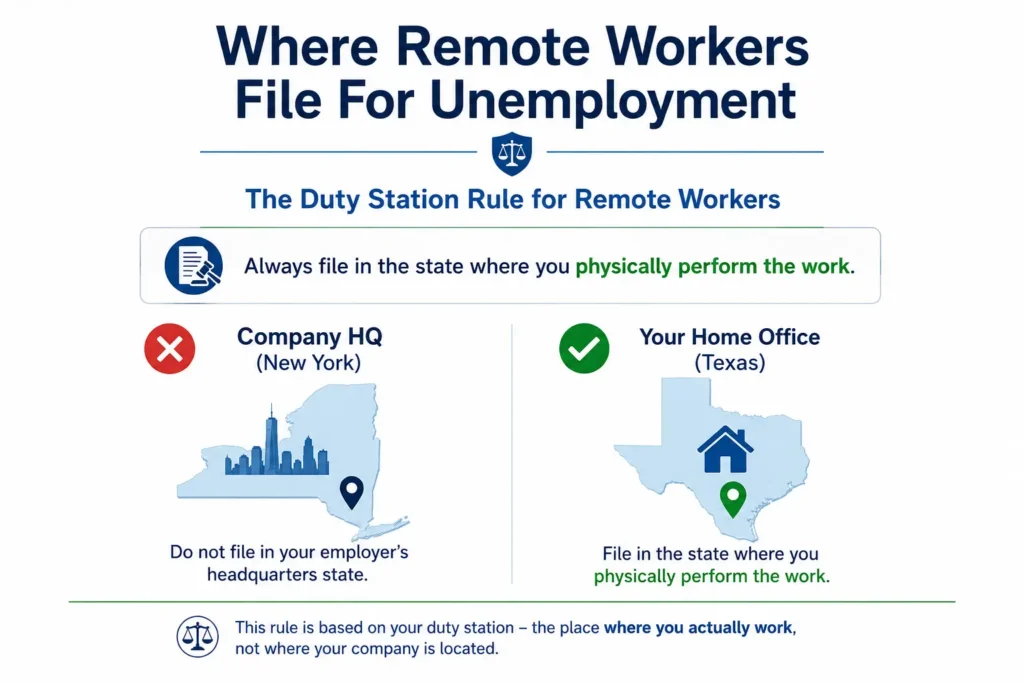
If you work remotely in a different state than your company’s headquarters, you must file for unemployment in the state where you physically performed the work. If you moved or worked in multiple states, you can file a combined wage claim to maximize your benefits.
Remote work creates massive confusion for fired employees. Let’s simplify it.
The Duty Station Rule
Unemployment taxes are paid to the state where the work is physically done. This is your “duty station.”
If you sit at your kitchen table in Texas, but your company’s headquarters is in New York, you must file your claim in Texas. Texas collected the tax, so Texas pays the benefit. If you worked from an RV and lived in three different states last year, you can file a Combined Wage Claim. This forces the states to pool your income history, ensuring you get the highest possible weekly payout.
How do you win your unemployment appeal hearing against an employer?
To win your unemployment appeal, remember that the burden of proof is entirely on your employer. They must provide documented evidence of your willful misconduct to the Administrative Law Judge (ALJ). If they rely on hearsay or fail to appear, you win by default.
Employers frequently contest unemployment claims to keep their corporate tax rates low. Do not panic if your claim is initially denied. You must appeal.
When you appeal, you get a telephone hearing with an Administrative Law Judge (ALJ). The most important legal concept here is the Burden of Proof. You do not have to prove you were a good employee. The employer must prove you were intentionally bad. If your boss shows up empty-handed with no written warnings or signed policies, the judge will rule in your favor.
Practical Case Study: Winning the ALJ Appeal
Understanding how to navigate an appeal can save your finances. Here is a real-world example of how a worker beat a false misconduct claim.
The Situation: “Sarah” worked as a cashier. She woke up with a severe fever and immediately called her store manager, leaving a voicemail exactly as outlined in the company handbook. When she returned to work two days later, she was fired. The employer told the state unemployment agency she was fired for “job abandonment and insubordination.” Sarah’s benefits were blocked.
The Action: Sarah filed an appeal. During the phone hearing with the ALJ, the HR director claimed Sarah never called in. Sarah stayed calm. She uploaded her cell phone billing records to the state portal. The records proved she made a 3-minute phone call to the manager’s direct desk line at 6:15 AM on the day she was sick.
The Result: The employer lied. Sarah proved she followed the rules. Because the employer failed to meet their burden of proof for willful misconduct, the judge reversed the denial. Sarah was awarded thousands of dollars in back-paid unemployment benefits.
Frequently Asked Questions (FAQ) About Unemployment Eligibility
How does my employer find out if I filed?
When you submit your application, the state Department of Labor mails a “Notice of Claim” to your former employer. The employer has a brief window (usually 10 to 14 days) to respond if they wish to contest the claim.
Can I get unemployment if I was fired for attendance?
It depends on the context. If you frequently performed “no-call/no-shows” to go to the beach, that is willful misconduct, and you will be denied. However, if your absences were protected by the Family and Medical Leave Act (FMLA), or were due to a sudden, documented medical emergency, those absences do not legally disqualify you from benefits.
Do I need a lawyer for my unemployment appeal?
You are not legally required to have an attorney. Most workers represent themselves during the telephone hearing. However, if your case involves complex legal issues like a hostile work environment or illegal discrimination under the Equal Employment Opportunity Commission (EEOC), consulting an employment lawyer is highly recommended.
Disclaimer: The information provided on this website does not, and is not intended to, constitute legal advice. All information, content, and materials available on this site are for general informational and educational purposes only. Laws regarding employment and labor rights frequently change, and while we strive to keep our content updated, the information on this website may not constitute the most up-to-date legal or other information.
Use of, and access to, this website or any of the links or resources contained within the site do not create an attorney-client relationship between the reader, user, or browser and the website authors, contributors, or its owners. We are an independent publishing platform, not a law firm.
Readers of this website should contact a qualified employment attorney in their specific state to obtain advice with respect to any particular legal matter. No reader or user of this site should act or refrain from acting on the basis of information on this site without first seeking legal advice from counsel in the relevant jurisdiction. Only your individual attorney can provide assurances that the information contained herein – and your interpretation of it – is applicable or appropriate to your particular situation.
Know your rights.