
To request a reasonable accommodation at work, tell your employer in plain language that you have a medical condition and need a change to do your job — you don’t need to use the words “ADA” or name your diagnosis. Under the Americans with Disabilities Act (ADA), your employer must then engage in an “interactive process” to identify an effective accommodation, unless doing so would cause undue hardship. Put your request in writing, focus on your functional limitations (not your diagnosis), and keep a copy for your records. Here’s how to request reasonable accommodation at work.
Key Takeaways
- You have the right to request a reasonable accommodation without disclosing your exact diagnosis — describing your limitations is legally enough to start the process.
- Your employer must keep any medical information in a separate, confidential file — this is required by the ADA, not by HIPAA (most employers aren’t covered by HIPAA at all).
- Requesting an accommodation before a mistake happens can protect your job — employers can still enforce uniform conduct rules, even if a disability contributed to a violation.
- Telework is no longer treated as an automatic accommodation. New February 2026 EEOC/OPM guidance confirms remote work must be effective, not just preferred, and employers can offer in-office alternatives instead.
- Retaliation for requesting an accommodation is illegal, even if your employer ultimately denies the request.
Maybe you’re terrified you’ll be written up — or fired — for something connected to a condition you never chose to have. Maybe you’re worried that the moment you say the word “accommodation,” your manager will start treating you differently, or worse, that your private medical information will end up on someone’s desk who has no business seeing it.
You’re not overreacting. Under federal law — specifically the Americans with Disabilities Act (ADA) — you have the right to request a reasonable accommodation, and your employer has a legal duty to respond in good faith. This guide walks you through exactly how to request reasonable accommodation at work, what your employer can and can’t do with your medical information, and what to say when the moment feels high-stakes. You’ll leave with copy-paste email templates, a clear step-by-step process, and a plain-English understanding of your rights — no law degree required.
Can I Get Fired for an Accidental HIPAA Violation? (Disability vs. Conduct Rules)
If you work in healthcare, insurance, or any role where handling protected patient data is part of your job, this fear is real — and worth addressing head-on before anything goes wrong.
Why Requesting an Accommodation Before a Mistake Is Critical
The ADA protects you from discrimination because of your disability — it does not protect you from consequences for breaking rules that apply to everyone. If you have ADHD, a processing disorder, or a condition that affects focus or memory, and you accidentally mishandle patient information in violation of your employer’s HIPAA privacy protocols, your employer can generally still discipline or terminate you for that conduct violation. The disability doesn’t erase the rule.
This is exactly why timing matters so much. If you request an accommodation — like task-checklists, reduced interruptions, extra file-verification steps, or software safeguards — before an incident occurs, you give your employer a documented opportunity to help you succeed. That documentation can become powerful evidence later if you’re ever accused of a conduct violation that traces back to an unaccommodated limitation.
Direct Threat and Uniform Performance Standards
Employers are allowed to hold every employee — disabled or not — to the same essential conduct and safety standards, a legal concept sometimes called “uniformly applied conduct rules.” The Equal Employment Opportunity Commission (EEOC) has been clear that the ADA doesn’t require employers to excuse misconduct, even when a disability is a contributing factor, as long as the rule is job-related and applied consistently to everyone.
Bottom line: the strongest legal protection you have is a documented accommodation request made proactively — not an excuse offered after the fact.
Does Requesting an Accommodation Violate My Medical Privacy (Is It a HIPAA Violation)?
This is one of the most common — and most understandable — fears workers have, and it’s based on a myth almost every competitor article gets wrong.
The ADA Confidentiality Rule vs. HIPAA Protections
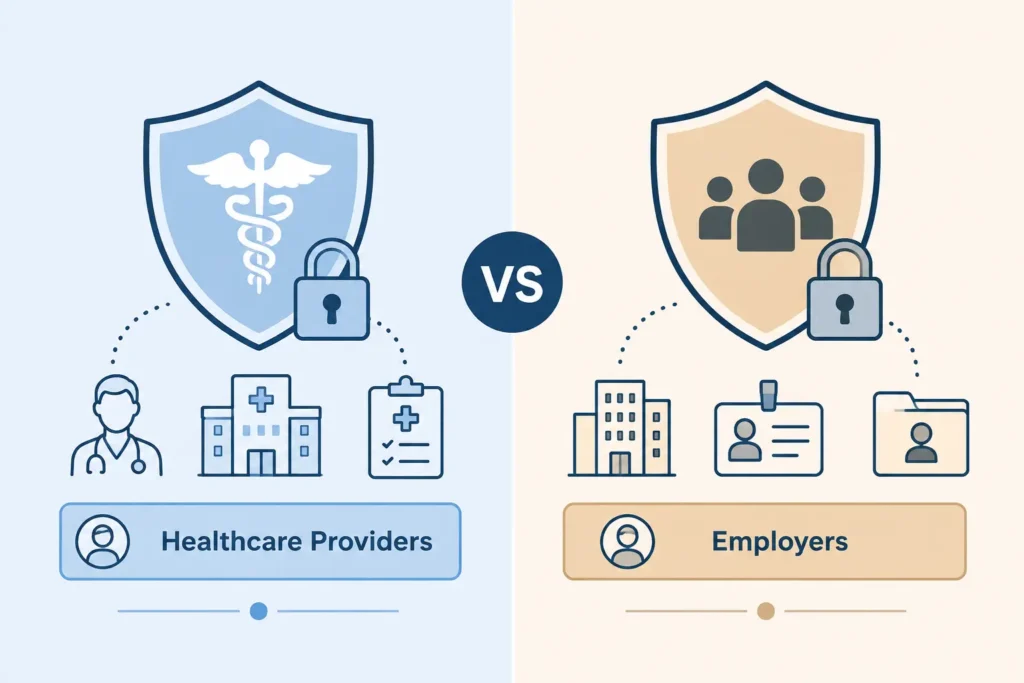
Here’s the part nobody explains clearly: HIPAA almost never applies to your employer as your employer. HIPAA governs healthcare providers, health plans, and insurance clearinghouses — not your manager or your HR department handling an accommodation request. So when you disclose a medical condition to request an accommodation, you’re not protected by HIPAA at all.
You’re protected by something else entirely: the ADA’s confidentiality rule. Under Title I of the ADA, any medical information your employer obtains — through a doctor’s note, a conversation, or a formal request — must be treated as a confidential medical record. That means it has to be:
- Collected on separate forms, not mixed into your regular personnel file
- Stored in a separate, secured file — physical or electronic — with restricted access
- Shared only on a strict need-to-know basis (for example, a supervisor may be told you need a modified schedule, but not your diagnosis)
What Medical Documentation Can Your Employer Legally Request?
Your employer can ask for documentation reasonable enough to confirm two things: that you have a disability, and that the accommodation you’re requesting relates to it. That typically means a brief note from a treating provider describing your functional limitations — what tasks are harder for you and why — not your full medical chart, therapy notes, or lab results. Employers are not entitled to your complete medical history just because you asked for a modified chair or a flexible start time.
What Qualifies as a Reasonable Accommodation Under the ADA?
A reasonable accommodation is any change to your job, work environment, or how things are usually done that lets you perform your job despite a disability — without imposing undue hardship on your employer.
Essential Functions vs. Marginal Functions
Your job has essential functions — the core duties the position exists to perform — and marginal functions, which are tasks that are helpful but not fundamental to the role. An accommodation must let you perform the essential functions. Your employer is not required to eliminate an essential function altogether, but it may need to modify how, when, or where that function gets done, or reassign marginal tasks to someone else.
Who Is Considered a “Qualified Individual” With a “Major Life Activity” Limitation?
You’re protected under the ADA if you’re a qualified individual with a disability — meaning you can perform the essential functions of your job, with or without accommodation — and your condition substantially limits one or more major life activities (things like walking, concentrating, breathing, learning, sleeping, or the operation of a major bodily function, such as the immune or neurological system). This standard covers a far wider range of conditions than most people assume, including many chronic illnesses, mental health conditions, and conditions currently in remission.
| Accommodation Type | Example | Typical Cost to Employer |
|---|---|---|
| Physical/Ergonomic | Adjustable desk, screen reader, ergonomic chair | Low ($0–$500) |
| Schedule-Based | Flexible start time, intermittent breaks | None |
| Leave-Based | Short unpaid leave beyond FMLA | Varies |
| Modified Duties | Reassigning a marginal task | None |
| Technology | Accessibility software, noise-canceling headphones | Low–Moderate |
| Location-Based | Partial or full telework | Varies by role |
Most accommodations cost employers little to nothing — the Job Accommodation Network (JAN) has consistently found that a majority of workplace accommodations cost $0.
How Does the 2026 EEOC Telework Guidance Affect Remote Work Requests?
If you’re hoping remote work is your accommodation, you need to understand a real shift that happened this year.
Return-to-Office Mandates and In-Office Alternatives
In February 2026, the EEOC and the Office of Personnel Management jointly issued new FAQ guidance addressing telework as a disability accommodation. While this guidance is formally directed at federal agencies, it applies existing ADA standards and case law that private employers are already citing as they design return-to-office policies. The core rule hasn’t changed: telework only has to be granted if it’s an effective accommodation — not simply the one you’d prefer. If your employer can offer an equally effective in-office alternative (a private workspace, a modified schedule, noise-reduction tools, assistive technology), it can lawfully offer that instead of full-time remote work.
Telework requested mainly for comfort, convenience, or general stress relief — without a documented connection to a specific functional limitation — generally does not meet the legal standard for a required accommodation.
When Can an Employer Reevaluate a Telework Accommodation?
Yes, your employer can revisit a telework accommodation you were previously granted — even one you’ve had for years. Employers may ask for updated medical documentation, reassess whether in-office alternatives now exist, and determine whether your role’s essential functions have changed. What they cannot do is automatically and categorically end all disability-based telework accommodations without individually evaluating each case. A blanket “everyone returns to office” policy that ignores existing accommodation obligations can still trigger a valid ADA claim.

How to Request Reasonable Accommodation at Work (Step-by-Step Guide)
Here’s exactly how to do this, in order.
- Identify the specific limitation your condition causes on the job — not the diagnosis itself, but what it actually makes harder (concentrating through noise, standing for long periods, meeting rigid start times).
- Disclose your need using plain English notice. You do not need to say “I am invoking my ADA rights.” Saying “I have a medical condition that’s making it hard for me to do X, and I need some changes” is legally sufficient to start the process.
- Put your request in writing — email is ideal, because it creates a timestamped record. Verbal requests count too, but they’re harder to prove later.
- Focus on functional limitations, not just your diagnosis. You control how much medical detail you share. “I have a condition that affects my concentration in loud environments” is enough; you don’t have to name the diagnosis.
- Trigger the interactive process with HR. Once your employer knows you need an accommodation, they’re legally required to engage with you — ask clarifying questions, discuss options, and try to find something workable. This is a two-way conversation, not a single email exchange.
- Provide documentation only if reasonably requested, and only what’s proportionate — a short provider letter confirming the condition and the functional limitation, not your full chart.
- Follow up in writing if you don’t hear back within one to two weeks, and keep copies of every communication.
Every step you document in writing makes your legal position stronger if this ever becomes a dispute.
What Templates Should I Use to Request an Accommodation in Writing?
Copy, personalize, and send. Keep a copy for your own records.
Email Template 1: Ergonomic or Physical Workspace Modification
Subject: Request for Workplace Accommodation
Hi [Manager/HR Name],
I have a medical condition that affects [describe limitation, e.g., “my ability to sit for extended periods without pain”]. I’d like to request an accommodation — specifically [e.g., “a sit-stand desk” or “an ergonomic chair”] — to help me continue performing my job effectively.
I’m happy to provide documentation from my healthcare provider if needed, and I’d like to discuss this further at your earliest convenience.
Thank you, [Your Name]
Email Template 2: Intermittent Leave or Schedule Change
Subject: Request for Reasonable Accommodation — Schedule Adjustment
Hi [Manager/HR Name],
I’m writing to formally request a reasonable accommodation under the ADA. I have a medical condition that periodically affects [describe limitation, e.g., “my ability to maintain a fixed start time”]. I’d like to request [describe accommodation, e.g., “a flexible start window of 8–10 a.m.” or “intermittent short breaks during flare-ups”].
I can provide medical documentation supporting this request. I’d appreciate the chance to discuss options that work for both my health and my role.
Best, [Your Name]
Email Template 3: Remote Work / Telework Request
Subject: Request for Reasonable Accommodation — Remote Work
Hi [Manager/HR Name],
I have a medical condition that limits my ability to [describe specific functional impact, e.g., “commute reliably during flare-ups” or “concentrate in an open office environment”]. I’d like to request [full-time / partial] telework as a reasonable accommodation.
I understand you may explore in-office alternatives as part of the interactive process, and I’m open to discussing what would be most effective. I can provide supporting medical documentation.
Thank you for considering this request, [Your Name]
When Can an Employer Deny an Accommodation Request?
Your employer’s obligation isn’t unlimited — and understanding the exceptions helps you gauge your leverage.
Defining “Undue Hardship” (Financial and Operational)
An employer can deny an accommodation if it would cause undue hardship — meaning significant difficulty or expense relative to the employer’s size, financial resources, and operational structure. A small five-person shop and a national retail chain will be judged very differently for the exact same request. “Undue hardship” is a real legal standard with a high bar — it is not just “inconvenient” or “annoying to arrange.”
| Factor Considered | Small Employer (Under 50 Employees) | Large Employer (1,000+ Employees) |
|---|---|---|
| Cost relative to budget | Higher hardship risk | Lower hardship risk |
| Disruption to operations | Weighed more heavily | Weighed less heavily |
| Availability of alternatives | Often limited | Usually broader |
| Likely outcome for low-cost requests | Still generally required | Almost always required |
Exhausted FMLA Leave and Reassignment to a Vacant Position
If you’ve used up all your Family and Medical Leave Act (FMLA) leave and still need more time to recover, that doesn’t automatically end your rights. Additional unpaid leave can itself be a reasonable accommodation under the ADA, unless it causes undue hardship. If you truly cannot perform your current role even with accommodation, your employer may be required to consider reassigning you to a vacant, equivalent position you’re qualified for — as a last resort, not a first option.
Practical Case Study: Navigating an ADA Accommodation and Privacy Dispute
Consider a composite, anonymized scenario built from patterns common in real accommodation disputes: a medical billing specialist with an attention-related processing disorder repeatedly struggled to catch data-entry errors during high-volume shifts — errors that risked exposing patient information in violation of internal HIPAA protocols.
Instead of waiting for a mistake to trigger discipline, she requested a reasonable accommodation in writing: a second-review checklist step and a slight adjustment to her workflow pacing during peak hours. She described her functional limitation — difficulty catching sequential errors under time pressure — without disclosing her full diagnosis. HR opened the interactive process, requested a brief provider note confirming the limitation, stored it in a separate confidential file, and approved the checklist accommodation within three weeks.
Six months later, when a data-entry error did occur, her documented, pre-existing accommodation request became central evidence that she had acted in good faith — and her employer’s own file showed they’d already engaged the ADA process. The paper trail she created before anything went wrong is what protected her job.
FAQ: Requesting Accommodations, Retaliation, and Medical Privacy
Do I have to disclose my exact medical diagnosis to my manager?
No. The ADA requires you to disclose enough information to establish that you have a disability and that your requested accommodation relates to a functional limitation. You are not required to state your specific diagnosis to your manager, HR, or anyone else — a description of your limitations is legally sufficient.
Can I be fired in retaliation for asking for an accommodation?
No. Requesting a reasonable accommodation is a protected activity under the ADA. Firing, demoting, or punishing you specifically because you made the request is illegal retaliation, even if your employer ultimately denies the accommodation itself. Retaliation claims can be filed with the EEOC separately from — or alongside — a denial-of-accommodation claim.
What exactly does my doctor need to write in their note?
Your provider’s note should confirm that you have a medical condition, describe how it limits a specific major life activity or job function, and connect that limitation to the accommodation you’re requesting. It does not need to include your full diagnosis, treatment history, or unrelated medical details.
What are my legal next steps if my employer says no? (EEOC Charge)
If your employer denies a reasonable accommodation without engaging in good faith or without a valid undue hardship justification, you can file a Charge of Discrimination with the EEOC. You generally have 180 days from the denial to file, extended to 300 days in states with their own fair employment agency. Filing a charge is required before you can bring a lawsuit for most ADA claims.
Does my employer have to accommodate a mental health condition the same way as a physical one?
Yes. The ADA covers mental health conditions — such as anxiety, depression, PTSD, and ADHD — the same way it covers physical disabilities, as long as the condition substantially limits a major life activity. Employers cannot legally treat a mental health accommodation request as less legitimate than a physical one.
Can my employer ask coworkers why I got a schedule change or new equipment?
No. Under the ADA’s confidentiality rule, your employer cannot disclose the medical reason behind your accommodation to coworkers. Coworkers may notice the change itself, but your employer is legally barred from explaining the medical “why” behind it.
What if I need an accommodation but I’m not sure I qualify as “disabled” under the law?
The legal definition of disability under the ADA is broader than most people expect, and it’s not your job to make that legal determination yourself. If your condition substantially limits a major life activity — even temporarily or when in remission — start the conversation. Let the interactive process, not your own assumptions, determine your eligibility.
Your Next Step
Requesting a reasonable accommodation isn’t about proving how sick you are — it’s about giving your employer the information they need, in writing, before a small problem becomes a job-ending one. Start today: identify your functional limitation, choose the template above that fits your situation, and send it. You don’t need a lawyer to start this process — you need a paper trail, and now you have one.
External Links
- EEOC Enforcement Guidance on Reasonable Accommodation
- EEOC/OPM 2026 Telework FAQ
- Job Accommodation Network (JAN) accommodation cost data
- File an EEOC Charge of Discrimination
- Family and Medical Leave Act overview
Disclaimer: The information provided on this website does not, and is not intended to, constitute legal advice. All information, content, and materials available on this site are for general informational and educational purposes only. Laws regarding employment and labor rights frequently change, and while we strive to keep our content updated, the information on this website may not constitute the most up-to-date legal or other information.
Use of, and access to, this website or any of the links or resources contained within the site do not create an attorney-client relationship between the reader, user, or browser and the website authors, contributors, or its owners. We are an independent publishing platform, not a law firm.
Readers of this website should contact a qualified employment attorney in their specific state to obtain advice with respect to any particular legal matter. No reader or user of this site should act or refrain from acting on the basis of information on this site without first seeking legal advice from counsel in the relevant jurisdiction. Only your individual attorney can provide assurances that the information contained herein – and your interpretation of it – is applicable or appropriate to your particular situation.
Know your rights.