
- While you cannot legally take FMLA for “burnout,” you can take up to 12 weeks of job-protected FMLA leave for the severe anxiety, depression, or physical exhaustion that burnout causes. To qualify, a licensed healthcare provider must certify your symptoms as a “serious health condition.”
If you are physically exhausted, suffering from panic attacks before your shift, and completely overwhelmed by a toxic workplace, you are likely searching for how to get fmla for burnout. You are not alone. Millions of American workers are at their breaking point. When you are running on empty, quitting often feels like the only way to survive.
Walking away from your paycheck should be your absolute last resort. Instead of resigning, you can use federal labor laws to force your employer to give you time to heal. This 2026 legal guide will teach you exactly how to navigate the medical paperwork, secure your income with short-term disability, and legally protect your job from a hostile HR department.
[INSERT IMAGE HERE: A realistic, high-quality photograph of an exhausted American worker sitting at an office desk, resting their face in their hands in front of a glowing laptop screen. The lighting is dim and moody, conveying severe occupational exhaustion and stress.]
- Prompt para criação da imagem: “A realistic, high-quality photograph of an exhausted American office worker sitting at a desk. They are resting their face in their hands, looking completely drained in front of a glowing laptop screen. Moody, cinematic lighting conveying severe occupational burnout and emotional exhaustion. 1200×800 resolution, 3:2 aspect ratio.”
- Alt Text: Exhausted worker resting their face in their hands at an office desk.
- Title Text: Taking FMLA for Severe Workplace Burnout
- Toggle Caption: Severe occupational burnout can lead to legally protected medical conditions like generalized anxiety and major depression.
- Technical SEO: Size: 1200 × 800 px, Format: WebP, Max Size: 150 KB, Quality 80-85%.
Can you take FMLA for burnout? (The Vocabulary Trap)
No. You cannot use the word “burnout” on your official FMLA paperwork because it is an occupational phenomenon, not a medical diagnosis. However, you can take FMLA for the recognized medical conditions caused by burnout, such as generalized anxiety disorder or major depression.
This is the biggest legal trap workers fall into. If you walk into HR and say, “I need fmla for burnout,” they will likely deny your request.
In the eyes of the law, “burnout” sounds like you are just tired of working. It sounds like a performance issue. To unlock the protections of the Family and Medical Leave Act (FMLA), you must change your vocabulary.
You must use the legally protected phrase: serious health condition.
While burnout is not a formal diagnosis in the DSM-5 (the psychiatric manual), the symptoms it causes absolutely are. If workplace burnout has caused you to develop chronic insomnia, severe depression, hypertension, or debilitating panic attacks, those resulting medical conditions qualify for up to 12 weeks of unpaid, job-protected leave.
Can you claim FMLA for stress and exhaustion?
You can only claim FMLA for stress if it severely incapacitates you and requires ongoing medical treatment. Everyday workplace stress does not qualify, but stress that causes physical illness, insomnia, or panic attacks is a legally protected serious health condition.
The Department of Labor is very clear: normal, everyday workplace stress does not give you the right to take three months off.
To legally force your employer to hold your job, your stress must reach the level of incapacity. Incapacity means you are physically or mentally unable to perform the essential functions of your job.
You must prove this by seeking “continuing treatment by a health care provider.” If you are so stressed that you end up in the emergency room with chest pains, or you are prescribed anti-anxiety medication by a psychiatrist, your stress has legally transformed into a qualifying medical condition.
How to get FMLA certification (Even with Telehealth in 2026)
To get FMLA, your doctor must complete federal Form WH-380-E. In 2026, you do not need a traditional primary care doctor; licensed online telehealth psychologists and psychiatrists can legally evaluate your symptoms and certify your FMLA paperwork digitally.
Your employer will not just take your word for it. They will require you to submit official medical documentation.
You will need your healthcare provider to fill out Form WH-380-E (Certification of Health Care Provider for Employee’s Serious Health Condition).
Many workers panic because they do not have a regular therapist or a primary care doctor. In 2026, the law recognizes the massive rise in remote healthcare. You can legally use a certified telehealth clinic to obtain your FMLA documentation. A licensed online psychologist or psychiatrist can evaluate your symptoms via video call. If they diagnose you with a condition like severe anxiety, they can digitally sign your Form WH-380-E.
Note: The current Department of Labor WH-380-E form expires on June 30, 2026. Always ensure your HR department provides you with the most up-to-date paperwork to avoid administrative delays.
Can I take intermittent FMLA leave for burnout?
Yes. Intermittent FMLA allows you to take leave in smaller chunks rather than a continuous block. If certified by your doctor, you can legally take one or two days off every week to attend therapy or manage severe anxiety flare-ups while keeping your job.
Most workers assume FMLA means you must disappear from work for three solid months. That is called continuous leave, and it is not your only option.
If you are dealing with burnout, you might just need a reduced schedule to survive. This is called intermittent leave.
Your doctor can write on your Form WH-380-E that you suffer from “episodic flare-ups of anxiety” and require two days off per week for the next two months. Or, they can certify that you need to leave work two hours early every Tuesday to attend specialized therapy.
Under federal law, your employer must grant this reduced schedule. They cannot penalize you, write you up for “leaving early,” or use those protected absences against you in a performance review.
Financial Survival: FMLA and Short-Term Disability (STD)
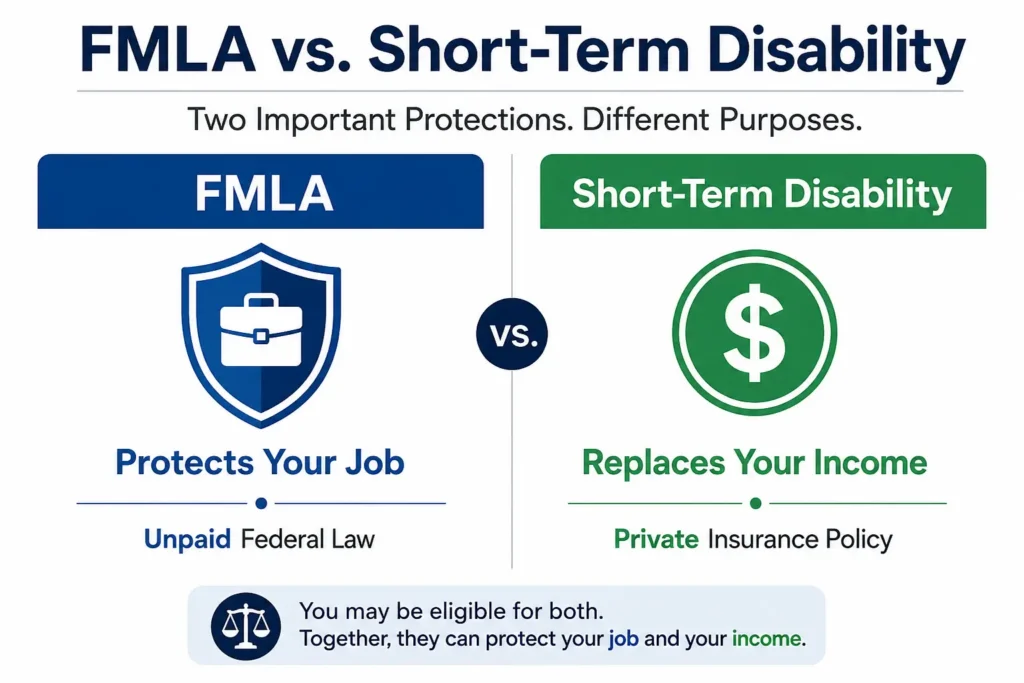
Because FMLA leave is strictly unpaid, you should simultaneously file a Short-Term Disability (STD) claim. If you have an employer-sponsored or private STD policy, it can replace 60% to 80% of your lost wages while you are on FMLA for mental health recovery.
FMLA protects your desk, but it does not protect your bank account. FMLA is unpaid leave. This is why many workers never take it; they simply cannot afford to miss a paycheck.
To survive financially, you must overlap your FMLA leave with a Short-Term Disability (STD) claim.
Check your employee benefits package immediately. If you pay into an STD plan, severe mental health crises generally qualify for wage replacement. While FMLA legally forces the company to keep you employed, the STD insurance company will cut you a weekly check (usually 60% of your normal salary) while you recover.
How do I tell my boss I need FMLA for mental health?
You should notify HR in writing that you require medical leave, but you do not have to disclose your specific mental health diagnosis. Simply state that you are requesting FMLA paperwork for a “serious health condition” and keep your medical details strictly confidential.
Privacy is a massive concern. You do not have to tell your manager about your panic attacks, depression, or burnout. The Americans with Disabilities Act (ADA) and HIPAA privacy rules severely restrict what an employer can ask you.
When requesting fmla for burnout, keep it strictly professional and in writing.
The Bulletproof Email Template for HR
Send this exact email to Human Resources, copying your personal email address for your records:
“Dear HR,
I am writing to formally request FMLA leave due to a serious health condition that currently prevents me from performing my essential job functions. Please provide me with the necessary FMLA eligibility notices and the medical certification form (WH-380-E) for my healthcare provider to complete.
Thank you,”
That is all you have to say. When your doctor fills out the WH-380-E, they are only required to provide the basic medical facts that justify the leave. They are not required to hand over your private therapy notes.
Can you be written up or fired while on FMLA?
No. Disciplining or firing an employee for unfinished work while they are on approved FMLA leave is a strict federal violation known as FMLA Interference. Punishing you for taking medical leave is illegal retaliation, which opens the company to massive lawsuits.
Toxic employers hate when workers take FMLA. They will often try to scare you out of taking it by threatening your job security.
If your boss texts you while you are on leave, demanding you finish a report, you are under no obligation to reply. If they write you up or fire you because you missed a deadline while you were on a protected medical leave, they have committed FMLA Interference and Retaliation.
Retaliation is highly illegal. If your employer fires you for using your legal rights, you can file a complaint with the federal Wage and Hour Division or hire an employment lawyer to sue them for wrongful termination, lost wages, and liquidated damages.
Practical Case Study: Using Intermittent Leave to Survive Burnout
Understanding how these laws apply in the real world is vital. In a recent case, a severely burned-out marketing director used intermittent FMLA to attend intense weekly therapy, protecting her job while she regained her mental health.
Let’s look at how a worker successfully navigated this exact crisis.
The Situation: “Sarah” was a marketing director working 60 hours a week. The chronic stress led to severe insomnia and daily panic attacks. She considered quitting because she felt she could no longer function.
The Action: Instead of resigning, Sarah spoke to a licensed telehealth psychiatrist. The psychiatrist diagnosed her with generalized anxiety disorder caused by occupational stress. Sarah emailed HR requesting FMLA paperwork. Her psychiatrist filled out Form WH-380-E, certifying that Sarah needed intermittent leave—specifically, every Friday off for the next eight weeks to attend therapy and rest.
The Result: HR was legally forced to approve the reduced schedule. Sarah’s boss was furious but could not legally discipline her for missing Fridays. By taking a 32-hour workweek, Sarah gave her brain the space it needed to heal. She kept her high-paying job, avoided a resume gap, and successfully recovered from her burnout without sacrificing her career.
Frequently Asked Questions (FAQ) About Mental Health FMLA
Does FMLA pay my salary while I am out for burnout?
No. The federal FMLA law guarantees job protection and the continuation of your health insurance benefits, but it does not provide paid leave. You must rely on accrued Paid Time Off (PTO), state-sponsored paid family and medical leave programs (if you live in states like California, New York, or Washington), or an employer-sponsored Short-Term Disability policy to receive income.
Can my employer deny my doctor’s FMLA certification?
Your employer cannot flatly reject a complete and legally sufficient Form WH-380-E. If HR doubts the validity of your doctor’s certification, federal law allows them to request a second medical opinion at the company’s expense. However, they cannot simply say “no” or call your therapist to demand more details without your explicit written permission.
Can I file for Workers’ Compensation instead of FMLA for workplace stress?
It is incredibly difficult to win a workers’ compensation claim for purely mental stress (often called a “mental-mental” claim) in most states. Insurance companies fight these aggressively, arguing your stress came from personal life issues, not work. FMLA is a much faster, guaranteed legal route to secure time off and protect your job without fighting a long legal battle.
Disclaimer: The information provided on this website does not, and is not intended to, constitute legal advice. All information, content, and materials available on this site are for general informational and educational purposes only. Laws regarding employment and labor rights frequently change, and while we strive to keep our content updated, the information on this website may not constitute the most up-to-date legal or other information.
Use of, and access to, this website or any of the links or resources contained within the site do not create an attorney-client relationship between the reader, user, or browser and the website authors, contributors, or its owners. We are an independent publishing platform, not a law firm.
Readers of this website should contact a qualified employment attorney in their specific state to obtain advice with respect to any particular legal matter. No reader or user of this site should act or refrain from acting on the basis of information on this site without first seeking legal advice from counsel in the relevant jurisdiction. Only your individual attorney can provide assurances that the information contained herein – and your interpretation of it – is applicable or appropriate to your particular situation.
Know your rights.