If you were just laid off and handed a separation agreement, you are likely panicked and wondering: will severance pay affect unemployment? It is terrifying to hold a check in one hand and wonder if cashing it will accidentally freeze your state benefits.
- Yes, severance pay will often affect your unemployment benefits, usually by delaying when your weekly checks begin. However, it rarely disqualifies you entirely. How long your benefits are delayed depends on your state’s laws and whether the severance was paid as a lump sum or salary continuation.
This 2026 legal guide is your financial survival manual. We will break down exactly how state agencies calculate your “blackout period,” expose the hidden loopholes that employers use to delay your claims, and explain why you must file for unemployment on Day 1—no matter how much severance you receive.

Does a severance package disqualify me from unemployment?
No. Receiving a severance package does not permanently disqualify you from receiving unemployment. In most states, severance pay is simply treated as allocated income, which creates a temporary “blackout period” where your benefit checks are delayed until the severance timeframe expires.
The biggest myth in employment law is that you have to choose between severance and unemployment. You are legally entitled to both.
Unemployment insurance is designed to replace lost wages. If your company pays you severance, the state views that money as a temporary wage replacement. You are not “disqualified” from receiving benefits; you are simply ineligible to double-dip during the specific weeks that the severance covers. Once those weeks run out, your standard unemployment benefits kick in.
Lump Sum vs. Salary Continuation: How is the delay calculated?
How your severance is paid dictates your unemployment timeline. A lump sum is mathematically allocated over a specific number of weeks based on your prior salary. Salary continuation keeps you on the official company payroll, completely preventing you from collecting unemployment until the final paycheck.
When negotiating your exit, the structure of the payment is just as important as the dollar amount.
1. Salary Continuation (The Slower Route)
If your employer agrees to pay you your normal salary for three months, you are still technically receiving wages. Most state Departments of Labor (DOL) will not consider you “unemployed” until that three-month period ends. Your unemployment claim will be entirely blocked until your final severance paycheck clears.
2. The Lump Sum “Allocation” Math
If your employer cuts you a single, massive check on your way out the door, the state steps in to do the math. They will allocate that lump sum across a specific number of weeks to calculate your blackout period.
Here is how the state calculates it:
If you earned $1,000 a week, and your company gives you a $10,000 lump sum severance check, the state divides the lump sum by your weekly wage.
$10,000 ÷ $1,000 = 10 weeks.
You will be ineligible for unemployment for exactly 10 weeks. On week 11, your state benefits begin.
The 2026 State-by-State Severance Rules (The 3 Systems)
State laws vary wildly on how severance impacts benefits. Permissive states like California allow you to collect unemployment immediately. Strict states like Texas delay your benefits based on the payout. New York has a unique 30-day rule that protects delayed severance payouts.
Do not trust generic national advice. Your right to collect depends entirely on your zip code. In 2026, state DOLs fall into three distinct categories:
- Permissive States (e.g., California, Washington): These states are incredibly worker-friendly. They legally classify severance as a bonus for past work, not future wages. In California, a lump sum severance check does not reduce or delay your unemployment benefits at all. You can collect both simultaneously.
- Strict Allocation States (e.g., Texas, Connecticut): These states strictly prohibit double-dipping. In Texas, your severance is prorated, and your unemployment is delayed dollar-for-dollar.
- The New York “30-Day” Secret: New York has a highly specific loophole. If you receive your lump sum severance payment within 30 days of your last day of work, your benefits are delayed. However, if your employer pays your severance more than 30 days after your final day, it does not affect your unemployment benefits at all.
The WARN Act Loophole: Is it severance or PILON?
Payments made under the mandatory WARN Act are legally distinct from severance and generally do not affect unemployment benefits. However, Payments in Lieu of Notice (PILON) are considered an extension of your employment and will severely delay your UI checks.
If you were caught in a massive corporate layoff (usually involving 50 or more employees), your payout might not actually be “severance.”
Under the federal Worker Adjustment and Retraining Notification (WARN) Act, large employers must give 60 days’ notice before a mass layoff. If they fail to do so, they must pay you 60 days of wages as a penalty. In many states (like New York), WARN pay is legally excluded from unemployment calculations. You can collect WARN pay and unemployment simultaneously.
However, be careful with Pay in Lieu of Notice (PILON). If an employer simply says, “We don’t want you in the office for your two-week notice, here is two weeks of pay,” state agencies classify PILON as standard wages, which will delay your benefits.
Can my employer force me to waive my unemployment rights?
No. It is illegal for an employer to force you to waive your right to collect unemployment benefits. If your severance agreement contains a clause stating you agree not to file for unemployment, that specific clause is legally void and unenforceable in court.
Corporate lawyers routinely try to intimidate laid-off workers. You might read your severance agreement and see a terrifying line: “Employee agrees to waive any and all claims against the company, including the right to file for state unemployment insurance.”
Do not panic. You can sign the document and take the money.
Unemployment insurance is a public safety net governed by state law, not a private civil right. You cannot legally sign it away. If your former employer tries to contest your unemployment claim by showing the judge that signed waiver, the state administrative law judge will immediately throw the waiver in the trash.
When should I actually file my unemployment claim?
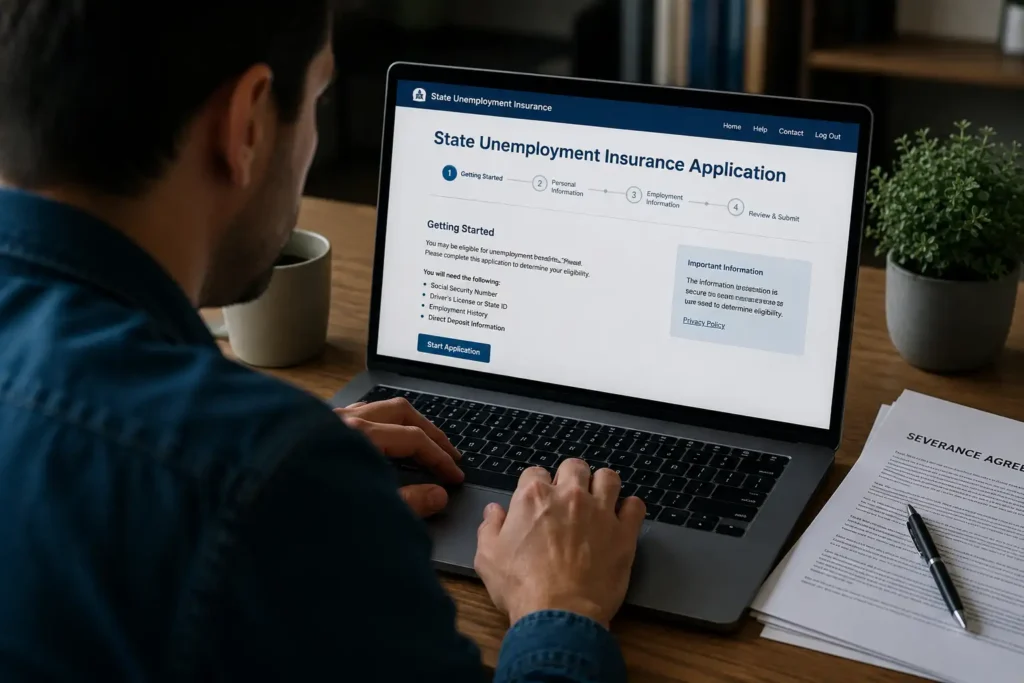
You must file your unemployment claim on Day 1 of your termination, regardless of your severance package. Filing immediately locks in your “base period” earnings and allows the state to automatically trigger your benefits the moment your severance blackout period ends.
The most catastrophic financial mistake workers make is waiting to file.
If you get a 3-month severance package, do not wait 3 months to log into your state’s UI portal.
State agencies calculate your Weekly Benefit Amount (WBA) based on a strict “base period” (the first four of the last five completed calendar quarters you worked). If you wait months to file, your highest-earning quarters might fall off the calculation, permanently reducing your weekly check.
Always file on Day 1. Report your severance accurately on the application. The state will put your claim on a “hold” status. You will continue to log in and certify every week. The moment your mathematical blackout period ends, the state will automatically release your funds.
Practical Case Study: Navigating a $20,000 Severance Payout
Understanding how allocation works across state lines is critical. A tech worker who received a $20,000 lump sum experienced completely different financial outcomes simply based on whether they filed their unemployment claim in Texas versus California.
Let’s look at how the exact same severance package is handled depending on state law.
The Situation: “Marcus” was a software engineer earning $2,000 a week. He was laid off and received a $20,000 lump sum severance check. He immediately filed for unemployment on his first day without work.
The Action (Texas): Because Texas is a strict deduction state, the Texas Workforce Commission (TWC) applied the allocation math ($20,000 lump sum ÷ $2,000 weekly wage = 10 weeks). Marcus was subjected to a 10-week blackout period. He certified his status every Sunday, but he received $0 in unemployment for those 10 weeks. On week 11, his standard UI checks finally began.
The Action (California): If Marcus worked in California, the outcome is vastly different. The Employment Development Department (EDD) does not view severance as wages for UI purposes. Marcus received his $20,000 lump sum and immediately began collecting his maximum weekly unemployment check on week 1, successfully double-dipping without breaking any laws.
Frequently Asked Questions (FAQ) About Severance and UI
Do I have to report my severance pay to the unemployment office?
Yes, absolutely. You must report all severance, dismissal pay, and accrued PTO payouts when you file your initial claim. Failing to report severance is considered unemployment fraud. If the state discovers the payment later during a routine audit, they will hit you with massive overpayment penalties, forcing you to pay back all your benefits with interest.
Does cashing out my unused vacation time affect my unemployment?
In most states, cashing out accrued Paid Time Off (PTO) or sick leave upon termination does not delay your unemployment benefits. It is legally viewed as money you already earned in the past, rather than a continuation of your future wages.
What happens if I get a new job during my severance blackout period?
If you are serving a 10-week blackout period due to a lump sum severance allocation and you find a new job on week 5, you simply stop certifying for unemployment. You get to keep the remainder of your severance money, but your state unemployment claim will be closed since you are now re-employed and earning wages again.
Disclaimer: The information provided on this website does not, and is not intended to, constitute legal advice. All information, content, and materials available on this site are for general informational and educational purposes only. Laws regarding employment and labor rights frequently change, and while we strive to keep our content updated, the information on this website may not constitute the most up-to-date legal or other information.
Use of, and access to, this website or any of the links or resources contained within the site do not create an attorney-client relationship between the reader, user, or browser and the website authors, contributors, or its owners. We are an independent publishing platform, not a law firm.
Readers of this website should contact a qualified employment attorney in their specific state to obtain advice with respect to any particular legal matter. No reader or user of this site should act or refrain from acting on the basis of information on this site without first seeking legal advice from counsel in the relevant jurisdiction. Only your individual attorney can provide assurances that the information contained herein – and your interpretation of it – is applicable or appropriate to your particular situation.
Know your rights.