Wondering what is constructive dismissal? Under U.S. law, often called constructive discharge, it occurs when an employer deliberately creates intolerable working conditions, forcing a reasonable person to quit. Even though you were not officially fired, the law treats your forced resignation as a wrongful termination.
If you are reading this at midnight, stressed out, and feeling like you have no choice but to hand in your two weeks’ notice tomorrow morning—stop. Do not quit just yet. Resigning the wrong way can destroy your legal rights and block your access to unemployment benefits. In this 2026 guide, we will break down exactly how the law protects you, what evidence you need to gather immediately, and how to fight back.
What Is the Legal Definition of Constructive Dismissal in the U.S.?
To answer what is constructive dismissal, we must look at how the government views forced resignations. In the United States, the legal system primarily uses the term constructive discharge. It happens when an employer violates employee rights so severely that quitting is the only logical option left.
If you search for constructive dismissal, you will often find articles talking about “breach of contract.” That is international law (common in the UK and Canada). In the U.S., because most employment is “at-will” (meaning you can be fired at any time), a standard pay cut or mean boss isn’t enough. For a constructive dismissal claim to hold up in America, the intolerable conditions must stem from illegal discrimination, retaliation, or a hostile work environment.
The Equal Employment Opportunity Commission (EEOC) is the federal agency that polices these laws. They view a forced quit exactly the same as an illegal firing.
The “Reasonable Person” Standard: How Courts Evaluate Your Choice to Quit
Courts do not rely on your personal feelings to decide if a workplace was intolerable. Instead, they use the objective “reasonable person” standard.
The judge will ask: Would a generic, reasonable person in this exact same situation feel they had absolutely no other choice but to resign? If you quit because your boss was annoying or gave you a bad performance review, the court will likely say a reasonable person would have stayed. If you quit because your boss routinely used racial slurs and HR refused to intervene, the court will agree that a reasonable person would flee that environment.
The “Aggravating Factors” Doctrine: Why a Toxic Workplace Is Not Enough
Here is a critical detail most online guides miss: a toxic workplace is not enough to win a federal lawsuit. U.S. courts generally require proof of “aggravating factors.”
Proving a hostile work environment is step one. To prove constructive discharge, you must show the harassment was even more severe. Aggravating factors include an employer demanding you commit an illegal act, subjecting you to severe public humiliation, or systematically stripping away all your job duties to force you out the door.
What Are the Top Examples of Constructive Discharge Under Federal Law?
If you want to know if you have a valid case, it helps to look at real-world benchmarks. Here are the top examples of employer behavior that legally justify a forced resignation.
Title VII of the Civil Rights Act
Under Title VII, it is illegal to discriminate based on race, color, religion, sex, or national origin. Constructive dismissal occurs when harassment based on these traits goes unchecked.
- Example: A female employee is subjected to daily sexual harassment by a supervisor. She reports it to HR three times. HR does nothing, and the supervisor threatens her physically. She is forced to resign for her own safety.
Americans with Disabilities Act (ADA)
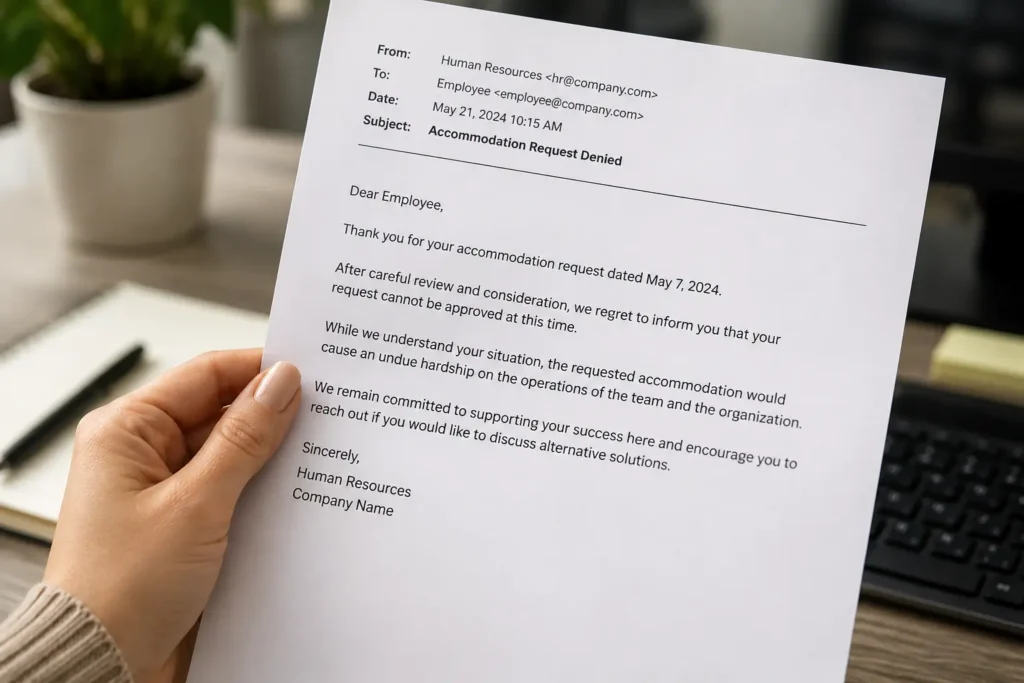
The ADA requires employers to provide “reasonable accommodations” for workers with medical conditions.
- Example: An employee with a severe back injury provides medical notes requiring a standing desk. The employer deliberately refuses to provide the $100 desk for six months, causing the employee agonizing pain until they are physically forced to quit.
Whistleblower Retaliation & FLSA
The Fair Labor Standards Act (FLSA) protects your right to fair pay. Employers cannot punish you for reporting illegal activity.
- Example: You report your employer for stealing your overtime pay. In response, your manager cuts your pay by 40%, moves you to the graveyard shift, and takes away your office. This is a classic retaliatory constructive discharge.
Is Constructive Dismissal Hard to Prove in Court?
Yes. Constructive dismissal is notoriously difficult to prove in U.S. courts. Why? Because the law automatically assumes that if you quit your job, you did so voluntarily.
To overcome the “at-will” employment doctrine, the burden of proof is entirely on you. You must prove that the employer’s illegal actions were the direct cause of your resignation. You cannot just claim the environment was hostile; you must bring hard evidence.
The 2026 Evidence Checklist: What to Save Before You Hand in Your Resignation
Before you send that resignation email, you must build a bulletproof paper trail. Once you quit, you will likely lose access to company systems. Gather this evidence now:
- Archive HR Complaints: Save copies of every email you sent to HR reporting the abuse. You must prove you gave the company a chance to fix the problem.
- Save Digital Harassment: Take screenshots of discriminatory Slack messages, Teams chats, or off-hours text messages from your boss.
- Document Retaliation: Save your work schedules from before you complained to HR and after. This proves your shifts were changed as a punishment.
- Keep a Private Log: Write down contemporaneous notes (dates, times, locations, quotes) of verbal abuse in a physical notebook at home.
- Medical Records: If the stress is causing anxiety, depression, or physical illness, get documented treatment from a doctor.
Warning: Do not forward confidential company trade secrets or client lists to your personal email. Employers will use IT violations as an excuse to claim they would have fired you anyway.
Case Study: How Federal Courts Rule on Forced Resignations
To truly understand what is constructive dismissal, we must look at how federal courts are interpreting the law in 2026.
A massive factor in these cases is the “statute of limitations”—the strict ticking clock you have to file a lawsuit. In the landmark Supreme Court logic of Green v. Brennan, the Court ruled that the clock for a constructive discharge claim begins ticking on the day you officially resign, not on the day of the last harassing incident.
2026 Legal Reality: The EEOC has aggressively stepped up enforcement this year. In recent early 2026 filings, the EEOC has actively pursued employers who force workers out by refusing remote-work medical accommodations. The trend is clear: courts are cracking down on employers who use passive-aggressive tactics (like ignoring emails and freezing workers out of software platforms) to force resignations.
Frequently Asked Questions About Constructive Dismissal
Can I get unemployment benefits if I quit and claim constructive dismissal?
Normally, if you quit your job voluntarily, you cannot collect unemployment. However, if you can prove you were forced to quit due to illegal working conditions, state workforce agencies will treat your resignation as a termination. You will need strong documentation (like unanswered HR complaints or medical notes) to prove you had good cause to leave.
Do I have to report the issue to HR before I can claim constructive discharge?
Yes, in almost all cases. The law grants employers the right to “notice and opportunity to cure.” If you suffer in silence and suddenly quit without ever telling HR about the harassment, the court will likely dismiss your case. You must prove the company knew about the intolerable conditions and deliberately failed to fix them.
How long do I have to file a constructive dismissal claim with the EEOC?
The federal deadline is incredibly strict. You only have 180 days from the date of your forced resignation to file a Charge of Discrimination with the EEOC. If your state has its own Fair Employment Practices Agency (FEPA) with local anti-discrimination laws, that deadline is extended to 300 days. Do not wait to seek legal counsel.
Disclaimer: The information provided on this website does not, and is not intended to, constitute legal advice. All information, content, and materials available on this site are for general informational and educational purposes only. Laws regarding employment and labor rights frequently change, and while we strive to keep our content updated, the information on this website may not constitute the most up-to-date legal or other information.
Use of, and access to, this website or any of the links or resources contained within the site do not create an attorney-client relationship between the reader, user, or browser and the website authors, contributors, or its owners. We are an independent publishing platform, not a law firm.
Readers of this website should contact a qualified employment attorney in their specific state to obtain advice with respect to any particular legal matter. No reader or user of this site should act or refrain from acting on the basis of information on this site without first seeking legal advice from counsel in the relevant jurisdiction. Only your individual attorney can provide assurances that the information contained herein – and your interpretation of it – is applicable or appropriate to your particular situation.
Know your rights.
prove constructive dismissal, employer, sue for constructive dismissal protection, intolerable working conditions, employment law, lawsuit, signs of constructive, establish constructive dismissal
wrongful dismissal, unfair dismissal, employment rights , employment contract , dismissal case , terminate , intolerable that a reasonable person , constructive dismissal case , wrongful termination claim , constructive termination , employment relationship , unlawful , intentionally created , conditions that were so intolerable
constructively , employer must , position would , file a wrongful termination , knowingly, qualify as a constructive, discharge , employer created , constructive dismissal may , establish a constructive , employee must , terms and , conditions , employee leaves , show that your employer , occurs when an employee , file a complaint , leave the job, changes in the job , employee resigns , compelled to resign , working conditions were so intolerable , resignation resulted , intentionally created or knowingly permitted , knowingly permitted working conditions , changes to the employment contract , business reasons , would have felt compelled , reasonable employee , based on a violation , created or knowingly permitted working , take legal action , reasonable person in the employee’s , person in the employee’s position , employee’s position would , employee’s , working conditions may , state and federal , need to resign , position would feel , either intentionally created , express or implied , provides a legal