
- If you are facing unwanted sexual advances, offensive comments, or physical assault, knowing what to do if sexually harassed at work is critical. You must immediately document the abuse digitally, report it to HR in writing to trigger legal liability, and file an EEOC charge if the company fails to protect you.
When you wake up dreading your shift because of a coworker or manager, panic sets in. You feel isolated, disgusted, and terrified of losing your paycheck. You might think that speaking up will only make the situation worse.
However, silence only protects the abuser. Federal employment laws are built to protect you, but you must know how to use them. This 2026 legal survival guide will teach you exactly how to trap an abusive boss with a digital paper trail. We will explain how to force Human Resources to act, how the federal Speak Out Act destroys corporate NDAs, and how to protect your right to sue.

Step 1: Document the abuse (The 2026 Digital Strategy)
Before you speak to anyone, you must gather evidence. Take screenshots of inappropriate Slack messages, save offensive emails, and write contemporaneous notes. A strong digital paper trail easily destroys the “he said, she said” defense that employers try to use.
In 2026, sexual harassment rarely happens without leaving a digital footprint. If you work remotely or in a hybrid setting, the abuse is likely happening on your screen.
If a manager sends you a late-night text or an inappropriate Microsoft Teams message, do not delete it in disgust. You must preserve it.
- Take Screenshots: Use your personal phone to take photos of your computer screen. If you use the company computer to take screenshots, IT might delete them if they lock your account.
- Save Voicemails: Download any offensive voicemails and email the audio files to your personal Gmail account.
- Contemporaneous Notes: If the harassment happens in person, immediately send an email to yourself. Write down exactly what was said, the time, the date, and who was in the room. Courts treat these “present sense” time-stamped emails as highly credible legal evidence.
Step 2: How to report the harassment to HR safely
You must report the harassment to Human Resources in writing. Reporting the abuse verbally gives the company “plausible deniability.” Sending a written email forces the company to acknowledge the problem, triggering their legal liability under Title VII.
Human Resources is not your friend. HR exists to protect the company from lawsuits.
However, you must use HR to build your case. Under federal law, a company is generally not liable for a coworker’s harassment unless management knew about it and failed to stop it. You must give them undeniable proof that they knew.
Never just walk into an HR office and complain. You must create a paper trail.
The Protective HR Email Template:
“Dear HR, I am writing to formally report ongoing sexual harassment by [Name]. On [Date], they made explicit comments about my body. I have asked them to stop, but the behavior continues. This is creating a hostile work environment. I request that you investigate this matter immediately and ensure my safety at work.”
Crucial Step: Always blind-copy (BCC) your personal email address when you send this complaint. If the company suddenly fires you and locks your email, you still possess the proof that you reported the abuse.
Can I be fired for reporting sexual harassment?
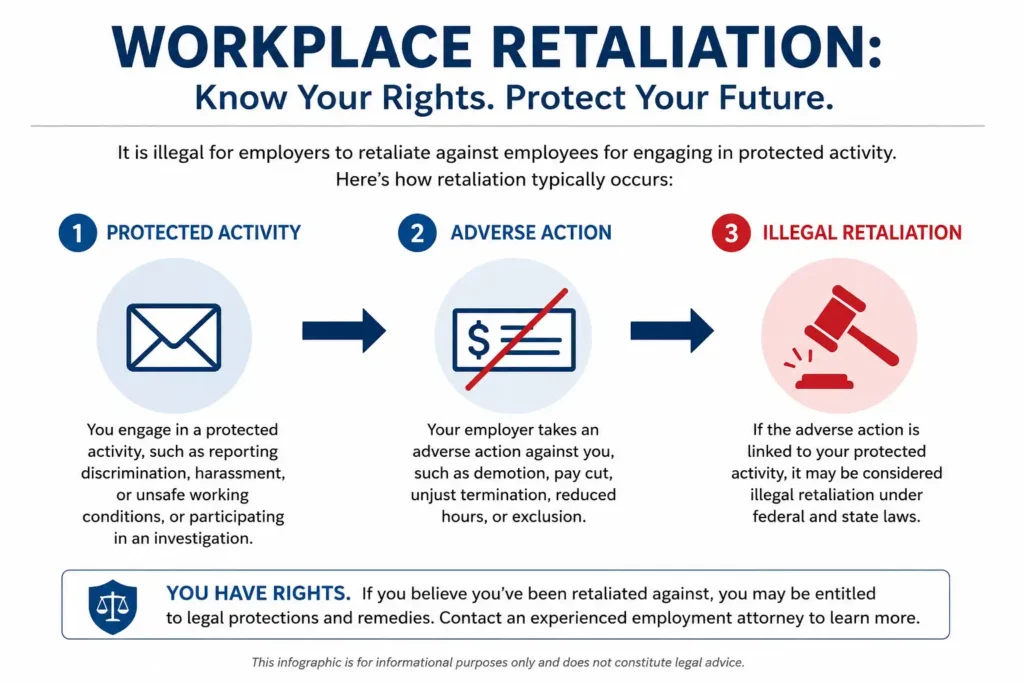
No. Firing, demoting, or cutting the hours of an employee because they reported sexual harassment is highly illegal. This is called retaliation. Retaliation violates Title VII of the Civil Rights Act and is the most common charge filed with the EEOC.
Fear of retaliation is the number one reason victims stay silent. You need to know that federal law strictly protects whistleblowers.
If you report an abusive manager on Tuesday, and the company suddenly fires you on Thursday for “poor performance,” they have committed illegal retaliation.
Even if you cannot perfectly prove the original sexual harassment, you can easily win a massive retaliation lawsuit. The highly suspicious timing (known as temporal proximity) proves the company acted maliciously to silence you.
The Speak Out Act: Are NDAs legal in 2026?
Under the federal Speak Out Act, employers can no longer enforce pre-dispute Non-Disclosure Agreements (NDAs) or non-disparagement clauses to silence victims of sexual harassment or sexual assault. You have the federal right to speak your truth.
For decades, toxic corporations hid predators by forcing new hires to sign strict NDAs on their first day of work. If the employee was later harassed, the company threatened to sue them if they spoke out.
That era is over.
Thanks to the bipartisan Speak Out Act, any NDA or non-disparagement clause you signed before a sexual harassment dispute arose is completely void and unenforceable. Your employer cannot legally silence you. You have the absolute right to report the abuse to the government, speak to an attorney, or warn your coworkers.
What to do if HR ignores your complaint
If your employer fails to stop the harassment, you must file a formal charge with the Equal Employment Opportunity Commission (EEOC). You have a strict 180-day deadline from the date of the last harassing incident to file this federal complaint.
If you followed the steps, sent the email, and HR did nothing, the company is now legally complicit in the abuse. You must escalate the issue to the federal government.
You cannot just hire a lawyer and sue your boss tomorrow. Federal law requires you to exhaust administrative remedies first. You must file a charge through the EEOC Public Portal
- The 180-Day Deadline: In most states, you only have 180 days to file.
- The 300-Day Deadline: If your state has a local Fair Employment Practices Agency (like California or New York), your deadline extends to 300 days.
Once the EEOC investigates, they will issue you a “Right to Sue” letter. This document gives your employment lawyer the official green light to file your civil lawsuit in federal court.
Should I quit? (Understanding Constructive Discharge)
If the harassment is unbearable, you may feel forced to quit. If a reasonable person would also feel forced to flee, the law treats your resignation as an illegal firing. This is called a “constructive discharge.”
Toxic employers hope you will just quit. If you quit voluntarily, they do not have to pay unemployment, and they avoid a messy firing.
Do not hand them a free victory. If you must leave for your mental health and physical safety, you must claim a constructive discharge.
To protect your right to sue and your right to collect state unemployment benefits, your resignation letter must be highly specific. Do not use a polite “thank you for the opportunity” template.
The Constructive Discharge Resignation:
“I am forced to resign effective immediately. Because HR has ignored my repeated written complaints regarding ongoing sexual harassment, this workplace remains severely hostile. I have no choice but to leave to protect my safety.”
By using this wording, you prove that your departure was not voluntary. You were forced out. This allows you to sue for back pay (the wages you lose while looking for a new job) and front pay.
Frequently Asked Questions (FAQ)
Does sexual harassment only happen between men and women?
No. Title VII protects all employees from sexual harassment regardless of gender. Same-sex harassment is completely illegal. Furthermore, the Supreme Court has ruled that harassment based on sexual orientation or gender identity is a protected form of sex discrimination.
Can I be harassed by a customer or a vendor?
Yes. Your employer has a legal duty to provide a safe workplace. If a regular client, a vendor, or a daily customer is sexually harassing you, and your boss knows about it but refuses to ban the customer to “save the sale,” your employer is legally liable for that third-party harassment.
Do I need an attorney to file an EEOC complaint?
You are not legally required to have an attorney to file a charge through the EEOC online portal. However, corporate lawyers will aggressively fight your claim. An experienced employment lawyer knows exactly how to phrase your EEOC charge to maximize your financial settlement. Most worker-rights attorneys work on a contingency basis, meaning you pay nothing unless they win your case.
Disclaimer: The information provided on this website does not, and is not intended to, constitute legal advice. All information, content, and materials available on this site are for general informational and educational purposes only. Laws regarding employment and labor rights frequently change, and while we strive to keep our content updated, the information on this website may not constitute the most up-to-date legal or other information.
Use of, and access to, this website or any of the links or resources contained within the site do not create an attorney-client relationship between the reader, user, or browser and the website authors, contributors, or its owners. We are an independent publishing platform, not a law firm.
Readers of this website should contact a qualified employment attorney in their specific state to obtain advice with respect to any particular legal matter. No reader or user of this site should act or refrain from acting on the basis of information on this site without first seeking legal advice from counsel in the relevant jurisdiction. Only your individual attorney can provide assurances that the information contained herein – and your interpretation of it – is applicable or appropriate to your particular situation.
Know your rights.