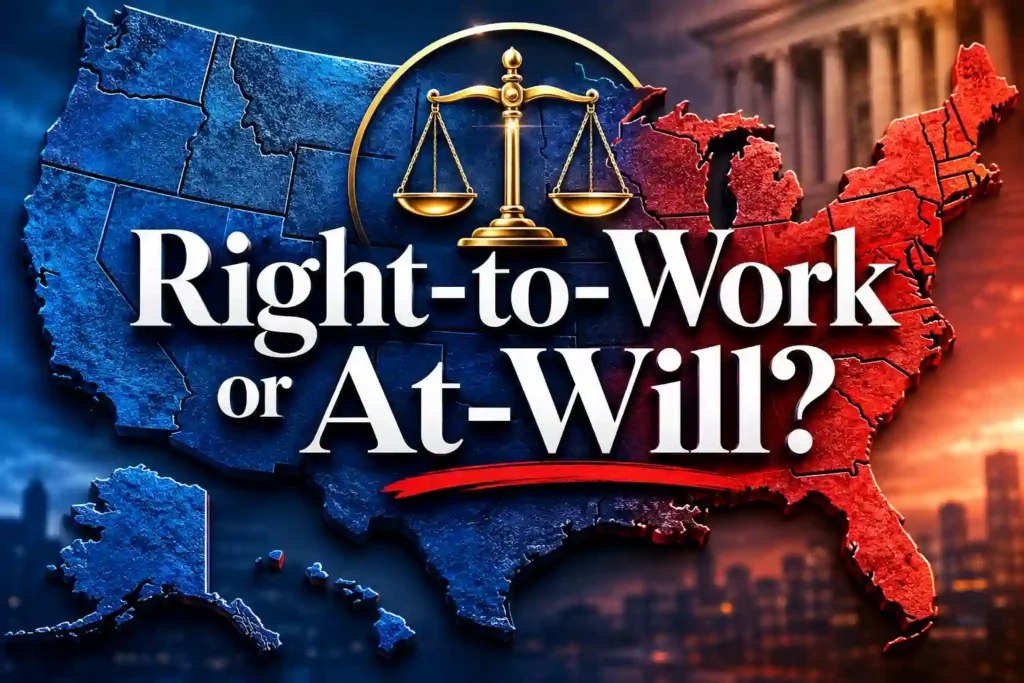
Is California an at will employment state?
- What are the at-will employment states? Well, if you work in any of the 49 U.S. states or Washington D.C., you are in an “at-will” employment state. The only exception is Montana. At-will means your employer can legally fire you at any time, for any reason, or for no reason at all—but they can never fire you for an illegal reason.
When a manager pulls you into a room and suddenly terminates you without a single prior warning, your first instinct is to look for a legal shield. You immediately search: is my state an at-will employment state? For the vast majority of American workers, the answer is a harsh reality check. The law is heavily stacked in favor of corporations.
However, “at-will” is not a blank check for your boss to break the law. This 2026 legal survival guide will demystify exactly what your employer can and cannot do. We will expose the three legal exceptions that instantly void at-will rules, clear up the massive confusion between “right-to-work” and “at-will,” and explain why getting fired for “no reason” actually guarantees your right to state unemployment checks.
Montana & The 2026 “Just Cause” Movement
Montana is the only state in the U.S. that is not an at-will employment state. Once a worker passes their initial probationary period, Montana employers must have “good cause” to fire them. However, local municipalities in other states are beginning to pass their own just-cause protections.
When American workers ask, “is my state an at-will employment state,” they are usually hoping to find a loophole. At the state level, the only loophole is moving to Montana.
Under the Montana Wrongful Discharge From Employment Act (WDEA), an employer cannot fire you arbitrarily once you complete a probationary period (which is 12 months by default in 2026). They must prove they have a legitimate, business-related reason, such as severe incompetence, theft, or chronic absenteeism.
While Montana stands alone at the state level, the legal landscape is slowly shifting in 2026 through the Municipal Just Cause Movement.
- New York City: Fast-food workers are now legally protected from at-will firings and can only be terminated for “just cause” or a legitimate economic layoff.
- Philadelphia & Seattle: Similar ordinances are being heavily debated or implemented to protect gig workers and specific retail sectors from arbitrary termination.
If you are not in Montana or protected by a specific city ordinance, your job is completely at-will.
Right-to-Work vs. At-Will: What is the difference?
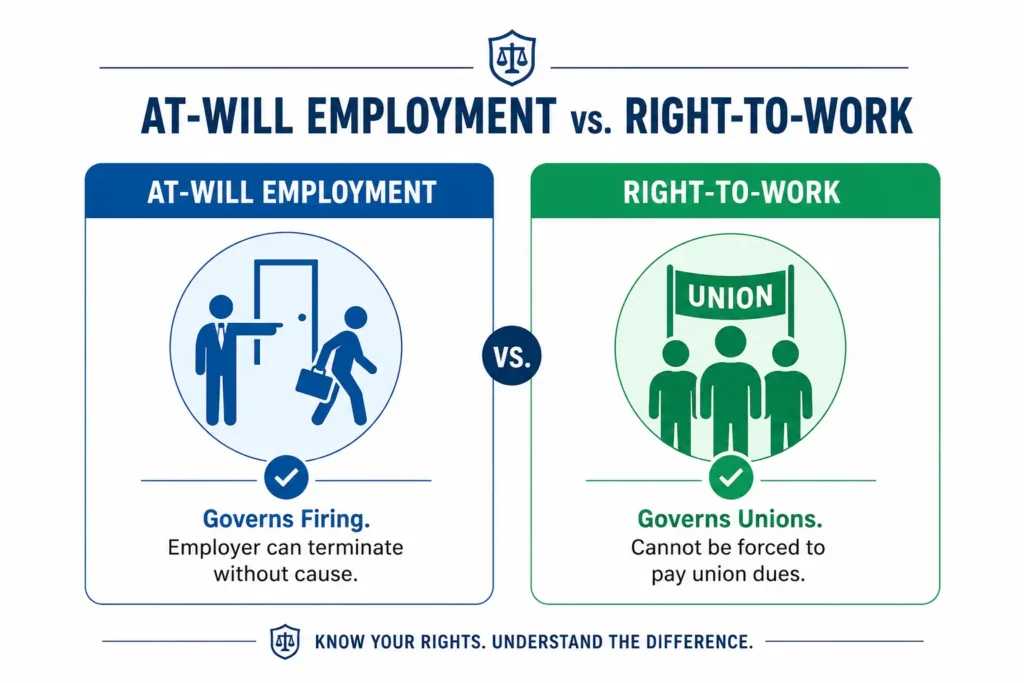
“At-will” employment refers to your boss’s legal right to fire you without cause. “Right-to-work” laws have nothing to do with firing; they simply mean that an employee cannot be legally forced to join a labor union or pay union dues as a condition of keeping their job.
This is the single most misunderstood concept in American labor law. Workers constantly say, “My boss can’t fire me, I live in a right-to-work state!” This is dangerously incorrect.
Let’s permanently clarify the difference:
| The Law | What It Controls | Does it stop a boss from firing you? |
| At-Will Employment | Termination Rules | No. They can fire you at any time. (Applies to 49 states). |
| Right-to-Work | Labor Union Dues | No. It just means you don’t have to pay union fees. (Applies to 26 states). |
Living in a right-to-work state (like Texas or Florida) gives you zero extra protection against being fired. In fact, states that aggressively promote right-to-work laws are often the most ruthless at-will states, recognizing almost no exceptions for workers.
The 3 “Common Law” Exceptions That Void At-Will Firing
Even in an at-will state, you cannot be fired if the termination violates public policy, breaches an implied contract, or violates the covenant of good faith and fair dealing. In 2026, digital evidence like Slack messages frequently proves implied contracts.
If your boss fires you and you do not have a union, your employment lawyer will immediately look to see if your termination falls into one of these three common law exceptions.
1. The Public Policy Exception (Recognized in 42 States)
Your boss cannot fire you for doing something that benefits the public good, or for refusing to break the law.
- Example: If your boss orders you to dump toxic chemicals into a river, and you refuse, they cannot fire you for “insubordination.”
- Example: You cannot be fired for taking time off to serve on jury duty or answering a legal subpoena.(Note: States like Florida, Georgia, and Alabama do not recognize this exception).
2. The Implied Contract Exception (Recognized in 38 States)
You do not need a formal, signed paper contract to be protected. If your employer promised you job security, the court can treat that as an implied contract.
- The 2026 Digital Reality: Implied contracts are no longer just found in printed employee handbooks. If your manager sends you a Microsoft Teams message stating, “Your job is 100% secure for the next two years as long as you hit your sales quota,” and you hit the quota but get fired anyway, that digital message is an implied contract.
3. Covenant of Good Faith and Fair Dealing (Recognized in 11 States)
An employer cannot fire you purely out of malice to rob you of something you already earned.
- Example: You spend six months closing a $5 million real estate deal. The day before your massive $100,000 commission check is supposed to clear, your boss fires you to keep the money for the company. In states like California and Massachusetts, this is a highly illegal bad-faith firing.
Federal Protections: When an At-Will Firing Becomes Illegal
Federal law always overrides state at-will laws. It is completely illegal in all 50 states to fire a worker based on a protected civil rights characteristic (like race, gender, or age) or as retaliation for whistleblowing or taking protected medical leave.
At-will means your boss can fire you for wearing a green shirt when they prefer blue. It means they can fire you because they simply do not like your personality.
However, they cannot fire you for any reason strictly forbidden by federal law.
- Discrimination (Title VII, ADA, ADEA): Your boss cannot fire you because of your race, religion, gender, pregnancy status, sexual orientation, physical disability, or age (if you are over 40).
- Retaliation (Whistleblowing): If you file a formal complaint about sexual harassment, report the company for unpaid overtime (FLSA violation), or report a severe safety hazard to OSHA, you are legally protected. If you are fired shortly after blowing the whistle, the at-will doctrine will not save the company from a massive retaliation lawsuit.
- Medical Leave (FMLA): If you take legally protected leave under the Family and Medical Leave Act to care for a newborn or a sick spouse, you cannot be fired for absenteeism.
Can you get unemployment if you are fired “at-will”?
Yes. If your employer uses the at-will doctrine to fire you “for no reason” or simply because “it wasn’t a good fit,” they are handing you an automatic approval for state unemployment benefits. You are only disqualified if you are fired for willful misconduct.
Workers are often terrified when HR says, “We are exercising our right to terminate your at-will employment.” They assume this legal jargon means they get nothing.
Financially, getting fired for “no reason” is the best-case scenario for collecting unemployment.
To legally block your unemployment claim, the employer must prove to the state Department of Labor that you committed willful misconduct (e.g., stealing from the register, punching a coworker, or failing a drug test).
If the employer tells the state, “We just didn’t like their vibe,” or “We had to cut budget,” the state will immediately approve your weekly unemployment checks.
Practical Case Study: Beating At-Will Firing With Digital Evidence
Understanding how to find the exceptions to at-will employment is the difference between walking away empty-handed and securing a massive settlement. A tech worker used digital Slack evidence to prove an implied contract, successfully suing for wrongful termination.
Let’s look at how modern workers beat the at-will presumption in court.
The Situation: “Sarah” worked as a software developer in Texas (a strict at-will state). During a massive round of corporate layoffs, Sarah grew nervous. She messaged her VP on Slack, asking if she should start looking for a new job. The VP replied, “Absolutely not. You just finished the backend API. We need you. As long as you don’t commit a crime, you have a guaranteed spot here for the next 12 months.”
The Action: Three weeks later, Sarah was fired without cause. HR stated she was simply an at-will employee. Sarah immediately contacted an employment lawyer and provided screenshots of the VP’s Slack messages.
The Result: The employer tried to rely on the standard at-will defense. However, Sarah’s lawyer argued that the VP’s direct written promise of 12 months of security created an implied contract, voiding her at-will status. Facing a brutal breach of contract lawsuit, the company settled out of court, paying Sarah the full 12 months of salary they had promised her.
Frequently Asked Questions (FAQ) About At-Will Employment
Can I be fired for no reason in an at-will state?
Yes. In 49 states, your employer can legally fire you for a good reason, a bad reason, or no reason at all. However, they cannot fire you for an illegal reason, such as your race, gender, disability, or as retaliation for blowing the whistle.
Does an at-will employee have to give a 2-week notice?
No. At-will employment works both ways. Just as your employer can terminate you without warning, you have the absolute legal right to walk out of your job at any moment, without giving a two-week notice, unless you have a signed, binding employment contract stating otherwise.
What is the difference between at-will and right-to-work?
At-will employment governs how a job ends, meaning you can be fired without cause. Right-to-work laws govern union membership, meaning you cannot be forced to join a labor union or pay union dues to keep your job. They are entirely separate laws.
Can I sue my employer for wrongful termination in an at-will state?
Yes, but only if you can prove that the firing violated a specific federal or state protection. You can sue if you were fired due to discrimination, illegal retaliation, or if your employer breached a verbal promise or digital contract (like a Slack message) guaranteeing your job security.
Does a company handbook protect me from at-will firing?
Usually, no. Most modern corporate employee handbooks contain a prominent “At-Will Disclaimer” on the first page, explicitly stating that the handbook is not a legal contract and does not change your at-will status. However, if the handbook contains mandatory, specific disciplinary steps before firing, it might create a binding implied contract.
Disclaimer: The information provided on this website does not, and is not intended to, constitute legal advice. All information, content, and materials available on this site are for general informational and educational purposes only. Laws regarding employment and labor rights frequently change, and while we strive to keep our content updated, the information on this website may not constitute the most up-to-date legal or other information.
Use of, and access to, this website or any of the links or resources contained within the site do not create an attorney-client relationship between the reader, user, or browser and the website authors, contributors, or its owners. We are an independent publishing platform, not a law firm.
Readers of this website should contact a qualified employment attorney in their specific state to obtain advice with respect to any particular legal matter. No reader or user of this site should act or refrain from acting on the basis of information on this site without first seeking legal advice from counsel in the relevant jurisdiction. Only your individual attorney can provide assurances that the information contained herein – and your interpretation of it – is applicable or appropriate to your particular situation.
Know your rights.
is california an at will employment state , california at will employment, at will employment texas, is illinois an at will employment state, at will employment florida, is california at will employment, is florida an at will employment state, is michigan an at will employment state, at will employment michigan, is colorado an at will employment state, is florida at will employment state, is ny an at will employment state, is ohio an at will employment state, is pennsylvania an at will employment state, colorado at will employment, florida at will employment, is georgia an at will employment state, is maryland an at will employment state, is north carolina an at will employment state, is virginia an at will employment state, is washington an at will employment state, at will employment ca , at will employment illinois, at will employment ohio, at will employment vs right to work, illinois at will employment, is arizona an at will employment state, is indiana an at will employment state, is missouri an at will employment state, is nc an at will employment state, is new jersey an at will employment state, is nj an at will employment state, is oregon an at will employment state, is pa an at will employment state, virginia at will employment, at will employment colorado, at will employment in california, at will employment pa, is colorado an employment at will state, is georgia an employment at will state, is kentucky an at will employment state, is nevada an at will employment state, is ohio an employment at will state, is virginia an employment at will state, is washington state an at will employment state, is wisconsin an at will employment state, massachusetts at will employment, michigan at will employment, ohio at will employment, oregon at will employment, washington state at will employment, at will employment georgia, at will employment nj, at will employment washington, is iowa an at will employment state, is louisiana an at will employment state, is new york an employment at will state, is pa at will employment, is utah an at will employment state, is virginia at will employment state, pa at will employment, right to work vs employment at will, at will employment arizona, at will employment indiana, at will employment nyc, at will employment wisconsin, is alabama an at will employment state, is arizona an employment at will state, is indiana an employment at will state, is minnesota an at will employment state, is missouri an employment at will state, is ny an employment at will state, is oklahoma an at will employment state, is pennsylvania an at will employment, maryland at will employment, pa at will employment state, at will employment in nj, at will employment in washington state, at will employment ma, at will employment maryland,at will employment missouri, at will employment nevada, at will employment vs ,ca at will employment, california at will employment law, can at will employees sue for wrongful termination, is florida an at will state for employment, is iowa an employment at will state, is nebraska an at will employment state, is tennessee an at will employment state, is west virginia an at will employment state, is wv an at will employment state, ma at will employment, md at will employment, missouri at will employment, new jersey at will employment, ny at will employment, pennsylvania employment at will, va at will employment, washington at will employment