
If you just handed your manager a legitimate note from your doctor—only to be told that your absence still counts as an unexcused strike or that your lifting restrictions won’t be honored—you are likely feeling angry, sick, and scared for your job. Sitting up late at night, you are asking yourself a critical question: can an employer override a doctor’s sick note?
Let’s give you the straight legal truth right away. A basic clinic note is not a magic shield against every company attendance policy, especially for a minor illness in an at-will state. However, your boss cannot legally ignore or override a physician’s documentation when your condition falls under federal laws like the Family and Medical Leave Act (FMLA), the Americans with Disabilities Act (ADA), the Pregnant Workers Fairness Act (PWFA), Workers’ Compensation, or state Paid Sick Leave statutes. Let’s break down when your note is legally untouchable, expose illegal HR tactics, and show you how to protect your job.
When can an employer legally override a doctor’s sick note—and when is it illegal?
Under at-will rules, an employer can ignore a Doctor’s Sick Note for a minor, unprotected illness. However, companies cannot legally override Medical Certification or Medical Work Restrictions protected by the FMLA, ADA, Pregnant Workers Fairness Act (PWFA), Workers’ Compensation, or State Paid Sick Leave Statutes.
Protected medical leave vs. unprotected absence under at-will employment
Most workers assume that handing over a piece of paper signed by a physician automatically forces an employer to excuse an absence. Unfortunately, under the at-will employment doctrine, that is not always true.
The law draws a sharp line between a protected medical leave vs. unprotected absence. If you catch a minor 24-hour stomach bug, visit an urgent care clinic, and live in a state without mandatory sick leave laws, your employer can technically reject that doctor’s sick note / medical certification and issue an attendance warning.
However, the moment your illness, injury, or pregnancy triggers federal civil rights laws or state sick-time statutes, your boss loses the power to override your doctor. Ignoring protected medical documentation becomes illegal interference and retaliation.
Why “no-fault” attendance point systems cannot penalize protected sick notes
Many warehouses, retail chains, and call centers use strict no-fault attendance point systems. Under these automated trackers, any missed shift earns a “point,” and hitting six or eight points triggers automatic termination—even if you bring a medical excuse.
Here is what HR rarely advertises: federal and state laws override company point policies. Under FMLA interference and retaliation rules, as well as State and Municipal Paid Sick Leave (PSL) statutes (enforced across California, New York, Illinois, Michigan, Minnesota, Washington, and over a dozen other jurisdictions in 2026), employers cannot assign attendance points for legally protected medical absences. If an automated HR system penalizes you for using accrued statutory sick leave or FMLA time, the company is breaking the law.
| Leave Type / Protection | Can Employer Override Note? | Governing Law / Rule |
| Minor Illness (No State PSL) | Yes, under at-will rules. | Standard company attendance policy applies. |
| Serious Health Condition | No (if eligible). | Family and Medical Leave Act (FMLA). |
| Disability / Light Duty | No, must engage in good faith. | Americans with Disabilities Act (ADA). |
| Pregnancy / Childbirth | No, accommodations required. | Pregnant Workers Fairness Act (PWFA). |
| State Paid Sick Leave | No, protected statutory time. | State and Municipal PSL Statutes (2026). |
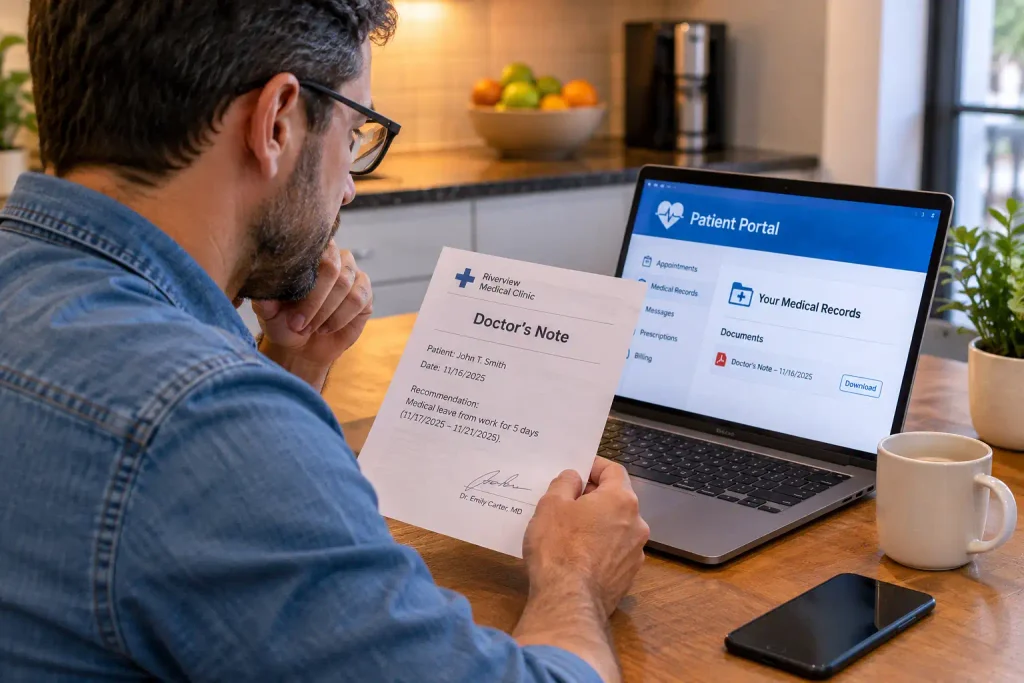
How do the FMLA, ADA, and PWFA stop managers from ignoring medical restrictions?
Federal civil rights statutes strip managers of the power to play doctor. The Family and Medical Leave Act (FMLA) protects serious health absences, while the Americans with Disabilities Act (ADA) and Pregnant Workers Fairness Act (PWFA) mandate an ADA Interactive Process for Light Duty restrictions.
The FMLA second and third medical opinion rule (why HR can’t just say no)
The Family and Medical Leave Act (FMLA) applies to private employers with 50 or more employees and covers eligible workers who have worked there for at least 12 months (and logged 1,250 hours). When you submit a completed FMLA medical certification for a serious health condition, your supervisor cannot simply toss it aside because they think you “look fine.”
Under federal regulation 29 C.F.R. § 825.307, strict rules govern the FMLA second and third medical opinion rule:
- No arbitrary rejections: If HR doubts the validity of your doctor’s certification, they cannot simply override it or deny your leave.
- Employer-paid second opinion: HR must pay out-of-pocket for you to see an independent healthcare provider of their choice (who cannot be regularly employed by the company).
- Binding third opinion: If your doctor and the company’s second doctor disagree, the employer must pay for a third, mutually agreed-upon specialist whose decision is final and binding.
Why blanket “100% healed” return-to-work policies violate the ADA
Imagine you recover from back surgery and your physician issues a fitness-for-duty certification clearing you to return to work with a temporary light duty restriction: no lifting over 15 pounds for four weeks. Your manager looks at the note and says, “Don’t come back until you are 100% healed with zero restrictions.”
That blanket refusal is a classic legal trap. Under the Americans with Disabilities Act (ADA) (covering employers with 15 or more employees), enforcing a rigid “100% healed” / full-duty return policy is frequently treated by the federal courts and the U.S. Equal Employment Opportunity Commission (EEOC) as a per se violation of federal law. Instead of rejecting your medical work restrictions, HR must engage in the ADA interactive process to determine whether temporary light duty, schedule adjustments, or assistive equipment can reasonably accommodate you without causing “undue hardship.”
Pregnancy accommodations under the PWFA and Workers’ Compensation injury notes
Two additional statutory shields prevent managers from ignoring medical notes:
- Pregnant Workers Fairness Act (PWFA): Under this federal statute, covered employers must provide reasonable accommodations—including extra bathroom breaks, seated stools, lifting limits, and recovery time off—for pregnancy, childbirth, and related medical conditions, even if the condition does not rise to the level of a traditional ADA disability.
- Workers’ Compensation Board / State Workers’ Comp Laws: If you were injured on the job, work restrictions issued by your authorized treating physician are legally binding under state workers’ compensation statutes. Forcing an injured worker to violate those restrictions exposes the employer to severe statutory penalties and benefit liabilities.
Can your boss call your doctor or demand your private medical diagnosis?
Your direct supervisor cannot call your clinic or demand your private diagnosis. Under strict Authentication vs. Clarification privacy rules, only HR may verify that a Doctor’s Sick Note is authentic, while the ADA and GINA prohibit demanding underlying medical records.
Authentication vs. clarification: what HR is legally allowed to ask your clinic
Many workers worry that calling their doctor’s office violates HIPAA (the Health Insurance Portability and Accountability Act). While HIPAA restricts what your doctor can disclose without your permission, employment statutes draw the actual workplace boundary around authentication vs. clarification:
- Authentication: An HR representative (never your direct supervisor) may contact your clinic solely to verify that the signature is genuine and that the clinic actually issued the note.
- Clarification: HR may ask the provider to clarify illegible handwriting or confirm the expected duration of restrictions—but only after giving you an opportunity to cure any incomplete information first.
- Strict Prohibition: Your employer cannot demand your private medical chart, therapy notes, or sensitive clinical history just to excuse a routine sick day.
Medical privacy boundaries under the ADA, GINA, and 2026 telehealth rules
Federal law tightly restricts what medical details HR can force you to reveal:
- ADA Confidentiality: Any medical note or restriction you submit must be stored in a separate, locked confidential medical file—never in your regular personnel folder where floor supervisors can read it.
- Genetic Information Nondiscrimination Act (GINA): Under GINA, employers are strictly forbidden from requesting genetic information or family medical history when evaluating sick notes or FMLA paperwork.
- Telehealth Healthcare Provider Validity: In 2026, virtual urgent care and telemedicine visits are standard primary care. Under U.S. Department of Labor (USDOL) enforcement guidance, an electronic sick note or certification signed by a licensed physician, nurse practitioner, or clinical psychologist via a legitimate telehealth visit carries the exact same legal weight as an in-person clinic visit.
What should you do if your employer rejects your doctor’s note or writes you up?
If management rejects a valid Doctor’s Sick Note, immediately create a paper trail via email citing applicable FMLA, ADA, or State Paid Sick Leave protections. Save copies of all Medical Work Restrictions and disciplinary write-ups before filing a complaint with the USDOL or EEOC.
Step-by-step documentation script to send HR when a sick note is ignored
When a manager refuses your note or threatens attendance points, never argue verbally in the hallway. Verbal conversations vanish; written emails win legal claims. Follow these four steps immediately:
- Keep the original note: Always hand over a copy or scan, keeping the signed original and your clinic visit receipt at home.
- Send a calm, timestamped email to HR: Copy your personal email address so you have proof of delivery outside company servers.
- Use clear statutory language: You do not need to sound like a lawyer, just put HR on formal notice that your note involves protected medical leave or accommodations.
- Save every disciplinary write-up: If management issues an attendance warning anyway, sign it “Received, do not agree—absence covered by medical documentation” and keep a copy.
Copy-and-Paste Email Script to HR:
“Hi [HR Representative Name], I am following up in writing regarding the doctor’s note I submitted on [Date] covering my absence/work restrictions from [Start Date] to [End Date]. My manager indicated this time may still count as an unexcused attendance point. Because this medical documentation relates to a protected health condition / statutory sick leave, I am requesting that HR confirm my absence is excused and initiate any required FMLA or ADA interactive review. Please let me know if you need any additional standard forms completed by my provider. Thank you, [Your Name].”
Practical Case Study: Defeating an illegal “100% healed” override after surgery
Consider a retail warehouse associate whose manager rejected a surgeon’s Light Duty lifting restriction under a blanket 100% Healed policy. By documenting the refusal and filing an EEOC charge, he proved an ADA Interactive Process failure and recovered lost wages.
Let’s look at how these rules protect real workers. Devon worked as an inventory associate at a regional retail distribution center. After undergoing outpatient hernia surgery, his surgeon issued a fitness-for-duty certification clearing him to return to work after two weeks, provided he followed a temporary light duty restriction limiting lifting to 20 pounds for 30 days.
When Devon handed the note to his operations manager, the manager handed it back and said, “Corporate policy requires you to be 100% healed before stepping onto the floor. Stay home unpaid until your doctor removes every restriction.” Devon followed the paper-trail strategy: he emailed HR attaching his surgeon’s note, asked for an ADA interactive process meeting to discuss seated inventory scanning tasks, and saved HR’s written refusal enforcing the blanket policy. Devon filed an administrative charge with the U.S. Equal Employment Opportunity Commission (EEOC). Federal investigators cited the company for enforcing an unlawful “100% healed” / full-duty return policy, resulting in $14,500 in back-pay settlement funds and immediate workplace accommodation.
Frequently Asked Questions (FAQ) About Doctor’s Sick Notes at Work
Facing disciplinary threats while sick or recovering creates immediate stress. Below, we answer common questions about getting fired with a doctor’s note, virtual telehealth excuses, and employer refusals of light-duty restrictions.
Can you get fired if you have a doctor’s note?
Yes, if your absence is not protected by federal or state law. In an at-will state without mandatory sick leave statutes, an employer can legally terminate an employee for missing work due to a minor, non-qualifying illness—even with a clinic note. However, firing you for an absence protected by the FMLA, ADA, PWFA, Workers’ Compensation, or State Paid Sick Leave statutes is illegal retaliation.
Can an employer reject a doctor’s note from a telehealth or urgent care visit?
No, provided the note comes from a licensed healthcare provider acting within their scope of practice. Both federal USDOL FMLA regulations and state sick-leave laws recognize legitimate telemedicine consultations and urgent care clinic notes on equal footing with traditional office visits.
Can an employer refuse light-duty restrictions from my doctor?
An employer does not have to create a brand-new, permanent position that does not exist. However, under the ADA and PWFA, an employer cannot automatically reject temporary medical work restrictions without engaging in a documented interactive process and proving that accommodating your restrictions would cause genuine, significant “undue hardship” to business operations.
Disclaimer: The information provided on this website does not, and is not intended to, constitute legal advice. All information, content, and materials available on this site are for general informational and educational purposes only. Laws regarding employment and labor rights frequently change, and while we strive to keep our content updated, the information on this website may not constitute the most up-to-date legal or other information.
Use of, and access to, this website or any of the links or resources contained within the site do not create an attorney-client relationship between the reader, user, or browser and the website authors, contributors, or its owners. We are an independent publishing platform, not a law firm.
Readers of this website should contact a qualified employment attorney in their specific state to obtain advice with respect to any particular legal matter. No reader or user of this site should act or refrain from acting on the basis of information on this site without first seeking legal advice from counsel in the relevant jurisdiction. Only your individual attorney can provide assurances that the information contained herein – and your interpretation of it – is applicable or appropriate to your particular situation.
Know your rights.
References & Official Legal Resources
Do not let an employer bully you into working injured or penalize you for legally protected medical absences. Verify your statutory rights regarding medical certifications, reasonable accommodations, and formal complaint procedures through these official government portals:
-
U.S. Department of Labor (USDOL) – Family and Medical Leave Act (FMLA) Guide:
Review federal medical certification rules, the second-opinion dispute process (29 C.F.R. § 825.307), and employee protections against FMLA interference at the USDOL FMLA Compliance Portal. -
U.S. Equal Employment Opportunity Commission (EEOC) – Disability & Accommodation Rights:
Explore federal rules prohibiting blanket “100% healed” policies and requiring employers to engage in the ADA interactive process via the EEOC Leave & Reasonable Accommodation Guidance. -
U.S. Equal Employment Opportunity Commission (EEOC) – Pregnant Workers Fairness Act (PWFA):
Access federal protections requiring workplace light-duty accommodations and recovery leave for pregnancy and childbirth at the EEOC PWFA Official Resource Center. -
U.S. Department of Labor (USDOL) – State Labor Offices & Paid Sick Leave Directory:
Locate your specific state labor agency to verify local Paid Sick Leave statutes and state-level medical excuse protections at the USDOL State Labor Office Directory.
Keywords: can an employer override a doctors sick note, can my employer ignore my doctor’s note, can you get fired if you have a doctor’s note, can an employer refuse light duty restrictions, 100 percent healed policy ada violation, can an employer override a doctors sick note, can my boss call my doctor to verify a sick note, fmla second medical opinion rule