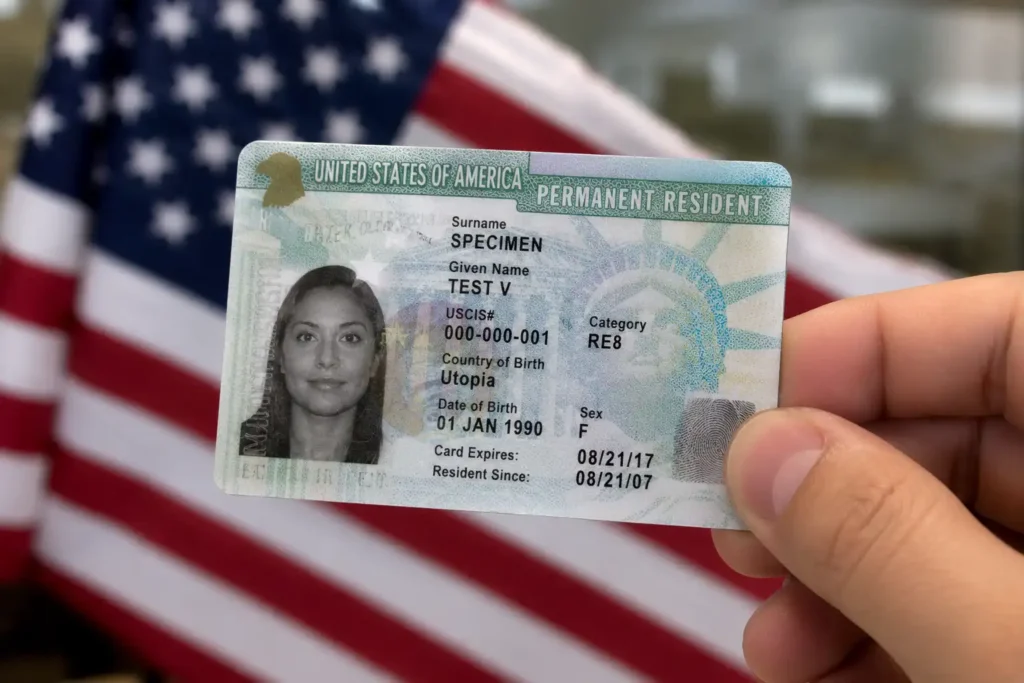
If you are sitting up late at night staring at your visa expiration date and wondering how to build a permanent future in the United States, you are not alone. Asking yourself “can my employer sponsor me for a green card” is one of the highest-stakes questions a foreign worker can face, especially when you cannot afford a private immigration lawyer just to get straight answers.
Let’s cut through the legal fog right away. Yes—almost any financially stable U.S. business can sponsor you for permanent residency, even if you work at a small startup or do not hold a college degree. However, strict federal rules control who pays the legal bills, how long the Department of Labor takes, and how you can protect your spot in line if you get laid off. Let’s break down the exact rules, late-2026 regulatory changes, and worker protections you need before approaching HR.
What are the requirements for an employer to sponsor you for a green card?
Yes, nearly any legitimate U.S. company can pursue Employment-Based Green Card Sponsorship if the role is permanent and full-time. The employer must prove Employer Ability to Pay the Prevailing Wage Determination and prove no qualified U.S. workers are available through PERM Labor Certification.
Employer eligibility: company size, permanent job offers, and ability to pay
Many workers assume only Fortune 500 tech giants can sponsor green cards. That is a myth. Under federal law, a 10-person restaurant, a regional construction firm, or a local healthcare clinic can file an employment-based green card sponsorship petition.
To qualify as a sponsor, your employer must meet three core rules:
- Permanent, full-time job offer: The role must be a bona fide, year-round position (at least 35 to 40 hours per week), not seasonal or temporary contract work.
- Employer ability to pay requirement: Under federal regulation 8 C.F.R. § 204.5(g)(2), the company must prove through federal tax returns, audited financial statements, or your current W-2 paystubs that it can afford to pay your offered wage from the day the case starts until you receive your green card.
- Good-faith recruitment: For most categories, the employer must test the U.S. labor market honestly rather than tailoring job requirements solely to exclude qualified American applicants.
Choosing between EB-1, EB-2, and EB-3 preference categories (including no-degree jobs)
Under the Immigration and Nationality Act (INA § 203(b)), employer-sponsored green cards fall into three main EB-1, EB-2, and EB-3 preference categories. Your job’s minimum requirements—not just your personal resume—determine which tier applies:
- EB-1 (Priority Workers): Reserved for multinational managers/executives (EB-1C), outstanding professors/researchers (EB-1B), and individuals with extraordinary ability (EB-1A). This tier skips labor certification entirely.
- EB-2 (Advanced Degree or Exceptional Ability): Covers jobs requiring at least a master’s degree, or a bachelor’s degree plus five years of progressive post-graduation work experience.
- EB-3 (Skilled Workers, Professionals, and Other Workers): Covers jobs requiring a bachelor’s degree (Professionals), at least two years of specialized training or experience (Skilled Workers), or less than two years of training with zero college degree required (Unskilled / “Other Workers”).
| Green Card Tier | Minimum Job Requirement | PERM Labor Certification Needed? | Typical 2026 Queue Speed |
| EB-1 | Multinational manager or extraordinary achievement. | No (Skips DOL stage). | Fastest; minimal backlogs for most countries. |
| EB-2 | Master’s degree or Bachelor’s + 5 years experience. | Yes (Unless applying for NIW). | Moderate; multi-year backlogs for India/China. |
| EB-3 Skilled | Bachelor’s degree OR 2+ years trade experience. | Yes, mandatory. | Moderate; similar to EB-2 for most countries. |
| EB-3 Unskilled | Under 2 years training; no college degree needed. | Yes, mandatory. | Slower due to strict 10,000 annual visa cap. |

How does the 3-step employer green card sponsorship process work in 2026?
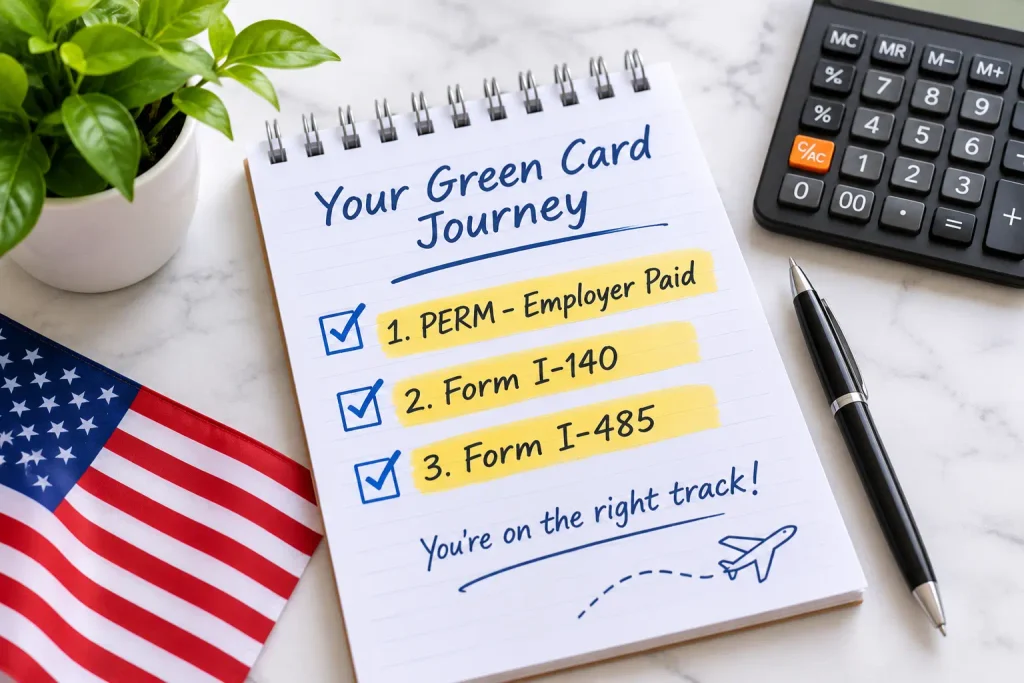
Employer sponsorship follows three stages: obtaining PERM Labor Certification (ETA Form 9089) from the U.S. Department of Labor, filing Form I-140 with USCIS, and submitting Form I-485 once your Priority Date becomes current on the U.S. Department of State Visa Bulletin.
Step 1: Prevailing Wage Determination and PERM Labor Certification (late-2026 DOL updates)
For most EB-2 and EB-3 cases, the process begins at the U.S. Department of Labor (USDOL) – Office of Foreign Labor Certification (OFLC). First, the company requests a Prevailing Wage Determination (PWD – Form ETA-9141) to establish the legally required minimum salary for your role and city. Next, the company conducts mandatory recruitment and files PERM Labor Certification (ETA Form 9089) proving no qualified U.S. worker applied.
In late 2026, two critical realities govern this first stage:
- Realistic 2026 timelines: Between Prevailing Wage processing (6–8 months), mandatory recruitment, and DOL analyst review (averaging roughly 11 to 14 months), the PERM stage alone takes 18 to 24 months in 2026.
- November 2026 DOL PERM Modernization Rule (RIN 1205-AC29): On November 17, 2026, the Department of Labor unveiled a sweeping proposed rule overhauling the PERM system for the first time since 2004. The proposal replaces outdated print newspaper ads with mandatory 90-day digital and social media job postings, proposes eliminating automatic Schedule A exemptions (which previously let nurses and physical therapists skip PERM), and enforces strict waiting periods—up to two years in proposed rules—if an employer recently laid off U.S. workers in similar roles.
Step 2: Filing Form I-140 with USCIS and locking in your Priority Date
Once the Department of Labor certifies your PERM application, your employer has strictly 180 calendar days to file Form I-140 (Immigrant Petition for Alien Workers) with U.S. Citizenship and Immigration Services (USCIS).
During this step, USCIS verifies two things: that you possess every degree, license, and skill listed in the job ad, and that your employer meets the financial ability-to-pay standard. The exact date your PERM (or EB-1 I-140) was officially received becomes your Priority Date—your permanent place in the green card line. Standard I-140 processing takes 6 to 10 months, though employers can pay for Form I-907 Premium Processing to get a decision in 15 business days.
Step 3: Form I-485 Adjustment of Status vs. Consular Processing
Having an approved I-140 does not automatically hand you a green card. You must check the monthly U.S. Department of State (DOS) Visa Bulletin to see if your Priority Date is “current” (earlier than the cutoff date listed for your category and country of birth).
Once your Priority Date is current, you complete the final stage:
- Adjustment of Status (Form I-485): If you are lawfully inside the United States, you file Form I-485 (Application to Register Permanent Residence or Adjust Status) alongside medical exam results (Form I-693). While waiting, you also receive an Employment Authorization Document (EAD work card) and Advance Parole travel permit.
- Consular Processing: If you live outside the United States, the National Visa Center (NVC) schedules an immigrant visa interview at a U.S. embassy or consulate in your home country.
Who pays for green card sponsorship—and which employer fee clawbacks are illegal?
Under federal law, your employer must pay 100% of PERM Labor Certification legal and recruitment expenses. While Form I-140 and Form I-485 fees can be negotiated, any contract forcing you to reimburse PERM costs violates the Mandatory Employer PERM Fee Rule.
Why forcing employees to pay or reimburse PERM legal fees violates federal law
Many employers pressure foreign workers into signing repayment agreements—known as “clawback clauses”—stating that if the worker quits within two years, they must reimburse the company $10,000 in green card legal fees.
Here is the federal protection every worker needs to know: under the Mandatory Employer PERM Fee Rule (20 C.F.R. § 656.12), it is strictly illegal for an employer to require an employee to pay, subsidize, or reimburse any attorney fees or advertising costs tied to the PERM Labor Certification stage. Even if you signed a promissory note agreeing to repay PERM costs upon resignation, federal regulators treat that repayment demand as unlawful fee-shifting. Furthermore, the U.S. Department of Justice (DOJ) – Immigrant and Employee Rights Section (IER) actively fines companies that retaliate against or discriminate against workers during PERM recruitment.
Breakdown of I-140 and I-485 government filing fees and premium processing costs
While the employer must pay 100% of Stage 1 (PERM), federal rules allow employers and employees to negotiate who pays for Stage 2 (Form I-140) and Stage 3 (Form I-485). Knowing the exact 2026 cost split protects you from being overcharged:
| Sponsorship Expense | Who Must Pay Under Federal Law? | Typical 2026 Cost Range |
| PERM Recruitment & Legal Fees | 100% Employer (Employee payment is illegal). | $4,000 – $8,500+ |
| Form I-140 USCIS Filing Fee | Negotiable (Usually paid by employer). | $715 (+ Asylum Program Fee) |
| Form I-907 Premium Processing | Negotiable (Employee may legally pay to speed up). | $2,805 (Optional) |
| Form I-485 Green Card Filing | Negotiable (Often paid by employee/family). | $1,440 per adult applicant |
What happens if you get laid off or want to change jobs during green card sponsorship?
Under AC21 Job Portability & The 180-Day Rule, once your Form I-140 has been approved for 180 days, your Priority Date stays locked permanently. After your Form I-485 is pending for 180 days, you can switch to a same or similar job.
How AC21 job portability and the 180-day rule protect your Priority Date
Workers often feel trapped in low-paying or toxic jobs for years out of fear that leaving will erase their green card progress. Congress passed the American Competitiveness in the Twenty-First Century Act (AC21) specifically to prevent employers from holding workers hostage.
Under AC21 job portability & the 180-day rule, two major milestones shield your future:
- I-140 Priority Date Retention (180 Days Post-Approval): Once USCIS approves your Form I-140 and 180 calendar days pass, your employer cannot revoke your Priority Date—even if they lay you off or withdraw the petition out of spite. Your new employer must file a new PERM and I-140, but you keep your original place in the Visa Bulletin line.
- I-485 Job Portability (180 Days Pending): Once your Form I-485 has been pending for 180 days or more (and your I-140 is approved), you can transfer your green card application to a brand-new employer—or even start your own business—without restarting PERM or I-140, as long as the new job is in a “same or similar” occupational classification (filed via Form I-485 Supplement J).
Self-petition alternatives (EB-2 NIW and EB-1A) when an employer stalls or has layoffs
What if your employer refuses to sponsor you, delays filing for years, or suffers corporate layoffs that freeze PERM recruitment? You do not have to sit helplessly.
Qualified professionals can file an EB-2 National Interest Waiver (NIW) or EB-1A Extraordinary Ability self-petition directly with USCIS—requiring no employer sponsor and no PERM Labor Certification. If your work in science, healthcare, engineering, business, education, or technology holds substantial merit and national importance, you can sponsor yourself, pay your own legal fees legally, and carry your Priority Date across any employer.
Practical Case Study: Surviving a layoff and saving a green card via the 180-day rule
Consider a software engineer laid off 200 days after his Form I-140 approval. Because he passed the 180-Day Rule threshold under AC21, he retained his original Priority Date, transferred his H-1B to a new employer, and kept his green card timeline intact.
Let’s see how these rules save real careers. Arjun worked as a systems engineer on an H-1B visa. His employer filed his PERM and obtained an approved Form I-140 in the EB-2 category, locking in a Priority Date from early 2024. Exactly 200 days after his I-140 approval, the company announced sudden restructuring layoffs and terminated Arjun’s position.
Management threatened to revoke his I-140 unless he signed an agreement repaying $6,500 in PERM legal costs. Arjun knew his rights: first, he refused the illegal PERM reimbursement demand under 20 C.F.R. § 656.12; second, because more than 180 days had passed since his I-140 approval, AC21 legally prevented the company from destroying his Priority Date. Within 45 days, Arjun found a new employer who transferred his H-1B visa—using his approved I-140 to secure a three-year extension beyond his sixth H-1B year—and restarted his I-140 while keeping his original 2024 Priority Date intact.
Frequently Asked Questions (FAQ) About Employer Green Card Sponsorship
Asking your employer for permanent residency sponsorship raises tough questions about timing, degree requirements, and visa status. Below, we answer the most urgent questions foreign workers ask before starting the green card process.
Can my employer sponsor me for a green card without a college degree?
Yes. Under the EB-3 preference category, employers can sponsor Skilled Workers (roles requiring at least two years of job experience or vocational training) and Unskilled / “Other Workers” (roles requiring less than two years of training and zero college degree). While EB-3 Unskilled faces longer Visa Bulletin wait times, no university degree is required.
How long does it take to get a green card through an employer in 2026?
For workers born in countries without per-country backlogs (“Rest of World”), the full process—Prevailing Wage, PERM Labor Certification, Form I-140, and Form I-485—typically takes 2.5 to 3.5 years in 2026. For workers born in India or China in the EB-2 or EB-3 categories, Visa Bulletin backlogs extend total wait times to 5 to 12+ years, making AC21 job portability essential.
Can my employer sponsor me if I am currently outside the United States or on F-1 OPT?
Yes. An employment-based green card is based on a prospective permanent job offer upon approval. Your employer can start PERM sponsorship while you are working on F-1 OPT/STEM OPT, H-1B, L-1, or TN status—or even while you reside abroad waiting for Consular Processing.
Disclaimer: The information provided on this website does not, and is not intended to, constitute legal advice. All information, content, and materials available on this site are for general informational and educational purposes only. Laws regarding employment and labor rights frequently change, and while we strive to keep our content updated, the information on this website may not constitute the most up-to-date legal or other information.
Use of, and access to, this website or any of the links or resources contained within the site do not create an attorney-client relationship between the reader, user, or browser and the website authors, contributors, or its owners. We are an independent publishing platform, not a law firm.
Readers of this website should contact a qualified employment attorney in their specific state to obtain advice with respect to any particular legal matter. No reader or user of this site should act or refrain from acting on the basis of information on this site without first seeking legal advice from counsel in the relevant jurisdiction. Only your individual attorney can provide assurances that the information contained herein – and your interpretation of it – is applicable or appropriate to your particular situation.
Know your rights.
References & Official Legal Resources
Do not rely on workplace rumors when your immigration status and career are on the line. Verify federal green card sponsorship rules, check current Visa Bulletin cutoff dates, and review worker fee protections through these official U.S. government portals:
-
U.S. Citizenship and Immigration Services (USCIS) – Employment-Based Immigration:
Review official eligibility criteria for EB-1, EB-2, and EB-3 categories, Form I-140 filing procedures, and AC21 job portability protections at the USCIS Permanent Workers Portal. -
U.S. Department of Labor (USDOL) – Permanent Labor Certification (PERM):
Examine Prevailing Wage rules, ETA Form 9089 standards, and federal regulations (20 C.F.R. § 656.12) prohibiting employee PERM fee payments at the USDOL Office of Foreign Labor Certification Portal. -
U.S. Department of State (DOS) – Monthly Visa Bulletin:
Track current Priority Date cutoff dates across EB-1, EB-2, and EB-3 preference categories for your country of birth via the official Department of State Visa Bulletin Center. -
U.S. Department of Justice (DOJ) – Immigrant and Employee Rights Section (IER):
Report workplace citizenship-status discrimination, unlawful document abuse, or unfair PERM recruitment practices at the DOJ Immigrant and Employee Rights Portal.
Related Keywords: can my employer sponsor me for a green card, employer sponsored green card process 2026, who pays for perm labor certification fees, can my employer sponsor me for a green card, eb2 vs eb3 green card sponsorship requirements, can my employer sponsor me for a green card, can i get a green card through my employer without a degree, ac21 180 day rule priority date retention, how long does employer green card sponsorship take