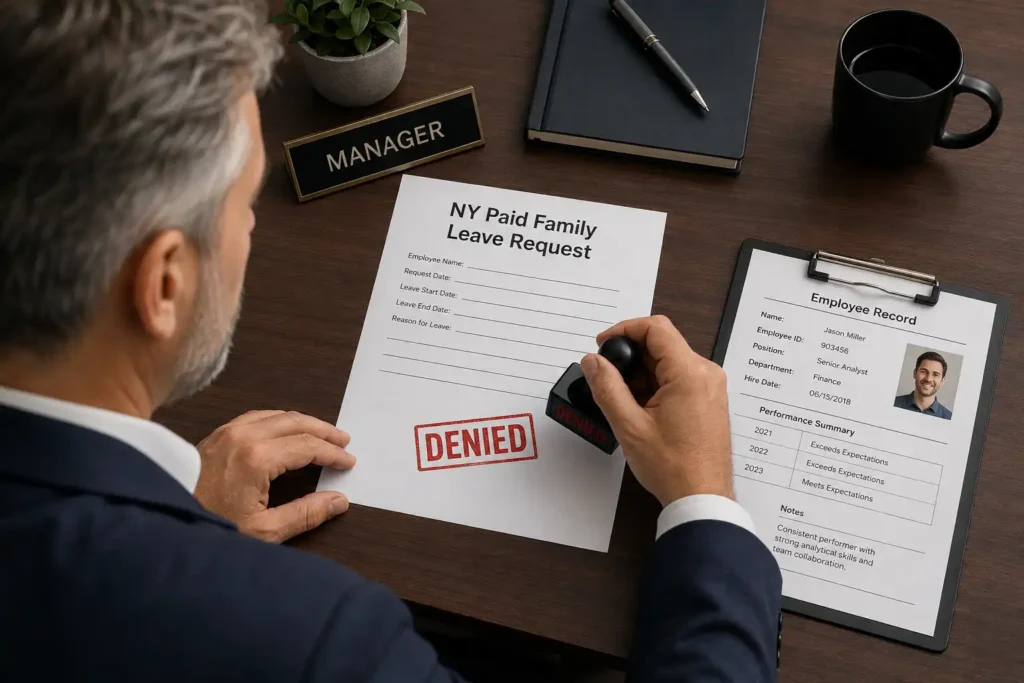
It’s 1 a.m., you just got a text from your boss saying your leave “isn’t happening,” and Google is the only lawyer you can afford right now. Take a breath — that text is very likely wrong. Under the New York Workers’ Compensation Law, employers are legally barred from denying Paid Family Leave. They administer the paperwork; they don’t make the call.
That distinction matters more than it sounds. Most articles on this topic blur employer and insurer roles together, which leaves workers arguing with the wrong party. This guide separates the two clearly, walks you through the exact legal reasons a claim can actually be denied, and gives you the specific forms, deadlines, and dollar figures you need to fight back in 2026 — including what to do if your employer is stonewalling your paperwork or punishing you for asking.
No — your employer cannot legally deny your New York Paid Family Leave (NY PFL) request. Under the New York Workers’ Compensation Law, your employer’s only job is to complete Part B of Form PFL-1 and confirm your eligibility. The decision to approve or deny your benefits belongs entirely to the insurance carrier, which must pay or deny your claim within 18 calendar days.
Key Takeaways
- Employers do not have the legal authority to deny NY PFL. Only the insurance carrier can approve or deny a claim.
- The insurance carrier must decide within 18 calendar days of receiving your complete request or your leave start date, whichever is later.
- Your employer must return Part B of Form PFL-1 within three business days. If they don’t, you can send your claim to the insurer without it.
- You can appeal a denial through arbitration with National Arbitration and Mediation (NAM) for a $25 filing fee.
- Retaliation for taking PFL is illegal. If your employer punishes you for requesting or using leave, you can file Form PFL-DC-119 and, if needed, PFL-DC-120 with the Workers’ Compensation Board.
Can My Employer Legally Deny My NY Paid Family Leave Request?
No. Your employer cannot deny your Paid Family Leave. Their legal role is limited to completing Part B of the Request For Paid Family Leave (Form PFL-1), confirming basic facts like your eligibility and wages. Once that’s done, your claim goes to the employer’s PFL insurance carrier, which is the only party with legal authority to approve or deny it.
This confusion happens constantly because employers sound like they’re denying leave — a manager says “we can’t do that right now” or HR refuses to sign paperwork. But under the New York Workers’ Compensation Law, employers do not have veto power over PFL. If your employer is verbally denying your leave, telling you not to apply, or refusing to process your form, that’s not a lawful denial — it’s an illegal roadblock, and it’s addressed later in this guide.
Think of your employer as a notary, not a judge. They verify facts. The insurance carrier — a private company like NYSIF, The Hartford, or MetLife, depending on your employer’s policy — is the judge.
What Are the Valid Legal Reasons an Insurance Carrier Can Deny NY PFL?
Insurance carriers can only deny NY PFL claims for specific, documented legal reasons — not because staffing is tight or your manager doesn’t like the timing. The three most common valid grounds are eligibility gaps, signed waivers, and missed statutory deadlines.
Failing to Meet the 26-Week or 175-Day Eligibility Thresholds
Full-time employees — those working 20 or more hours per week — must be employed for 26 consecutive weeks before they’re eligible for PFL. Part-time employees, working fewer than 20 hours per week, must accumulate 175 worked days, which do not need to be consecutive and can build up over multiple years with the same employer.
A common trap: taking an unpaid leave of absence before hitting 26 weeks can reset your eligibility clock if the break exceeds 26 weeks. If your denial cites eligibility, check your actual hire date and hours against these thresholds — carriers sometimes get this wrong, especially with irregular schedules.
Having a Signed PFL Waiver on File
If you signed a PFL Waiver, you legally opted out of both PFL contributions and PFL benefits. Employers must offer this waiver only to employees who work fewer than 20 hours a week and won’t hit 175 days, or who work 20+ hours but won’t reach 26 consecutive weeks. A signed, valid waiver is a legitimate reason for denial — but the waiver is automatically revoked within eight weeks if your schedule changes to make you eligible again. If you don’t remember signing one, request a copy from HR; it must be on file.
Missing the 18-Day Rule Deadlines
Once your claim file is complete, the insurance carrier has 18 calendar days to either pay your benefit or issue a written denial — counted from the date they receive your complete request or your first day of leave, whichever comes later. A “denial” for missing this window usually isn’t really a denial about your eligibility — it’s a procedural delay, and it’s actionable in its own right (more on that in the appeals section below).
What Should I Do If My Employer Refuses to Fill Out Part B of Form PFL-1?

Your employer must return your completed Form PFL-1 within three business days. If they stall past that window, you don’t have to wait — you can submit your claim directly to the insurance carrier without Part B and note that your employer failed to respond in time.
Here’s exactly how it works if your employer is dragging their feet:
- Complete Part A of Form PFL-1 with your personal and leave information.
- Deliver the form to your employer and keep a dated copy or email trail as proof.
- Wait three business days. This is the legal deadline for your employer to complete Part B and return it.
- If they miss the deadline, submit the form to the insurance carrier anyway, along with a written note explaining the employer’s failure to respond.
- Attach supporting documentation relevant to your leave type (like a birth certificate for bonding leave or medical certification for caregiving).
- File a complaint separately if the delay looks intentional or retaliatory — this is different from a simple denial and is covered in the next section.
Employer non-response is not a valid reason for the insurer to reject your claim. Carriers are equipped to process incomplete employer sections, and doing so protects your right to timely benefits.
How Do I Fight a NY Paid Family Leave Denial?
You can appeal a PFL denial through arbitration, and if the denial involves retaliation, you have a separate, more serious complaint process through the state. These are two different tracks depending on what actually happened to you.
Appealing an Insurer Denial via NAM Arbitration
If the insurance carrier denies your claim for a standard reason — like disputed eligibility or incomplete documentation — you appeal through National Arbitration and Mediation (NAM), the independent body designated to resolve NY PFL disputes.
- Request the arbitration form from NAM directly (available online at NAM’s PFL arbitration portal).
- Explain your denial reason and attach the denial letter you received from the carrier or employer.
- Attach supporting evidence, such as birth certificates, medical certifications, or military deployment orders, depending on your leave type.
- Pay the $25 filing fee. This is refundable if the arbitrator rules in your favor.
- Submit a copy to your employer and the insurer, since NAM requires all parties to be notified.
- Wait for the arbitrator’s written decision, which is binding on the dispute.
Note: NAM arbitration only covers disputes about whether you should be paid — not discrimination or retaliation claims. Those go to the Workers’ Compensation Board instead.
Filing Forms PFL-DC-119 and PFL-DC-120 for Employer Retaliation
If your employer fired you, cut your pay, demoted you, or disciplined you because you requested or took PFL, that’s a separate legal violation — not a benefits dispute — and it’s handled by the New York State Workers’ Compensation Board (WCB), not NAM.
- Complete Form PFL-DC-119, the Formal Request for Reinstatement, explaining what happened and what corrective action you want (reinstatement, back pay, etc.).
- Deliver the form to your employer and send a copy to the Workers’ Compensation Board’s Paid Family Leave unit.
- Give your employer 30 days to respond and correct the situation.
- If your employer doesn’t reinstate you or resolve the issue within 30 days, file Form PFL-DC-120, the formal Discrimination/Retaliation Complaint, with the WCB.
- Attend the scheduled hearing before a Workers’ Compensation Law Judge, who determines whether the law was violated.
- If the judge rules in your favor, your employer can be ordered to reinstate you, pay back wages with interest, cover attorney’s fees, and pay a penalty of up to $500.
Retaliation claims carry real teeth — this isn’t just a paperwork dispute, it’s a legal violation with financial consequences for the employer.
How Much Does NY Paid Family Leave Pay in 2026?
In 2026, NY PFL pays 67% of your average weekly wage, capped at 67% of the New York State Average Weekly Wage (NYSAWW) of $1,833.63 — making the maximum weekly benefit $1,228.53, according to the New York State Workers’ Compensation Board and the Department of Financial Services. Over a full 12-week leave, that caps your total possible benefit at $14,742.36.
Your actual payout depends on your last eight weeks of gross wages before your leave started, including bonuses and commissions. Employees earning less than the NYSAWW receive the full 67% of their own average wage — the cap only applies to higher earners.
| Year | NYSAWW | Max Weekly Benefit | Max Total Benefit (12 weeks) | Employee Contribution Rate |
|---|---|---|---|---|
| 2024 | $1,718.15 | $1,151.16 | $13,813.92 | 0.373% |
| 2025 | $1,757.19 | $1,177.32 | $14,127.84 | 0.388% |
| 2026 | $1,833.63 | $1,228.53 | $14,742.36 | 0.432% |
Sources: NYS Workers’ Compensation Board and NYS Department of Financial Services.
Practical Case Study: Overcoming a Wrongful PFL Denial and Retaliation
Consider a composite, anonymized scenario based on common patterns seen in WCB retaliation cases. A warehouse worker took eight weeks of bonding leave after adopting a child. When she tried to return, her manager told her the position had been “restructured” and offered a lower-paying role in a different department instead.
She filed Form PFL-DC-119, formally requesting reinstatement to her original position and documenting the timeline: her leave dates, her manager’s exact wording, and the new job posting for her old role that appeared online during her leave. Her employer didn’t respond within the 30-day window.
She then filed Form PFL-DC-120 with the Workers’ Compensation Board. At the hearing, the judge found that reassigning her to a lower-paying position after PFL constituted unlawful retaliation under Workers’ Compensation Law sections 203-b and 120. The employer was ordered to reinstate her to her original role and pay her lost wages with interest.
The lesson: documentation and the formal reinstatement process are what convert a frustrating situation into an enforceable legal outcome. Emails, screenshots, and dated forms matter far more than verbal complaints.
When You DO Need a Lawyer
Most straightforward PFL denials — eligibility disputes, missed deadlines, incomplete paperwork — can be resolved through NAM arbitration without an attorney. You should consider consulting an employment lawyer if:
- Your employer terminated you shortly after you requested or returned from PFL
- You’re facing a pattern of retaliation beyond a single incident
- Your employer disputes facts that require subpoenaing records or witnesses
- The WCB hearing outcome doesn’t fully resolve your lost wages or reinstatement
- You’re weighing a related claim under the FMLA (Family and Medical Leave Act) or state discrimination law
Many employment attorneys in New York offer free consultations for PFL retaliation cases, and some work on contingency, meaning you pay nothing unless you win.
Frequently Asked Questions About NY PFL Denials
Can I be fired for taking NY Paid Family Leave?
No. Firing an employee for requesting or taking NY Paid Family Leave is illegal under the Workers’ Compensation Law. You have the right to be reinstated to the same or a comparable position when your leave ends, and employers who violate this can face reinstatement orders, back pay, and financial penalties.
Who actually pays my PFL benefits?
Your PFL benefits are paid by your employer’s private insurance carrier, not directly from your employer’s bank account. PFL is typically bundled with an employer’s existing disability benefits insurance policy, funded through employee payroll contributions.
How long does it take for NY PFL to be approved?
The insurance carrier must pay or deny your PFL claim within 18 calendar days of receiving your complete request or your leave start date, whichever is later. If that deadline passes with no response, you can escalate through NAM arbitration.
What’s the difference between a PFL denial and employer retaliation?
A PFL denial is a decision by the insurance carrier about your benefits eligibility. Retaliation is illegal punishment by your employer for requesting or using leave, such as termination, demotion, or a pay cut. Denials go through NAM arbitration; retaliation goes through the Workers’ Compensation Board.
Can my employer require me to use PTO instead of PFL?
Generally, you have the right to choose whether to use accrued paid time off concurrently with PFL, though some employer policies may run PFL alongside other leave types. Check your specific employer’s written PFL policy or ask your HR department for the exact language, since employer disability policies can vary in how they coordinate benefits.
Does it cost money to file a NAM arbitration appeal?
Yes, NAM arbitration requires a $25 filing fee, which is refundable if the arbitrator rules that you should have been paid your PFL benefits.
What happens if my employer never fills out Part B of Form PFL-1?
You can submit your claim to the insurance carrier without your employer’s Part B if they miss the required three-business-day deadline. Note the missed deadline in writing when you submit, and keep records of your original delivery to your employer.
Conclusion
Here’s what to remember: your employer cannot legally deny your NY Paid Family Leave — only the insurance carrier can, and only for specific reasons like eligibility, a signed waiver, or missed deadlines. If your employer is blocking your paperwork or punishing you for requesting leave, that’s not a denial — it’s a separate legal violation with its own enforcement process through the Workers’ Compensation Board.
Start by identifying exactly what happened to you: a benefits denial, or employer retaliation. Then use the specific form — NAM arbitration for the former, PFL-DC-119 and PFL-DC-120 for the latter — to hold the right party accountable.
Your next step: Pull your denial letter or your employer’s response right now, and check it against the valid reasons in this guide. If it doesn’t match, you likely have a strong case to appeal.
External Sources Referenced:
- [NYS Paid Family Leave — Official Site]
- [NYS Workers’ Compensation Board — PFL 2026 Updates] — wcb.ny.gov — direct government source
- [NAM PFL Arbitration Portal] — official arbitration intake
- [NYS Department of Financial Services — PFL Rate Announcements] —
This article is for informational purposes only and does not constitute legal advice. For guidance specific to your situation, consult a licensed New York employment attorney.