
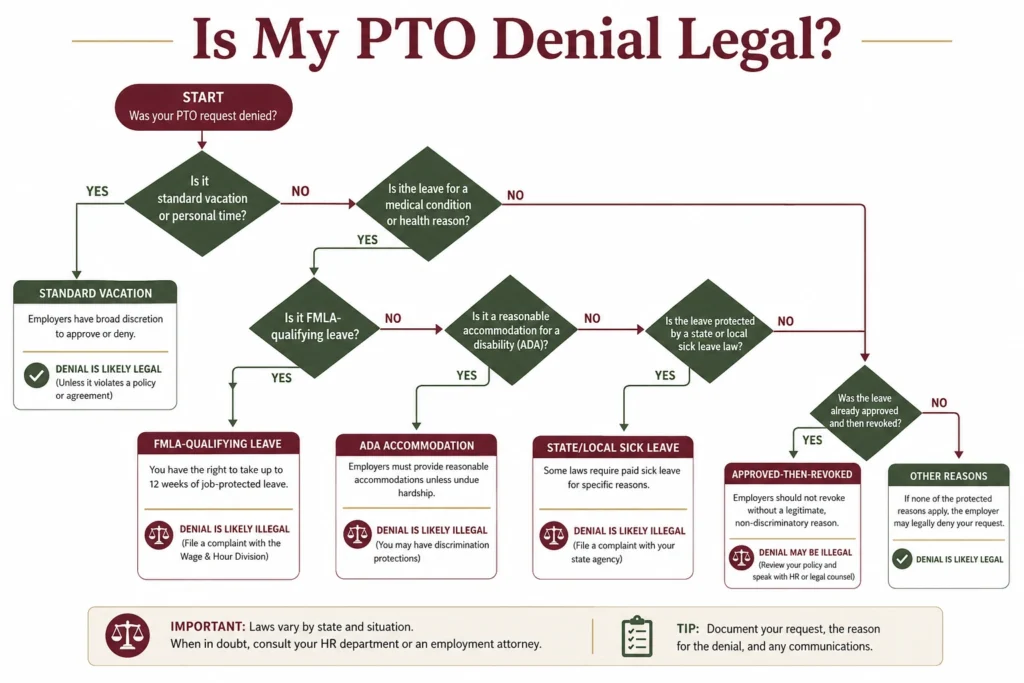
Yes, your employer can legally deny most standard PTO requests — but not all of them. Under federal law, employers control vacation scheduling. However, they cannot deny time off that qualifies under the Family and Medical Leave Act (FMLA), the Americans with Disabilities Act (ADA), Title VII of the Civil Rights Act, or your state’s mandatory sick leave or paid family leave law. If any of those apply to your situation, a denial may be illegal.
- Standard vacation PTO is not a federal right. Most employers can deny it based on business needs.
- Protected leave is different. FMLA, ADA accommodations, and state sick leave cannot legally be blocked by a PTO denial.
- Your state may give you stronger protections. California, Colorado, Montana, Nebraska — and now Minnesota and Maine — have laws that protect accrued PTO as earned wages.
- A verbal approval your boss later cancels may still be legally binding under a doctrine called promissory estoppel.
- Retaliation for asserting your rights is illegal. If you file a complaint and then get fired, that may be a separate federal violation.
Introduction
Your manager just said no. You asked for time off — maybe for a family trip you already paid for, maybe to recover from surgery, maybe just to breathe — and the answer was no. Now you’re sitting here wondering: can they actually do that?
The honest answer is: sometimes yes, sometimes absolutely not. The key is knowing which situation you’re in. Under the Fair Labor Standards Act (FLSA), federal law does not require employers to offer paid vacation at all — but once they promise it, a whole separate set of rules kicks in. And if your time off request touches medical leave, a disability, or your religion, the legal landscape shifts dramatically in your favor.
This guide walks you through every scenario: when your boss is within their rights, when they’ve crossed a legal line, what your state’s law says in 2026, and exactly what to do next.
Can My Employer Legally Deny My PTO Request?
The short answer is yes — for standard vacation, your employer usually can deny the request. The United States does not have a federal law that guarantees paid vacation time. That makes the U.S. one of the only developed nations in the world without it.
What controls your vacation time is your employer’s internal PTO policy, spelled out in your employee handbook or offer letter. That policy is essentially a contract. Your employer can set the rules — including when you can and can’t take time off — as long as those rules don’t cross into illegal discrimination or violate protected leave statutes.
Here’s where it gets important: if your reason for needing time off involves a serious health condition, a disability, a qualifying family event, or a religious observance, standard PTO rules no longer apply. Federal law takes over.
When Can a Company Lawfully Deny Standard Vacation Time?
Employers have broad authority to manage their workforce’s schedules. Courts have consistently upheld the following as valid, legal reasons to deny a vacation request.
Staffing Shortages and Blackout Periods
Many businesses — retailers, restaurants, tax firms, healthcare facilities — set blackout periods, defined windows when no vacation is approved. A retail company blocking all PTO from November 15 through December 31 is a textbook example. This is fully legal as long as:
- The blackout policy was communicated to you in writing (usually in the employee handbook)
- It applies equally to all employees in similar roles
- It is not being used to target a specific protected group
If your coworker with the same seniority gets approved during a blackout period and you don’t, that disparity is worth documenting.
The Trap of “Constructive Denial”
This one doesn’t get talked about enough. Constructive denial is when a manager never formally says “no” — they just never say “yes” either. They delay, reschedule the approval meeting, ask for more notice, or simply go quiet until your planned travel dates pass.
This is a real management tactic. Your handbook may or may not set a deadline for PTO responses — check it carefully. If your company has a 48-hour or 5-business-day response policy and your manager routinely ignores it, you have documented grounds to escalate to HR.
The Risks of Going Anyway: Job Abandonment
Here’s the hard truth: if you take unapproved time off under an at-will employment arrangement, your employer can fire you for it. This is called job abandonment — treating an unauthorized absence as a voluntary resignation. Most states follow at-will employment doctrine, which means your employer doesn’t need a “good” reason to terminate you, only a legal one.
Thinking about going anyway? If the leave would qualify as FMLA or a protected ADA accommodation (more on this below), taking it without approval may still be legally protected — but you’d need to be ready to fight for it retroactively, and that fight is stressful and uncertain.
When Is Denying Paid Time Off Illegal Under Federal Law?
This is where the rules flip — and where your employer can get into serious trouble.
FMLA and Protected Medical Leave
The Family and Medical Leave Act (FMLA) — administered by the U.S. Department of Labor — requires covered employers (50+ employees) to provide up to 12 weeks of unpaid, job-protected leave per year for qualifying reasons. Those include:
- Your own serious health condition
- Caring for a spouse, child, or parent with a serious health condition
- The birth, adoption, or foster placement of a child
- Certain military-related leave
If your PTO request is for any of these reasons, your employer cannot legally deny it — even if you’re asking during a blackout period, even if it’s inconvenient, even if they just hired you for a big project. (Note: you must have worked for the employer for at least 12 months and 1,250 hours to qualify.)
If your employer denies FMLA-qualifying leave, you can file a complaint with the Department of Labor’s Wage and Hour Division. The statute of limitations is generally two years (three if the violation was willful).
ADA and Title VII Reasonable Accommodations
Here’s something most workers don’t realize: a standard vacation request can transform into a legally protected right the moment it’s tied to a disability or a religious practice.
Under the Americans with Disabilities Act (ADA), if you need time off to manage a recognized disability — including mental health conditions like severe depression or PTSD — your employer must provide a reasonable accommodation, which can include modified leave, unless doing so causes “undue hardship” to the business. Most leave requests for medical reasons do not rise to that threshold.
Under Title VII of the Civil Rights Act, employers must reasonably accommodate sincere religious observances. If you need time off for a religious holiday that your employer doesn’t recognize on the company calendar, denying it — without attempting accommodation — may constitute religious discrimination.
Both types of accommodation requests should go to HR in writing. The EEOC handles enforcement. You generally have 180 days from the discriminatory act to file a charge (300 days in states with their own anti-discrimination agencies).
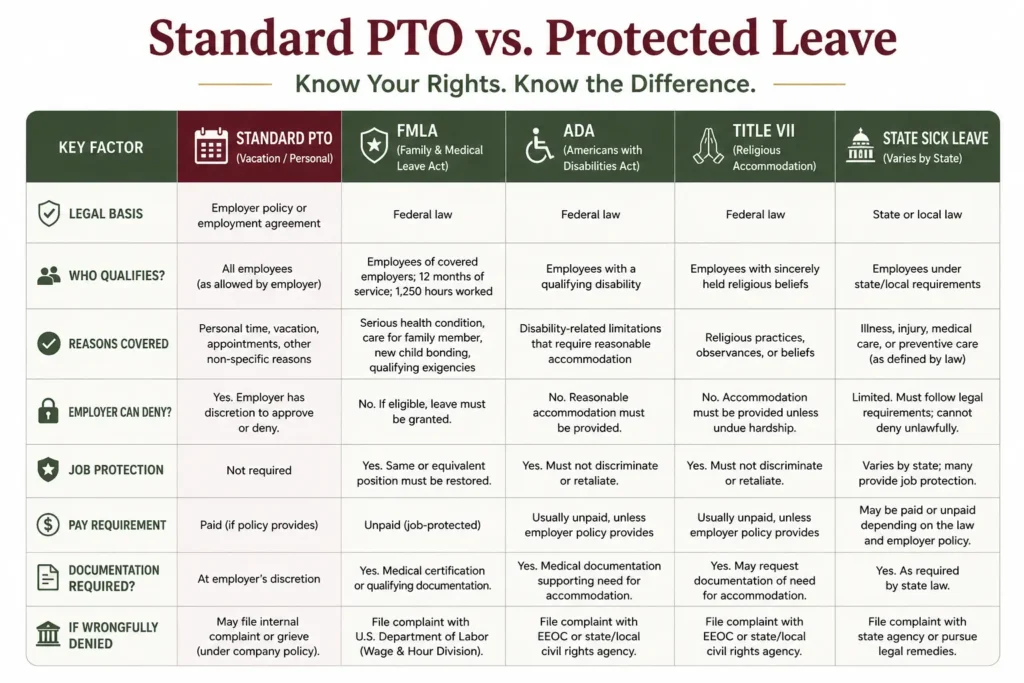
Side-by-side comparison table graphic — “Standard PTO vs. Protected Leave” with columns for FMLA, ADA, Title VII, and State Sick Leave, showing key protections at a glance:
How Do 2026 State Laws Protect My Accrued PTO and Sick Leave?
Federal law sets the floor. State law often builds a much higher ceiling.
Vested Wages vs. Use-It-Or-Lose-It Policies
Most states allow employers to implement use-it-or-lose-it policies — meaning accrued PTO expires at the end of the year if unused. But a handful of states treat accrued PTO as a form of earned wages (called vested wages or deferred compensation). In those states, letting your PTO expire — or refusing to let you use it — can constitute wage theft.
The “Big Four” states with the strongest accrued PTO protections:
| State | Can Employer Use “Use-It-Or-Lose-It”? | Payout at Termination Required? | Notes |
|---|---|---|---|
| California | No | Yes | Accrued PTO = wages. Cannot expire. |
| Colorado | No | Yes | CDLE enforces this strictly |
| Montana | No | Yes | Only state with no at-will employment |
| Nebraska | No | Yes | Written policy controls payout triggers |
If you’re in one of these states and your employer refuses to let you use earned PTO, you may have a wage theft claim with your state labor commission — not just an HR complaint.
The 2026 PFML Rollouts: Minnesota and Maine
Two major Paid Family and Medical Leave (PFML) programs launched in 2026. These are separate from, and often stronger than, FMLA:
- Minnesota PFML (active January 1, 2026): Provides up to 12 weeks of paid leave for medical reasons and up to 12 weeks for family reasons (up to 20 total combined weeks) via the MN Paid Leave program. Employees contribute via payroll tax; employers with 30+ employees must comply.
- Maine PFML (active May 1, 2026): Provides up to 12 weeks of paid leave per year through the Maine Paid Family and Medical Leave program. Covers employees who’ve worked at least 6 months.
If you’re in Minnesota or Maine and your employer denies leave for a qualifying medical or family event, they may be violating state law — not just federal law. These programs come with their own enforcement mechanisms and penalties.
Other states with active paid leave programs as of 2026: California, Colorado, Connecticut, Delaware, Maryland, Massachusetts, New Jersey, New York, Oregon, Rhode Island, Washington, and Washington D.C.
The “Sick Leave Reclassification” Strategy
Here’s a tactic many workers don’t know about. Let’s say your vacation request is denied — but you genuinely fall ill before or during the dates you requested off. In most states with mandatory sick leave laws (and there are now 17 of them), you have the right to call in sick and use protected sick leave, regardless of whether your vacation was approved.
Your employer cannot count protected sick leave against your attendance record. Firing you for using it is illegal retaliation. This is a real legal lifeline if you’re in a state like California, New York, or Illinois.
Practical Case Study: When an Employer Revokes an Already-Approved PTO
The following is a composite scenario based on common fact patterns in employment law disputes.
Meet Daniel. Daniel is a warehouse shift supervisor in Ohio. In March, he submitted a vacation request for the last week of July — his daughter’s first birthday. His manager approved it in writing via email. Daniel bought $1,800 in non-refundable airline tickets and booked a resort.
Two weeks before the trip, his manager emailed: “We have a mandatory inventory audit that week. Your vacation is canceled. You’re needed.”
Daniel went to HR and did four things right:
- He forwarded the original approval email as proof of the commitment.
- He invoked promissory estoppel — a legal doctrine (meaning “a promise the law will enforce”) that applies when you reasonably relied on someone’s promise and suffered real financial harm as a result. His employer made a promise (the approval), he relied on it (bought tickets), and the revocation caused measurable harm ($1,800 loss).
- He requested, in writing, either reinstatement of the approved dates or reimbursement of his losses.
- He documented everything. Every conversation, every email, every date.
Ohio courts have recognized promissory estoppel claims against employers in similar situations. Daniel’s company ultimately reimbursed his travel costs rather than face a formal complaint to the Ohio Civil Rights Commission.
The retaliation piece: After Daniel pushed back, his manager began scheduling him for undesirable shifts and writing him up for minor infractions that had previously gone unaddressed. That’s classic retaliatory behavior — which is independently illegal under Ohio law and potentially under federal law. Daniel documented those changes with dates and filed them with HR. The paper trail protected him.
What Should I Do If My Manager Unfairly Denies My PTO?
Don’t just accept it. Here’s a step-by-step action plan.
Step-by-Step Action Plan
- Review your employee handbook. Look for the exact PTO policy language: blackout periods, accrual rules, the timeline for approval decisions, and what “denied” means officially.
- Identify the real reason for your leave. Medical? Family emergency? Religious observance? If any protected category applies, your path forward changes significantly.
- Request the denial in writing. If your manager verbally denied it, email them: “To confirm our conversation on [date], my PTO request for [dates] has been denied. Could you confirm the reason in writing?” This creates a record and sometimes prompts a reversal.
- Calculate your accrued balance. Know exactly how much PTO you’ve earned. Check your paystub or your HR portal.
- Check your state’s sick leave and PFML laws. If you’re in a covered state, review the specific qualifying conditions.
- Escalate to HR, not just your manager. Frame it as seeking clarification, not making accusations. HR has legal liability too.
- File an external complaint if warranted. DOL Wage and Hour Division (for FMLA violations), the EEOC (for ADA/Title VII violations), or your state labor board (for wage theft or sick leave violations).
Email Scripts to Challenge a Denial
Script 1 — Polite but firm pushback for standard vacation:
Subject: Follow-Up on PTO Request — [Your Name], [Dates]
Hi [Manager’s Name],
Thank you for letting me know about the scheduling conflict. I understand the team has demands during that period. I’ve had this time blocked since [date you submitted]. Given that I’ve been flexible on scheduling throughout the year, I’d like to respectfully ask whether [alternate dates] or a partial approval of [dates] might work. I’m happy to discuss coverage options to make this work for the team. Please let me know.
Script 2 — Legal pivot to formal accommodation request:
Subject: Formal Request for Medical/Religious Leave Accommodation — [Your Name]
Hi [Manager’s Name] and [HR Contact],
I’m following up on the denial of my PTO request for [dates]. I want to formally advise you that this leave is [medically necessary due to a serious health condition / required for a sincere religious observance]. As such, I am requesting a reasonable accommodation under [the ADA / Title VII of the Civil Rights Act]. I’d like to schedule a meeting to discuss this formally. Please confirm receipt of this request.
(Keep a copy of this email. The date you sent it starts the clock on your employer’s obligation to engage in what the law calls an “interactive process.”)
Frequently Asked Questions About PTO Denials
Can I be fired for taking approved PTO?
Generally, no — if your PTO was formally approved in writing, firing you for taking it could constitute a wrongful termination or a breach of contract claim, depending on your state. However, if your employer revoked the approval before you left and you went anyway, your situation is more complex. Document the original approval and consult your state labor board.
Do I have to give a reason for taking PTO?
For standard vacation PTO, most employers do not legally require a reason — but many ask for one in practice. However, if your leave is FMLA-qualifying, you are required to give enough information for your employer to recognize the request may be covered. You don’t have to use the phrase “FMLA” — but you do need to mention that it’s for a serious health condition or qualifying family reason.
Can an employer take away accrued PTO?
It depends on your state. In California, Colorado, Montana, and Nebraska, accrued PTO is treated as earned wages and cannot be taken away or forfeited. In most other states, a use-it-or-lose-it policy in your employee handbook can legally expire unused PTO at the end of the year, as long as the policy was disclosed to you when you were hired.
Does a statute of limitations apply to unpaid vacation time?
Yes. If you’re owed vacation pay that was never paid out (typically at termination), the statute of limitations for wage claims varies by state — generally 2 to 3 years for standard wage claims, and up to 4 years in California. In states where PTO is a wage, the DOL Wage and Hour Division can help you recover it. Act quickly — waiting too long can bar your claim entirely.
What if my employer has fewer than 50 employees?
FMLA only covers employers with 50 or more employees within 75 miles. If your employer is smaller, you do not have federal FMLA rights. However, many states have their own family and medical leave laws that cover smaller employers. California’s CFRA, for example, covers employers with just 5 employees. Check your specific state’s law.
Can my employer change the PTO policy without telling me?
Employers generally can modify PTO policies prospectively (going forward) with proper notice. They typically cannot retroactively take away PTO you already earned under the old policy, especially in vested-wage states. Any change should be communicated in writing and reflected in a new employee handbook.
Can my employer change the PTO policy without telling me?
Employers generally can modify PTO policies prospectively (going forward) with proper notice. They typically cannot retroactively take away PTO you already earned under the old policy, especially in vested-wage states. Any change should be communicated in writing and reflected in a new employee handbook.
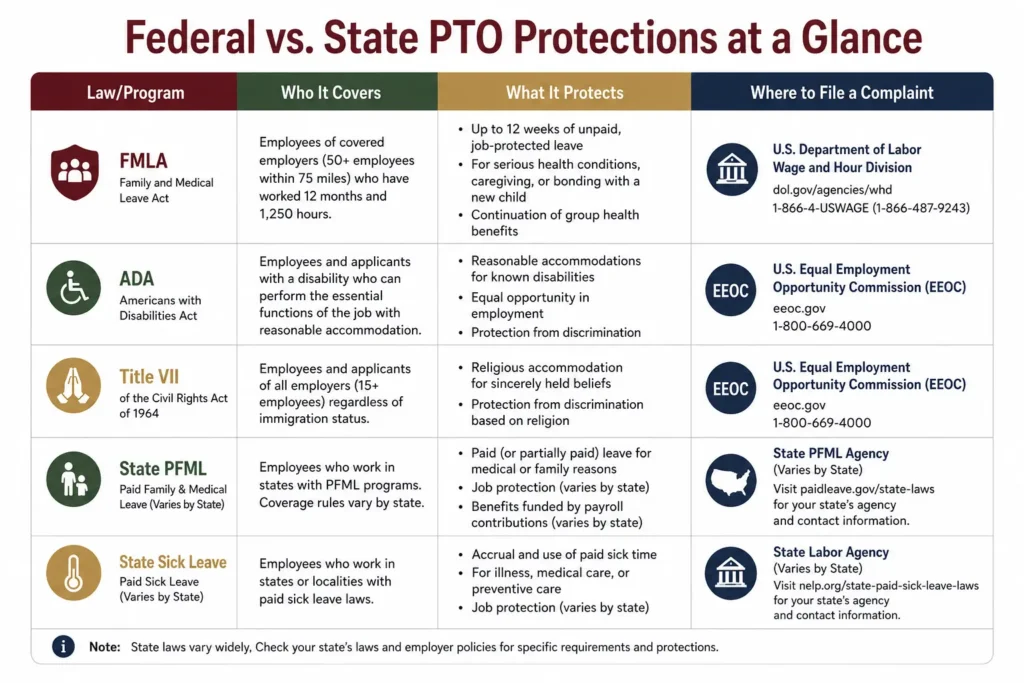
Summary comparison table — “Federal vs. State PTO Protections at a Glance” listing key laws, who they cover, what they protect, and where to file a complaint:
When Do You Actually Need a Lawyer?
Most PTO disputes can be resolved through HR escalation or a state labor board complaint — without an attorney. But consider consulting an employment lawyer if:
- You’ve been fired or demoted after requesting or taking protected leave (that’s retaliation)
- You’re owed significant unpaid vacation wages at termination (a few thousand dollars or more)
- You’re in a protected class and believe the denial is discriminatory — only your requests are being denied, while others in similar roles get approved
- Your employer revoked approved leave after you made financial commitments, and they refuse to discuss reimbursement
- You received a formal disciplinary action for asserting your leave rights
Most employment attorneys offer free initial consultations, and many take wage and retaliation cases on contingency — meaning you pay nothing unless you win. Use the EEOC’s attorney locator or your state bar’s referral service.
Conclusion
Your employer has real authority over your schedule — but that authority has clear legal limits. When standard vacation is denied, document it, check your handbook, and decide whether to push back through HR. When the leave touches a medical condition, a disability, a religious practice, or a qualifying family event, you’re no longer asking for a favor — you’re asserting a right that federal and state law protect.
In 2026, more workers than ever have access to paid leave protections through new state programs in Minnesota, Maine, and a growing list of others. Know your state. Know your accrual balance. Put everything in writing.
You’re not being difficult. You’re being informed. That’s the most powerful tool you have.
This article is for informational purposes only and does not constitute legal advice. Employment law varies by state and individual circumstance. If you believe your rights have been violated, consult a licensed employment attorney or contact your state’s labor board.