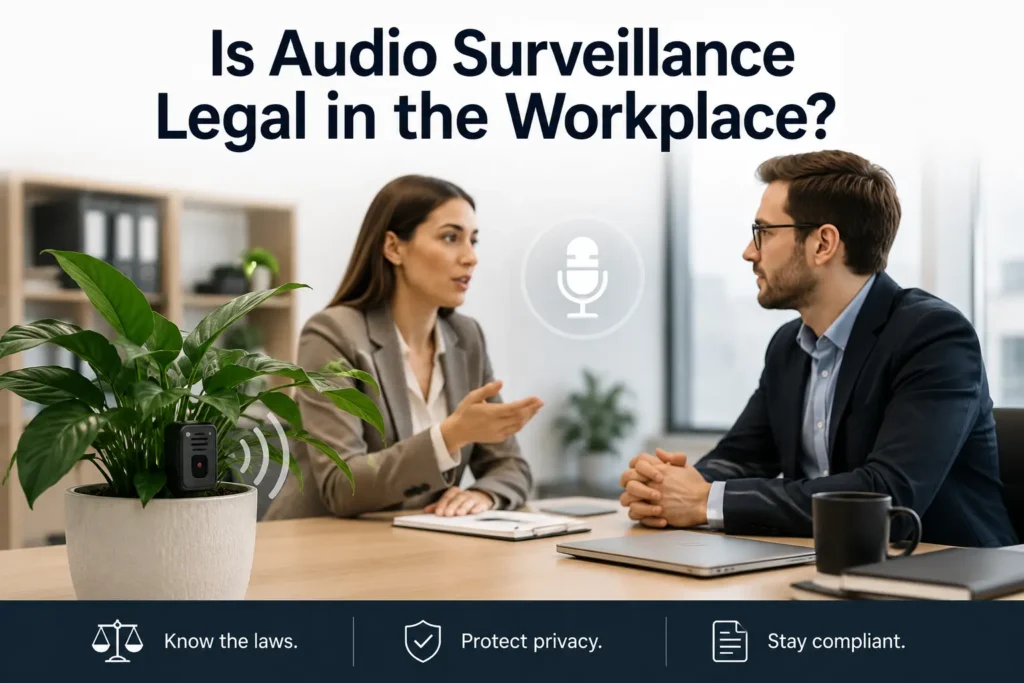
Audio surveillance in the workplace is legal under federal law — but only with proper consent. The federal Electronic Communications Privacy Act (ECPA) allows employers to record workplace conversations if at least one party consents. However, 12 states require everyone on the call to consent. Secretly recording employees in private spaces like restrooms or break rooms is illegal everywhere in the United States.
- Federal law (ECPA) allows workplace audio recording with one-party consent — meaning your employer can record a conversation they are part of.
- 12 states — including California, Florida, and Illinois — require all-party consent. Recording without it is a criminal offense.
- Covert recording in areas where employees have a reasonable expectation of privacy (restrooms, locker rooms) is illegal in every U.S. state.
- The NLRA prohibits employers from using audio surveillance to monitor union organizing, wage discussions, or other protected group activity.
- Employees who secretly record HR or management in a one-party state may not be committing a crime — but can still be fired for violating company policy.
Introduction
If you’ve ever wondered whether your boss can legally put a microphone in the conference room — or whether you can secretly record a conversation with HR — you’re not alone. Questions about audio surveillance in the workplace exploded in 2024–2026 as AI meeting assistants like Zoom Copilot and Otter.ai became standard tools at U.S. companies.
The short answer is: it depends. It depends on your state, the location of the recording, what was being discussed, and who gave consent. This guide walks you through exactly what federal law says, which states have stricter protections, where recording is always off-limits, and what rights you have as an employee if your employer crosses the line.
Is It Legal for Employers to Use Audio Surveillance in the Workplace?
Workplace audio surveillance is legal under federal law, but strictly regulated. The Electronic Communications Privacy Act (ECPA) — specifically the Federal Wiretap Act (18 U.S.C. § 2511) — permits recording if at least one party to the conversation consents. However, state laws vary drastically, and employers who record without proper consent face severe criminal penalties, civil lawsuits, and federal labor law violations.
The Federal Baseline: One-Party Consent Explained
Under federal law, a conversation can be legally recorded if one party to that conversation consents. That “one party” can be the employer themselves.
Here’s what that looks like in practice:
- A manager sits in on a sales call and presses record — that’s legal federally, because the manager is a party to the call.
- An employer installs a microphone in a conference room where they are not present and records employees without notice — that is almost certainly illegal, even under federal law, because no party to that specific conversation has consented.
The ECPA also contains a “business extension exemption” (18 U.S.C. § 2510(5)(a)), which lets employers monitor calls made on company-owned phone systems for legitimate business purposes like quality assurance. But this exemption has limits — once it becomes clear a call is personal, monitoring must stop.
The bottom line: Federal one-party consent sounds permissive, but it does not give employers a blank check. Covert surveillance of conversations they’re not part of, in spaces where employees expect privacy, crosses into wiretapping.
The State-Level Divide: All-Party Consent Laws
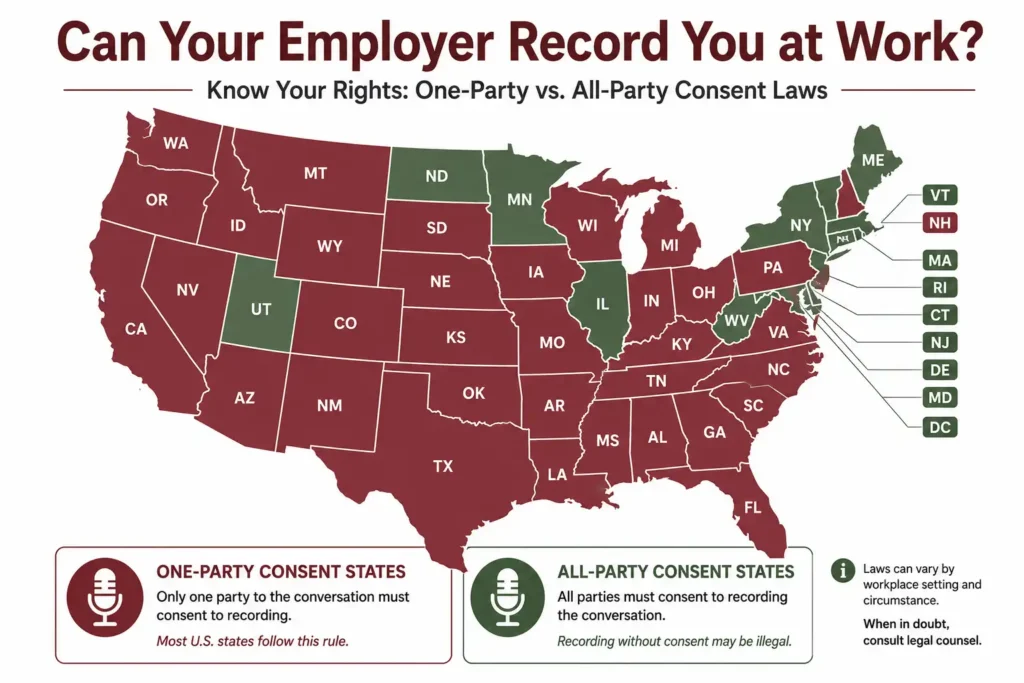
Twelve states go further than federal law and require all-party consent — meaning every single person being recorded must agree before audio can be captured. These states are:
| State | Law | Penalty for Violation |
|---|---|---|
| California | CIPA (Penal Code § 632) | Up to $5,000/violation + civil damages |
| Connecticut | C.G.S. § 52-570d | Criminal + civil liability |
| Delaware | 11 Del. C. § 1335 | Criminal misdemeanor |
| Florida | § 934.03 | 3rd-degree felony |
| Illinois | EAVESDROPPING ACT (720 ILCS 5/14) | Class 4 felony |
| Maryland | Md. Code Ann., Cts. & Jud. Proc. § 10-402 | Felony |
| Massachusetts | M.G.L. c. 272, § 99 | Up to 5 years imprisonment |
| Michigan | M.C.L. § 750.539c | Felony |
| Montana | Mont. Code Ann. § 45-8-213 | Misdemeanor |
| Nevada | N.R.S. § 200.620 | Category D felony |
| New Hampshire | N.H. Rev. Stat. § 570-A:2 | Criminal offense |
| Oregon | O.R.S. § 165.540 | Class A misdemeanor |
| Pennsylvania | 18 Pa. C.S. § 5703 | 3rd-degree felony |
| Washington | R.C.W. § 9.73.030 | Gross misdemeanor |
Note: Washington state is sometimes listed separately. Some sources count 12 states, others 13, depending on how they classify Connecticut and Oregon’s statutes. The practical rule: always assume all-party consent is required unless you have confirmed the state law.
If you or anyone being recorded is in one of these states, everyone must consent before any audio recording begins — full stop.
How Do Remote Work and Cross-State Jurisdictions Affect Eavesdropping Laws?
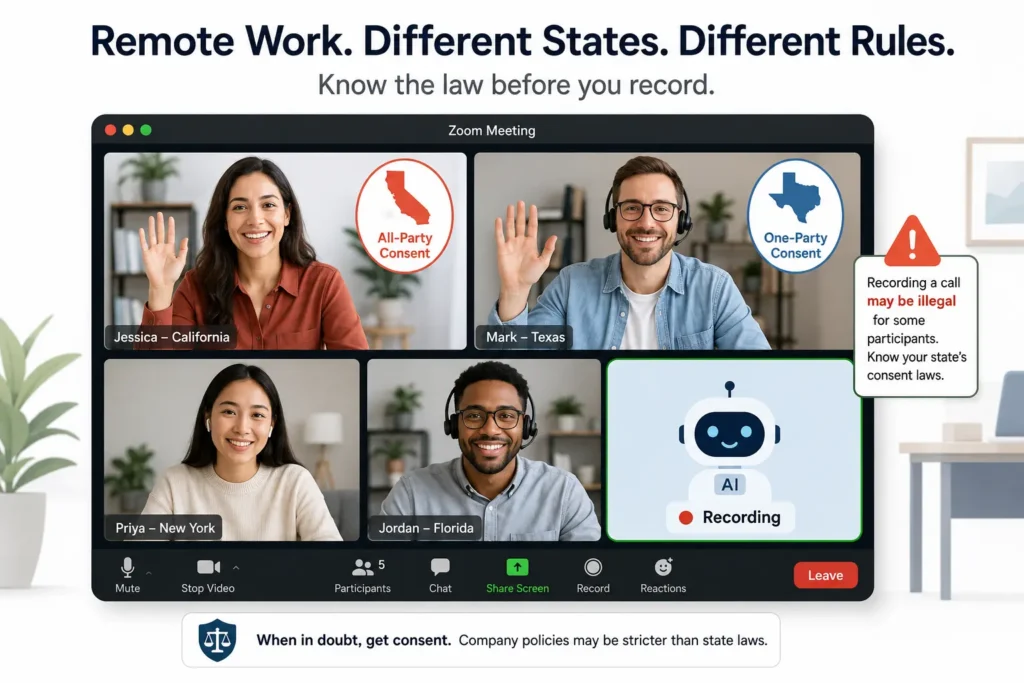
When a recorded call crosses state lines, courts generally apply the strictest state’s privacy law. A manager in Texas (a one-party consent state) who records a Zoom call without telling a remote employee in California (an all-party consent state) is likely committing a felony under California law — even if the manager never steps foot in California.
The Cross-State Jurisdiction Conundrum
The explosion of remote work since 2020 created a legal gray zone that most employers — and most attorneys — haven’t fully figured out yet. Here’s a practical rule of thumb for distributed teams:
Always default to all-party consent compliance across your entire workforce.
Why? Because:
- Litigation risk falls on the employer, not the employee.
- Courts in all-party states have consistently asserted jurisdiction when one party to the call was located within their borders.
- The penalties in all-party states (criminal felonies, $5,000-per-incident civil damages in California) far outweigh the administrative burden of getting written consent up front.
The Risks of AI Meeting Assistants and Automated Transcription
This is where 2025–2026 introduced a brand-new legal minefield.
Tools like Otter.ai, Zoom Copilot, Microsoft Copilot, and Fireflies.ai join your meetings and record, transcribe, and analyze everything said. Most users click “allow” without thinking twice. But deploying these bots in a workplace setting — especially across state lines — raises serious legal risks:
- Voice fingerprinting: Many AI transcription tools process voice patterns to identify speakers. In Illinois and Texas, this may trigger biometric privacy laws (Illinois BIPA — Biometric Information Privacy Act — allows $1,000–$5,000 in damages per violation per person).
- Undisclosed recording: Simply having an AI bot join a meeting without announcing it to all participants may constitute illegal interception in all-party consent states.
- FTC scrutiny: The Federal Trade Commission (FTC) has flagged automated data collection through meeting AI as an emerging consumer protection concern, particularly when employees are not clearly informed.
Best practice: Before using any AI meeting assistant in a work context, send a written disclosure to all participants, confirm their state of residence, and obtain documented consent.
Where Is Covert Audio Surveillance Always Illegal at Work?
Covert recording is universally illegal in spaces where employees have a reasonable expectation of privacy. Regardless of your state’s consent laws, employers cannot place hidden microphones or activate recording devices in restrooms, locker rooms, or changing areas. Beyond physical spaces, secretly recording union-organizing efforts or protected group discussions violates federal labor law.
Defining a “Reasonable Expectation of Privacy”
Courts use this standard to draw the line between where surveillance is acceptable and where it isn’t. Here’s how it breaks down in a workplace context:
Lower expectation of privacy (recording may be permitted with proper notice):
- Sales floor or retail floor
- Building lobby or reception area
- Warehouse production floor
- Call center workstations
High expectation of privacy (recording is prohibited everywhere in the U.S.):
- Restrooms and bathrooms
- Locker rooms and changing areas
- Medical or counseling offices
- Private offices with closed doors (in many contexts)
- Break rooms and lunch rooms (especially in all-party states)
The key factor isn’t always the room — it’s whether a reasonable person would believe they could speak privately in that space. A conversation about medical symptoms in a break room carries a higher expectation of privacy than a sales pitch on the open floor.
The NLRA Exception: Spying on Protected Concerted Activity
Even in states where one-party consent applies and surveillance would otherwise be legal, the National Labor Relations Act (NLRA) draws a hard line.
Section 8(a)(1) of the NLRA makes it an unfair labor practice for an employer to interfere with employees’ rights to organize, discuss working conditions, or engage in collective action. The National Labor Relations Board (NLRB) has ruled repeatedly that:
- Secretly recording employees discussing wages with coworkers violates the NLRA.
- Deploying audio surveillance specifically to identify union organizers is illegal.
- Disciplining employees based on secretly recorded protected activity can trigger reinstatement orders and back pay awards.
Real-world example: In 2023, a regional logistics company in Ohio installed covert audio recorders in a break room after rumors spread about a unionization vote. When discovered, the NLRB ordered the company to cease all surveillance, post notices of employees’ rights, and pay $47,000 in back pay to three workers who were identified and later disciplined based on the recordings.
This isn’t a technicality. The NLRA protection covers discussions about wages, hours, working conditions — basically most of what workers talk about when management isn’t around. If you believe your employer is using audio surveillance to spy on protected activity, you can file a charge with the NLRB at nlrb.gov (Rel: nofollow, opens in new tab; anchor text: “file a charge with the NLRB”).
Can Employees Legally Record Conversations with HR or Management?
In a one-party consent state, an employee who records their own conversation with a manager or HR representative is generally not committing a crime — because they are a party to that conversation and they consent. However, the employer can still fire them for violating a company policy that prohibits unauthorized recording. The criminal law question and the employment law question are completely separate.
Employee-Initiated Recording vs. Company Policy
Here’s the critical distinction most workers miss:
| Question | Answer |
|---|---|
| Is secretly recording HR illegal in a one-party state? | No — you are a party to the conversation. |
| Can your employer fire you for it? | Yes — if your company handbook prohibits recording, they can treat it as insubordination. |
| Is secretly recording HR illegal in an all-party state? | Yes — recording without HR’s knowledge is a crime. |
| Can your employer fire you for it? | Yes, and you may also face criminal charges. |
In at-will employment states (which covers most of the U.S.), your employer doesn’t need a good reason to fire you — they just can’t fire you for an illegal reason (like retaliation for whistleblowing). Violating a no-recording policy is a legal reason to terminate.
The bottom line: Before you hit record on your phone in a meeting with HR, check two things: (1) which state you’re in, and (2) whether your employee handbook has a recording prohibition clause.
Admissibility of Evidence in Wrongful Termination Claims
So you secretly recorded your boss making discriminatory comments. Can you use it?
Maybe — but it’s complicated.
- In one-party consent states, a recording made by a party to the conversation is generally admissible in civil court and in EEOC (Equal Employment Opportunity Commission) or DOL (Department of Labor) investigations.
- In all-party consent states, an illegally obtained recording may be excluded from evidence — and you could face counterclaims.
- Even in favorable states, courts have discretion. A judge may admit the recording but limit how it can be used.
Practical advice: If you believe you’ve experienced discrimination, harassment, or wage theft, document everything in writing (emails, texts, dated notes) alongside any recordings. Written documentation is admissible everywhere. Contact the EEOC at eeoc.gov (Rel: nofollow, opens in new tab; anchor text: “contact the EEOC”) to understand your options before relying solely on a recording as evidence.
Practical Case Study: The Dangers of CCTV Audio and the CIPA
A small retail business in Los Angeles upgraded its security system in 2024 with modern IP cameras. The cameras came with HD audio capability enabled by default. The owner focused on the video feed quality and never thought about the microphones.
Over the next eight months, the cameras in the break room continuously recorded employee conversations — including private discussions about medical issues, personal finances, and wages.
How a $4,000 Camera System Turned Into a $2.1 Million Class-Action
When a former employee discovered the recordings during a wrongful termination dispute, the company was hit with a class-action lawsuit under the California Invasion of Privacy Act (CIPA) (Penal Code § 632).
Under CIPA, each unauthorized recording of a confidential communication carries a civil penalty of up to $5,000 per violation. With 14 employees recorded over eight months — dozens of conversations each — the damages added up fast.
The case settled for $2.1 million in 2025.
What went wrong:
- The owner assumed video-only cameras didn’t record audio.
- Modern security cameras — including popular consumer brands like Ring, Nest, and commercial CCTV systems — often have omnidirectional microphones enabled out of the box.
- There was no posted notice, no consent form, and no policy in the employee handbook.
The fix is simple and takes 10 minutes: Log into your camera’s admin settings and disable audio capture. Most commercial systems allow you to toggle audio off per-camera or system-wide. If you’re unsure how, contact your vendor.
What Are the Best Practices for a Compliant Audio Recording Policy?
Legal compliance requires disabling ambient CCTV microphones by default, securing written consent in the employee handbook, and posting visible signage in any area where active quality-assurance recording takes place. Employers who follow these steps dramatically reduce their legal exposure.
Disabling CCTV Audio by Default
- Audit every camera on your property. Log into each camera’s management console and check the audio settings.
- Disable audio capture on all cameras in non-public areas. This includes break rooms, private offices, and any space where employees gather informally.
- Document the disabling. Keep a log of when audio was disabled, by whom, and on which devices. This is your paper trail if you’re ever accused of unauthorized recording.
- Test annually. Firmware updates can re-enable default settings. Build an annual audit into your IT calendar.
Popular systems where audio should be reviewed: Ring Business, Avigilon, Verkada, Axis, and Hikvision all enable audio by default on some models.
Drafting an Express Consent Policy
Implied consent (the idea that employees “knew” they might be recorded) is a weak legal defense. Express consent — written, signed, and specific — is what holds up in court.
Here’s a checklist for HR:
- Add a clear “Electronic Monitoring and Recording Policy” section to your employee handbook.
- State exactly what may be recorded: phone calls, video meetings, physical locations.
- State the business purpose for recording (quality assurance, compliance training, legal documentation).
- Require employees to sign an acknowledgment during onboarding — a separate signature line, not buried in a general handbook receipt.
- For call center or customer-service environments, post visible signage at workstations: “Calls in this area may be monitored and recorded for quality assurance.”
- For remote employees, include a meeting recording disclosure in your video conferencing policy and obtain written acknowledgment before deploying AI transcription tools.
- Review and update the policy annually, or whenever you adopt new monitoring technology.
Resources: The Department of Labor’s Wage and Hour Division (dol.gov/agencies/whd) (Rel: nofollow, opens in new tab) and the EEOC (eeoc.gov) (Rel: nofollow, opens in new tab) both publish guidance on employee rights related to workplace monitoring.
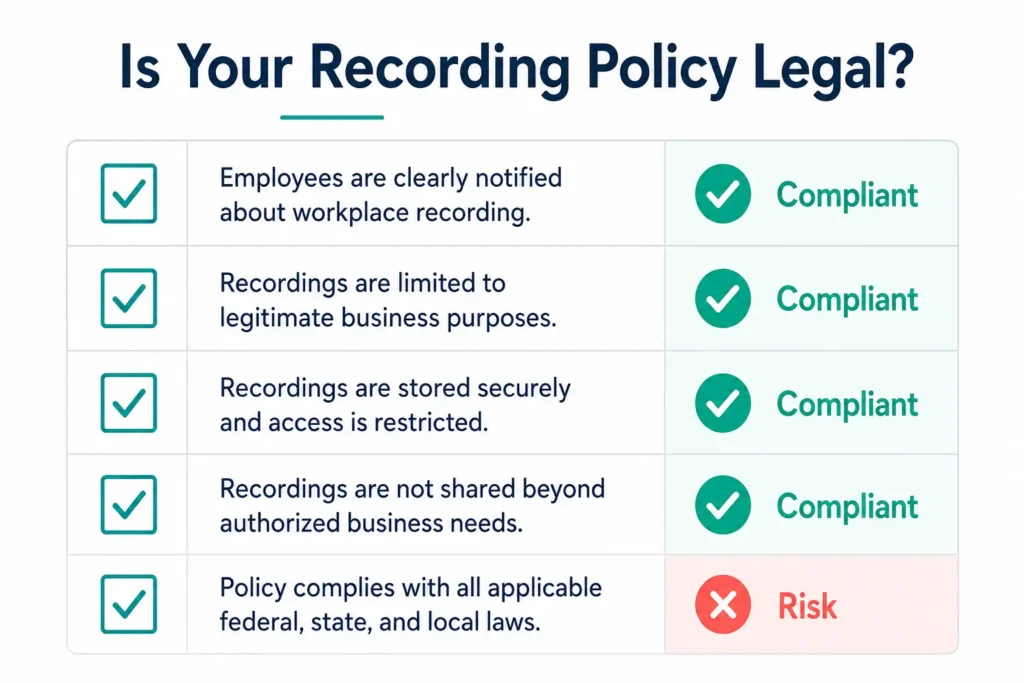
Checklist graphic — Is Your Workplace Recording Policy Legal?
Frequently Asked Questions About Workplace Audio Surveillance
Can my boss record my conversations without me knowing?
Your employer can legally record a conversation they are personally part of in all 50 states under federal one-party consent law. However, a boss who places a hidden microphone in a room and records conversations they are not part of is almost certainly breaking the law — under the Federal Wiretap Act at the federal level, and under stricter state statutes in all-party consent states. Recording in private spaces like restrooms is illegal everywhere.
Is it illegal to record a meeting at work?
Recording a work meeting is legal in one-party consent states if the person doing the recording is participating in the meeting. In all-party consent states — including California, Florida, Illinois, Pennsylvania, and Washington — recording a meeting without the knowledge and consent of every participant is a criminal offense, regardless of whether you’re an employer or an employee.
Can I sue my employer for recording me without permission?
Yes. If your employer recorded you in violation of a state wiretapping statute, you may have a civil claim for damages. California’s CIPA allows up to $5,000 per violation plus actual damages. Pennsylvania, Florida, and Illinois offer similar civil remedies. You may also have a separate claim under the NLRA if the recording targeted protected concerted activity like wage discussions or union organizing.
Are audio recordings allowed on CCTV security cameras?
Standard security cameras with audio capability are legal in public-facing areas (lobbies, parking lots) where employees and visitors have low expectations of privacy, provided your state does not require all-party consent. Audio recording is never legal in restrooms, locker rooms, or changing areas. Many modern security cameras enable audio by default — employers who fail to disable this in private or semi-private areas face significant civil and criminal liability.
What should I do if I think my employer is illegally recording me?
Document your suspicion. Write down dates, locations, and any physical evidence you noticed (unusual devices, blinking lights, unfamiliar wiring). Do not tamper with any device you find. You have three options: (1) file a complaint with your state’s attorney general, (2) contact the NLRB if you believe the surveillance targets protected union or wage-related activity, or (3) consult an employment attorney — many offer free consultations and take wiretapping cases on contingency.
Does the ECPA protect remote workers on personal devices?
The ECPA’s protections extend to electronic communications, including calls and video conferences made on personal devices. An employer generally cannot record an employee’s personal phone calls, even during work hours, without consent. However, communications made on company-owned devices or platforms (like a corporate Zoom account) may be subject to employer monitoring under the business extension exemption — particularly if the employee was notified in writing.
Can an employer use AI tools to transcribe and analyze my conversations?
Yes, in states and circumstances where consent requirements are met. Employers who deploy AI meeting assistants must disclose their use and obtain appropriate consent — especially in all-party states and for workers whose voice data may be processed by biometric privacy laws (Illinois BIPA, Texas CUBI). Undisclosed use of AI transcription tools in an all-party consent state likely constitutes illegal interception under state wiretapping law.
When Do You Actually Need a Lawyer?
Most workers can understand their rights from a guide like this. But there are situations where you genuinely need legal representation:
- You’ve found evidence of hidden recording devices in private areas of your workplace.
- You were fired shortly after raising concerns about surveillance — this could be retaliation.
- You’re in an all-party consent state and believe you have been recorded without consent.
- Your employer used recordings to discipline you for protected activity (wage discussions, union organizing).
- You’re considering secretly recording HR and want to understand your specific legal exposure.
Many employment attorneys offer free initial consultations and handle wiretapping cases on contingency (meaning they only get paid if you win). The National Employment Law Project (nelp.org) (Rel: nofollow, opens in new tab; anchor text: “National Employment Law Project”) can help you find low-cost legal resources in your state.
Conclusion
Is audio surveillance legal in the workplace? It can be — but the line between legal monitoring and illegal eavesdropping is razor-thin, and the consequences for crossing it are severe.
Here’s what to remember:
- Federal law allows one-party consent recording. Your employer can record calls they’re part of.
- Twelve or more states require all-party consent. Anything less is a felony.
- Covert recording in private spaces is illegal everywhere — no exceptions.
- The NLRA protects your right to discuss wages and organize without surveillance.
- Remote work makes this more complex, not less. Cross-state calls default to the strictest law.
If you’re an employee who suspects illegal surveillance: document, report, and talk to an employment attorney before confronting your employer directly.
If you’re an employer or HR professional reading this: the cheapest thing you’ll ever do is disable your break-room camera’s audio settings today and add a signed recording policy to your onboarding packet tomorrow.
Questions? Bookmark this page and check back — we update it as laws change. And if this guide helped you, share it with a coworker who needs it.
This article is for informational purposes only and does not constitute legal advice. Employment law varies by state and individual circumstances. Consult a licensed attorney in your jurisdiction for advice specific to your situation.