
If you just woke up with a fever, handed your manager a medical certificate, and were told your job is terminated anyway, you are likely sitting in the dark at midnight, scared, angry, and asking: can you be fired for being sick with a doctor’s note?
Let’s clear up a painful corporate myth right now. Many workers believe a doctor’s note is a magical legal shield that makes them bulletproof. Legally speaking, it is not. But that does not mean your boss holds all the cards. While the at-will employment doctrine gives companies wide latitude, federal and state laws strictly prohibit firing you for medical conditions protected by statute. Let’s unpack the hard truths, expose corporate attendance traps, and show you how to defend your rights.
Can your employer legally fire you if you have a doctor’s note?
Generally, yes, unless protected by specific laws. Under the At-Will Employment Doctrine, employers can fire workers for missing shifts. A Doctor’s Note verifies an illness, but federal and state laws like the FMLA and ADA provide the actual legal protection against Wrongful Termination.
Why a doctor’s note is not a magic legal shield under at-will employment
In 49 states, your job is governed by the at-will employment doctrine. This means your employer can terminate your employment at any time, for almost any reason—or even no reason at all—unless it violates a specific law.
Many workers assume that handing over a doctor’s note / medical certification forces a company to excuse their absence. Under pure federal at-will rules, it does not. A medical note is simply a piece of paper verifying that you saw a healthcare provider; by itself, it does not override a company’s internal attendance guidelines unless an overarching federal or state statute steps in to shield you.
When federal and state laws override company attendance policies
While at-will employment gives employers broad powers, statutory employment laws act as an absolute ceiling over company policy.
If your illness qualifies under major federal safety nets—or if your local municipality enforces strict medical leave mandates—your employer’s internal rules cannot touch you. When federal law protects your medical absence, firing you crosses the line into illegal wrongful termination, opening the company up to heavy legal liability.

Why do “no-fault” attendance policies trap sick workers?
Many companies use a Neutral Attendance Policy / No-Fault Attendance system that assigns points for every missed shift, regardless of medical excuses. While these policies seem fair on paper, they frequently violate state sick leave protections when used to punish verified medical absences.
How point-based attendance systems violate state sick leave protections
Have you ever worked at a company that uses a point system? Call in sick? That’s 1 point. Leave early with a fever? That’s 0.5 points. Accumulate 6 points, and you are automatically fired.
These neutral attendance policies (no-fault attendance) are designed by corporate HR teams to look completely unbiased. However, when companies use rigid point systems to penalize workers who submit legitimate medical documentation, they often run headfirst into state and local state paid sick leave laws. In 2026, over 20 states and dozens of municipalities legally bar employers from counting protected sick days toward attendance disciplinary points.
Defeating pretextual terminations disguised as attendance violations
Employers rarely admit they are firing you because you have a chronic illness or took medical leave. That would invite an immediate lawsuit.
Instead, they rely on pretextual termination. They use a minor attendance infraction or point accumulation as a fake excuse to mask an illegal firing. If you can prove that management selectively enforced their attendance rules only after you submitted a doctor’s note or disclosed a health condition, their defense crumbles in front of regulatory investigators.
| Attendance Policy Type | Legal Status | Can You Be Fired for Sick Days? |
| Strict No-Fault Point System | Legal in theory, but restricted by state law. | Yes, unless the absence is protected by FMLA, ADA, or state sick leave mandates. |
| State-Protected Sick Leave | Strictly regulated by state/city statutes. | No. Penalizing verified sick days violates local labor statutes. |
| Pretextual Attendance Firing | Illegal discrimination / retaliation. | No. Using attendance rules to mask medical discrimination is unlawful. |
What specific medical details must be in your doctor’s note to trigger legal protection?
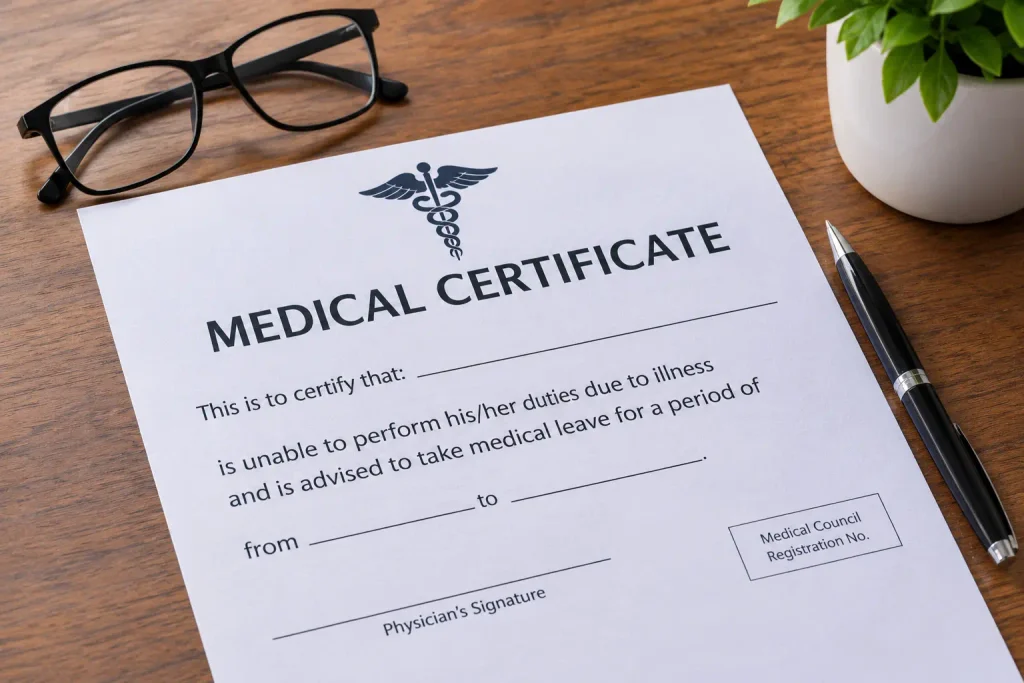
A generic prescription-pad note often fails to protect you. To trigger legal safeguards, your healthcare provider must document specific Functional Limitations, the expected duration of absence, and outline the medical necessity for leave during the mandatory Interactive Process with HR.
Avoiding the trap of vague medical notes and incomplete documentation
If your doctor scribbles “Patient may return to work on Monday” on a tiny prescription slip, you are walking into a trap. HR departments and corporate legal teams frequently reject vague notes because they lack actionable compliance data.
To secure true job protection for extended medical leave / sick leave, your doctor’s note must go beyond a simple confirmation of illness. It needs to establish a clear medical timeline, verify that the condition prevents you from performing your core job duties, and provide an expected recovery window.
Initiating the interactive process with your employer
When you submit a thorough medical note for a serious or ongoing condition, your company cannot simply ignore it. They are legally required to engage in the interactive process—a good-faith dialogue between employer and employee.
During this conversation, HR and management must discuss your medical needs, review your doctor’s recommendations, and determine what adjustments or leave time can be provided without causing an undue burden to the business.
What federal and state laws prevent employers from firing sick workers?
When health crises strike, federal safety nets protect your job. The Family and Medical Leave Act provides unpaid leave for serious conditions, while the Americans with Disabilities Act mandates medical accommodations enforced by the Equal Employment Opportunity Commission.
Utilizing the Family and Medical Leave Act (FMLA) and ADA accommodations
When an illness is severe or chronic, federal statutes step in to shield your livelihood.
- Family and Medical Leave Act (FMLA): If you work for an employer with 50+ employees and have worked there for at least a year, the FMLA grants you up to 12 weeks of unpaid, job-protected leave per year for serious health conditions. Firing you while on approved FMLA leave is a direct federal violation.
- Americans with Disabilities Act (ADA): If your company has 15 or more employees, the ADA protects workers with qualifying physical or mental impairments. Under ADA guidelines, granting a temporary medical leave of absence is often recognized as a mandatory reasonable accommodation.
Understanding medical privacy boundaries and employer overreach
When you submit a doctor’s note, your employer does not have absolute rights to your personal medical history.
Under strict medical privacy / confidentiality standards enforced by federal and state regulations, your boss cannot demand your exact diagnosis, medical history, or treatment notes unless it is strictly necessary to evaluate your leave request. Overly aggressive demands from managers probing into private health details frequently violate federal civil rights protections.
Practical Case Study: Overturning a wrongful termination after a medical leave
Consider an administrative assistant fired under a point-based policy after submitting a doctor’s note for surgery recovery. Her employment attorney proved it was a pretextual termination, forcing the company to reverse the firing and full back wages.
Let’s look at how this plays out in the real world. Sarah worked as an administrative coordinator at a mid-sized financial firm. After undergoing a scheduled minor surgery, she provided HR with a formal doctor’s note requiring two weeks of strict medical rest.
Two days after returning to work, Sarah was terminated. Management claimed she had crossed the threshold of their no-fault attendance policy because her pre-surgery sick days pushed her past her point limit. Sarah contacted an employee rights advocate. Her attorney subpoenaed company records and proved that male employees with non-medical attendance infractions were routinely granted grace periods, whereas Sarah was strictly targeted immediately following her medical leave. Facing an open-and-shut discrimination case under the ADA and state sick leave statutes, the company folded, reversed the termination, and paid Sarah full back wages.
Frequently Asked Questions (FAQ) About Doctor’s Notes and Job Security
Being sick at work brings heavy anxiety about job security. Below, we answer critical questions about medical notes, employer privacy limits, and your rights under state sick leave statutes.
Can my boss demand my exact medical diagnosis and health history?
Generally, no. While employers can ask for functional limitations and return-to-work dates, demanding your full medical diagnosis or private health history violates federal privacy guidelines and ADA boundaries.
What should I do if my employer rejects a valid medical excuse?
Document everything in writing. Send an email to HR summarizing your medical situation, attaching your doctor’s note, and requesting clarification on why the valid medical excuse was rejected under company policy or state law.
How many sick days am I legally allowed to take under federal law?
There is no universal federal limit for basic sick days. Federal law provides 12 weeks of unpaid leave strictly through the FMLA for qualifying serious health conditions at larger companies, while other days are governed by state mandates and company policy.
Disclaimer: The information provided on this website does not, and is not intended to, constitute legal advice. All information, content, and materials available on this site are for general informational and educational purposes only. Laws regarding employment and labor rights frequently change, and while we strive to keep our content updated, the information on this website may not constitute the most up-to-date legal or other information.
Use of, and access to, this website or any of the links or resources contained within the site do not create an attorney-client relationship between the reader, user, or browser and the website authors, contributors, or its owners. We are an independent publishing platform, not a law firm.
Readers of this website should contact a qualified employment attorney in their specific state to obtain advice with respect to any particular legal matter. No reader or user of this site should act or refrain from acting on the basis of information on this site without first seeking legal advice from counsel in the relevant jurisdiction. Only your individual attorney can provide assurances that the information contained herein – and your interpretation of it – is applicable or appropriate to your particular situation.
Know your rights.
References & Official Legal Resources
Do not let an employer intimidate you with unlawful attendance policies or wrongful terminations. Verify your statutory rights regarding medical leave, disability accommodations, and statutory protections through these official federal channels:
-
U.S. Equal Employment Opportunity Commission (EEOC) – Disability Discrimination Guidance:
Review how federal civil rights laws protect workers with medical conditions, govern medical inquiries, and require reasonable workplace accommodations at the EEOC ADA Guidance Portal. -
U.S. Department of Labor (USDOL) – Family and Medical Leave Act (FMLA):
Explore federal regulations, employee eligibility requirements, and job-protected leave standards for serious health conditions via the USDOL FMLA Compliance Center. -
U.S. Department of Labor – State Labor Offices Directory:
Locate your specific state department of labor to review local paid sick leave statutes, employee rights, and state-specific protections at the USDOL State Labor Office Directory. -
U.S. Equal Employment Opportunity Commission – Medical Inquiries:
Examine federal rules explaining what medical documentation employers are legally permitted to request when you take sick leave, under the EEOC Medical Examination and Inquiry Standards.
keywords: can you be fired for being sick with a doctors note, does a doctors note protect your job, fired for missing work with medical excuse, can you be fired for being sick with a doctors note, no fault attendance policy sick leave, ada medical leave reasonable accommodation, can an employer reject a doctors note, wrongful termination for medical reasons