
If you recently compared paychecks with a coworker and your manager pulled you into a tense meeting or fired you the next day, you are likely terrified, angry, and frantically searching the internet at midnight asking: can you get fired for discussing wages?
Let’s clear this up immediately. In most private-sector American workplaces, the answer is a hard no. Corporate America loves to pretend that salaries are top-secret information, but federal law guarantees your right to talk about money. When employers punish salary transparency, they are committing illegal Workplace Retaliation. Let’s break down your federal protections, expose common corporate traps, and map out your path to justice.
Can your boss legally fire you for discussing your salary at work?
Generally, no. Under Section 7 of the National Labor Relations Act, most private-sector employees have a federally protected right to engage in Wage Discussions. Firing you for comparing paychecks constitutes illegal Workplace Retaliation and an Unfair Labor Practice under federal labor law.
How the National Labor Relations Act (NLRA) protects your right to talk about pay
The foundational shield protecting your paycheck conversations is Section 7 of the National Labor Relations Act (NLRA). Enforced by the National Labor Relations Board (NLRB), this federal law states that private-sector workers have the right to join together for mutual aid or protection.
Comparing your salary with a coworker is legally defined as Protected Concerted Activity. You do not need to be in a union for this law to protect you. Whether you are talking at the watercooler, texting on a weekend, or comparing pay stubs in the breakroom, federal law treats salary transparency as an essential worker right.
Why Pay Secrecy Policies and corporate gag orders are completely illegal
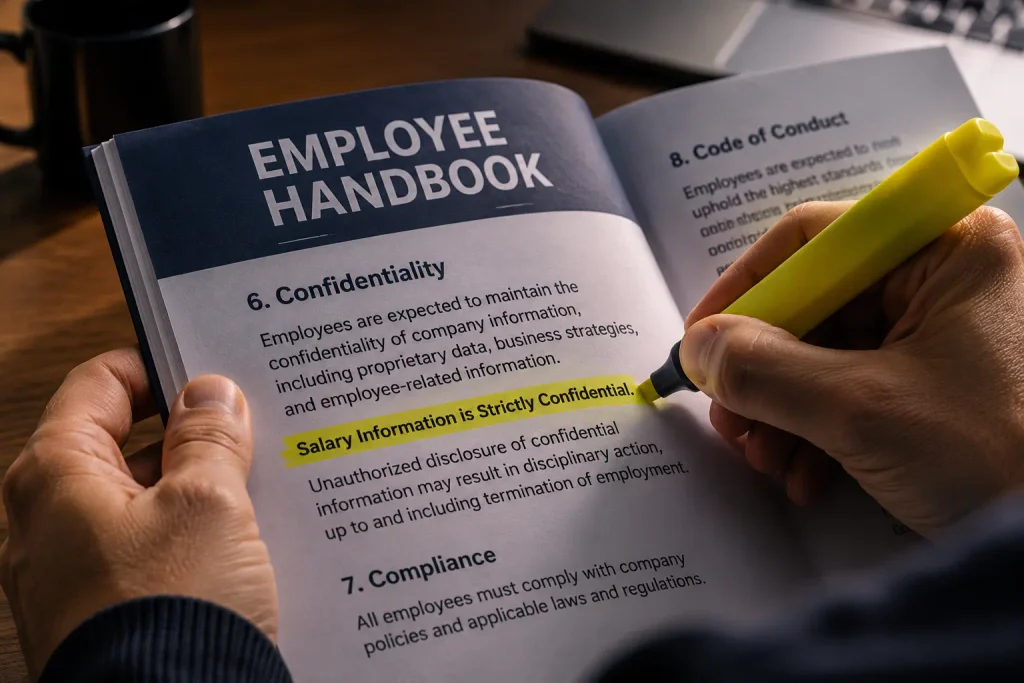
Look closely at your employee handbook. Does it say that wages are “confidential” or that discussing your pay with coworkers will result in immediate termination?
If it does, that handbook clause is completely illegal and unenforceable. Under NLRB enforcement guidelines, maintaining Pay Secrecy Policies or forcing workers to sign broad Non-Disclosure Agreements (NDAs) / Confidentiality Clauses that ban salary talks violates federal labor law. An employer cannot draft a rule that strips away your statutory rights under the NLRA.
How do employers use the “productivity pretext” to mask wage retaliation?
Employers rarely admit they are firing you for talking about pay. Instead, they use a Pretextual Firing, claiming you were disciplined for “disrupting productivity” or “talking on the clock.” If they only punish wage talks, this excuse is legally invalid.
The Slack and Microsoft Teams digital surveillance loophole
In 2026, corporate tracking has evolved. Many companies use aggressive Digital Surveillance / Chatroom Monitoring software on platforms like Slack, Microsoft Teams, or internal company email to flag keywords like “salary,” “raises,” or “pay”.
If management singles you out because an algorithm caught you discussing compensation in a private team chat, they are violating federal law. Monitoring employee communications to suppress wage transparency or isolate workers who engage in protected concerted activity is a direct violation of federal labor rules.
Separating watercooler chats from actual workplace disruption
Employers often try to defend a firing by claiming your conversation “disrupted the business.”
Here is the legal standard: you have a right to discuss wages during non-working times (like lunch breaks, rest periods, or before and after your shift). If you are chatting about pay while actively ignoring customers or abandoning critical assembly-line duties, an employer can discipline you—but only if they strictly enforce that productivity rule for all non-work chatter. If they only punish you because the topic happened to be salaries, it is an illegal retaliatory trap.
Are there exceptions where employees can legally be disciplined for discussing pay?
Yes. The NLRA does not protect everyone. Supervisors, true managers, independent contractors, and public-sector employees are generally excluded. Furthermore, a Payroll Exception applies if your job gives you routine access to confidential payroll data and you misuse that access.
Understanding the Payroll Exception and administrative access boundaries
There is a narrow exception to salary transparency rules known as the Payroll Exception.
If your specific job position requires you to handle sensitive company finances, human resources files, or payroll administration, you are held to a higher standard. If you use your administrative access to snoop on executive salaries or leak confidential company payroll records outside your job duties, your employer can legally discipline you. However, if you are a standard employee simply discussing your own pay or comparing notes with a peer, this exception does not apply to you.
Supervisors, managers, and independent contractors: Who is excluded?
Not every worker falls under NLRA protections. Federal labor laws explicitly exclude certain categories:
- Supervisors and Managers: If you have the authority to hire, fire, discipline, or independently direct other workers, you are classified as management and lack Section 7 protections.
- Independent Contractors: True 1099 independent contractors are independent businesses under the law, meaning they do not share employee collective bargaining protections.
- Public-Sector Workers: Federal, state, and local government employees are governed by civil service laws and state statutes rather than the private-sector NLRA. (Though many public entities have independent state transparency laws protecting wage talks).
| Worker Category | Protected Under NLRA Section 7? | Can Legally Discuss Wages? |
| Hourly / Salaried Staff | Yes | Yes (Fully protected federal right). |
| HR / Payroll Personnel | Conditional | Yes, unless they illegally snoop or leak files. |
| Supervisors & Managers | No | No (Excluded from NLRA scope). |
| Independent Contractors | No | Governed by contract law, not labor law. |
What should you do if you are retaliated against or fired for discussing wages?
If you are punished for comparing pay, document everything immediately. Save text messages, emails, and witness names. You have a strict six-month deadline to file an Unfair Labor Practice charge with the National Labor Relations Board to seek back pay.
Filing an Unfair Labor Practice (ULP) charge with the NLRB
If your employer crosses the line and fires you for salary transparency, you do not have to accept it. You can fight back by filing a formal Unfair Labor Practice (ULP) charge against the company.
This administrative complaint triggers an investigation by federal labor officials. The agency will review your termination timeline, interview witnesses, and examine whether the company’s stated reason for firing you was a fake excuse designed to mask illegal retaliation.
Navigating the strict six-month statute of limitations
Time is working against you. Under federal labor law, there is a strict Statute of Limitations. You only have six months from the exact date of the retaliatory firing or discipline to file your ULP charge with the federal board. If you wait past the six-month mark, you permanently lose your right to seek federal relief.

Practical Case Study: Overturning a retaliatory firing for salary transparency
Consider a remote customer service rep who discussed her hourly rate on a private Slack channel. When fired for ‘unauthorized software use,’ her attorney proved it was a pretextual firing, securing full Back Pay and Interest through an NLRB settlement.
Let’s look at how this plays out in the real world. Jessica worked as a remote customer service specialist. After discovering a male coworker with identical duties made $4 an hour more, she messaged him on a private corporate chat channel to discuss the pay disparity. Two days later, management fired Jessica, claiming she violated company policy by using internal chat tools for “non-work communications.”
Jessica knew her rights. She contacted an employment advocate and filed a ULP charge before the six-month deadline expired. Investigators proved the company selectively enforced its chat policy only against Jessica after she brought up pay. Facing heavy federal penalties, the company folded and agreed to a settlement, paying Jessica full Back Pay and Interest for the wages she lost while unemployed.
Frequently Asked Questions (FAQ) About Wage Discussions and Retaliation
Navigating pay transparency at work can bring heavy employer pushback. Below, we answer critical questions about salary sharing on social media, handbook gag clauses, and your rights under federal labor law.
Can my boss fire me for posting my salary on social media?
Yes, you are protected. Online wage discussions on platforms like Facebook, X, or LinkedIn count as Protected Concerted Activity. If your post invites coworkers to discuss pay or working conditions, firing you for it violates federal labor law.
Are employers allowed to put pay secrecy rules in employee handbooks?
No. Any handbook rule, confidentiality agreement, or written policy that explicitly bans salary discussions or punishes workers for comparing pay is completely illegal and violates federal statutes.
What financial remedies can I recover if I win an NLRB case?
If the board finds your employer guilty of unlawful retaliation, you can recover full Back Pay and Interest for every dollar lost during your unemployment, compensation for out-of-pocket expenses, and an official order requiring the company to post a notice admitting they violated federal law.
References & Official Legal Resources
Do not let an employer intimidate you into silence with illegal threats. Verify your statutory rights regarding pay transparency, concerted activity, and formal complaints through these official federal channels:
-
National Labor Relations Board (NLRB) – Wage Discussions Portal:
Review your protected federal rights regarding salary transparency and concerted activity under Section 7 at the NLRB Wage Discussion Guidelines. -
National Labor Relations Board – Filing a Charge:
Access official instructions, forms, and timelines required to file an Unfair Labor Practice charge within the six-month window via the NLRB Charge Filing Portal. -
Worker.gov – Pay Discussion Rights:
Explore federal summaries detailing employee rights to ask about, disclose, or discuss compensation without facing workplace discrimination or retaliation at the Worker.gov Pay Disclosure Guide. -
U.S. Department of Labor (USDOL) – Employee Rights:
Examine broad federal labor protections, collective bargaining standards, and worker advocacy resources under the USDOL Addressing Wages and Working Conditions Portal.
keywords: can you get fired for discussing wages, is it illegal to discuss salary at work, keywords: can you get fired for discussing wages, can you get fired for discussing wages, is it illegal to discuss salary at work, pay secrecy policies illegal, can you get fired for discussing wages, retaliation for talking about pay, nlrb unfair labor practice charge, protected concerted activity salary