
Yes — non-compete agreements, also called restrictive covenants, are enforceable in most states in 2026, but only if they pass a strict “reasonableness test,” meet any applicable 2026 statutory salary threshold, and don’t violate a state-specific ban. There is no federal law that voids non-competes nationwide. Whether yours holds up depends almost entirely on which state’s law applies to your job, not on federal policy.
That single fact trips up more workers than almost anything else in employment law. You’ve probably heard that “the government banned non-competes.” That’s only half true, and the half that’s missing could cost you your next job offer if you get it wrong.
Here’s what you’ll learn in this guide: exactly what happened to the federal non-compete ban, how your state’s law treats your specific agreement, what courts look at when deciding whether to enforce a non-compete, what happens if you’re fired or you breach one anyway, and when it’s time to actually call an employment lawyer.
Key Takeaways
- Non-compete agreements are enforceable in most U.S. states in 2026, but only if they pass a strict “reasonableness” test and, in some states, meet a minimum salary threshold.
- The FTC’s proposed nationwide ban on non-competes is dead — the agency dropped its appeal in September 2025, and enforcement now happens state by state.
- Four states — California, Minnesota, North Dakota, and Oklahoma — ban nearly all employee non-competes outright.
- Getting fired does not automatically void your non-compete, but it can open up strong legal defenses.
- Even where a non-compete is unenforceable, your NDA and non-solicitation clauses usually still apply.
Did the FTC Ban Non-Competes, or Are They Still Legal in 2026?
Non-competes are still legal in 2026. The Federal Trade Commission (FTC) officially abandoned its appeal defending a nationwide non-compete ban in September 2025, meaning the rule will never take effect. The FTC has instead shifted to case-by-case enforcement, going after specific employers it believes are abusing restrictive covenants under Section 5 of the FTC Act, which prohibits “unfair methods of competition.”
Here’s the timeline, because the back-and-forth is exactly why so many workers are confused:
- April 2024: The FTC finalized a rule that would have banned almost all new and existing employee non-competes nationwide.
- August 2024: A federal judge in Texas blocked the rule before it ever took effect, ruling the FTC had exceeded its authority.
- October 2024: The FTC appealed that ruling.
- September 2025: Under new leadership, the FTC voluntarily dropped its appeal, effectively killing the nationwide ban for good [FTC Press Release].
The day before it dropped the appeal, the FTC filed an enforcement action against a national pet-cremation company accused of forcing broad non-competes on nearly all of its employees, from executives down to hourly workers [Federal Trade Commission]. That case signals where federal policy is actually headed: not a blanket ban, but targeted lawsuits against employers whose non-competes look abusive. The National Labor Relations Board (NLRB) has separately taken the position that overly broad non-competes can violate employees’ rights to organize and discuss working conditions, though this guidance continues to evolve.
Bottom line: the federal ban is off the table. Your rights now come almost entirely from state law.
How Do State Laws and 2026 Statutory Salary Thresholds Affect Enforceability?
Because there’s no federal ban, enforceability depends on where you work. State law falls into three buckets.
The Ban States (California Business and Professions Code Section 16600)
Four states have banned nearly all employee non-competes, full stop, regardless of salary, job title, or what you signed:
- California — Business and Professions Code Section 16600 voids virtually all post-employment non-competes, even ones signed out of state if you now work in California.
- Minnesota
- North Dakota
- Oklahoma
If you live and work in one of these four states, your non-compete is almost certainly unenforceable, no matter what it says or how much money you make. Employers sometimes still put non-competes in contracts hoping employees won’t know their rights — don’t let that intimidate you.
The 2026 Statutory Salary Threshold States
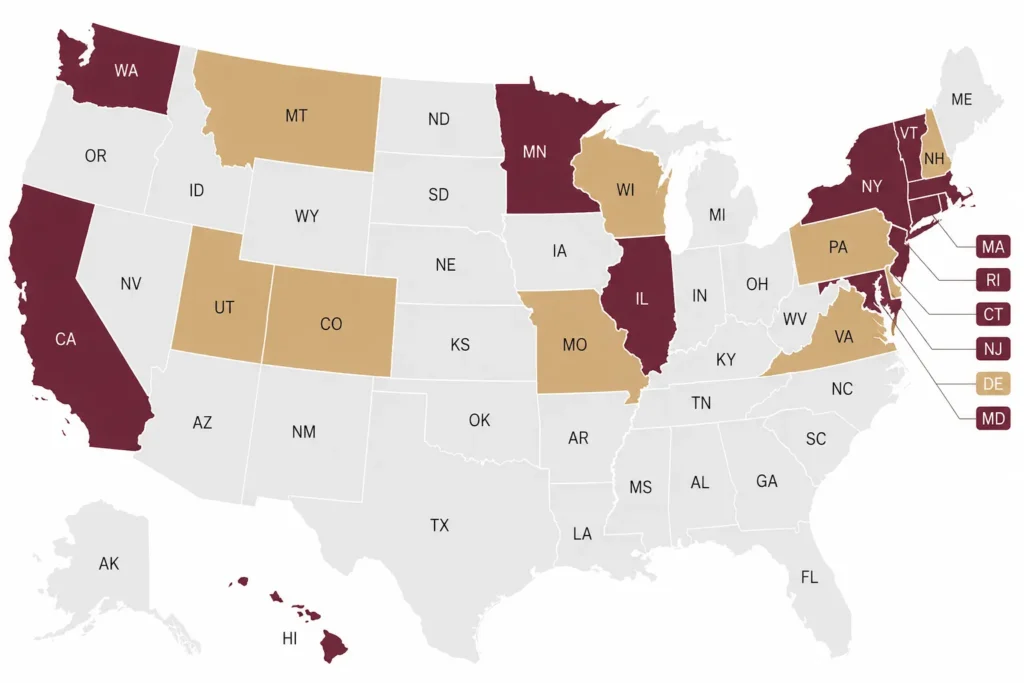
A larger group of states allow non-competes, but only against employees who earn above a set dollar amount. If you earn less than the threshold, your non-compete is void even if you signed it willingly. These thresholds rise every year, and the 2026 numbers are:
| State | 2026 Non-Compete Salary Threshold | Adjusts Annually? |
|---|---|---|
| Washington, D.C. | $162,164 | Yes |
| Colorado | $130,014 (non-solicit: $78,008.40) | Yes |
| Washington State | $126,858 (contractors: $317,147) | Yes |
| Oregon | $119,541 | Yes |
| Virginia | ~$78,365 (based on state average weekly wage) | Yes |
| Maine | $63,840 | Yes |
| Illinois | $75,000 (non-solicit: $45,000) | No (fixed) |
| Maryland | $49,920 (effective July 2026) | Yes |
| Rhode Island | $39,900 | Yes |
| New Hampshire | 200% of federal minimum wage | Tied to minimum wage |
[Data compiled from state labor agency guidance and employment law tracking published through mid-2026. Thresholds are subject to change; verify current figures with your state labor department.]
If you earn less than your state’s threshold, your non-compete cannot legally be enforced against you — period. This is one of the most overlooked defenses in the country. Plenty of laid-off workers assume they’re bound by a contract that was never enforceable in the first place.
The Standard “Reasonableness” States
Most remaining states have no flat ban and no salary threshold. Instead, judges decide enforceability case by case using common-law factors — which brings us to the test that matters most for the majority of American workers.
How Do Courts Use “The Reasonableness Test” to Evaluate Restrictive Covenants?
Even in states without a specific ban or threshold, a non-compete has to clear three hurdles before a judge will enforce it. Miss any one of them, and the whole agreement — or at least part of it — can fall apart.
Protecting a Legitimate Business Interest
Employers cannot use a non-compete just to avoid competition. Courts require the employer to show it’s protecting something specific and real, such as:
- Trade secrets and proprietary information
- Specialized, employer-paid training
- Established customer relationships you built on the job
If your employer’s real goal was simply “we don’t want you working for a rival,” that’s usually not a legitimate interest a court will protect.
Limiting Geographic Scope & Temporal Duration
A non-compete must be narrowly tailored in both distance and time to survive court review. A restriction banning you from working anywhere in the country for five years is far more likely to be struck down than one limiting you to a 25-mile radius for six months. The tighter the restriction matches the actual threat to the employer, the more likely a judge upholds it.
The Requirement of Valid “Consideration”
You must have received something of real value in exchange for signing. In contract law, this is called consideration. A signing bonus, a new job offer, or a promotion can count. But in many states, simply continuing an existing at-will job — with no raise, bonus, or new terms — is not enough consideration to make a non-compete you sign after you’re already hired enforceable.
Is a Non-Compete Enforceable if I Face Involuntary Dismissal or Am Fired?
Being fired does not automatically void your non-compete, but involuntary termination can open up powerful legal defenses your employer would rather you not know about. Some states specifically refuse to enforce non-competes against employees who were laid off or fired without cause, reasoning that it’s unfair to both take away someone’s job and restrict where they can work next. A handful of states also carve out entire professions — Texas, for example, imposes special requirements on physician non-competes, including a right to buy out the restriction.
If you were let go, ask yourself:
- Was I fired “for cause” or laid off? Some states treat these very differently.
- Did my employer breach the contract first? If they failed to pay wages, benefits, or bonuses owed under the agreement, courts may treat that as the employer breaking the deal — which can release you from your obligations too.
- Does my state carve out an exemption for involuntary termination?
What Happens if You Breach a Contract: Injunctive Relief vs. Civil Damages?
Breaking a non-compete is scary to think about, but here’s the reality: breach of contract is a civil matter, not a criminal one. You will not go to jail for taking a new job. What you might face is a lawsuit, and employers typically pursue one of two remedies.
The most immediate danger is injunctive relief — specifically, a preliminary injunction. This is a court order that can legally freeze you out of your new job while the case is pending, sometimes within days of your employer filing. It’s fast, and it’s the tool employers use most aggressively because it doesn’t require proving actual financial harm first.
The second path is a lawsuit for civil damages — money the employer claims it lost because you competed against them. This route is slower and requires the employer to prove real financial harm, which is often harder than it sounds.
Will a Judge Void the Whole Contract or Use the Blue-Pencil Doctrine?
Courts don’t always throw out an unreasonable non-compete entirely — many states allow judges to edit it down under what’s called the blue-pencil doctrine. Instead of voiding a five-year, nationwide restriction completely, a judge might “blue-pencil” it down to something reasonable, like one year within a 50-mile radius. Whether your state allows blue-penciling (and how aggressively courts use it) varies widely, which is exactly the kind of detail worth confirming with a local employment attorney before you assume your contract is either fully enforceable or fully dead.

Practical Case Study: Defeating an Overly Broad Non-Compete After a Layoff
Consider an anonymized, realistic scenario based on common patterns in restrictive-covenant disputes: a mid-level software engineer at a mid-size tech company is laid off during a company-wide downsizing, unrelated to performance. Her contract, signed three years earlier as a condition of employment (with no bonus or raise attached), includes a two-year, nationwide non-compete barring her from working for “any company that competes in software services” — a definition broad enough to cover almost the entire tech industry.
When she accepts a new job at a competitor, her former employer sends a cease-and-desist letter threatening an injunction. Her attorney identifies three weaknesses: no separate consideration was given when she signed, the geographic scope (nationwide) and role definition are far broader than necessary to protect any specific trade secret, and her new salary is below her state’s 2026 statutory threshold. Facing a lack of consideration, an unreasonably broad restriction, and a salary-threshold exemption, the former employer chooses not to pursue the injunction. The lesson: a contract that looks intimidating on paper often collapses once measured against actual state law.
When Do You Actually Need a Lawyer?
Not every non-compete question requires an attorney, but you should strongly consider one if:
- You’ve received a cease-and-desist letter or your former employer has threatened or filed for an injunction.
- Your new job is in the same industry, region, and role the agreement restricts.
- You’re unsure whether your state bans, limits, or fully enforces your specific agreement.
- Your employer is withholding your final paycheck or benefits as leverage.
- You signed the agreement after you were already hired, with no clear new compensation.
Many employment attorneys offer a free or low-cost initial consultation specifically for non-compete disputes, because the stakes (your next paycheck) are high and the analysis is genuinely state-specific. This isn’t a situation where “just wait and see” is free — an injunction can be filed within days.
Frequently Asked Questions About Non-Compete Enforceability
Can I go to jail for breaking a non-compete?
No. Breaching a non-compete agreement is a civil contract dispute, not a crime. The worst-case financial outcomes are a court injunction blocking your new job or a lawsuit for monetary damages — not criminal charges or jail time.
Are non-solicitation and non-disclosure agreements (NDAs) enforced the same way as non-competes?
No. Non-solicitation agreements (which restrict poaching clients or coworkers) and non-disclosure agreements (which protect confidential information) are generally easier for employers to enforce than non-competes, because they don’t stop you from working — they only limit specific conduct. Even in states that ban or void non-competes, your NDA and non-solicitation clauses usually still apply.
Does my non-compete still apply if my employer goes out of business?
It depends on your state and the specific language of your contract. In many cases, a non-compete is treated as an asset that can transfer if the company is acquired or its assets are sold, meaning the restriction may survive under a new owner. If the company simply dissolves with no successor, some courts find the non-compete unenforceable since there’s no longer a legitimate business interest left to protect.
What is a “restrictive covenant”?
A restrictive covenant is the legal umbrella term for any contract clause that limits what you can do after leaving a job — including non-competes, non-solicitation agreements, and non-disclosure agreements.
Do I have to sign a non-compete to get hired?
In most states, yes, an employer can require you to sign one as a condition of employment. However, in ban states like California, employers cannot legally enforce it even if you sign it, and requiring you to sign one in bad faith can itself expose the employer to liability in some jurisdictions.
Can my employer make me sign a non-compete after I’ve already started working?
Yes, but in many states this requires new consideration — something of value beyond just letting you keep your current job, such as a raise, bonus, or promotion. Without it, the agreement may not be enforceable.
How do I find out my state’s specific non-compete law?
Check your state department of labor’s website, or search your state’s business and professions code or labor code for “restrictive covenants” or “non-compete agreements.” State bar association websites often publish free consumer guides as well.
What should I do the moment I get a cease-and-desist letter?
Don’t respond directly to your former employer or their attorney. Save the letter, gather your original contract and any pay records, and contact an employment attorney promptly — timing matters if your former employer is seeking an injunction.
The Bottom Line
Non-compete agreements are still enforceable in 2026 in most states, but “enforceable” doesn’t mean “automatic.” You have the right to have your specific contract measured against your specific state’s law — its ban status, its salary threshold, and its reasonableness standards — before assuming you’re stuck. The federal ban that made headlines never took effect, but the state-by-state patchwork it left behind gives many workers far more room to move than they realize.
If you’re facing a cease-and-desist letter or an active threat right now, don’t wait: talk to an employment attorney in your state today. If you’re just researching before signing a job offer, bookmark this guide and share it with a friend facing the same fight.
External sources referenced (hyperlink in CMS):
- Federal Trade Commission, “Federal Trade Commission Files to Accede to Vacatur of Non-Compete Clause Rule,”
- U.S. Department of Labor — for general FLSA/worker rights context
- National Labor Relations Board —
Disclaimer: The information provided on this website does not, and is not intended to, constitute legal advice. All information, content, and materials available on this site are for general informational and educational purposes only. Laws regarding employment and labor rights frequently change, and while we strive to keep our content updated, the information on this website may not constitute the most up-to-date legal or other information.
Use of, and access to, this website or any of the links or resources contained within the site do not create an attorney-client relationship between the reader, user, or browser and the website authors, contributors, or its owners. We are an independent publishing platform, not a law firm.
Readers of this website should contact a qualified employment attorney in their specific state to obtain advice with respect to any particular legal matter. No reader or user of this site should act or refrain from acting on the basis of information on this site without first seeking legal advice from counsel in the relevant jurisdiction. Only your individual attorney can provide assurances that the information contained herein – and your interpretation of it – is applicable or appropriate to your particular situation.
Know your rights.