
You checked your pay stub and something’s missing. Maybe you dropped a tray, shorted the register, or sent an invoice to the wrong client — and now your paycheck is lighter because of it. Before you panic, here’s the short version: in most cases, your employer cannot legally deduct pay for an honest mistake at work, and even when federal law technically allows a deduction, your state may flatly forbid it.
This guide breaks down exactly what the Fair Labor Standards Act (FLSA) says about paycheck deductions for mistakes, which states go further to protect you, and — most importantly — what to do right now if money has already disappeared from your check.
Can Your Boss Dock Your Pay for a Mistake? (The Short Answer)
Under federal FLSA law, an employer can only deduct pay for workplace mistakes if the deduction does not drop your earnings below the minimum wage. However, many states strictly prohibit deducting pay for cash shortages, broken equipment, or honest mistakes without your express written consent.
That’s the core of it. Federal law sets a floor, not a ceiling. Your state can — and often does — build stronger protections on top of it. So the real answer depends on two things: where you work, and whether you’re paid hourly or on salary. We’ll cover both.
What Is the “Free and Clear” Payment Rule? (Understanding the FLSA Baseline)
The U.S. Department of Labor (DOL) enforces 29 CFR § 531.35, known as the “Free and Clear” payment rule. This mandate dictates that your wages must be paid unconditionally. Your employer cannot force you to kick back your wages to cover general business losses.
In plain English: once your employer owes you a wage, that money is yours, “free and clear,” with no strings attached. The regulation was written to stop a specific abuse — employers requiring workers to hand wages back, directly or indirectly, to cover the cost of doing business. A broken laptop, a shoplifter who walked out without paying, a wire transfer sent to the wrong account — these are business risks. Under the free and clear rule, they’re not automatically your financial risk, no matter what a manager tells you at the register.
There’s an important limit built into this rule, though: it only fully protects your pay down to the minimum wage threshold. If you earn well above minimum wage, the FLSA technically permits a deduction that eats into your overtime or above-minimum earnings — federal law doesn’t ban that outright. This is exactly why so many states step in with tougher rules, which we’ll get to shortly.
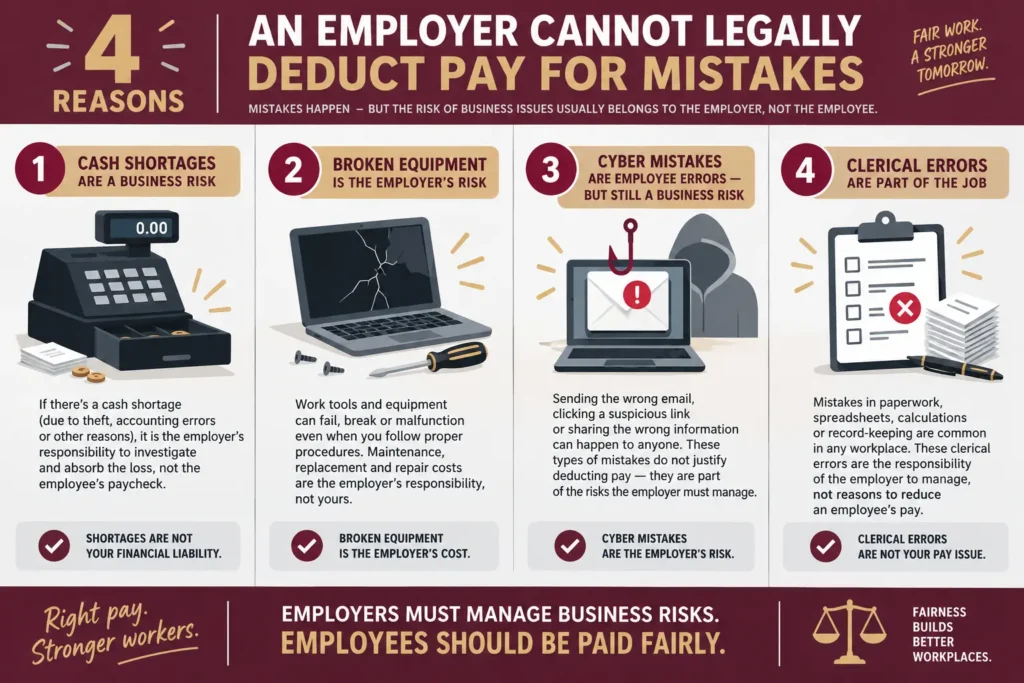
What 4 Things Cannot Be Legally Deducted from Your Paycheck?
Certain categories of “mistakes” show up in wage complaints again and again. Here are the four the Wage and Hour Division (WHD) — the DOL agency that investigates these claims — sees most often.
1. Cash Register Shortages and Dine-and-Dash Customers
If your drawer comes up short, or a customer eats and runs, that’s generally treated as a cost of doing business, not employee theft. Under federal law, an employer can’t use a shortage to push your pay below minimum wage. Many states go further and ban this deduction entirely, regardless of your hourly rate, unless there’s proof you personally pocketed the money.
2. Broken Equipment and Dropped Company Laptops
This is the 2026 update to a classic problem. It used to be a broken cash register or a dented delivery van. Now it’s a cracked company laptop, a coffee spill on a point-of-sale tablet, or a lost company phone. Accidental damage during normal work duties is still, legally, an accident — not grounds for automatic pay docking.
3. Cyber Mistakes (Phishing Scams and Wire Fraud)
This is where a lot of workers get blindsided. An employee clicks a convincing phishing link, or wires funds to what looks like a legitimate vendor, and the company loses thousands of dollars. Some employers try to recover that loss straight out of the employee’s paycheck. Here’s the problem with that: your paycheck isn’t corporate cyber-insurance. Businesses are expected to carry their own risk for fraud, phishing, and social-engineering losses — the same way they’d carry the risk of a break-in or a bad investment. Docking an employee’s wages for it, without meeting strict legal requirements (proof of gross negligence, written consent, and staying above minimum wage), is a common and costly employer mistake.
4. Clerical Errors and Accounting Mistakes
Sent the wrong invoice? Transposed two numbers in a spreadsheet? Approved a purchase order that should’ve gone to someone else? Ordinary clerical and administrative errors fall into the same bucket as the other categories here — they’re treated as the ordinary cost of running a business, not a debt you personally owe your employer.
Salaried vs. Hourly: How Does the Salary Basis Test Protect Exempt Workers?
Exempt (salaried) employees are protected by the Salary Basis Test under 29 CFR § 541.603. If an employer docks an exempt worker’s pay for a partial-day mistake, they risk losing the FLSA exemption entirely, opening the company up to massive back-pay liability for unpaid overtime.
Here’s why this matters so much. To classify you as exempt from overtime, your employer must pay you a fixed, predetermined salary that doesn’t fluctuate based on the quality or quantity of your work. The moment they start docking that salary for a mistake — even a costly one — they’re treating you like an hourly worker while still denying you overtime pay. Courts and the DOL take that seriously.
There is a narrow escape hatch for employers: the “safe harbor” and “window of correction” provisions in the same regulation. If a deduction was isolated, inadvertent, and the employer promptly reimburses you, they may avoid losing your exemption. But a pattern of docking exempt salaries for mistakes is a red flag — and potentially very expensive for the employer, since it can convert months (or years) of your “exempt” work into overtime-eligible hours retroactively.
If you’re salaried and see a mistake-related deduction on your pay stub, that alone is worth flagging. It may signal a much bigger compliance problem than the dollar amount suggests.
Federal vs. State Law: When Is Written Consent Required?
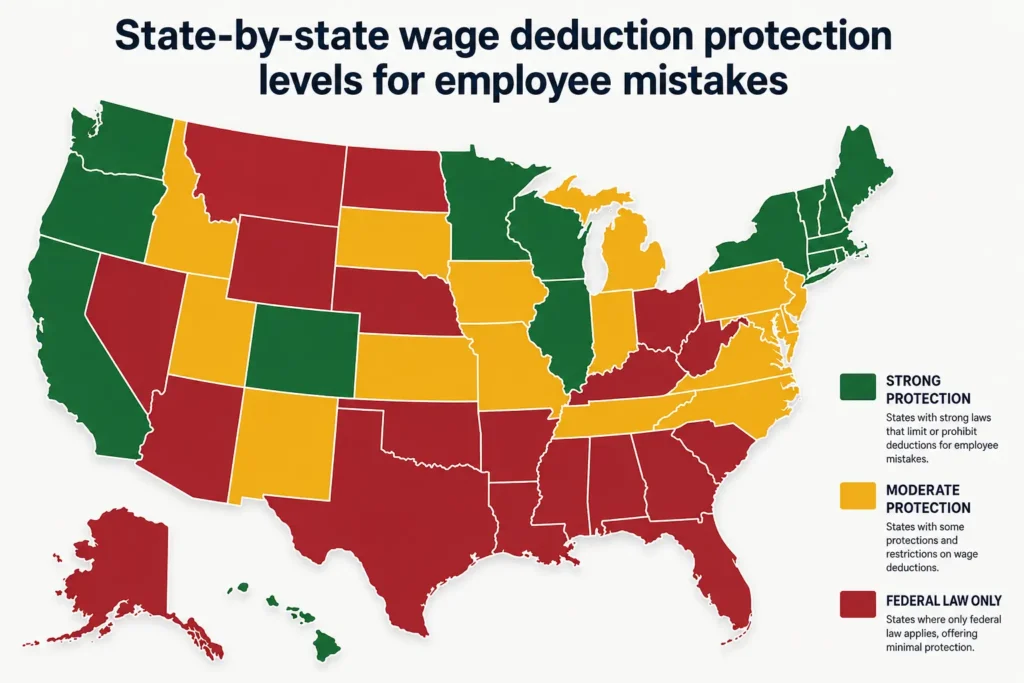
While federal law allows deductions down to minimum wage, state laws often override this. For example, the California DLSE and the Massachusetts Attorney General generally require prior written consent to deduct for a mistake, and usually only if the employer proves willful misconduct or gross negligence.
This state-by-state patchwork is confusing, so here’s the pattern most states follow:
- Bans mistake-related deductions almost entirely (e.g., California, Colorado, Delaware): Even with a signed form, an employer generally can’t deduct for ordinary negligence. California’s Labor Code § 221, enforced by the DLSE, only allows it if the employer proves dishonesty, willfulness, or gross negligence — a much higher bar than “you made a mistake.”
- Requires written consent, plus limits (e.g., Massachusetts, Connecticut, Arizona): A signature alone doesn’t make a deduction legal — it still can’t drop you below minimum wage, and some states require consent before the incident, not after.
- No extra protection beyond federal law (e.g., Georgia, Florida): The FLSA’s minimum-wage floor is essentially your only backstop.
Bottom line: never assume federal law is the whole story. Search “[your state] wage deduction law” or check your state labor board’s website before accepting that a deduction was legal.
The “Firing vs. Fining” Paradox: How Does At-Will Employment Factor In?
Under the At-Will Employment Doctrine, your employer can legally fire you for breaking a laptop, making a bad trade, or a register shortage. However, they cannot legally deduct the cost of that mistake from your final paycheck without following strict FLSA and state guidelines.
This surprises a lot of people, so it’s worth sitting with. In most states, your employer has enormous freedom to end your employment for almost any reason, including a single costly mistake. What they don’t have is unlimited freedom to fine you for it out of wages you already earned. Termination and wage deductions are governed by completely different bodies of law, and confusing the two is one of the most common employer missteps — and one of the most common employee misunderstandings, too.
In other words: your employer might have the right to fire you over the broken laptop. They almost never have the right to also take $400 out of your paycheck for it.
Case Study: When a Remote Worker’s Cyber Mistake Backfired on the Employer
Consider a composite scenario built from patterns seen in real wage-and-hour disputes: A remote accounts-payable employee receives an email that appears to come from a longtime vendor, requesting an updated bank account for an upcoming invoice. It looks legitimate — right logo, right tone, right invoice number. The employee processes the $18,000 wire transfer. It turns out to be a business email compromise scam, and the money is gone.
The finance director, furious, instructs payroll to deduct $1,000 per pay period from the employee’s wages “until the loss is recovered” — without written consent and without proving gross negligence. The employee, now paid below minimum wage for several pay periods, files a complaint with the state labor board and the WHD.
The outcome in cases like this is consistent: regulators treat wire fraud losses the same way they treat register shortages or equipment damage — an ordinary business risk the employer must absorb, not a debt the employee owes. The employer is typically ordered to repay the full amount deducted, sometimes with liquidated damages (an amount equal to the back pay, awarded as a penalty) on top. Worse for the company, one improperly docked employee’s complaint often triggers a broader investigation into everyone in the same job classification.
The lesson for workers: a company’s technology failure or judgment call is not automatically your financial liability, even when the mistake happened on your keyboard.
Action Plan: How to Dispute an Illegal Paycheck Deduction
If you’ve spotted a deduction you believe is illegal, don’t just vent about it — build a record. Here’s how.
Step 1: Refuse the Blanket Payroll Deduction Form (Professionally)
If HR hands you a form authorizing “any and all deductions for losses, mistakes, or damages” — read it closely before signing. A blanket authorization signed under pressure is very different from specific, informed written consent for one clearly described incident, and blanket forms are often unenforceable anyway. You can say: “I’d like to review this before signing — can I get a copy?” That’s not insubordination. That’s due diligence, and it’s your right.
Step 2: Request the Policy and State Law in Writing
Ask HR or payroll, in writing (email is fine), for the specific written policy authorizing the deduction and the legal basis for it. This does two things: it creates a paper trail, and it often causes employers to quietly reverse an improper deduction rather than put their reasoning in writing.
Step 3: File a Wage and Hour Claim
If the deduction isn’t reversed, you can file a complaint with your state labor board, or with the federal Wage and Hour Division (WHD) of the Department of Labor, which enforces the FLSA nationwide and doesn’t charge a filing fee. Bring your pay stubs showing the deduction, any written communication about it, and your employer’s stated reason. Many state complaints can be filed entirely online.
Frequently Asked Questions (FAQ) About Wage Deductions
Can they dock my pay for being late to work?
Usually yes — but that’s a different situation from a “mistake” deduction. Docking pay for hours you genuinely didn’t work (like clocking in 20 minutes late) is generally legal, since you’re simply not being paid for time not worked. That’s separate from a financial penalty — deducting extra money beyond your unworked time as punishment — which runs into the same restrictions covered throughout this guide.
Can I be fired for refusing to sign a deduction authorization form?
In most at-will states, an employer can legally terminate you for refusing to sign almost any company form, including a deduction authorization. However, if the form authorizes something illegal under your state’s law, some states offer retaliation protections for employees who push back on unlawful pay practices. This is genuinely fact-specific and jurisdiction-specific, so if you’re facing this exact situation, a quick consultation with your state labor board or a local employment attorney is worth the time.
Can my employer take my final paycheck to cover unreturned equipment?
Generally, no — not unilaterally. Your final paycheck is treated as strictly protected wages in most states, and many states require it to be paid in full, on time, regardless of unreturned equipment. An employer typically has to pursue you separately (through a formal claim or small-claims court) to recover the cost of a laptop or uniform you didn’t return — they usually can’t simply subtract it from wages you already earned.
A final note: Wage and hour law varies significantly by state, and the specific facts of your situation matter. This article explains general FLSA principles and common state patterns — it isn’t legal advice for your individual case. If a significant amount of money is involved, a free consultation with an employment attorney or a complaint to your state labor board is the fastest way to get an answer specific to you.
Helpful resources:
- U.S. Department of Labor – Wage and Hour Division
- eCFR – 29 CFR § 531.35 (Free and Clear Payment Rule)
- eCFR – 29 CFR § 541.603 (Effect of Improper Deductions from Salary)
- California DLSE – Deductions FAQ
Disclaimer: The information provided on this website does not, and is not intended to, constitute legal advice. All information, content, and materials available on this site are for general informational and educational purposes only. Laws regarding employment and labor rights frequently change, and while we strive to keep our content updated, the information on this website may not constitute the most up-to-date legal or other information.
Use of, and access to, this website or any of the links or resources contained within the site do not create an attorney-client relationship between the reader, user, or browser and the website authors, contributors, or its owners. We are an independent publishing platform, not a law firm.
Readers of this website should contact a qualified employment attorney in their specific state to obtain advice with respect to any particular legal matter. No reader or user of this site should act or refrain from acting on the basis of information on this site without first seeking legal advice from counsel in the relevant jurisdiction. Only your individual attorney can provide assurances that the information contained herein – and your interpretation of it – is applicable or appropriate to your particular situation.
Know your rights.